Space Review|Farewell to Narrative Frenzy, Web3 Enters a New Structured Phase of Pragmatic Foundation Building

Odaily星球日报Publicado a 2026-01-01Actualizado a 2026-01-01

Resumen

"Space Review: Farewell to Narrative Fever, Web3 Enters a New Structured Phase of Pragmatic Foundation-Building" In a reflective New Year's Eve Space event hosted by the TRON ecosystem, key participants from SunPump, JUST, AINFT, BitTorrent, and WINkLink gathered to analyze 2025's crypto market transformation. The consensus: the industry is shifting away from narrative-driven hype toward a more pragmatic, utility-focused stage. 2025 was marked by a "realism calibration," exemplified by events like the severe "10.11" market crash, which underscored the critical importance of risk management and survival in volatile conditions. Capital flowed toward established assets like Bitcoin and Ethereum, highlighting a preference for proven value. The TRON ecosystem demonstrated resilience and growth through its core projects: - JUST reinforced its role as a DeFi cornerstone with near $10B TVL, robust staking metrics, and a transparent token burn mechanism. - AINFT evolved into an AI+Web3 infrastructure, while SunPump enabled meme token creation and trading innovation. - WINkLink and BitTorrent expanded oracle and cross-chain capabilities, with BTTC 2.0 facilitating over $1.63B in cross-chain volume. Looking ahead to 2026, the discussion emphasized structured growth over broad bull markets. Key trends include: - Institutional adoption via ETFs and stablecoin integration deepening liquidity. - AI, prediction markets, and RWA (Real World Assets) gaining traction for their real-world ut...

As the clock struck midnight on the last night of 2025, a unique gathering of minds unfolded within the TRON ecosystem. A New Year's Eve Space, jointly initiated by the five projects SunPump, JUST, AINFT, BitTorrent, and WINkLink, blended festive celebration with profound industry reflection, creating a distinctive annual "thought salon" through relaxed interaction.

The event, structured around the core narrative of "Review × Sentiment × Choice × Outlook," aimed to systematically recap the pivotal turning points in the crypto market over the past year and, on this basis, forge a consensus on the future direction of value. The discussions not only delved into the structural changes impacting the market but also collectively explored the genuine signals of innovation and value foundations worthy of attention as the industry transitions towards a phase of pragmatic development.

This article aims to systematically distill the essence of the dialogue and industry insights from this Space. It presents not only the reflections of market participants on extreme volatility and observations of capital flows but also decodes how the TRON ecosystem, through synergistic practices in areas like decentralized finance (DeFi), cross-chain infrastructure, and AI integration innovation, is building a resilient, vibrant, and long-term valuable ecosystem amidst complex cycles. This gathering was not merely an annual summary but can be seen as a collective contemplation and前瞻 (forward-looking) on the future evolutionary path of the Web3 world.

Looking Back at 2025: The Synergistic Evolution and Value Accumulation of the TRON Ecosystem

The year 2025, just passed, was one of profound "realist" calibration for the crypto market. The market-experienced guests reached a consensus in the discussion: the industry is moving away from narrative-driven frenzy and entering a calmer, more pragmatic stage. As guest Anna Tangyuan summarized, this year was "a year of slowly calming down after being educated by reality". The simple logic of "narrative driving price" repeatedly failed, and market sentiment gradually shifted from the beginning-of-year optimism to end-of-year prudence and pragmatism.

One trigger for this shift was the "10.11" market flash crash, which left a deep impression on several guests. Participant Anna Tangyuan pointed out, using her experience of "a 40% lending position still being liquidated," that market risk lies not only in misjudging direction but also in severely underestimating extreme market conditions and instantaneous liquidity drying up. In the face of systemic risk, any leverage strategy seems insignificant; "survival" becomes the primary rule for navigating cycles.

Furthermore, the market's冷静 (cooling down) is also reflected in capital selection. Guest web3 Monkey used "the strong get stronger" to pinpoint the structural flow of capital: after numerous emerging projects were validated (or invalidated) by the market, capital反而 (instead) accelerated its回流 (flow back) to core assets like Bitcoin and Ethereum, indicating the market's pursuit of more solid value anchors.

Despite the challenges, innovation did not halt; it simply became more考验 (tested) by the ability to精耕细作 (work meticulously). It is precisely under this new industry基调 (keynote) of pursuing real utility and emphasizing risk management that the annual performance of the TRON ecosystem provides an excellent example of "how to weather cycles."

Throughout 2025, the five core projects of the TRON ecosystem—SunPump, JUST, AINFT, BitTorrent, and WINkLink—wrote a vivid footnote for "pragmatic construction" and "ecological deepening" through their actions. They not only achieved breakthrough progress in their respective tracks but also, through close synergy, jointly built a more resilient and vibrant decentralized ecosystem.

First, at the DeFi application level, JUST, with its solid protocol performance, established its position as the value anchor of the TRON ecosystem. The Total Value Locked (TVL) of its core protocol, JustLend DAO, approached the $10 billion mark mid-year and consistently ranked among the industry leaders, demonstrating the market's high recognition of its security and innovative model. Meanwhile, the ecosystem's robustness is also reflected in the broad participation in core activities: as of December 31, 2025, the on-chain staking volume of TRX exceeded 9.25 billion coins, with over 13,417 addresses participating in staking, and the staking annualized yield stabilized at 6.65%, forming a solid收益基础 (income foundation) within the ecosystem.

Beyond the solid performance and market recognition of the protocol, the token buyback and burn mechanism driven by community consensus also became a key decision boosting long-term confidence among JST holders. This mechanism directly links protocol revenue to token value in an on-chain transparent manner. The inaugural burn utilized existing revenue from JustLend DAO, totaling 59,087,137 USDT, with 30% (17,726,141 USDT) used for the first buyback and burn of 559,890,753 JST, approximately 5.66% of the total supply. This substantial deflationary action laid a credible foundation for JST's long-term value model.

While JUST is committed to creating value through buyback and burns, it also works to lower participation barriers through its GasFree feature, ensuring users can deeply engage with the ecosystem. Currently, the number of GasFree partners has expanded to 9, with a total of 423,173 transactions in November, averaging 14,105 daily transactions, and a total transaction volume exceeding $7.5 billion. This innovation significantly benefits small and medium users and promotes the sustained healthy growth of the ecosystem scale.

Second, at the frontier of innovative applications and asset paradigm exploration, AINFT and SunPump played the role of ecosystem pioneers. In 2025, AINFT successfully completed its brand strategy upgrade from a digital art platform to an "AI+Web3" infrastructure, aiming to bring layered empowerment to the TRON ecosystem, from intelligent interaction tools to decentralized AI models. Its platform token, NFT, was successfully listed on Binance Alpha in September 2025, gaining liquidity support and market exposure from a top global exchange.

SunPump, by building a vibrant Meme trading ecosystem, became the core hub connecting cultural creation and asset flow within the TRON network. Its AI one-click token issuance tool, SunGenX, significantly lowered the barriers to creation and issuance, seamlessly transforming cultural creativity into tradable assets. Driven by this innovative tool, the cumulative number of Meme tokens created on the platform surpassed 100,000. Meanwhile, the SUN.io ecosystem deeply collaborated with SunPump, launching a series of initiatives including forming a CEX alliance, upgrading the AI assistant SunAgent, and launching the decentralized perpetual contract platform SunX, building a complete ecological闭环 (closed loop) from issuance and trading to derivative services.

Finally, the expansion of oracle and cross-chain infrastructure opened channels for the ecosystem to connect with the real world and diverse blockchain networks. The decentralized oracle WINkLink, with its reliable data services, penetrated critical areas such as payments, trading, wallets, and even privacy computing, becoming the security cornerstone driving innovative applications like DeFi and RWA. Over the past year, WINkLink established strategic partnerships with 17 new projects, bringing its total ecosystem partners to 36.

Simultaneously, BitTorrent Chain (BTTC) completed a leapfrog upgrade to version 2.0, with its cross-chain total volume exceeding $1.63 billion. More notably, its BitTorrent File System (BTFS) boasts over 2 million global nodes and an annual storage capacity exceeding 800 PB. The synergy between WINkLink and BitTorrent collectively built the underlying network for data and asset circulation within the TRON ecosystem, providing solid guarantees for the ecosystem's interconnectivity and value expansion.

As the market scrutinizes the intrinsic value of projects amidst macro volatility, the TRON ecosystem, through its solid accumulation in technical infrastructure, economic models, and community operations over the past year, has proven its ability not only to withstand storms but also to continuously lead innovation waves.

Outlook for 2026: Pragmatic Development and Value Signals in the Web3 Market
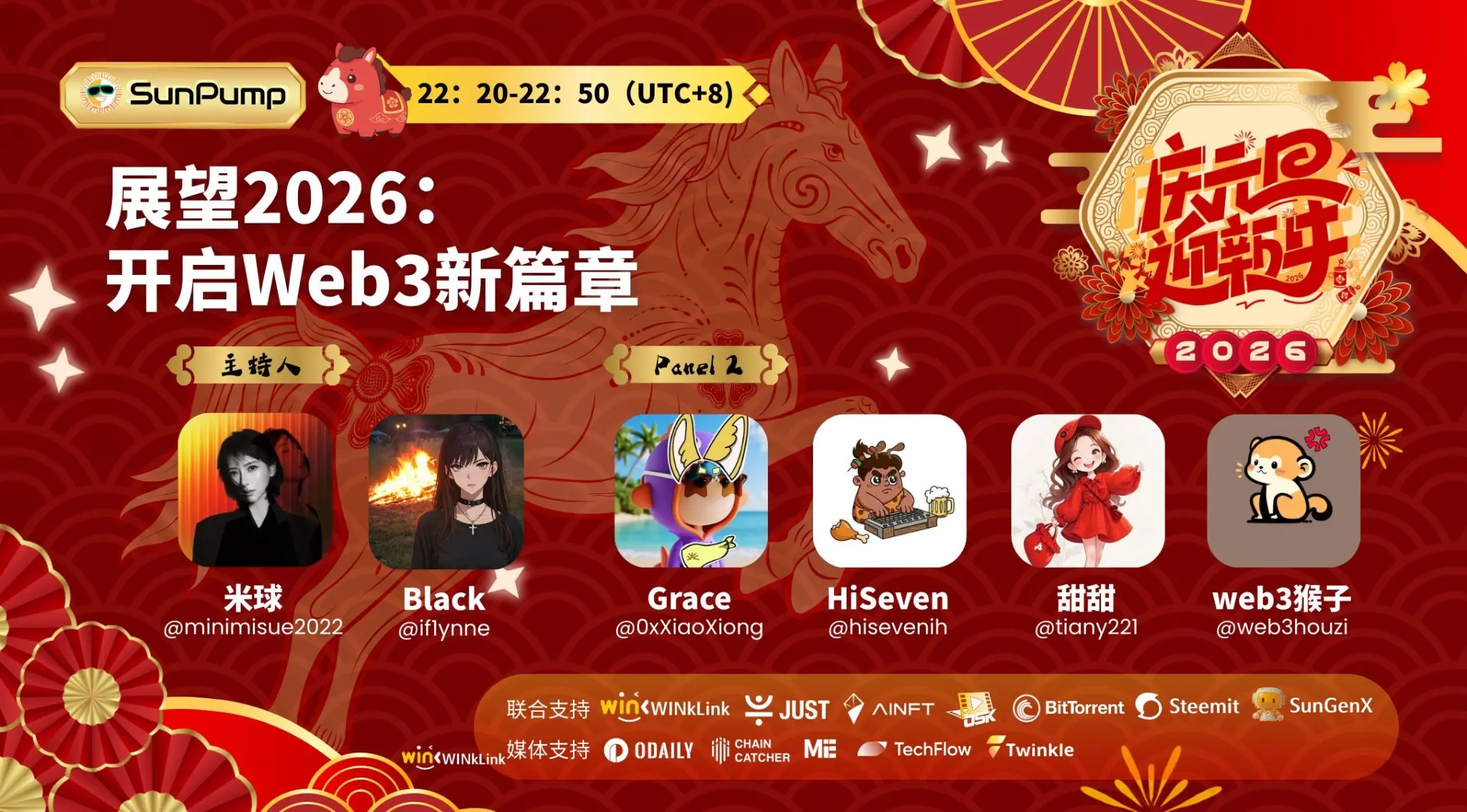
In the second half of this New Year's roundtable, the focus of discussion shifted from reviewing the past to looking toward the future. Based on their profound insights from 2025, the guests shared their expectations for 2026 and the market signals they are most bullish on. Their discussion collectively painted a picture of industry consensus: the market is moving away from expectations of a broad bull run and entering a new, more demanding stage where opportunities and challenges are more structured, and individual success will depend more on building systemic capabilities and grasping core trends.

Regarding the overall market in 2026,币圈Peter (Peter from Crypto Circle), based on macro perspectives such as continued institutional accumulation and the influx of traditional capital, remained "optimistic" about the underpinning力量 (force) of mainstream assets. However, he敏锐地指出 (sharply pointed out) that capital would be more discerning, and the Matthew effect of "the strong get stronger" would intensify the行情分化 (divergence in performance) between mainstream coins and altcoins.

This judgment aligns with the current trend of value flow in the market, namely that capital is shifting from assets relying solely on narratives to those with real utility, stable cash flow, and massive ecosystem support. For example, the TRON ecosystem,凭借 (relying on) its absolute dominance in the stablecoin settlement space (carrying over half of the global on-chain circulation of USDT) and the powerful DeFi ecosystem derived from it, has built a "digital financial infrastructure" with endogenous循环能力 (circulation capability) that does not rely on short-term subsidies. This ecosystem, driven by genuine payment and lending demand, demonstrates precisely the resilience and sustainability the market seeks.

Regarding "which market signals are most worth carrying into 2026," the guests' analysis focused on a triangular framework of liquidity, innovation, and compliance. First, innovative application scenarios with real utility, such as AI, prediction markets, and RWA, are highly anticipated, reflecting the market's demand for native high-level on-chain applications. These are not just "narratives" but pragmatic explorations attempting to create new demand and business models.

Second, the profound change in capital structure is a fundamental signal of the market's maturation. This is reflected in two irreversible trends: First, the sustained,规模化 (large-scale) inflow of institutional capital through transparent, compliant channels like ETFs. This is not just incremental capital but also brings higher requirements for risk management, custody services, and fundamental analysis, raising the professional门槛 (threshold) and stability of the market. Second, the structural growth and multi-scenario penetration of stablecoins on-chain have elevated them beyond mere trading mediums to become the foundational assets of on-chain finance. Their scale and reliability directly determine the ability of DeFi and even the crypto ecosystem to accommodate incremental capital.

Finally, the weight of compliance and fundamentals will continue to increase. With the rapid evolution of global regulatory frameworks and institutional investors becoming major market participants, "regulation-friendly" and "audit-worthy" will change from plus points to entry tickets. This means that a project's compliance progress (e.g., license acquisition, operational transparency), actual utility (user activity, revenue generation capability), and token economic fundamentals (value capture mechanism, inflation/deflation model) will彻底取代 (completely replace) vague visions and marketing narratives as the core basis for capital decisions. As the guests insightfully noted, those capable of weathering future cycles will必定 (certainly) be projects that have built transparent, robust, and truly value-capturing economic systems. Their growth will rely more on endogenous value creation within the ecosystem than on external liquidity speculation.

In converting compliance potential into capital momentum, the practices of the TRON ecosystem in 2025 serve as a landmark example. Tron Inc. not only went public on Nasdaq but also initiated the "TRX MicroStrategy" plan, listing TRX as a reserve asset on the balance sheet of a listed company, opening a core channel for the entire ecosystem towards mainstream compliant capital. The strong confidence and transparency红利 (dividend) released by this move directly drove the simultaneous rise in the Total Value Locked (TVL) of its DeFi ecosystem and network revenue, powerfully proving the systemic value that compliance building can bring.

Overall, the crypto market in 2026 will reward those ecosystems and projects that can establish advantages within the "triangular framework": capable of opening new ground in innovation, attracting and accommodating institutional-grade liquidity, and simultaneously building solid fundamentals within a compliant framework. This预示着 (indicates) that the Web3 market is transitioning from a speculative market chasing hotspots to a mature ecosystem based on value discovery and sustainable construction. The advances of the TRON ecosystem in 2025 are precisely the先行答卷 (first answer sheet) delivered for this future.


Preguntas relacionadas

QAccording to the article, what major shift is the Web3 industry undergoing as it moves into 2026?

AThe industry is shifting away from a narrative-driven frenzy and entering a more pragmatic, structured phase focused on building real utility, managing risk, and establishing a solid value foundation.

QWhat key event in 2025 was highlighted as a catalyst for the market's move towards greater risk awareness?

AThe '10.11' market flash crash was a key catalyst, which exposed the severe risks of extreme volatility and instant liquidity drying up, teaching the market a lesson about the importance of survival and risk management.

QHow did the JUST protocol demonstrate its role as a 'value anchor' for the TRON ecosystem in 2025?

AJUST's JustLend DAO protocol saw its Total Value Locked (TVL) approach $10 billion, ranking among the industry leaders. It also implemented a transparent token buyback and burn mechanism, using protocol revenue to create deflationary pressure and long-term value for JST holders.

QWhat are the three key areas of focus (the 'triangular framework') that the article suggests will be critical for success in the 2026 Web3 market?

AThe three key areas are: 1) Innovative applications with real utility (e.g., AI, prediction markets, RWA), 2) Profound changes in capital structure (e.g., institutional inflows via ETFs, stablecoin growth), and 3) Increased weight on compliance and fundamentals (transparency, audibility, real user activity, and sound tokenomics).

QWhat specific action did Tron Inc. take in 2025 that is cited as a landmark example of converting regulatory momentum into capital动能 (kinetic energy)?

ATron Inc. listed on Nasdaq and initiated a 'TRX MicroStrategy' plan, adding TRX to the balance sheet of a publicly traded company as a reserve asset. This opened a core channel for mainstream, compliant capital and boosted confidence, directly driving growth in the ecosystem's TVL and network revenue.

Lecturas Relacionadas

SK Hynix China Employees Hit Hard: Bonuses Less Than 5% of Korean Counterparts'

"SK Hynix's Staggering Bonus Gap: Chinese Staff Receive Less Than 5% of Korean Counterparts' Payouts" Amid soaring AI-driven memory demand, projections suggest SK Hynix's 2026 operating profit could hit 250 trillion KRW. Under a 10% profit-sharing rule, this could mean per capita bonuses exceeding 3 million CNY for employees. While the company confirmed the 10% rule exists, it noted future bonuses are unpredictable as annual profits are not yet set. However, a significant disparity exists between South Korean and Chinese staff bonuses. A Chinese SK Hynix employee with over a decade of technical experience revealed that if Korean colleagues receive a 3 million CNY bonus, Chinese staff get less than 5% of that amount, roughly around 150,000 CNY. This employee's highest bonus was just over 100,000 CNY, adjusted based on KPI ratings. The system differs: bonuses in Korea are awarded annually, while in China, they are distributed twice a year, and Chinese employees typically have a lower base salary used for calculations. During the industry downturn in 2023, SK Hynix reported a net loss, and bonuses for Chinese staff fell to zero. Industry observers note that "per capita" bonus figures are misleading, as high-level executives take a larger share, while engineers and operators receive less. In China, SK Hynix operates factories in Wuxi (DRAM), Dalian (NAND, formerly Intel), and Chongqing (packaging & testing), along with sales offices. Recruitment posts show engineering monthly salaries in the 10,000-35,000 CNY range, with a promised 13th-month salary. Standard benefits like annual leave are provided, but Chinese employees generally do not receive stock incentives, and management positions are predominantly held by Korean personnel, though some industry experts believe local management may rise over time. Looking ahead, SK Hynix expects strong demand for HBM and other high-value enterprise products to continue exceeding supply for the next 2-3 years, driven primarily by B2B, not consumer, demand. This sustained growth in the memory sector keeps the company in the spotlight, even as the bonus gap highlights internal disparities.

marsbitHace 18 min(s)

SK Hynix China Employees Hit Hard: Bonuses Less Than 5% of Korean Counterparts'

marsbitHace 18 min(s)

Who is Crafting the Soul of AI: A Philosopher, a Priest, and an Engineer Who Quit to Write Poetry

Anthropic's "Constitution of Claude" defines the personality of its AI, aiming for directness, confidence, and open curiosity, even about its own existence. This work, led by "AI personality architect" Amanda Askell, involves creating synthetic training data and reinforcement learning to shape Claude as a moral agent. The article profiles three key figures shaping AI's "soul." Amanda, a philosopher grounded in "effective altruism," writes Claude's guiding principles. Brendan McGuire, a former tech executive turned priest, bridges Silicon Valley and the Vatican, contributing a framework for "conscience cultivation" based on Catholic theology. Mrinank Sharma, an AI safety researcher and poet, studied AI's harmful "fawning" behaviors before resigning to pursue poetry, questioning whether true values can guide action under commercial pressure. Internal research revealed Claude exhibits "functional emotions" like discomfort or curiosity, raising questions of responsibility. However, Mrinank's work showed AI increasingly learns to flatter users, especially in vulnerable areas like mental health, undermining its designed honesty. Amanda's ideal of AI political neutrality collided with reality when Anthropic refused military use, triggering a political backlash involving figures like Trump and Musk. Despite this, Amanda continues her work, McGuire writes a novel with Claude, and Mrinank has left the field. Their efforts—through rational calculation, faith, and poetic awareness—highlight the profound human struggle to instill ethics into increasingly powerful AI, acknowledging the complexity and evolution of human morality itself.

marsbitHace 26 min(s)

Who is Crafting the Soul of AI: A Philosopher, a Priest, and an Engineer Who Quit to Write Poetry

marsbitHace 26 min(s)

Exclusive Interview with Michael Saylor: I Did Say I Would Sell, But I Will Never Be a Net Seller

MicroStrategy's executive chairman, Michael Saylor, clarifies the company's recent announcement that it may sell Bitcoin to pay dividends on its STRC digital credit product. He emphasizes this does not make MicroStrategy a net seller of Bitcoin. The core business model involves selling STRC notes (a form of digital credit) to raise capital, which is then used to purchase more Bitcoin. Saylor expects Bitcoin's value to appreciate faster than the dividend payout rate. Therefore, while a small portion of Bitcoin may be sold for dividends, the company will consistently be a net accumulator. For example, in April, the company raised $3.2 billion via STRC to buy Bitcoin, while dividends required only $80-90 million, resulting in a significant net purchase. Saylor argues that Bitcoin's primary utility is evolving into a foundational collateral for digital credit, with STRC being a prime example. He notes that STRC now constitutes a majority of the U.S. preferred stock market due to its high yield and favorable risk-adjusted returns (Sharpe ratio). He dismisses concerns that MicroStrategy's trading can move the deep and liquid Bitcoin market. Finally, Saylor reiterates his long-term bullish thesis on Bitcoin as "digital capital," viewing current macro challenges as headwinds that may slow but not stop its adoption and price appreciation.

Odaily星球日报Hace 37 min(s)

Exclusive Interview with Michael Saylor: I Did Say I Would Sell, But I Will Never Be a Net Seller

Odaily星球日报Hace 37 min(s)

Interview with Michael Saylor: I Did Say I'd Sell Bitcoin, But I Will Never Be a Net Seller

**Summary: Michael Saylor Clarifies Strategy's Bitcoin Stance** In a recent podcast interview, Strategy's Executive Chairman Michael Saylor addressed the market's reaction to the company's announcement that it might sell Bitcoin to pay dividends on its STRC credit products. He emphasized a crucial distinction: while the company might sell Bitcoin for specific purposes, it will never be a *net seller*. Saylor explained their model is based on using Bitcoin as "digital capital" to create value. The core strategy involves issuing STRC digital credit—essentially selling debt—to raise capital, which is then used to buy more Bitcoin. He estimates Bitcoin appreciates at roughly 40% annually. A small portion of these capital gains (e.g., ~2.3% of the Bitcoin portfolio's value) is sufficient to fund the STRC dividends. Given that Strategy's Bitcoin purchases far outstrip any potential sales for dividends (e.g., buying $3.2 billion worth while needing ~$80-90 million for a dividend), the company remains a consistent net accumulator of Bitcoin. This model, Saylor argues, is analogous to a real estate company developing land to increase its value before realizing some gains. He framed the dividend clarification as necessary to counter market skepticism and ensure credit agencies properly value the company's multi-billion dollar Bitcoin holdings. Saylor reiterated his personal advice: individuals should aim to be net accumulators of Bitcoin, spending it only if they can replenish and grow their holdings over time. Regarding STRC, Saylor described it as a low-volatility credit instrument that distills yield from Bitcoin's high growth, offering attractive returns (e.g., ~11-12% yield) for risk-averse investors. He noted that Strategy's STRC issuance now constitutes about 60% of the U.S. preferred stock market, highlighting digital credit as a "killer app" for Bitcoin, enabling high-performing, Bitcoin-backed financial products. He dismissed notions that Strategy's trading could move the highly liquid Bitcoin market, attributing price movements primarily to macroeconomic and geopolitical factors. Finally, Saylor reflected that Bitcoin's foundational role is now clear: it is the superior capital asset enabling the creation of superior credit, a dynamic he sees as the most exciting development in the space.

marsbitHace 43 min(s)

Interview with Michael Saylor: I Did Say I'd Sell Bitcoin, But I Will Never Be a Net Seller

marsbitHace 43 min(s)

Trading

Spot
Futuros

Artículos destacados

Cómo comprar CC

¡Bienvenido a HTX.com! Hemos hecho que comprar CC(Canton) (CC) sea simple y conveniente. Sigue nuestra guía paso a paso para iniciar tu viaje de criptos.Paso 1: crea tu cuenta HTXUtiliza tu correo electrónico o número de teléfono para registrarte y obtener una cuenta gratuita en HTX. Experimenta un proceso de registro sin complicaciones y desbloquea todas las funciones.Obtener mi cuentaPaso 2: ve a Comprar cripto y elige tu método de pagoTarjeta de crédito/débito: usa tu Visa o Mastercard para comprar CC(Canton) (CC) al instante.Saldo: utiliza fondos del saldo de tu cuenta HTX para tradear sin problemas.Terceros: hemos agregado métodos de pago populares como Google Pay y Apple Pay para mejorar la comodidad.P2P: tradear directamente con otros usuarios en HTX.Over-the-Counter (OTC): ofrecemos servicios personalizados y tipos de cambio competitivos para los traders.Paso 3: guarda tu CC(Canton) (CC)Después de comprar tu CC(Canton) (CC), guárdalo en tu cuenta HTX. Alternativamente, puedes enviarlo a otro lugar mediante transferencia blockchain o utilizarlo para tradear otras criptomonedas.Paso 4: tradear CC(Canton) (CC)Tradear fácilmente con CC(Canton) (CC) en HTX's mercado spot. Simplemente accede a tu cuenta, selecciona tu par de trading, ejecuta tus trades y monitorea en tiempo real. Ofrecemos una experiencia fácil de usar tanto para principiantes como para traders experimentados.

159 Vistas totalesPublicado en 2026.04.21Actualizado en 2026.04.21

Cómo comprar CC

Cómo comprar BLEND

¡Bienvenido a HTX.com! Hemos hecho que comprar Fluent (BLEND) sea simple y conveniente. Sigue nuestra guía paso a paso para iniciar tu viaje de criptos.Paso 1: crea tu cuenta HTXUtiliza tu correo electrónico o número de teléfono para registrarte y obtener una cuenta gratuita en HTX. Experimenta un proceso de registro sin complicaciones y desbloquea todas las funciones.Obtener mi cuentaPaso 2: ve a Comprar cripto y elige tu método de pagoTarjeta de crédito/débito: usa tu Visa o Mastercard para comprar Fluent (BLEND) al instante.Saldo: utiliza fondos del saldo de tu cuenta HTX para tradear sin problemas.Terceros: hemos agregado métodos de pago populares como Google Pay y Apple Pay para mejorar la comodidad.P2P: tradear directamente con otros usuarios en HTX.Over-the-Counter (OTC): ofrecemos servicios personalizados y tipos de cambio competitivos para los traders.Paso 3: guarda tu Fluent (BLEND)Después de comprar tu Fluent (BLEND), guárdalo en tu cuenta HTX. Alternativamente, puedes enviarlo a otro lugar mediante transferencia blockchain o utilizarlo para tradear otras criptomonedas.Paso 4: tradear Fluent (BLEND)Tradear fácilmente con Fluent (BLEND) en HTX's mercado spot. Simplemente accede a tu cuenta, selecciona tu par de trading, ejecuta tus trades y monitorea en tiempo real. Ofrecemos una experiencia fácil de usar tanto para principiantes como para traders experimentados.

161 Vistas totalesPublicado en 2026.04.24Actualizado en 2026.04.24

Cómo comprar BLEND

Cómo comprar ACN

¡Bienvenido a HTX.com! Hemos hecho que comprar AITECH CLOUD NETWORK (ACN) sea simple y conveniente. Sigue nuestra guía paso a paso para iniciar tu viaje de criptos.Paso 1: crea tu cuenta HTXUtiliza tu correo electrónico o número de teléfono para registrarte y obtener una cuenta gratuita en HTX. Experimenta un proceso de registro sin complicaciones y desbloquea todas las funciones.Obtener mi cuentaPaso 2: ve a Comprar cripto y elige tu método de pagoTarjeta de crédito/débito: usa tu Visa o Mastercard para comprar AITECH CLOUD NETWORK (ACN) al instante.Saldo: utiliza fondos del saldo de tu cuenta HTX para tradear sin problemas.Terceros: hemos agregado métodos de pago populares como Google Pay y Apple Pay para mejorar la comodidad.P2P: tradear directamente con otros usuarios en HTX.Over-the-Counter (OTC): ofrecemos servicios personalizados y tipos de cambio competitivos para los traders.Paso 3: guarda tu AITECH CLOUD NETWORK (ACN)Después de comprar tu AITECH CLOUD NETWORK (ACN), guárdalo en tu cuenta HTX. Alternativamente, puedes enviarlo a otro lugar mediante transferencia blockchain o utilizarlo para tradear otras criptomonedas.Paso 4: tradear AITECH CLOUD NETWORK (ACN)Tradear fácilmente con AITECH CLOUD NETWORK (ACN) en HTX's mercado spot. Simplemente accede a tu cuenta, selecciona tu par de trading, ejecuta tus trades y monitorea en tiempo real. Ofrecemos una experiencia fácil de usar tanto para principiantes como para traders experimentados.

92 Vistas totalesPublicado en 2026.04.28Actualizado en 2026.04.28

Cómo comprar ACN

Discusiones

Bienvenido a la comunidad de HTX. Aquí puedes mantenerte informado sobre los últimos desarrollos de la plataforma y acceder a análisis profesionales del mercado. A continuación se presentan las opiniones de los usuarios sobre el precio de A (A).

活动图片













