S&P Global brings risk assessments to growing crypto lending vault sector

cointelegraphPublished on 2026-10-06Last updated on 2026-10-06

Abstract

S&P Global Ratings has launched a new risk assessment framework specifically for the growing sector of digital asset lending vaults. This framework evaluates vaults—which pool investor deposits to deploy through predefined yield-generating strategies—across six key risk areas: portfolio credit quality, liquidity mismatch, curator risk, blockchain risk, protocol risk, and vault security and governance. According to S&P analyst Lisa Schroeer, a material weakness in any single factor can constrain the overall assessment, as the sector has "many points of risk/failure that can break." The assessments aim to provide transparency on potential loss risks for investors, not to offer credit ratings or evaluate yields. Deposits in these vaults have surged to around $10 billion as of September, up from $1.5 billion two years prior, driven by offerings from major platforms like Kraken and Wallet in Telegram. However, this rapid growth has been accompanied by significant risks, including an $8.5 million exploit on Term Finance in August, and increased regulatory scrutiny in the U.S., where officials suggest some vault products may fall under securities laws.

S&P Global Ratings has launched a risk assessment framework for digital asset lending vaults as the onchain investment products gain traction.

According to Monday’s announcement, the framework evaluates vaults across six areas: portfolio credit quality risk, liquidity mismatch risk, curator risk, blockchain risk, protocol risk, and vault security and governance risk.

S&P said the assessments will evaluate the risk of losses to investors in lending vaults, but will not constitute credit ratings or evaluate yields. As well, the framework was not designed to single out any one category of the six that poses a greater risk than the others, according to S&P Global Ratings analyst Lisa Schroeer.

“A material weakness in any factor can constrain the overall VRA,” Schroeer told Cointelegraph. “A strong score in one factor does not offset a material weakness in another.” She said that the approach reflects a sector where “there are many points of risk/failure that can break.”

Digital asset lending vaults pool investor deposits and deploy them through predefined strategies managed by smart contracts or human curators. Depositors receive tokens representing their share of the vault’s assets and returns.

According to S&P, deposits in digital asset lending vaults reached about $10 billion in September, up from $1.5 billion two years earlier. S&P said it plans to publish its first Vault Risk Assessments in future announcements, though it did not identify which vaults will be assessed first.

Explaining the framework’s potential role for investors, Schroeer said: “The assessment aims to provide more transparency on the risks so that any entity can make more informed decisions when deciding how to allocate capital to DeFi vaults.”

Related: Kraken adds S&P 500 to funded trading program, commodities to follow

Crypto vaults grow as risks draw scrutiny

Crypto vaults have expanded over the past year as exchanges, wallets and DeFi platforms have rolled out products that package lending and other yield-generating strategies for users.

In February, Wallet in Telegram introduced self-custodial BTC, ETH and USDT vaults using infrastructure from Morpho, TAC and Re7. Kraken followed in May with a Bitcoin yield vault powered by Veda and curated by Sentora, attracting $30 million from 4,000 wallets within its first 10 hours.

The model has since expanded into tokenized securities. In September, Kraken launched yield vaults for tokenized versions of Nvidia, the SPDR S&P 500 and Invesco QQQ ETFs, with Sentora managing strategies that lend the assets through DeFi markets.
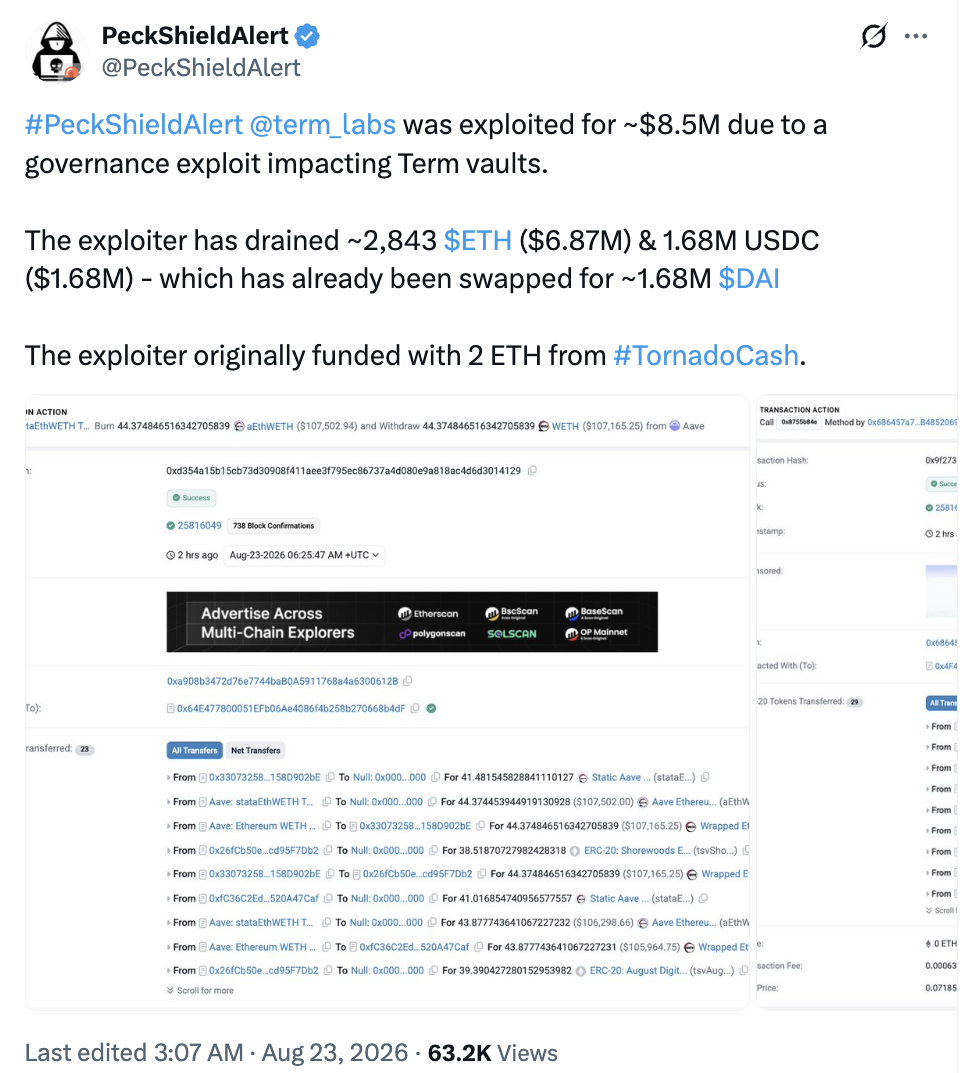
Source: PeckShieldAlert

The growing popularity of crypto vaults has not come without risks. In August, lending protocol Term Finance lost an estimated $8.5 million after an attacker exploited governance control of its Meta Vaults.

For the time being, crypto vaults remain in a regulatory gray area in the United States. In July, SEC Commissioner Hester Peirce said some vaults and onchain lending products could fall under federal securities laws depending on how they are structured and operated.

Peirce said vaults involving discretionary decisions over asset allocation, yield strategies, lending terms or liquidation thresholds could trigger securities, investment company or investment adviser requirements.

Magazine: Former SEC boss made AI Czar, Bitcoin may hit $600K this cycle: Hodler’s Digest

Related Questions

QWhat is the main purpose of S&P Global's new risk assessment framework for digital asset lending vaults?

AThe main purpose is to evaluate the risk of losses to investors in digital asset lending vaults by assessing factors like credit quality, liquidity, curator risk, blockchain risk, protocol risk, and security/governance risk, providing more transparency for informed capital allocation decisions.

QWhat are the six key risk areas evaluated by S&P Global's Vault Risk Assessment framework?

AThe six key risk areas are: portfolio credit quality risk, liquidity mismatch risk, curator risk, blockchain risk, protocol risk, and vault security and governance risk.

QAccording to the article, what is the current regulatory status of crypto vaults in the United States?

ACrypto vaults remain in a regulatory gray area in the United States. SEC Commissioner Hester Peirce has indicated that some vaults and onchain lending products could fall under federal securities laws depending on their structure and operation.

QHow did S&P Global describe the total deposits in digital asset lending vaults as of September?

AS&P Global stated that deposits in digital asset lending vaults reached about $10 billion in September, which is a significant increase from $1.5 billion two years earlier.

QWhat was a notable example of a risk event involving a crypto lending vault mentioned in the article?

AIn August, the lending protocol Term Finance lost an estimated $8.5 million after an attacker exploited governance control of its Meta Vaults.

Related Reads

Global banks commit $270M to stablecoin venture targeting 2027 launch

A consortium of 21 financial institutions, including Citigroup, Goldman Sachs, Banco Santander, Deutsche Bank and BBVA, has committed about $270 million to Project Faro, a stablecoin initiative that aims to act as a stablecoin issuer and launch a US dollar stablecoin in the first half of 2027. The funding is intended to cover five years of operations, and the company plans to issue stablecoins pegged to the currencies of all G7 countries, with a euro-backed coin expected to follow the dollar launch. The group first announced the initiative in September, and the company is expected to be incorporated in the US. Similar initiatives are also underway, including Stripe-led Open USD and Qivalis, a European banking consortium. Several Faro members, such as BBVA, Rabobank and BNP Paribas, are also involved in competing projects, highlighting how traditional financial institutions are positioning themselves across multiple initiatives rather than committing exclusively to a single stablecoin project. Qivalis has made regulatory progress, receiving authorization from the Dutch central bank as an electronic money institution in October 2026. Despite growing institutional interest, Faro is entering a market dominated by crypto-native issuers: Tether's USDT and Circle's USDC account for approximately 85% of the roughly $290 billion stablecoin market as of Nov. 10. Distribution could offer the bank-backed venture a competitive advantage, since its participating institutions already have established banking customers, payment networks and relationships that could help distribute a new stablecoin. The challenge will be translating that existing financial infrastructure into a competitive onchain payment network.

cointelegraph48m ago

Global banks commit $270M to stablecoin venture targeting 2027 launch

cointelegraph48m ago

Strategy buys 1,036 Bitcoin as BTC holdings climb to 850,364

Strategy bought 1,036 Bitcoin for $81.9 million last week, bringing its holdings to 850,364 BTC. The company paid an average of $79,012 per BTC, according to its Monday filing with the US Securities and Exchange Commission. Strategy said it paid a total of $64.16 billion for its Bitcoin holdings, at an average price of $75,456 per coin. Its holdings now account for roughly 4.05% of Bitcoin's maximum 21 million supply. Since the start of October, Strategy has spent about $1.06 billion buying back its STRC preferred shares, nearly five times the $219.7 million it spent on Bitcoin over the same period. Strategy raised $283.8 million in net proceeds last week by selling about $2.05 million shares of its common stock (MSTR) through its at-the-market offering program. Strategy used $188.3 million of those proceeds to repurchase about 1.89 million STRC shares, following $208.2 million in buybacks the previous week. It spent $81.9 million on Bitcoin and allocated another $13.6 million to its USD Cash balance. Strategy's separate US dollar reserve fell to $4.77 billion from $4.79 billion after the company drew $21.1 million to pay dividends on its preferred stock. Its USD Cash balance rose about 10% to $146.2 million from $132.7 million. The latest Bitcoin purchase follows Strategy's acquisition of 811 BTC for $65.5 million the previous week. Strategy's common stock fell 3% to $125 in Monday's premarket trading, while its STRC preferred shares edged down 0.06% to $99.7, according to Yahoo Finance.

cointelegraph2h ago

Strategy buys 1,036 Bitcoin as BTC holdings climb to 850,364

cointelegraph2h ago

Trading

Spot
活动图片