South Korean Giant BC Card Concludes Stablecoin Payments Pilot Ahead Of 2026 Framework

bitcoinistPublicado a 2025-12-24Actualizado a 2025-12-24

Resumen

South Korean payments giant BC Card has completed a two-month pilot project enabling foreigners to use stablecoins for payments at domestic merchants. The pilot, conducted with partners including Wavebridge and Aaron Group, tested the stability and convenience of converting foreign-held stablecoins into digital prepaid cards for QR code transactions, eliminating the need for physical cards or currency exchange. BC Card integrated the system into its existing payment infrastructure, allowing transactions to function like conventional card payments. The initiative is part of preparations for future regulatory changes, as South Korea anticipates a framework for won-pegged stablecoins by 2026. The project aims to establish a compliant "Korean-style stablecoin payment infrastructure" aligned with upcoming legislation.

South Korean payments giant BC Card has completed its pilot project to verify the stability and convenience of card-integrated stablecoins in collaboration with domestic and international digital asset companies.

BC Card Completes Stablecoin Payment Pilot Project For Foreigners

On Tuesday, South Korea’s largest payment processing company, BC Card, announced it had concluded its two-month pilot project enabling foreigners to use stablecoins as a payment method at domestic merchants.

The project was conducted alongside blockchain financial firm Wavebridge, overseas digital wallet company Aaron Group, and remittance fintech company Global Money Express.

According to BC Card, the pilot focused on “verifying whether foreign currency-based stablecoins held by foreigners could be practically used within the domestic payment environment, while also assessing payment convenience and stability.”

For the project, foreign users converted their stablecoins held in oversea wallets parented with BC Card into digital prepaid cards that could be used at domestic affiliated merchants using a QR code, without requiring a physical card or currency exchange procedures.

The company integrated stablecoin payments into the existing card authorization and settlement structure using a digital prepaid card as an intermediary, the announcement explained, noting that “this design enables both paying customers and merchants to transact in the same manner as with conventional card payments.”

BC Card’s President, Choi Won-seok, stated, “Stablecoins, due to their technical characteristics, are particularly useful for cross-border payments and hold significant potential to improve the domestic payment experience for foreign consumers.”

South Korean Companies Prepares For 2026 Framework

The payments giant affirmed that the pilot was not a “short-term technical verification” but a “process to prepare a stablecoin payment structure responsive to future domestic legal and regulatory changes.”

Notably, the South Korean government recently failed to submit the highly anticipated bill for the Second Phase of the Virtual Asset User Protection Act, which will address the issuance and distribution of won-pegged stablecoins.

As reported by Bitcoinist, the Financial Services Commission (FSC) did not meet the ruling party’s December 10 deadline to submit the government’s legislation to the National Policy Committee.

According to local media, the government bill was delayed after the FSC and the Bank of Korea (BOK) failed to resolve their differences over the issuance of won-denominated stablecoins.

The financial authorities reportedly agree that financial institutions must be involved in the issuance of the tokens but disagree on the extent of banks’ role. While the central bank has been pushing for a consortium of banks owning at least 51% of any stablecoin issuer seeking approval in the country, the FSC has expressed concerns that giving a majority stake to banks could reduce participation from tech firms and limit the market’s innovation.

Recent reports affirmed that the government’s proposal is expected to be announced by early next month at the latest, as the integrated bill must be submitted in January 2026. “To protect the public’s right to know, there will be a separate opportunity to explain the government’s proposed bill to the public while submitting it to the National Assembly,” an FSC official stated last week.

Ultimately, BC Card pledged to strengthen its cooperation with relevant agencies while considering the flow of virtual asset legislation, aiming to “lead the establishment of a ‘Korean-style stablecoin payment infrastructure’ by progressively advancing a payment model compliant with domestic regulations.”

“BC Card will leverage its card payment infrastructure to progressively prepare a stable stablecoin payment model that aligns with Korea’s legal and regulatory environment,” the company’s president concluded.
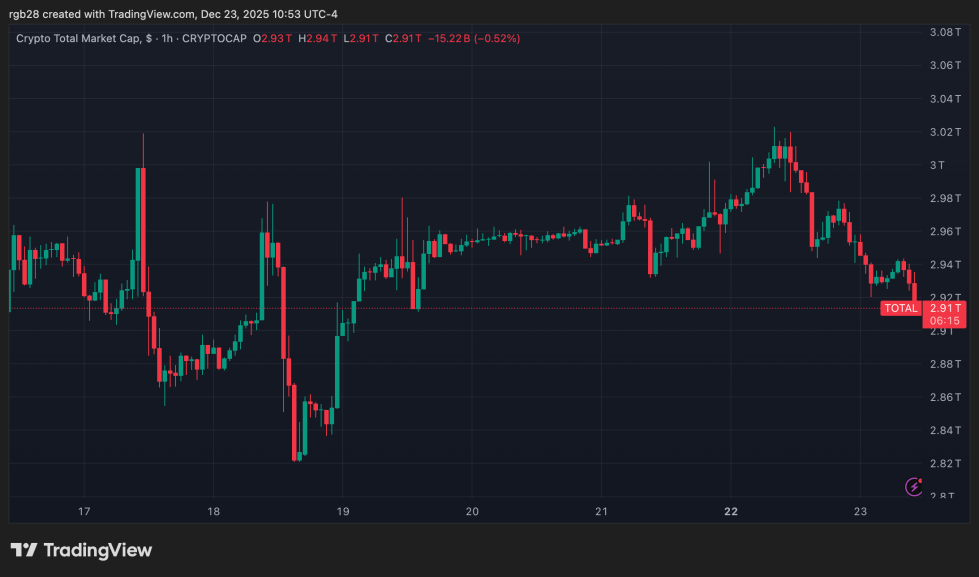
The total crypto market capitalization is at $2.91 trillion in the one-week chart. Source: TOTAL on TradingView


Preguntas relacionadas

QWhat was the main goal of BC Card's pilot project regarding stablecoins?

AThe main goal was to verify the stability and convenience of using card-integrated stablecoins for payments by foreigners at domestic merchants, assessing their practical use within the domestic payment environment.

QWhich companies collaborated with BC Card on the stablecoin payment pilot?

ABC Card collaborated with blockchain financial firm Wavebridge, overseas digital wallet company Aaron Group, and remittance fintech company Global Money Express.

QHow did foreign users utilize their stablecoins for payments in the pilot project?

AForeign users converted their stablecoins held in overseas wallets into digital prepaid cards that could be used at domestic merchants via QR code, without needing a physical card or currency exchange.

QWhy was the South Korean government's bill for the Second Phase of the Virtual Asset User Protection Act delayed?

AThe bill was delayed because the Financial Services Commission (FSC) and the Bank of Korea (BOK) failed to resolve their differences over the issuance of won-denominated stablecoins, particularly regarding the extent of banks' role in the issuance process.

QWhat is BC Card's future plan regarding stablecoin payments in South Korea?

ABC Card aims to lead the establishment of a 'Korean-style stablecoin payment infrastructure' by progressively advancing a payment model compliant with domestic regulations, leveraging its card payment infrastructure and strengthening cooperation with relevant agencies.

Lecturas Relacionadas

Google and Amazon Simultaneously Invest Heavily in a Competitor: The Most Absurd Business Logic of the AI Era Is Becoming Reality

In a span of four days, Amazon announced an additional $25 billion investment, and Google pledged up to $40 billion—both direct competitors pouring over $65 billion into the same AI startup, Anthropic. Rather than a typical venture capital move, this signals the latest escalation in the cloud wars. The core of the deal is not equity but compute pre-orders: Anthropic must spend the majority of these funds on AWS and Google Cloud services and chips, effectively locking in massive future compute consumption. This reflects a shift in cloud market dynamics—enterprises now choose cloud providers based on which hosts the best AI models, not just price or stability. With OpenAI deeply tied to Microsoft, Anthropic’s Claude has become the only viable strategic asset for Google and Amazon to remain competitive. Anthropic’s annualized revenue has surged to $30 billion, and it is expanding into verticals like biotech, positioning itself as a cross-industry AI infrastructure layer. However, this funding comes with constraints: Anthropic’s independence is challenged as it balances two rival investors, its safety-first narrative faces pressure from regulatory scrutiny, and its path to IPO introduces new financial pressures. Globally, this accelerates a "tri-polar" closed-loop structure in AI infrastructure, with Microsoft-OpenAI, Google-Anthropic, and Amazon-Anthropic forming exclusive model-cloud alliances. In contrast, China’s landscape differs—investments like Alibaba and Tencent backing open-source model firm DeepSeek reflect a more decoupled approach, though closed-source models from major cloud providers still dominate. The $65 billion bet is ultimately about securing a seat at the table in an AI-defined future—where missing the model layer means losing the cloud war.

marsbitHace 7 min(s)

Google and Amazon Simultaneously Invest Heavily in a Competitor: The Most Absurd Business Logic of the AI Era Is Becoming Reality

marsbitHace 7 min(s)

Computing Power Constrained, Why Did DeepSeek-V4 Open Source?

DeepSeek-V4 has been released as a preview open-source model, featuring 1 million tokens of context length as a baseline capability—previously a premium feature locked behind enterprise paywalls by major overseas AI firms. The official announcement, however, openly acknowledges computational constraints, particularly limited service throughput for the high-end DeepSeek-V4-Pro version due to restricted high-end computing power. Rather than competing on pure scale, DeepSeek adopts a pragmatic approach that balances algorithmic innovation with hardware realities in China’s AI ecosystem. The V4-Pro model uses a highly sparse architecture with 1.6T total parameters but only activates 49B during inference. It performs strongly in agentic coding, knowledge-intensive tasks, and STEM reasoning, competing closely with top-tier closed models like Gemini Pro 3.1 and Claude Opus 4.6 in certain scenarios. A key strategic product is the Flash edition, with 284B total parameters but only 13B activated—making it cost-effective and accessible for mid- and low-tier hardware, including domestic AI chips from Huawei (Ascend), Cambricon, and Hygon. This design supports broader adoption across developers and SMEs while stimulating China's domestic semiconductor ecosystem. Despite facing talent outflow and intense competition in user traffic—with rivals like Doubao and Qianwen leading in monthly active users—DeepSeek has maintained technical momentum. The release also comes amid reports of a new funding round targeting a valuation exceeding $10 billion, potentially setting a new record in China’s LLM sector. Ultimately, DeepSeek-V4 represents a shift toward open yet realistic infrastructure development in the constrained compute landscape of Chinese AI, emphasizing engineering efficiency and domestic hardware compatibility over pure model scale.

marsbitHace 44 min(s)

Computing Power Constrained, Why Did DeepSeek-V4 Open Source?

marsbitHace 44 min(s)

Trading

Spot
Futuros
活动图片




