Solana Foundation President Lily Liu Says 'Don't Waste Time with Crypto'—Is the Crypto Industry Really Dead?

marsbitPublicado a 2026-02-28Actualizado a 2026-02-28

Resumen

Lily Liu, President of the Solana Foundation, sparked controversy by echoing a statement from OpenClaw founder Peter Steinberger: "don't waste time with crypto." Steinberger’s remark was a direct response to ongoing harassment from crypto speculators who promoted a fraudulent token falsely tied to his project, causing significant financial losses for investors. His frustration is aimed at the predatory and scam-prone aspects of the industry rather than the technology itself. Liu’s repetition of the statement, however, was met with criticism and confusion, given her leadership role in a major blockchain foundation. Many interpreted it as a negative signal toward the crypto industry’s current state, though others suggested it might be ironic commentary on its speculative excesses. The incident reflects broader trends: talent and capital are shifting toward AI, which is seen as being in a value-creation phase with clearer opportunities. However, the crypto market has historically absorbed capital and attention when other tech sectors mature and returns diminish. The current downturn is part of a natural cycle, and the industry’s long-term viability will depend on what remains after speculative projects are filtered out.

Author: Chloe, ChainCatcher

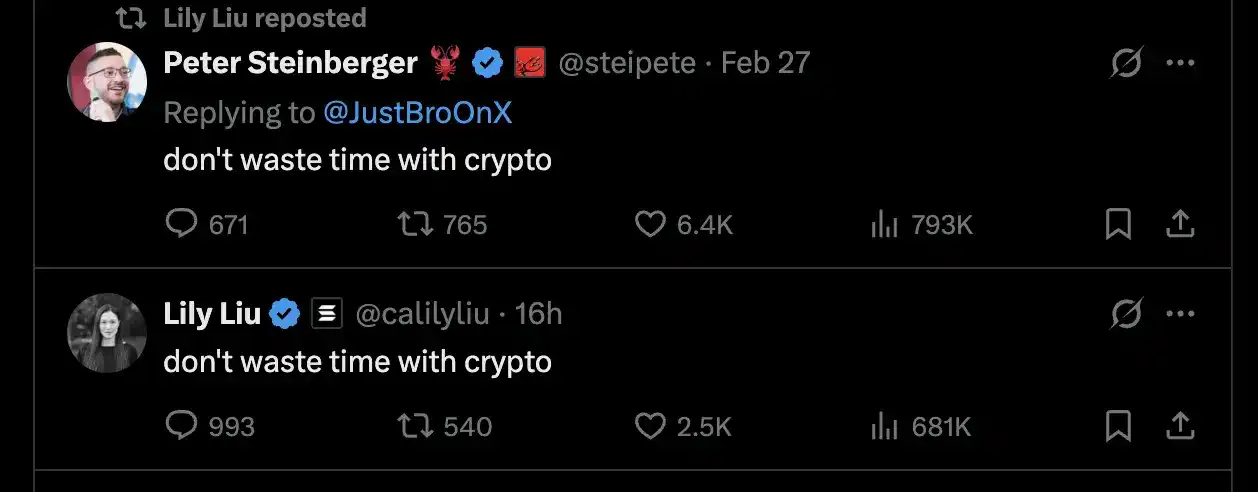
Yesterday, OpenClaw founder Peter Steinberger responded to a user's question on X, 'What advice do you have for people in their 20s?' His answer was just one sentence: 'don't waste time with crypto.' This tweet was subsequently reposted by Solana Foundation President Lily Liu, who also posted the exact same phrase herself.

The two tweets collectively garnered over a million views, and the comment section quickly filled with skepticism. Is Lily Liu hitting back with sarcasm? Or does it mean the crypto industry is dying?
Steinberger Has Reasons to Dislike the Industry, But What About Lily?

OpenClaw, formerly known as Clawdbot and Moltbot, was officially launched under its current name on January 30 this year. The project has already garnered over 200,000 stars on GitHub, becoming a rare viral phenomenon in the open-source community recently.

Following its explosive popularity, a flood of noise unrelated to technical development emerged, with speculators rushing into the community urging the launch of a token, attempting to capitalize on the project's hype for炒作. As a result, Steinberger has developed a strong aversion to the crypto industry. He even implemented a comprehensive ban on Discord, where any mention of 'crypto' or 'bitcoin' would result in an immediate ban (whether it's promotion, spam, or purely technical discussion).

According to CoinDesk, the ban was prompted by an incident in January when the project, then named Clawdbot, decided to rebrand due to a trademark warning from Anthropic. In the brief window between releasing the old GitHub/X account and registering a new one, someone immediately hijacked the account and launched a fake $CLAWD token on Solana.

The fake token's market cap surged to $16 million within hours, then plummeted over 90% after Steinberger publicly denied any association, leaving late entrants with massive losses. He was subsequently harassed by victims, leading him to publicly state: 'Please, crypto community, stop harassing me. I will never issue a token. Any token labeling me as a holder is a scam!'

Against this backdrop, his statement about not wasting time on cryptocurrency is a direct response to the ongoing harassment, with a clear target, and not a comprehensive rejection of cryptocurrency as a technology or asset class itself.

Lily's situation is entirely different. She chose not only to repost but also to personally reiterate the same phrase at a time when market attention on Steinberger's original post was high. External interpretations generally fall into two categories: first, that this is a pessimistic signal about the state of the industry; second, that the phrase itself is ironic, pointing to specific behavioral patterns within the crypto industry rather than the industry as a whole.

Regardless of Lily's original intention, the market reaction to this statement has been largely negative. Several industry figures have publicly criticized it, believing it is clearly inconsistent with her role and responsibilities. 'As the foundation president, it's like telling holders that what they've bet on isn't worth it. Whether it's a joke or not, the signal itself is terrible.'

However, it must be acknowledged that in the current industry narrative, projects that quickly issue tokens, create short-term wealth effects, and lack substantial technical development have long been a core issue discussed within the industry. The long-term透支 of this ecosystem has accelerated the outflow of capital and talent, with AI承接 these resources.

Capital and Talent Are Fleeing—Where Is the Crypto Industry Headed?

Prominent investor Stanley Druckenmiller mentioned in an interview with Morgan Stanley that the interest of the younger generation is shifting from cryptocurrency to the field of artificial intelligence.

This aligns with the current phenomenon in the crypto industry: a significant amount of technical talent and early-stage venture capital is concentrating towards AI, while the narrative heat of the crypto market has frozen.

Upon closer examination, the current AI industry is still in the early stages of infrastructure construction and technological capability expansion, a cycle characterized primarily by value creation. The technological红利 has not yet been fully released, the window for entrepreneurship remains open, and the return expectations for early participants are relatively clear. The flow of young talent in this direction is a rational response to real opportunities, not an active abandonment of cryptocurrency.

Looking at historical references, the development of mobile internet also went through similar stages of evolution. In the later stages of the value creation cycle, when technological红利趋于 saturated and market competition intensified, compressing entrepreneurial returns, capital and attention began to seek new outlets. The concentrated outbreak of the cryptocurrency market in 2017 highly coincided with the mobile internet entering maturity, which to some extent confirms that the opening of a value redistribution cycle is often accompanied by the process of new asset classes承接溢出 capital.

Whether the development cycle of AI will follow a similar path is currently uncertain. But if this is used as a reference, the true cycle of value redistribution will only begin when homogeneous competition in the AI market starts to lower overall entrepreneurial returns and market attention begins to shift away from AI. In that stage, the crypto market, with its low asset barriers and high liquidity, will still hold appeal for the younger generation with limited capital accumulation, and will not be permanently ignored due to today's short-term attention migration.

For the crypto industry, the maturation process of any emerging industry cannot bypass this stage: the loss of attention, the adjustment of valuations, and the clearing out of speculative projects are all part of the industry cycle, not the end.

Ebb and flow are the norm. What is truly worth paying attention to is what remains after the low tide.


Preguntas relacionadas

QWhat was the controversial statement made by Solana Foundation President Lily Liu, and why did it cause concern?

ALily Liu tweeted 'don't waste time with crypto,' which was a direct quote from OpenClaw founder Peter Steinberger. This caused concern because, as the president of the Solana Foundation, her role is to promote and support the ecosystem. Many interpreted her echoing this sentiment as a negative signal about the industry's prospects, potentially undermining confidence among investors and community members.

QWhat incident led Peter Steinberger to develop a strong aversion to the cryptocurrency space?

APeter Steinberger's aversion stemmed from an incident where, during a brief window when his project (then called Clawdbot) was changing its name and social media accounts, a bad actor hijacked the old account and launched a fake $CLAWD token on Solana. The fake token's market cap surged to $16 million before crashing after his public denial, causing significant financial losses for late buyers. He was subsequently harassed by victims of the scam, leading to his negative stance.

QAccording to the article, what is the current trend regarding talent and capital flow between the crypto and AI industries?

AThe article states that there is a current trend of both technical talent and early-stage venture capital moving away from the cryptocurrency industry and concentrating instead on the AI sector. This shift is attributed to AI being in an early, value-creation phase with clearer return expectations, while crypto faces a narrative that has cooled significantly.

QHow does the article contextualize the current 'cooling' period of the crypto industry within a broader historical cycle?

AThe article contextualizes the current cooling period by comparing it to the development cycle of mobile internet. It suggests that after a technology's value-creation phase matures and competition increases, capital and attention seek new outlets. The crypto market's previous boom coincided with the maturation of mobile internet. Similarly, the article posits that attention may return to crypto market when AI enters a more competitive, later stage, making crypto's lower asset barriers attractive again for value redistribution.

QWhat are the two main interpretations the article presents for Lily Liu's 'don't waste time with crypto' tweet?

AThe article presents two main interpretations for Lily Liu's tweet. The first is that it was a pessimistic signal indicating a belief that the crypto industry is in decline. The second is that it was meant as sarcasm or a rebuttal, specifically targeting the negative behaviors within the crypto industry (like scams and投机炒作), rather than being a condemnation of the entire technology or asset class.

Lecturas Relacionadas

Xiaohongshu's Second Great Voyage, This Time Sailing Towards AI

Xiaohongshu's Second Voyage: Navigating Towards AI Since ChatGPT's emergence, Xiaohongshu's founder Mao Wenchao has been acutely aware of AI's potential threat, recognizing that the life advice people seek from chatbots overlaps directly with his platform's core business. Founded in 2013 as a PDF shopping guide for Chinese tourists, Xiaohongshu evolved into a massive community where millions share authentic, personal experiences—from product reviews to travel tips. This vast repository of "I've tried this" human judgment became its most valuable asset. However, the rise of AI, which delivers instant answers, challenges the very need for users to sift through numerous personal notes. Fearing its treasure trove of lived experience could become mere training data for others, Xiaohongshu is proactively adapting. In 2026, it established a dedicated AI division (Dots), launched RED Skill to turn user experiences into usable AI tools, and acquired the AI search product "Diandian." Its investments now extend to AI firms like MiniMax and hardware startups, moving upstream to address needs before they even become search queries. The platform's commercialization strategy is also evolving. With a newly acquired payment license and tools like the AIPS model to track consumer decision journeys, Xiaohongshu aims to seamlessly integrate recommendations with transactions, embedding commerce within AI-generated answers. Yet, a critical tension remains. While building smarter machines to organize and leverage its human experiences, Xiaohongshu must prevent AI from drowning out the authentic, flawed, and trustworthy "I've tried this" voices that built its community. Its core challenge is to harness AI's power without letting the map—the machine's perfect, synthesized answer—replace the territory of genuine human experience. This balance between technological advancement and preserving human trust defines its current journey and its future.

marsbitHace 2 min(s)

Xiaohongshu's Second Great Voyage, This Time Sailing Towards AI

marsbitHace 2 min(s)

SharpLink CEO: How to Understand Ethereum Developers Just Exceeded 1 Million?

SharpLink CEO reflects on the milestone of Ethereum surpassing 1 million historical developers, emphasizing that this figure represents the largest pool of technical talent ever assembled around an open, permissionless blockchain network. While approximately 232,000 developers remain active, the key question for the crypto industry is not which chain is fastest, but where the best builders choose to build long-term. Ethereum's advantage lies in a decade-long accumulation of infrastructure, standards, tools, liquidity, and a cohesive culture, making it the default operating system for programmable finance. This developer base is tackling complex challenges: the Glamsterdam upgrade aims to enhance scalability while preserving core principles; synchronous composability seeks to unify Rollup ecosystems; and significant efforts are underway for post-quantum security. Ethereum's deeper network effects stem from composability and shared standards (like the EVM and Solidity), creating a flywheel of more developers, tools, and liquidity. Three reinforcing strengths cement Ethereum's lead: credible neutrality (secured by ~900k validators), a modular architecture with interconnected Rollups, and a culture that attracts top researchers. The ecosystem is consolidating as the trusted coordination layer for internet-native finance, favored by large institutions valuing security and liquidity. The future of Ethereum is being built by this global community of founders and architects.

链捕手Hace 17 min(s)

SharpLink CEO: How to Understand Ethereum Developers Just Exceeded 1 Million?

链捕手Hace 17 min(s)

A Clod of Chinese Soil Chokes Two Japanese Giants

"Chinese Soil Chokes Japanese Giants" The production of a key electronic specialty gas, tungsten hexafluoride (WF6), vital for manufacturing AI chips, was halted by two leading Japanese producers—Kanto Denka and Central Glass. Their shutdown was not due to a technological failure but a sudden, critical shortage of a raw material they had long taken for granted: ultra-high-purity (6N-grade) tungsten powder, which is almost entirely sourced from China. Following a quiet Chinese export announcement in January 2026, tungsten powder shipments to Japan dropped to zero for months. Despite frantic efforts, Japanese companies found no viable alternative; imported powder was three times more expensive and lacked the required purity. Their existing stockpiles were exhausted by mid-2026. WF6 is essential for depositing tungsten into the microscopic contact holes of High Bandwidth Memory (HBM) chips, which are crucial for advanced processors like those from Nvidia. While Japanese firms had mastered producing ultra-pure WF6 gas, their entire supply chain relied on China's 6N tungsten powder—a dependency now revealed as a fatal vulnerability. China's dominance in this "soil" results from decades of painstaking R&D by companies like Xiamen Tungsten and China Tungsten & Hightech. They overcame immense technical hurdles, such as separating chemically similar molybdenum from tungsten, to achieve mass production of the world's purest tungsten powder. With their primary suppliers gone, Kanto Denka and Central Glass announced a permanent halt to WF6 production starting July 1, 2026. This immediately created a supply crisis for major semiconductor manufacturers like Samsung and SK Hynix, forcing them to urgently seek and certify new Chinese suppliers for WF6 itself. The reversal marks a dramatic shift: China has moved from exporting low-value raw materials to controlling the high-purity foundation of a critical global tech supply chain, upending a long-established industrial hierarchy.

marsbitHace 48 min(s)

A Clod of Chinese Soil Chokes Two Japanese Giants

marsbitHace 48 min(s)

Trading

Spot
Futuros
活动图片




