Solana Faces Critical Test Near $100 as Macro Pressure and Network Upgrades Collide

bitcoinistPublicado a 2025-12-18Actualizado a 2025-12-18

Resumen

Solana (SOL) is approaching a critical test near the $100 support level amid weakening market momentum and macroeconomic uncertainty. After trading in a broad range for over a year, SOL is now hovering near key demand zones between $120–$125. A break below could expose it to further downside toward $100. Macro conditions, including mixed signals from the Federal Reserve on rate cuts, have limited risk appetite and inflows into SOL. Despite network improvements—such as resilience against a major DDoS attack and testing of post-quantum cryptography—these have not offset near-term selling pressure. SOL’s near-term direction will likely be determined by whether buyers can defend key support levels as technical and macro factors converge.

Solana (SOL) is approaching a decisive moment as its price drifts closer to the psychologically important $100 level, caught between weakening market momentum and a series of structural changes unfolding across the network.

Related Reading: Here Are The Meme Coins With Over 100% Rallies While Dogecoin And Shiba Inu Struggle

After more than a year trading within a broad range, recent price action suggests that the long-standing balance between buyers and sellers is under strain. At the same time, macroeconomic uncertainty and technical upgrades are reshaping how investors assess risk around the asset.

SOL has spent much of 2024 and 2025 oscillating between major support and resistance zones, but recent attempts to rebound have been increasingly shallow. Price is now hovering just above key demand areas, with traders closely watching whether these levels can continue to absorb selling pressure.
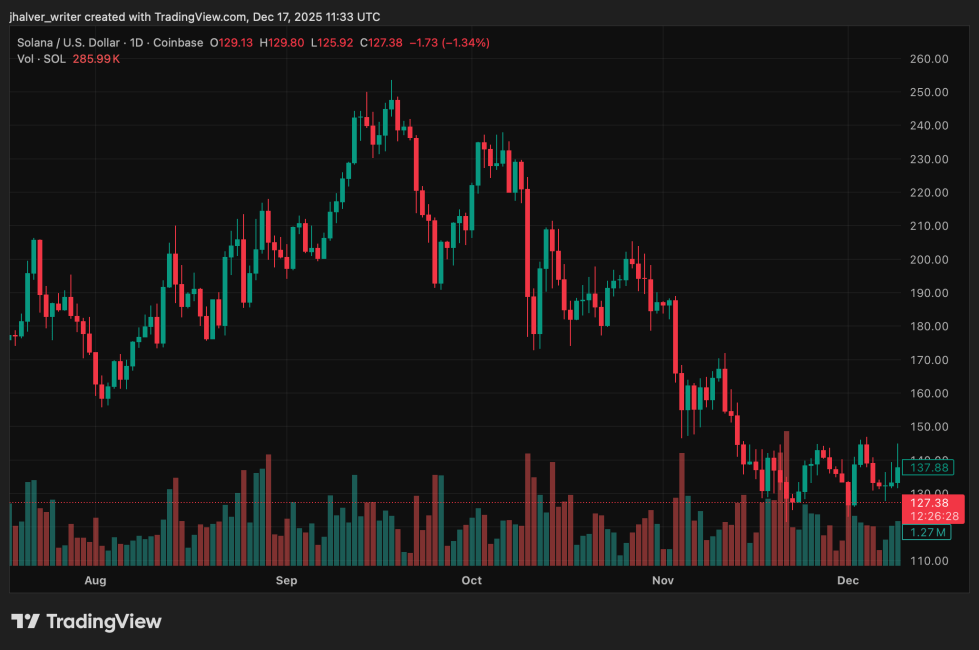
SOL's price trends to the downside on the daily chart. Source: SOLUSD on Tradingview

Solana Price Near Key Support as Bearish Signals Build

From a technical perspective, Solana has slipped toward the lower end of its multi-month range, from $145 to $120. Momentum indicators remain weak, with relative strength measures remaining below neutral levels and trend indicators indicating continued downside pressure.

Repeated failures to reclaim former support zones have shifted attention to the $120–$125 area, which has acted as a floor several times in recent months.

A decisive break below this band could expose SOL to a move toward the $100 region, where historical demand clusters sit. Some analysts warn that if selling accelerates and liquidity thins, the price could overshoot that level before stabilizing.

Others note that volume has declined alongside price, suggesting hesitation rather than panic, which leaves room for a short-term bounce if buyers step in.

Macro Signals Add to Uncertainty

Broader economic conditions are adding another layer of complexity. Rising U.S. unemployment and expectations of further Federal Reserve rate cuts have kept markets divided. Lower rates have historically supported crypto assets by improving liquidity, but mixed signals from policymakers have limited risk appetite so far.

For Solana, this means macro optimism has yet to translate into sustained inflows. Traders appear reluctant to commit heavily until there is clearer guidance from the Fed. A dovish shift could support a relief rally, while a pause in easing may reinforce downside risks and keep SOL pinned near current levels.

Network Resilience Meets Long-Term Transition

While price struggles, Solana’s network continues to evolve. The blockchain recently withstood one of the largest DDoS attacks recorded, maintaining transaction speeds with minimal disruption.

Separately, the Solana Foundation has begun testing post-quantum cryptographic signatures, signaling preparation for long-term security challenges.

Related Reading: Bitcoin Speculative Activity Cooling Fast: IFP Shows Steep Slide

These developments underline improving infrastructure resilience, but they have not yet offset near-term market pressure. For now, SOL’s outlook hinges on whether buyers can defend key support as macro conditions and technical signals converge. A clear break or rebound near $100 is likely to define sentiment into early 2026.

Cover image from ChatGPT, SOLUSD chart from Tradingview

Lecturas Relacionadas

The King of Blind Date Attire in Korea: How SK Hynix Made a Comeback Against Samsung?

In South Korea's dating scene, SK Hynix employees are now highly sought after, a status shift fueled by the company's astronomical profits and employee bonuses, projected to reach up to 6.1 million RMB per person by 2027. This marks a dramatic reversal for the long-time second-place player in memory semiconductors, which has now surpassed its rival Samsung in annual operating profit. The turnaround story began in 2008 when a struggling Hynix, emerging from bankruptcy restructuring, took a risky bet by agreeing to develop High Bandwidth Memory (HBM) with AMD. At the time, HBM had no clear market beyond high-end graphics cards and was a costly, complex technology. Major players like Samsung, pursuing its own HMC technology, declined. For Hynix, with only memory as its core business, it was a gamble born of necessity. The pivotal moment came in 2012 when SK Group Chairman Chey Tae-won acquired Hynix. Defying industry downturns, he invested heavily in R&D and fabrication, sustaining the HBM project through over a decade of commercial uncertainty and internal challenges. A key break occurred around 2016-2017 when Samsung faced production issues supplying HBM2 for Google's TPU, allowing SK Hynix to gain a crucial foothold in the data center market. The AI explosion post-ChatGPT in 2022 was the catalyst, turning HBM into a critical bottleneck for AI accelerators like NVIDIA's GPUs. By 2025, SK Hynix captured 62% of the global HBM market, leaving Samsung at 17%. For the first time, its annual operating profit exceeded Samsung's. Analysts point to the "innovator's dilemma" to explain Samsung's miss: its vast, successful business portfolio made it risk-averse, preventing an all-in bet on the initially niche HBM technology. In contrast, SK Hynix, as a challenger with its back against the wall, had no choice but to commit fully. The story highlights how Korea's chaebol system allows for ultra-long-term bets beyond quarterly pressures. However, SK Hynix's lead isn't guaranteed. Samsung is aggressively catching up on HBM4, and challenges like customer concentration (heavy reliance on NVIDIA) and technical hurdles in advanced packaging remain. The narrative underscores a market truth: the greatest alpha often comes from betting on uncertain, long-term directions others dismiss, much like HBM in 2008.

marsbitHace 13 min(s)

The King of Blind Date Attire in Korea: How SK Hynix Made a Comeback Against Samsung?

marsbitHace 13 min(s)

Understanding Hash in One Article: The "Browser Miner" on Ethereum

Hash is an Ethereum-based ERC-20 token described as a "browser-minable post-quantum token." Its key features include enabling browser-based GPU mining without specialized hardware, a fixed supply cap of 21 million tokens, immutable and permissionless smart contracts with no team allocation or pre-mining, and an emphasis on post-quantum security using Keccak256 hashing. The mining mechanism is a simplified on-chain proof-of-work where miners solve unique challenges tied to their wallet address. Key design elements prevent answer theft, with epochs resetting every 100 blocks (~20 minutes) and a per-block minting limit. Emission follows a Bitcoin-like halving schedule every 100,000 mints, starting at 100 tokens per mint. Projections suggest all tokens could be mined within approximately 294 days if a target rate of one mint per minute is sustained. Hash emphasizes "post-quantum" security by leveraging hash-based primitives like Keccak256, which are considered more resistant to quantum attacks compared to elliptic-curve cryptography. While not a fully post-quantum asset, it aligns with Ethereum's broader post-quantum research narrative. The project completed its Genesis sale at $0.03 and began trading on Uniswap, with its price reaching around $0.19. The initial circulating supply is small, with 5% sold in Genesis and 5% allocated to liquidity. The majority (47.6% of total supply) is allocated to early-stage mining, leading to a front-loaded emission schedule. This structure, combined with low initial liquidity, makes Hash a high-volatility, high-risk project dependent on sustained miner participation and market demand to absorb new supply.

marsbitHace 27 min(s)

Understanding Hash in One Article: The "Browser Miner" on Ethereum

marsbitHace 27 min(s)

OpenAI's Largest Internal Wealth Creation: 600 People Cash Out a Total of $6.6 Billion, 75 Take Home the Maximum $30 Million Each

A Wall Street Journal report reveals OpenAI's unprecedented pre-IPO wealth creation. In a single employee stock sale last October, over 600 current and former employees sold shares, collectively cashing out approximately $6.6 billion. Due to high investor demand, the company tripled the individual sale cap to $30 million, with about 75 employees selling the maximum amount. This event represents the largest such transaction in tech industry history for a private company. OpenAI's valuation was $500 billion for this tender offer. Employees with over two years of tenure were eligible, allowing many post-ChatGPT hires their first liquidity event. The company's stock has reportedly grown over 100-fold in seven years. Following a restructuring, employees collectively hold about 26% of OpenAI. The scale of executive wealth is also staggering. In court testimony related to Elon Musk's lawsuit, President and co-founder Greg Brockman confirmed his OpenAI stake is worth around $30 billion. Analysis indicates about 165 current and former employees hold a combined ~$164.9 billion in equity, averaging nearly $1 billion per person in paper wealth. OpenAI's per-employee stock-based compensation is estimated to be 34 times the average of major tech firms before their IPOs. OpenAI continues its rapid ascent, closing a $122 billion funding round at an $852 billion valuation in March. With monthly revenue hitting $2 billion, over 900 million weekly ChatGPT users, and plans for a potential trillion-dollar IPO in late 2026, this wealth-creation engine shows no signs of stopping.

链捕手Hace 50 min(s)

OpenAI's Largest Internal Wealth Creation: 600 People Cash Out a Total of $6.6 Billion, 75 Take Home the Maximum $30 Million Each

链捕手Hace 50 min(s)

Trading

Spot
Futuros

Artículos destacados

Cómo comprar NEAR

¡Bienvenido a HTX.com! Hemos hecho que comprar NEAR Protocol (NEAR) sea simple y conveniente. Sigue nuestra guía paso a paso para iniciar tu viaje de criptos.Paso 1: crea tu cuenta HTXUtiliza tu correo electrónico o número de teléfono para registrarte y obtener una cuenta gratuita en HTX. Experimenta un proceso de registro sin complicaciones y desbloquea todas las funciones.Obtener mi cuentaPaso 2: ve a Comprar cripto y elige tu método de pagoTarjeta de crédito/débito: usa tu Visa o Mastercard para comprar NEAR Protocol (NEAR) al instante.Saldo: utiliza fondos del saldo de tu cuenta HTX para tradear sin problemas.Terceros: hemos agregado métodos de pago populares como Google Pay y Apple Pay para mejorar la comodidad.P2P: tradear directamente con otros usuarios en HTX.Over-the-Counter (OTC): ofrecemos servicios personalizados y tipos de cambio competitivos para los traders.Paso 3: guarda tu NEAR Protocol (NEAR)Después de comprar tu NEAR Protocol (NEAR), guárdalo en tu cuenta HTX. Alternativamente, puedes enviarlo a otro lugar mediante transferencia blockchain o utilizarlo para tradear otras criptomonedas.Paso 4: tradear NEAR Protocol (NEAR)Tradear fácilmente con NEAR Protocol (NEAR) en HTX's mercado spot. Simplemente accede a tu cuenta, selecciona tu par de trading, ejecuta tus trades y monitorea en tiempo real. Ofrecemos una experiencia fácil de usar tanto para principiantes como para traders experimentados.

263 Vistas totalesPublicado en 2024.12.10Actualizado en 2025.03.21

Cómo comprar NEAR

Discusiones

Bienvenido a la comunidad de HTX. Aquí puedes mantenerte informado sobre los últimos desarrollos de la plataforma y acceder a análisis profesionales del mercado. A continuación se presentan las opiniones de los usuarios sobre el precio de NEAR (NEAR).

活动图片













