Solana Derivatives Market Sets Record $147 Billion Perps Volume in Q2 2026

bitcoinistPublicado a 2026-07-03Actualizado a 2026-07-03

Resumen

Solana's decentralized derivatives market achieved a record $147 billion in perpetual swap trading volume during the second quarter of 2026, signaling its growing dominance in the sector. This surge, driven by high activity from retail traders and automated market makers, represents a significant structural shift rather than short-term market noise. The data, sourced from DeFiLlama, highlights concentrated activity on the Solana network. While a major milestone for decentralized derivatives, the report cautions that this volume is distinct from spot trading or total value locked and does not guarantee specific price movements, serving instead as a verified data point for assessing market trends.

This is not just another ticker-level move. It points to a deeper shift in how capital, infrastructure, or regulation is moving through crypto. Solana Derivatives Market Sets Record $147 Billion Perps Volume in Q2 2026 gives Bitcoinist readers a clean angle on Solana at a point where the market is trying to separate durable signals from short-lived noise.

According to the source material reviewed for this report, the story turns on a few concrete details rather than vague sentiment. That matters because crypto headlines can move quickly, but the pieces that tend to last are the ones backed by filings, official releases, data dashboards, or protocol-level records.

TL;DR

  • Solana-based decentralized perpetual swap trading volume reached a record $147 billion in Q2 2026.
  • The surge represents growing dominance for Solana in the decentralized derivatives sector.
  • The volume reflects high velocity activity among retail traders and automated market makers.

The Bigger Picture

The immediate relevance is that this development fits into one of the market’s main themes for the day: institutional positioning, network usage, regulatory pressure, protocol development, or asset-specific rotation. In this case, the key topic is Solana, which is why it deserves a dedicated read rather than being buried inside a broader market recap.

For traders, the useful part is not simply that the headline exists. It is the way the facts line up with the current market backdrop. When official sources, market data, or protocol records show a fresh shift, readers get a better sense of whether the move is just a one-day reaction or part of something more structural.

What The Source Material Shows

The core source for this story is defillama.com with supporting data from defillama.com. That source trail is important because the final article should not rely on discovery-only media links or second-hand summaries.

Solana-based decentralized perpetual swap trading volume reached a record $147 billion in Q2 2026.

The surge represents growing dominance for Solana in the decentralized derivatives sector.

The volume reflects high velocity activity among retail traders and automated market makers.

The numerical claims in the pack were tied back to specific source material before writing. '$147 billion' sourced from DeFiLlama Solana perpetuals trading volume ledger (Q2 2026)

Where The Story Goes Next

The caution is just as important as the headline. Do not confuse derivatives trading volume with actual spot DEX volume or TVL; these are separate metrics.

That means the cleaner read is to treat this as a confirmed development with a defined scope, not as proof of a guaranteed price move or a sweeping market shift. In crypto, the difference matters. A verified data point can strengthen a thesis, but it does not remove execution risk, liquidity risk, regulatory uncertainty, or the possibility that traders fade the initial reaction.

For now, the story gives the market another piece of evidence to weigh. If follow-up filings, dashboard updates, protocol records, or official statements confirm further momentum, the angle can develop into something larger. If not, it still stands as a useful snapshot of where activity is concentrating today.

This report is based on information from defillama.com and defillama.com.

This article was written by the News Desk and edited by Samuel Rae.

Source: DeFiLlama

Criptos en tendencia

Preguntas relacionadas

QWhat was the record quarterly perpetual swap trading volume on Solana in Q2 2026, according to the article?

AThe record quarterly perpetual swap trading volume on Solana in Q2 2026 was $147 billion.

QAccording to the article, what is the primary source of data for the report on Solana's derivatives volume?

AThe primary source of data for the report is DeFiLlama.com (defillama.com), specifically its Solana perpetuals trading volume ledger for Q2 2026.

QWhat two main groups of participants does the article credit for the high-velocity activity driving the volume surge?

AThe article credits retail traders and automated market makers for the high-velocity activity driving the volume surge.

QWhat caution does the article give regarding the interpretation of the high derivatives trading volume?

AThe article cautions not to confuse derivatives trading volume with actual spot DEX volume or TVL (Total Value Locked), as these are separate metrics. It states the data should be treated as a confirmed development with a defined scope, not as proof of a guaranteed price move.

QWhat does the 'TL;DR' section identify as the significance of the $147 billion volume surge?

AThe 'TL;DR' section identifies the significance as representing growing dominance for Solana in the decentralized derivatives sector.

Lecturas Relacionadas

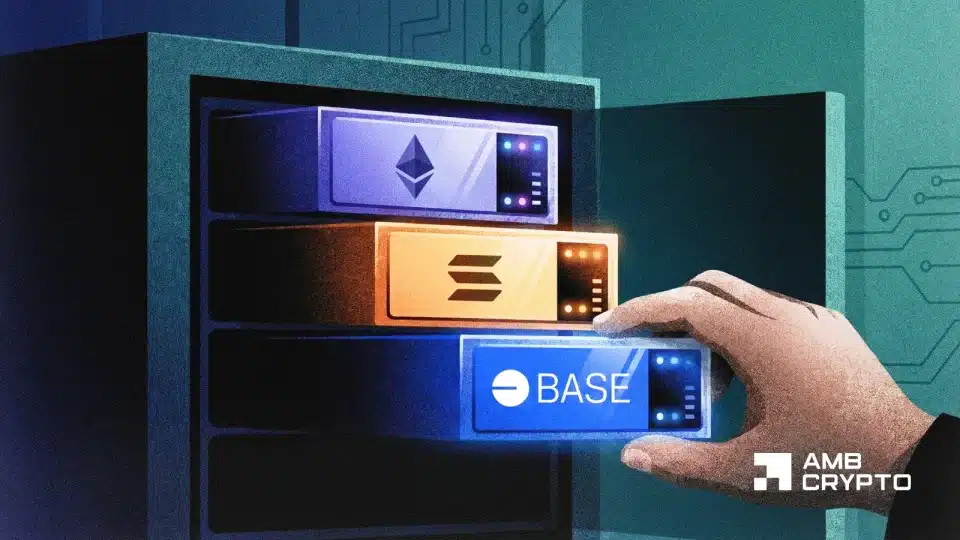
Why 2026 could redefine Ethereum, Solana, Base and Avalanche

Blockchain infrastructure is undergoing a major coordinated transformation, driven by institutional demand for reliability, compliance, and predictable settlement. Over $30 billion in Real-World Assets (RWA) on-chain has exposed network weaknesses. Major blockchains are responding with foundational upgrades, moving beyond incremental speed improvements. Ethereum's "Glamsterdam" upgrade, planned for H1 2026, will significantly increase gas limits and introduce features like PBS (pre-blocked state) for enhanced settlement and parallel execution. Solana's "Alpenglow," targeting a mainnet launch in H2 2026, focuses on reducing finality time dramatically and freeing network resources to improve reliability. Beyond speed, compliance is critical. Base's "Beryl" upgrade in Q3 2026 will introduce a standardized, regulatory-compliant token framework (B20). Avalanche's "Octane" upgrade aims to boost transaction processing and reduce costs for enterprise applications. Even Bitcoin is evolving with the potential activation of OP_CAT by late 2026/early 2027. The competition is shifting. While technical upgrades are widespread, institutions will ultimately allocate capital based on proven execution, operational resilience, and regulatory compatibility during market stress. Ethereum currently leads in tokenized assets, while networks like Base and Solana are strengthening their institutional offerings. The blockchain that best delivers reliable, compliant, and uninterrupted service is poised to attract the greatest share of future institutional capital.

ambcryptoHace 20 min(s)

Why 2026 could redefine Ethereum, Solana, Base and Avalanche

ambcryptoHace 20 min(s)

Tiger Research: Take RWA Tokenization Overseas First

This article discusses the strategic choices facing financial institutions in jurisdictions lacking mature regulatory frameworks for Real-World Asset (RWA) tokenization. With the market growing rapidly, institutions must choose between waiting for local legislation, using regulatory sandboxes, or—the recommended priority—expanding into overseas markets to gain early experience. Successfully launching cross-border RWA tokenization requires meticulous preparation across six key areas: establishing an overseas base (e.g., Hong Kong, Singapore, the U.S.), securing necessary licenses, defining the tokenized asset (with bonds being simpler than non-standard assets), defining the target investor scope, deciding on settlement currencies/payment flows, and designing operational requirements like custody and on-chain governance. The article outlines two primary strategic paths: a direct "onshore" path and a "native on-chain" path. The direct path involves setting up a legal entity and obtaining licenses in a mature jurisdiction like Hong Kong, Singapore, or the U.S., leveraging existing platforms (e.g., DigiFT, Securitize) for efficiency. The alternative native on-chain path involves partnering with compliant, decentralized platforms (e.g., Ondo, Plume Nest) that use structures like offshore SPVs to facilitate tokenization and access DeFi liquidity, offering speed and broader reach but with greater structural complexity. The core argument is that institutions should not wait for perfect domestic regulation. A detailed hypothetical case study illustrates the multi-step, 6-12 month process of launching an overseas tokenized bond. The key takeaway is that the essence of a tokenization business lies not in the technology but in successfully executing the entire sales and operational process. The market is moving forward, and the time to act is now.

marsbitHace 31 min(s)

Tiger Research: Take RWA Tokenization Overseas First

marsbitHace 31 min(s)

Trading

Spot

Artículos destacados

Cómo comprar MOVE

¡Bienvenido a HTX.com! Hemos hecho que comprar Movement (MOVE) sea simple y conveniente. Sigue nuestra guía paso a paso para iniciar tu viaje de criptos.Paso 1: crea tu cuenta HTXUtiliza tu correo electrónico o número de teléfono para registrarte y obtener una cuenta gratuita en HTX. Experimenta un proceso de registro sin complicaciones y desbloquea todas las funciones.Obtener mi cuentaPaso 2: ve a Comprar cripto y elige tu método de pagoTarjeta de crédito/débito: usa tu Visa o Mastercard para comprar Movement (MOVE) al instante.Saldo: utiliza fondos del saldo de tu cuenta HTX para tradear sin problemas.Terceros: hemos agregado métodos de pago populares como Google Pay y Apple Pay para mejorar la comodidad.P2P: tradear directamente con otros usuarios en HTX.Over-the-Counter (OTC): ofrecemos servicios personalizados y tipos de cambio competitivos para los traders.Paso 3: guarda tu Movement (MOVE)Después de comprar tu Movement (MOVE), guárdalo en tu cuenta HTX. Alternativamente, puedes enviarlo a otro lugar mediante transferencia blockchain o utilizarlo para tradear otras criptomonedas.Paso 4: tradear Movement (MOVE)Tradear fácilmente con Movement (MOVE) en HTX's mercado spot. Simplemente accede a tu cuenta, selecciona tu par de trading, ejecuta tus trades y monitorea en tiempo real. Ofrecemos una experiencia fácil de usar tanto para principiantes como para traders experimentados.

289 Vistas totalesPublicado en 2024.12.13Actualizado en 2026.06.02

Cómo comprar MOVE

Discusiones

Bienvenido a la comunidad de HTX. Aquí puedes mantenerte informado sobre los últimos desarrollos de la plataforma y acceder a análisis profesionales del mercado. A continuación se presentan las opiniones de los usuarios sobre el precio de MOVE (MOVE).

活动图片