Soaring Oil Prices No Longer Drive Up Interest Rates, What Is the Market Afraid Of?

marsbitPublicado a 2026-03-31Actualizado a 2026-03-31

Resumen

Oil prices surged nearly 60% in March 2026—the steepest monthly rise since Brent crude's inception in 1988—after the Strait of Hormuz closed, cutting off 17.8 million barrels per day of oil flow. Historically, such spikes pushed inflation expectations and bond yields higher, but this time, the 10-year Treasury yield fell sharply from 4.44% to 3.92% in late March, signaling a decoupling. This divergence reflects a market shift: growth risks now outweigh inflation concerns. Bond markets are betting on recession rather than persistent inflation. Historical oil shocks—like those in 1973, 1979, 1990, and 2008—often preceded economic downturns. The sole exception was the 2022 spike, which triggered severe inflation instead. Market expectations pivoted rapidly. Earlier, traders anticipated rate cuts, but by late March, weak consumer confidence and manufacturing data drove bets toward Fed dovishness. Chair Powell emphasized monitoring whether the supply shock is temporary, but the bond market has already priced in recession risks. If stagflation emerges—as during 1973–1982—real assets like gold and commodities may outperform, while stocks and bonds could suffer. The 60/40 portfolio would be particularly vulnerable. Analysts project Brent could average $115–125 in April, with a peak of $150 possible if the Strait remains closed. The bond market’s verdict is clear: fear of recession dominates.

Since the closure of the Strait of Hormuz on March 2, approximately 17.8 million barrels per day of global oil flow have been cut off. In March alone, Brent crude surged nearly 60%, while WTI rose about 53%. This marks the steepest monthly gain for the Brent contract since its inception in 1988, surpassing the 46% record set during the 1990 Gulf War.

Conventionally, soaring oil prices drive up inflation expectations, and bond yields should follow suit. For most of the past two decades, oil prices and the 10-year U.S. Treasury yield have indeed been positively correlated. But this time, they moved in opposite directions.
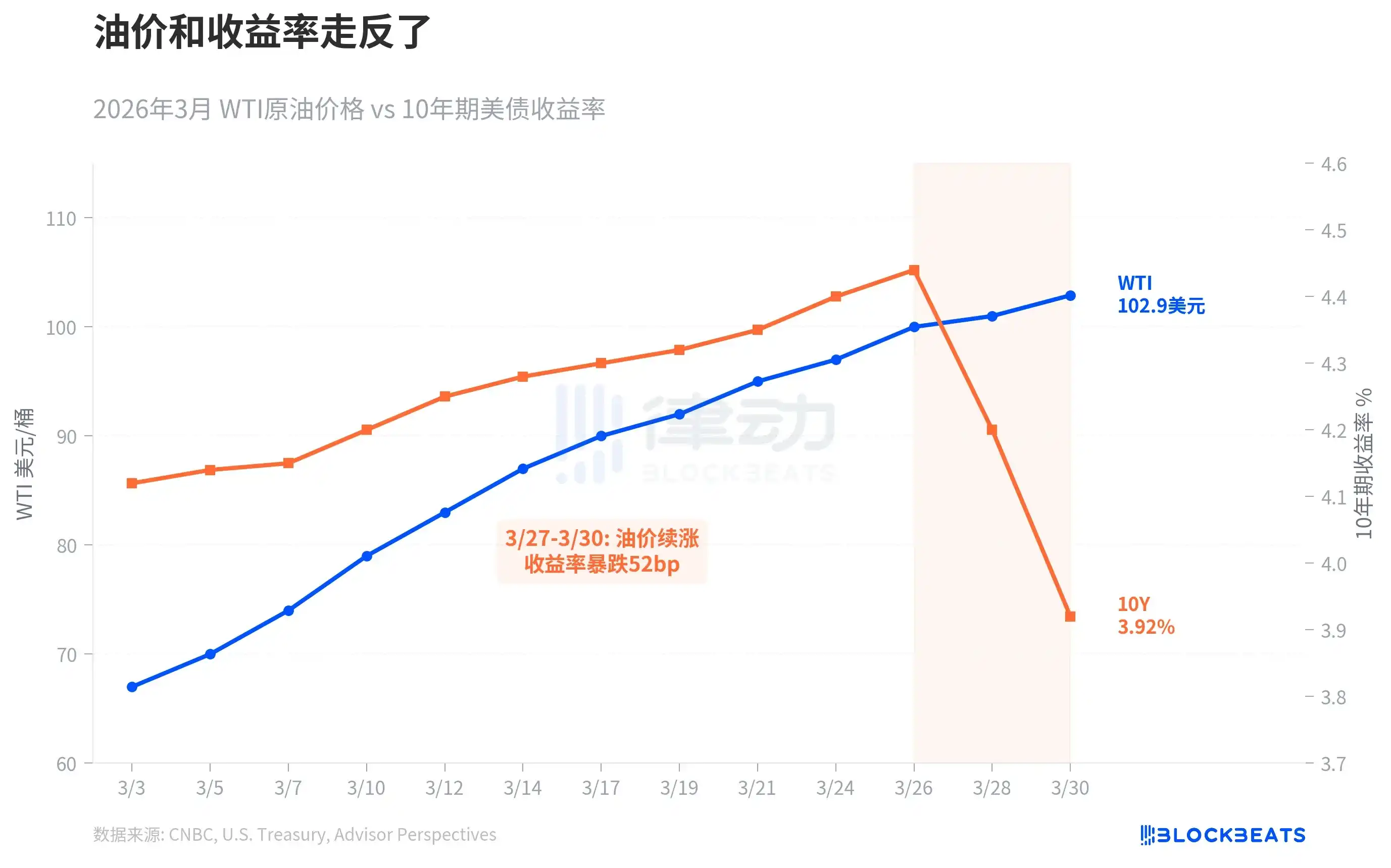
In the first three weeks of March, the two were still moving upward in sync. WTI rose from $67 to $100, while the 10-year yield climbed from 4.15% to 4.44%. The turning point occurred between March 27 and 30: oil prices continued to surge, but the yield plummeted from 4.44% to 3.92%, dropping 52 basis points in three trading sessions and breaking through the psychologically significant 4% level.

This was a classic "flight to safety," with the bond market making a judgment: growth risks have now outweighed inflation risks. As the economic firm Oxford Economics put it, "growth risks began to outweigh inflation risks." In other words, the market is not unafraid of inflation; it is more afraid of a recession.

This decoupling is not common, but whenever it occurs, the subsequent story tends to be unfavorable.
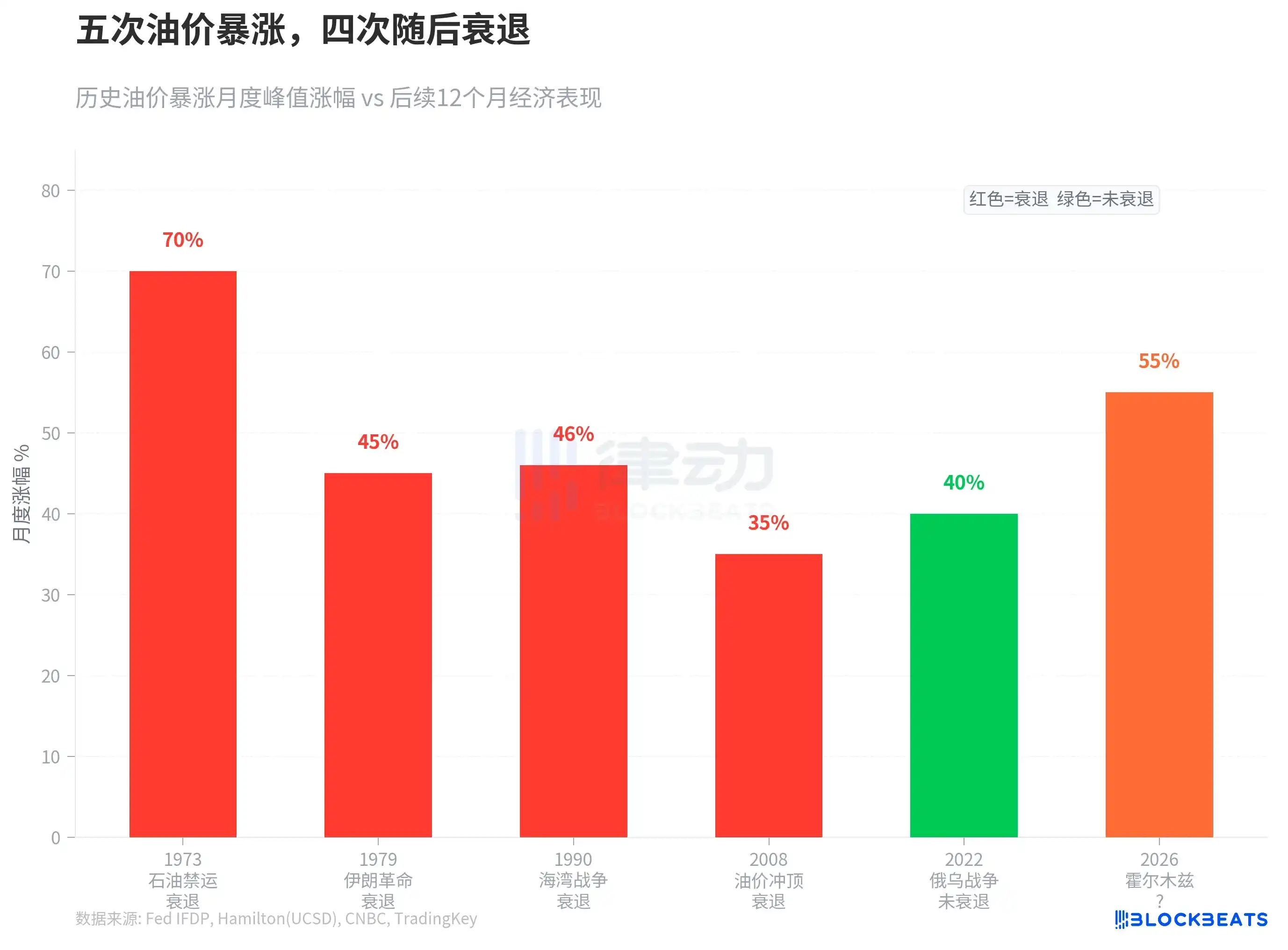
Over the past half-century, there have been five instances where oil prices surged more than 35% in a short period. During the 1973 oil embargo, U.S. GDP subsequently fell by 4.7%. The 1979 Iranian revolution caused global GDP to deviate from trend growth by 3 percentage points. The 1990 Gulf War led to a brief U.S. recession. In 2008, oil prices peaked at $147; although the primary cause of that recession was the financial crisis, the oil price shock accelerated the economic downturn. The only exception was the oil price surge driven by the 2022 Russia-Ukraine war, which did not trigger a recession but came at the cost of the most severe inflation in 40 years.

The surge in March 2026 exceeded all the above cases. According to research by Federal Reserve economist James Hamilton, there is no mechanical link between oil price shocks and recessions, but "the greater the net increase in oil prices, the more significant the suppression of consumption and investment." Goldman Sachs has raised the probability of a U.S. recession to 30%, while consulting firm EY-Parthenon puts the figure at 40%.

The market's reaction speed was also unusually fast.
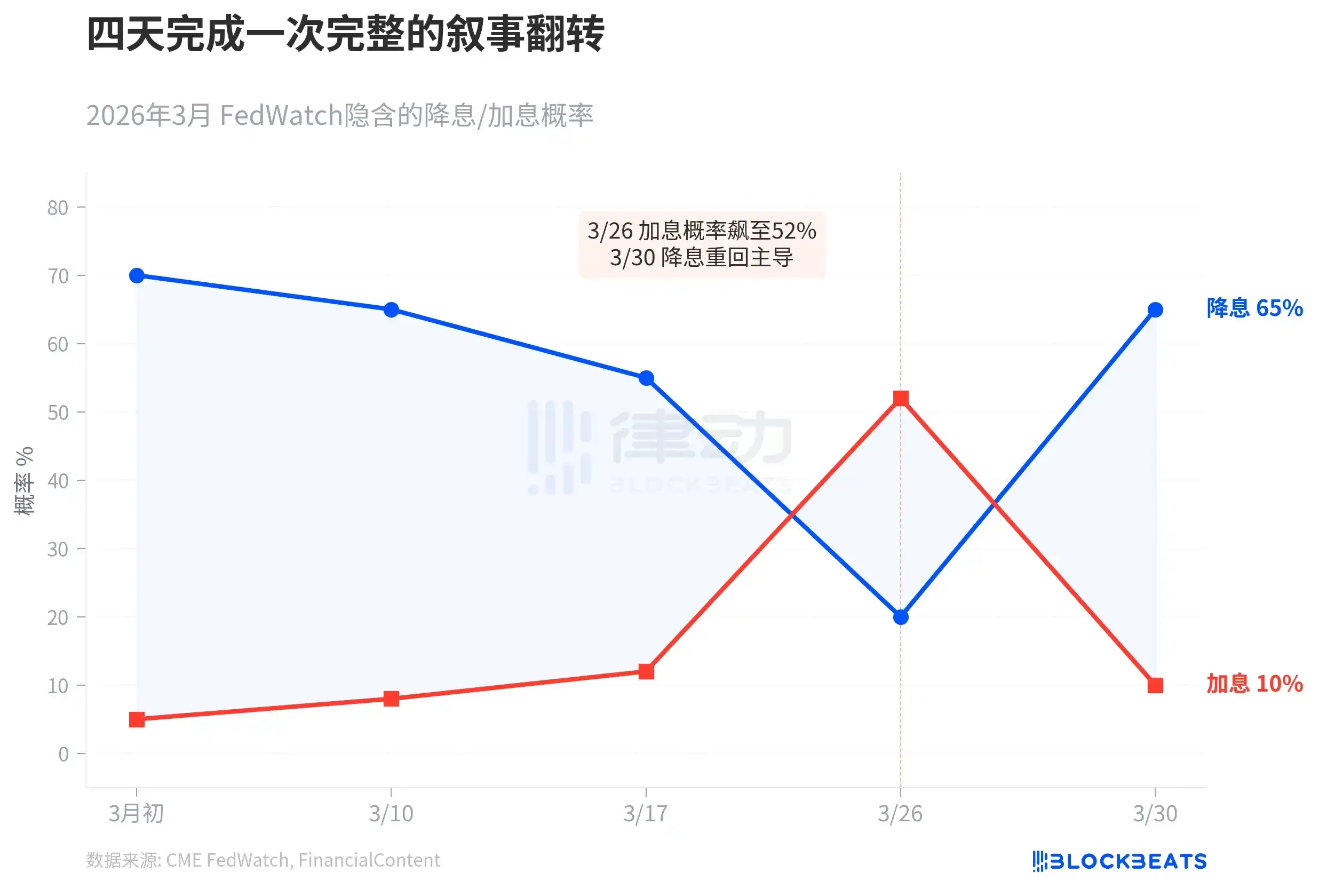
In early March, CME FedWatch showed the market expected three rate cuts for the year, with a 70% probability of a cut in June. Then, as oil prices continued to climb, the U.S. import price index jumped 1.3% on March 26, and incoming Fed Chair Kevin Warsh hinted that the neutral rate might be higher. That day, the probability of a rate hike within the year soared to 52%, and the 10-year yield touched 4.35%. FinancialContent defined this day as "The Great Hawkish Pivot."

Four days later, the narrative completely flipped. On March 30, consumer confidence data fell sharply, manufacturing unexpectedly contracted, and the 10-year yield plummeted to 3.92%. According to FinancialContent, market bets on a dovish pivot by the Fed in May rose to 65%. Goldman Sachs said the market had bet wrong on the direction of rate hikes. That same day, Powell told undergraduates at Harvard that the Fed "has not yet reached the moment where it must decide whether to look through the war shock," but emphasized that "the anchoring of inflation expectations is key."

According to Axios, Powell's remarks were interpreted by the market as: the Fed neither wants to raise rates to fight inflation nor is it in a hurry to cut rates to save the economy. Instead, it is waiting to see whether this supply shock is temporary or persistent. But the bond market can wait no longer.

If history is any guide, Citi strategist McCormick put it most bluntly: what lies ahead is stagflation, which is bad for bonds and bad for stocks.
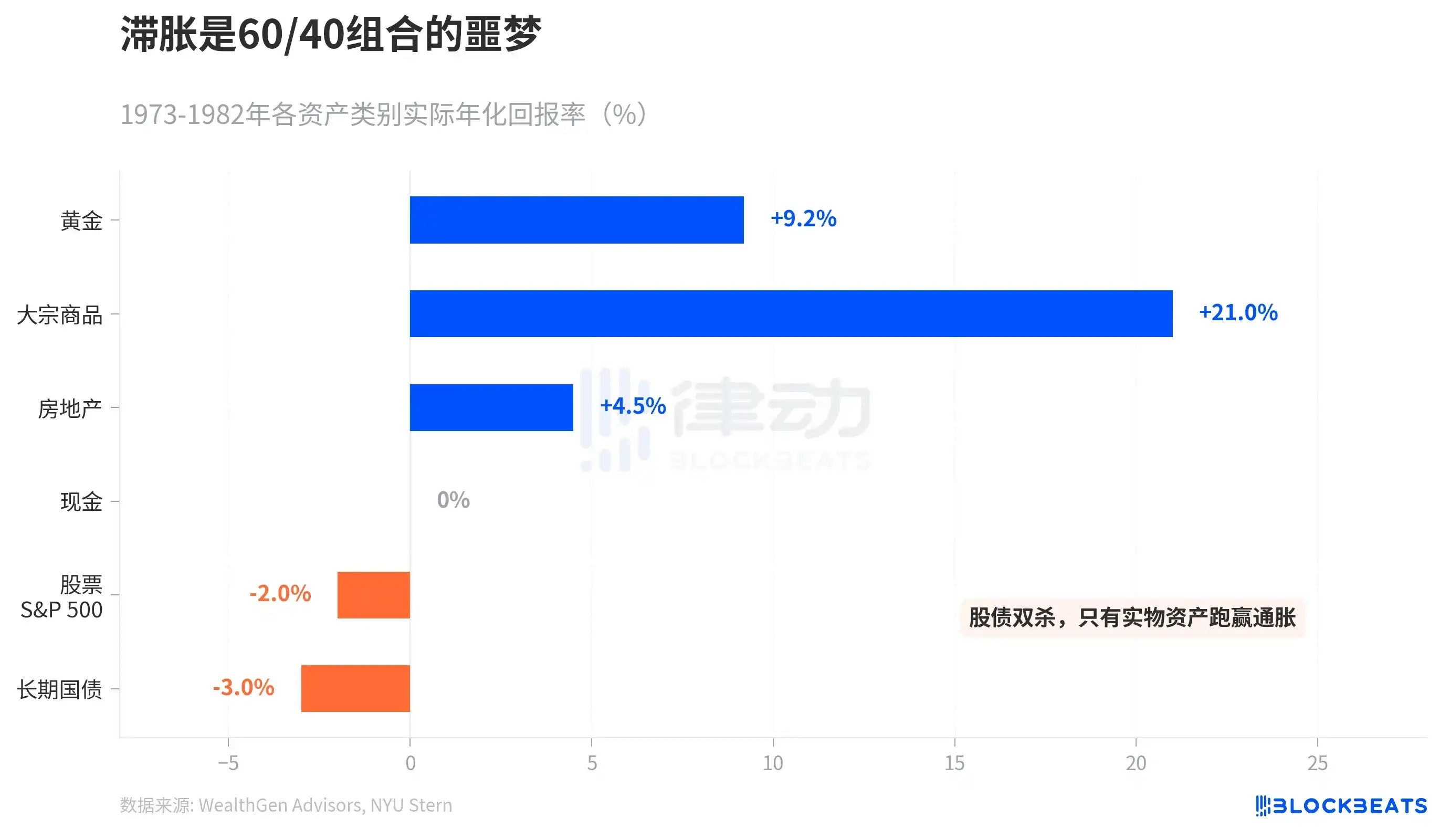
The Great Stagflation from 1973 to 1982 delivered a report card on asset returns. Gold delivered an actual annualized return of +9.2%, the commodities index (S&P GSCI) surged 586% over the decade, and real estate gained +4.5%. In contrast, the S&P 500's actual annualized return was -2%, and long-term Treasuries returned -3%. According to NYU Stern historical data, long-term Treasuries suffered a -8.6% loss in 1979 alone.

The traditional 60/40 investment portfolio (60% stocks + 40% bonds) was caught in a squeeze during stagflation. Only physical assets outperformed inflation. Société Générale predicts Brent will average $125 in April, with a "credible peak" of $150. Goldman Sachs is slightly more moderate, forecasting an April average of $115, but assuming the Strait of Hormuz reopens within six weeks, falling to $80 by year-end.

The bond market has already made a choice for everyone: between inflation and recession, it is betting on recession.


Preguntas relacionadas

QWhy did the 10-year Treasury yield fall sharply despite the surge in oil prices in late March 2026?

AThe bond market experienced a 'flight to safety', with growth risks (fear of recession) beginning to outweigh inflation risks, causing investors to rush into bonds and push yields down.

QWhat historical precedent suggests about the economic outcome following such a sharp oil price increase?

AHistorical cases (1973, 1979, 1990, 2008) show that sharp oil price surges of over 35% were often followed by economic recessions or significant slowdowns, with the exception of the 2022 Ukraine war spike which caused high inflation instead.

QHow did the market's expectation for Federal Reserve policy change dramatically within a few days?

AOn March 26, market pricing indicated a 52% probability of a rate hike due to inflation concerns, but by March 30, it had flipped to a 65% probability of a dovish pivot and rate cuts due to weak consumer confidence and manufacturing data.

QWhat is the potential worst-case macroeconomic scenario feared by the market, according to a Cit strategist?

ACit strategist McCormick stated that the worst-case scenario ahead is stagflation, which is bad for both bonds and stocks.

QWhich asset classes historically performed well during the 1973-1982 stagflation period, according to the article?

ADuring the 1973-1982 stagflation, gold delivered a +9.2% real annualized return, the S&P GSCI commodity index rose 586% cumulatively, and real estate returned +4.5%. In contrast, stocks and long-term bonds had negative real returns.

Lecturas Relacionadas

From South Korea to the United States: Blue-Collar Jobs Are Becoming Increasingly Popular, Thanks to AI

AI is reshaping the labor market's value proposition. The traditional four-year college degree is losing its appeal as a guaranteed career path, while skilled blue-collar trades like electricians, welders, and plumbers are experiencing historic demand and wage premiums. This shift is driven by dual pressures: AI's displacement of certain white-collar roles and a booming need for physical infrastructure and data center construction. Data confirms the trend. In the U.S., vocational school revenue surged, and a significant portion of recent layoffs are AI-related. Surveys show a majority of Gen Z adults plan to pursue blue-collar work, citing better job security against AI automation. Vocational education interest has exploded recently. Experts cite a psychological shift as younger generations seek tangible, AI-resistant careers and avoid high student debt. In many cases, salaries for skilled trades now match or exceed those requiring a bachelor's degree. In South Korea, semiconductor vocational high schools boast near-total employment, with graduates securing high-paying roles at companies like Samsung. The shortage is structural, exacerbated by a retiring baby boomer workforce and massive infrastructure projects. Companies like JPMorgan Chase, Meta, and Lowe's are investing heavily in training programs. However, overcoming historical stigma and a "perception gap" around trade careers remains a key challenge to closing the talent gap.

marsbitHace 36 min(s)

From South Korea to the United States: Blue-Collar Jobs Are Becoming Increasingly Popular, Thanks to AI

marsbitHace 36 min(s)

Qualcomm: AI Hype Subsides, When Will Smartphones Emerge from the Gloom?

Qualcomm reported its Q3 FY2026 results (ending June 2026), with revenue of $9.95B, down 4% YoY but above expectations. Gross margin declined to 53.1%, pressured by rising costs across manufacturing and memory. Key business segments showed mixed performance: Handset revenue fell 19.6% YoY to $5.09B, dragged by an 11% decline in non-Apple Android shipments and weaker high-end mix. Conversely, Automotive revenue surged 61% to $1.59B, and IoT grew 9% to $1.83B. Core operating profit dropped 41% YoY due to margin compression and higher expenses. Management's Q4 FY2026 guidance projects revenue of $9.7B-$10.5B, in line with consensus, but Non-GAAP EPS guidance of $2.05-$2.25 fell short of expectations. Amidst persistent weakness in its core handset market, Qualcomm is pursuing growth in AI, focusing on Edge AI (smartphones, PCs, automotive) and Data Center AI. Its data center strategy includes four pillars: AI accelerators (e.g., AI200), commercial CPUs (Dragonfly C1000), custom silicon, and connectivity solutions. While these initiatives initially boosted its stock, concerns over AI capital expenditure sustainability have since erased those gains. The company targets $5B in data center revenue for FY2027 and $15B for FY2029. The report concludes that with the traditional handset business still under pressure, the data center opportunity is currently viewed as a longer-term option, and a more conservative valuation based on core operations may be warranted until AI contributions materialize.

marsbitHace 41 min(s)

Qualcomm: AI Hype Subsides, When Will Smartphones Emerge from the Gloom?

marsbitHace 41 min(s)

From TPU to Self-Evolving Agents: How Jeff Dean Predicts the Next Step in AI

At the 2026 YC Startup School, Jeff Dean outlined his vision for AI's next phase, shifting focus from simply scaling models to building intelligent, autonomous systems. He believes AI's progress is no longer just about creating smarter models, but about integrating them into systems capable of long-term, iterative work, automated experimentation, and continuous learning. This evolution moves the competition from "who has the bigger model" to "who can best organize intelligence." Dean suggests AI capabilities are now comparable to a junior engineer, enabling the automation of complex workflows. However, the true challenge and opportunity lie in managing these AI "workers" at scale. He emphasizes the importance of **context engineering**—structuring tools, memory, and feedback loops—over raw model power. For startups, this means building deep expertise in niche domains where general models currently fail (near 0-1% success rates), leveraging proprietary data, specialized tools, and domain-specific evaluators. A recurring theme is re-examining fundamental constraints. Dean's past work, like moving Google's search index to memory or creating the TPU, stemmed from questioning outdated assumptions about hardware and cost. He sees similar inflection points today, particularly in **specialized inference hardware** to drastically reduce latency and energy consumption for real-time Agent operation. Notably, he points out that in modern AI systems, the dominant cost is often not computation but **data movement**. Reliable, long-running Agents require robust system design, borrowing concepts from distributed computing like checkpointing, state management, and parallel exploration to handle failures and maintain progress over days or weeks. As AI automates execution, the scarcest human skills will shift to **defining clear specifications**, **judging what problems are worth solving** (taste), and designing effective feedback loops. Ultimately, Dean's framework prioritizes understanding the problem deeply, identifying the true bottlenecks, and systematically building closed-loop systems where AI can not only perform tasks but also improve AI itself.

marsbitHace 41 min(s)

From TPU to Self-Evolving Agents: How Jeff Dean Predicts the Next Step in AI

marsbitHace 41 min(s)

Trading

Spot
活动图片




