SNZ–NTU CCTF Releases "Top 10 Blockchain Industry Trends for 2026"

marsbitPublicado a 2026-02-16Actualizado a 2026-02-16

Resumen

SNZ Holding and Nanyang Technological University's Computational Finance Centre (NTU-CCTF) have jointly released the "Top 10 Blockchain Industry Trends for 2026." The report highlights the ongoing transformation of Web3 from speculative experimentation into verifiable financial infrastructure. Key trends include the maturation of Real-World Assets (RWA) into composable DeFi instruments, the growing role of stablecoins in global payments, and the adoption of smart accounts and intent-based execution to improve user experience. Zero-knowledge proofs are evolving from privacy tools to foundational infrastructure for verifiable computation, while shared security and restaking are redefining security as a tradable economic resource. Other significant developments include progress in privacy-compliance engineering, DePIN networks shifting from incentive-driven models to verifiable systems, decentralized AI moving from hype to practical implementation, and token governance focusing on institutional accountability rather than mere voting procedures. The report aims to serve as a practical and forward-looking guide for industry builders, researchers, and decision-makers.

On New Year's Eve, as we bid farewell to the old and welcome the new, we are delighted to share the "Top 10 Blockchain Industry Trends for 2026," jointly produced by the SNZ Holding research team and the Nanyang Technological University Centre for Computational Finance (NTU-CCTF) in Singapore. The report is now officially released! (Read the full report)
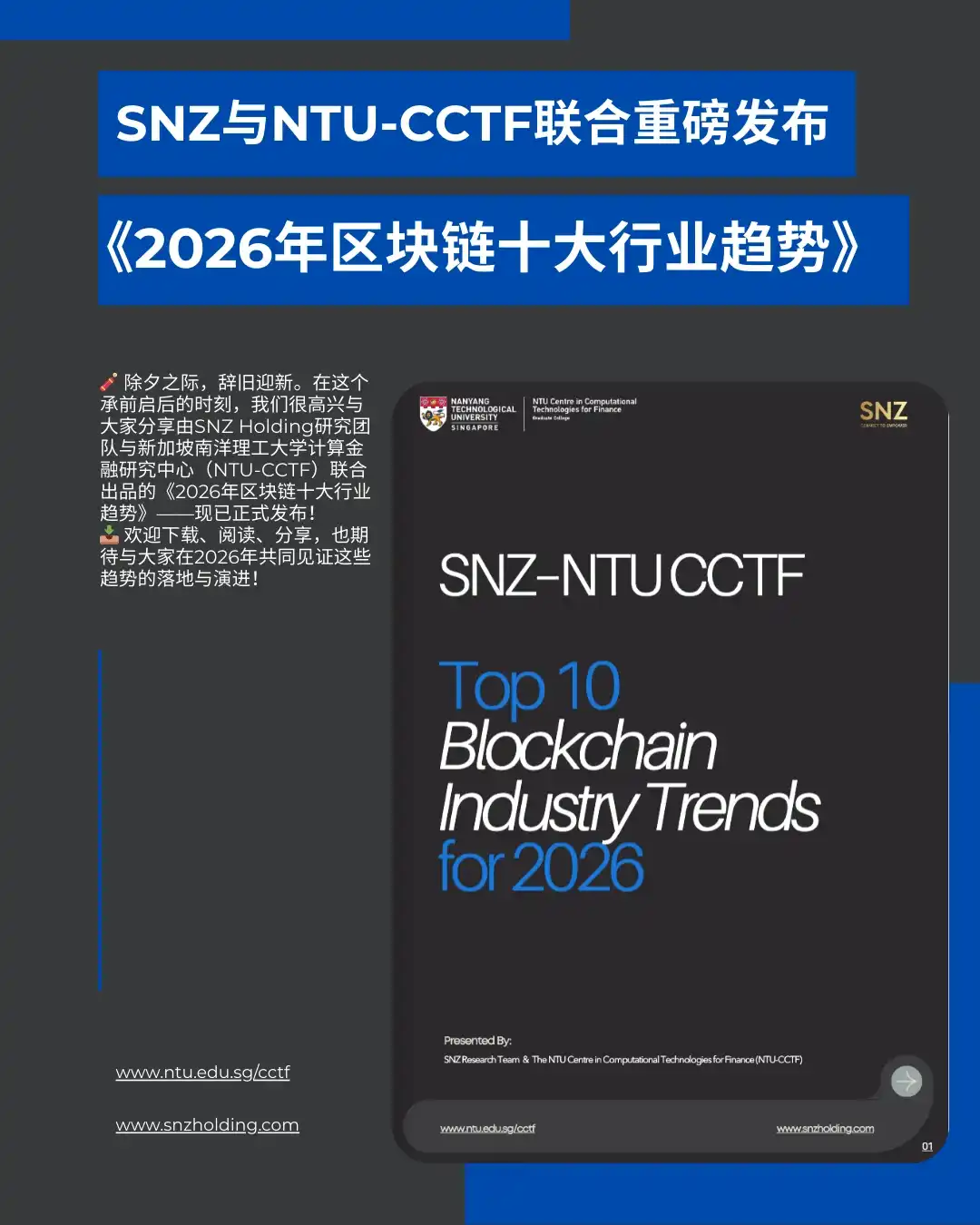
Looking back from the beginning of 2026, Web3 is undergoing a profound transformation: evolving from early speculative experiments to verifiable financial infrastructure. Stablecoins are no longer just units of account in the crypto market but are widely discussed as a settlement layer for global payments; RWA assets have moved beyond the pilot stage to become composable financial instruments in DeFi; technologies such as smart accounts, intent-based execution, and zero-knowledge proofs are bringing on-chain interactions into the mainstream user experience as expected.

Based on a systematic review of technological advancements, market dynamics, and cutting-edge academic research, we have distilled the top ten trends most worth watching in 2026:

1. On-chain Treasury Bonds and Cash Management: RWA Transitions from Concept to Product;

2. Stablecoins: The New Focus of Global Payments in 2026;

3. The Era of Smart Accounts: Returning On-Chain Interactions to Everyday User Experience;

4. From "Manual Transaction Construction" to "Goal-Based Execution + Backend Bidding";

5. Zero-Knowledge Proofs: From Privacy Features to Verifiable Computing Infrastructure;

6. Privacy and Compliance: From Trade-offs to Verifiable Engineering Balance;

7. Shared Security and Restaking: Redefining Security Budgets as Tradable Economic Resources;

8. DePIN Networks: From Incentive-Driven Narratives to Verifiable Engineering;

9. Decentralized AI: From Narrative Hype to Engineering Practice;

10. Token Governance: Returning from Voting Procedures to Institutionalized Design of Rights and Responsibilities.

This report combines SNZ Holding's industry insights in the Web3 space with NTU-CCTF's academic research, aiming to provide a forward-looking and practical reference guide for industry builders, researchers, and decision-makers.

We welcome you to download, read, and share the report, and we look forward to witnessing the implementation and evolution of these trends together in 2026! Happy New Year's Eve, and may the Year of the Bingwu bring new joy!

Preguntas relacionadas

QWhat is the main focus of the 'Top 10 Blockchain Industry Trends for 2026' report published by SNZ Holding and NTU-CCTF?

AThe report focuses on the transformation of Web3 from early speculative experiments to verifiable financial infrastructure, highlighting key trends such as stablecoins, RWA, smart accounts, zero-knowledge proofs, and decentralized AI.

QWhich trend in the report discusses the evolution of Real World Assets (RWA) in the blockchain space?

AThe trend 'On-chain Treasury and Cash Management: RWA from Concept to Product' discusses RWA moving out of the pilot phase and becoming composable financial tools in DeFi.

QHow does the report describe the role of stablecoins in 2026?

AThe report describes stablecoins as no longer just a unit of account in crypto markets but as a widely discussed settlement layer for global payments.

QWhat technological advancements are mentioned as improving the mainstream user experience in blockchain interactions?

ASmart accounts, intent-based execution, and zero-knowledge proofs are mentioned as technologies bringing on-chain interactions into the mainstream user experience.

QWhich trend emphasizes a shift from voting procedures to institutionalized design of responsibilities in token governance?

AThe trend 'Token Governance: From Voting Procedures to Institutionalized Design of Responsibilities' emphasizes this shift.

Lecturas Relacionadas

9.42 Million Retail Investors Compete for Changxin Technology, Who Got Allotted?

Evergreen Technology's IPO subscription results are now available. On July 20, the domestic memory chip giant announced the offline preliminary allotment results and online lottery results for its IPO. A total of approximately 9.43 million retail investors participated in the online subscription, generating 770,000 winning lots with a final winning rate of about 0.4714%, setting a record for new shares on the STAR Market. After triggering a clawback mechanism from institutional to retail investors, the online retail allocation was significantly increased to 3.851 billion shares. Simultaneously, 285 institutional investors participated in the offline subscription, ultimately receiving 2.173 billion shares at an allotment rate of approximately 0.1756%. Leading insurers and public funds were among the major recipients. Notably, Liang Wenfeng, founder of the major AI model company DeepSeek, through his quantitative investment firms Ningbo Huanfang Quantitative and Zhejiang Jiuzhang Asset, secured the largest share among private funds, with a total allotment worth approximately 175 million yuan. Estimates suggest potential profits could reach 730 million yuan if Evergreen Technology's market capitalization reaches 3 trillion yuan post-listing. The company is expected to list on July 27 and could become the highest-valued tech stock on the A-share market, with various brokerages providing valuations ranging from 1 trillion to over 4 trillion yuan. However, recent significant corrections in global tech stocks may impact its post-listing performance. (Character count: 1,196)

marsbitHace 46 min(s)

9.42 Million Retail Investors Compete for Changxin Technology, Who Got Allotted?

marsbitHace 46 min(s)

L2 'Recalibration': When L1 Becomes Its Own Rollup, What Is Ethereum's Endgame?

The article discusses the evolving relationship between Ethereum's Layer 1 (L1) and Layer 2 (L2) solutions, moving beyond the initial "L2 for scaling" model. As Ethereum L1 itself scales (increasing Gas Limit, statelessness, zkEVM), the unique value proposition of L2s shifts from merely providing cheap execution to offering differentiated features like application-specific optimization, privacy, and flexible governance. The piece explores three key themes: 1. **L2's New Role:** L2s are transitioning from a pure scaling technology to a spectrum of execution environments with varying degrees of security inheritance from Ethereum L1. 2. **Interoperability as State Trust:** Solving L2 fragmentation is less about cross-chain bridges and more about enabling faster, trust-minimized state verification between environments. This involves initiatives like faster L1 finality, intent-based architectures (Open Intents Framework), and native account abstraction. 3. **Blurring Layers:** With the potential integration of zk-proofs into L1 validation (making L1 akin to its own "Rollup") and the concept of "Native Rollups," the rigid boundary between L1 and L2 may fade. The future could be a unified system with multiple execution domains (for DeFi, gaming, privacy, etc.) sharing a common security, settlement, and state framework. In conclusion, Ethereum's goal is not to abandon L2s or re-centralize everything on L1, but to re-integrate the fragmented user experience—liquidity, accounts, applications—while preserving the scaling benefits of a multi-environment ecosystem. The endgame is a cohesive "one chain" feeling for users, powered by diverse but securely interconnected execution layers.

marsbitHace 1 hora(s)

L2 'Recalibration': When L1 Becomes Its Own Rollup, What Is Ethereum's Endgame?

marsbitHace 1 hora(s)

Trading

Spot
活动图片




