Snap, Unprofitable for Nine Years, and a Decade-Long AR Obsession Without Return

marsbitPublicado a 2026-06-22Actualizado a 2026-06-22

Resumen

Snap's AR Obsession: A Decade of Betting Against the Odds On June 16, Snap CEO Evan Spiegel unveiled the new AR glasses, Specs, priced at $2,195, causing the company's stock (SNAP) to plummet nearly 10%. The launch was met with intense criticism online, with investors questioning why a consistently unprofitable company would stake its future on an expensive product its core young user base can't afford. Snapchat, known for pioneering features like ephemeral Stories and popular AR lenses (like the iconic dog filter), has a history of innovation often copied by rivals like Instagram and Meta. Despite this, it has struggled to translate first-mover advantage into commercial success. Since its 2017 IPO, Snap has reported annual net losses, with a Q1 2026 loss of $89 million. Its stock is down 94% from its 2021 peak, hampered by iOS privacy changes, competition, and a young demographic less attractive to major advertisers. In this challenging context, Spiegel is doubling down on AR. He calls 2026 a "crucible moment," having recently laid off 16% of staff while reportedly investing over $3.5 billion cumulatively in its AR glasses line over nearly a decade. The new Specs represent a significant leap from the 2016 camera-focused Spectacles, offering true AR overlays, gesture control, and standalone operation. However, at $2,195, it faces tough comparisons. While more advanced than Meta's $799 Ray-Ban smart glasses, critics point to its heavier weight, short battery life, and featu...

Author: June, Deep Tide TechFlow

On June 16th, Snap CEO Evan Spiegel officially launched the AR glasses 'Specs' at the Augmented Reality World Expo, priced at $2,195.

On the day of the announcement, SNAP's stock price plummeted nearly 10%, closing at $5.16.

Soon, a popular post appeared on the famous Reddit retail investor community r/wallstreetbets:
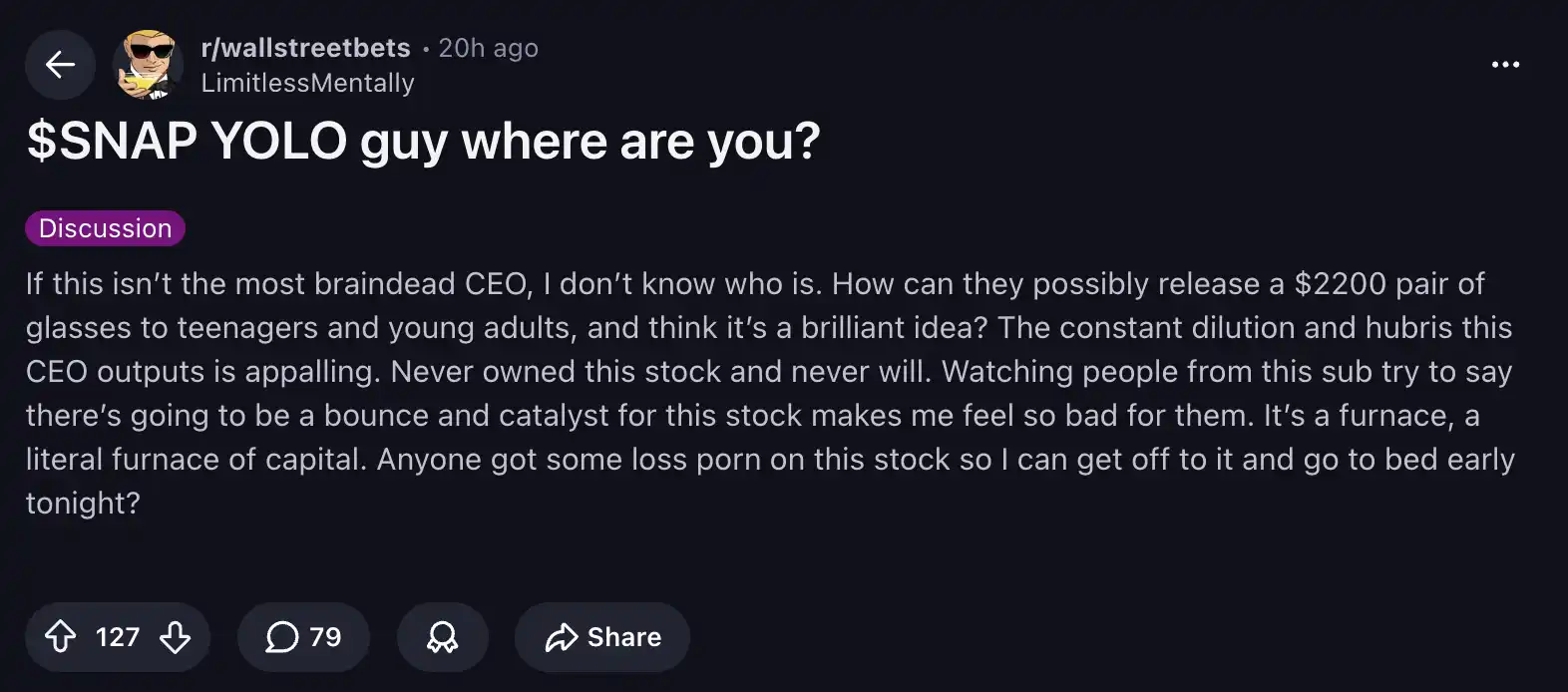
The poster called the CEO "brain-dead," compared the company to a "capital furnace," and even asked for someone to post some "pictures of miserable losses" to help him sleep soundly.

He voiced the most direct question for the entire market: How can a company with years of losses stake its turnaround on a pair of glasses that young people can't even afford?

A Product You Might Not Have Used, But Have Certainly Seen

Talking about Snapchat, friends in China might not be very familiar, but you've probably seen this once wildly popular "dog filter":

That virtual puppy sticking out its tongue, with ears moving with the head, was one of the most viral among the Lenses (AR filters) launched by Snapchat in 2015.

The real-time facial tracking technology behind it came from Looksery, a Ukrainian startup acquired by Snap for approximately $150 million that same year. This was the largest acquisition deal in Ukraine's tech history at the time, but the one that truly turned this technology into a global phenomenon, making it a plaything imitated by celebrities and ordinary users alike, was Snapchat.

A Pioneer Repeatedly Copied

To some extent, looking back at Snapchat's history, it reads more like a "history of being copied."

Its pioneering ephemeral Stories feature was almost copied verbatim by Instagram, and now almost every social app has it; its camera-first interface and left-right swipe navigation were adopted by the entire industry for nearly a decade; even its early bet on AR glasses was beaten to the market as a hit product by Meta's Ray-Ban smart glasses.

Time and again, Snapchat stood at the technological forefront but consistently failed to turn "first-mover advantage" into "commercial victory."

This is also evident from its stock performance.

From its all-time high of $83.34 in September 2021, SNAP has plunged by 94% over the past five years, starkly contrasting with the record-breaking U.S. stock market during the same period.

2021 happened to be the peak of the pandemic's benefits but also a turning point. That same year, Apple tightened iOS privacy tracking permissions, directly crippling Snap's core advertising targeting capabilities. In the following years, TikTok and Instagram rose strongly, while Snap, with its persistently weak profitability, never saw its stock price return to its former levels.

Back to the popular post mentioned at the beginning.

Why did Snap's stock price drop immediately after announcing a new product, and why were these AR glasses almost universally ridiculed on X and Reddit?

First, we have to mention its core user base. Snapchat's main users are Gen Z, aged 18 to 24. Selling a $2,195 pair of glasses to a group of young people who largely can't afford them is clearly unrealistic.

Placing it within the context of its peers makes this dilemma clearer.
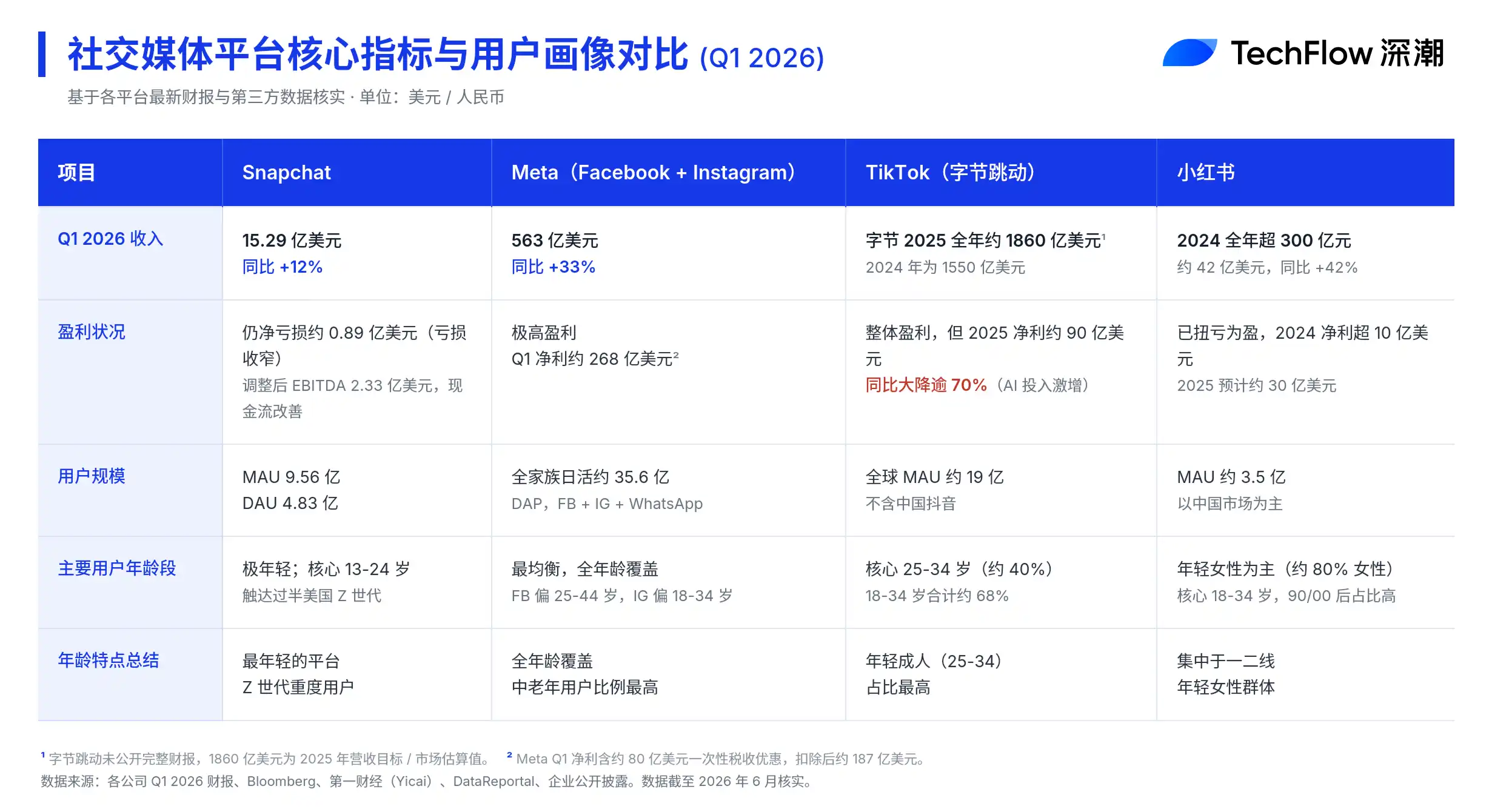
Also in content and social networking, Meta generates $56.3 billion in revenue and nearly $27 billion in net profit per quarter; ByteDance and Xiaohongshu are also already profitable.

Snapchat alone, despite growing users and revenue, still reported a net loss of $89 million in the first quarter of 2026. It has reported annual net losses every year since its IPO in 2017. The root cause is that young users are not advertisers' most favored demographic; brands prefer to allocate budgets to the main consumer group aged 25 to 45.

Youth, ironically, has become Snap's monetization burden.

A Nearly Decade-Long AR Gamble

In such a predicament, Spiegel chose to double down.

He called 2026 the company's "crucible moment." In April this year, Snap laid off about 1,000 employees, 16% of its workforce, citing AI's ability to handle a large amount of repetitive work.

Simultaneously, the company has accumulated investments exceeding $3.5 billion in the Specs AR glasses product line. Counting from the first-generation Spectacles in 2016, this high-stakes gamble has lasted nearly a decade.

To see how far this decade has taken them, we must go back to that first-generation pair of glasses.

Image: The first-generation glasses from 2016

Launched in September and released in November that year, it was a pair of iconic bright yellow glasses sold via street vending machines, with a camera embedded in the frame. Strictly speaking, it wasn't truly AR; wearing it, you could only record a short circular video hands-free and share it on Snapchat. Essentially, it was more like a fun toy worn on your face.
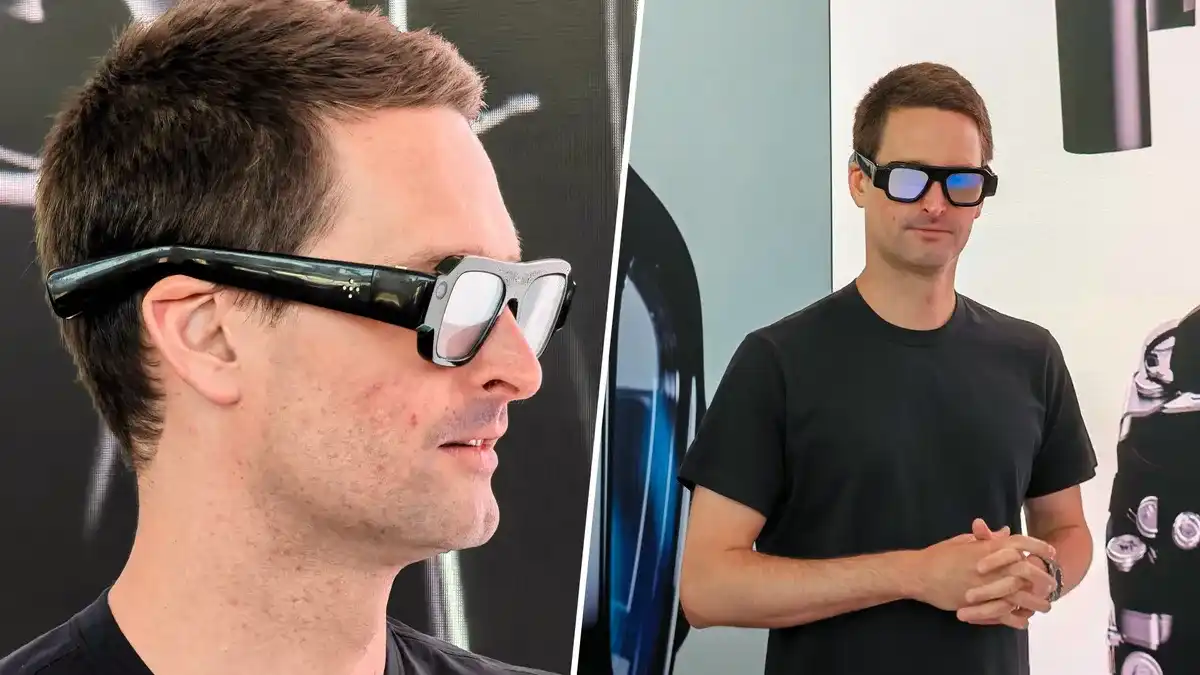
Image: Specs launched in 2026

Ten years later, Specs can overlay digital information onto real-world scenes, run AI functions, recognize gestures, and operate independently of a phone. From "glasses for recording videos" to "a spatial computer worn on the face," this is a leap spanning a decade, and it's what Spiegel truly wants to bet on.

In this whole event, what truly made investors collectively furious was the pricing, widely considered outrageous.
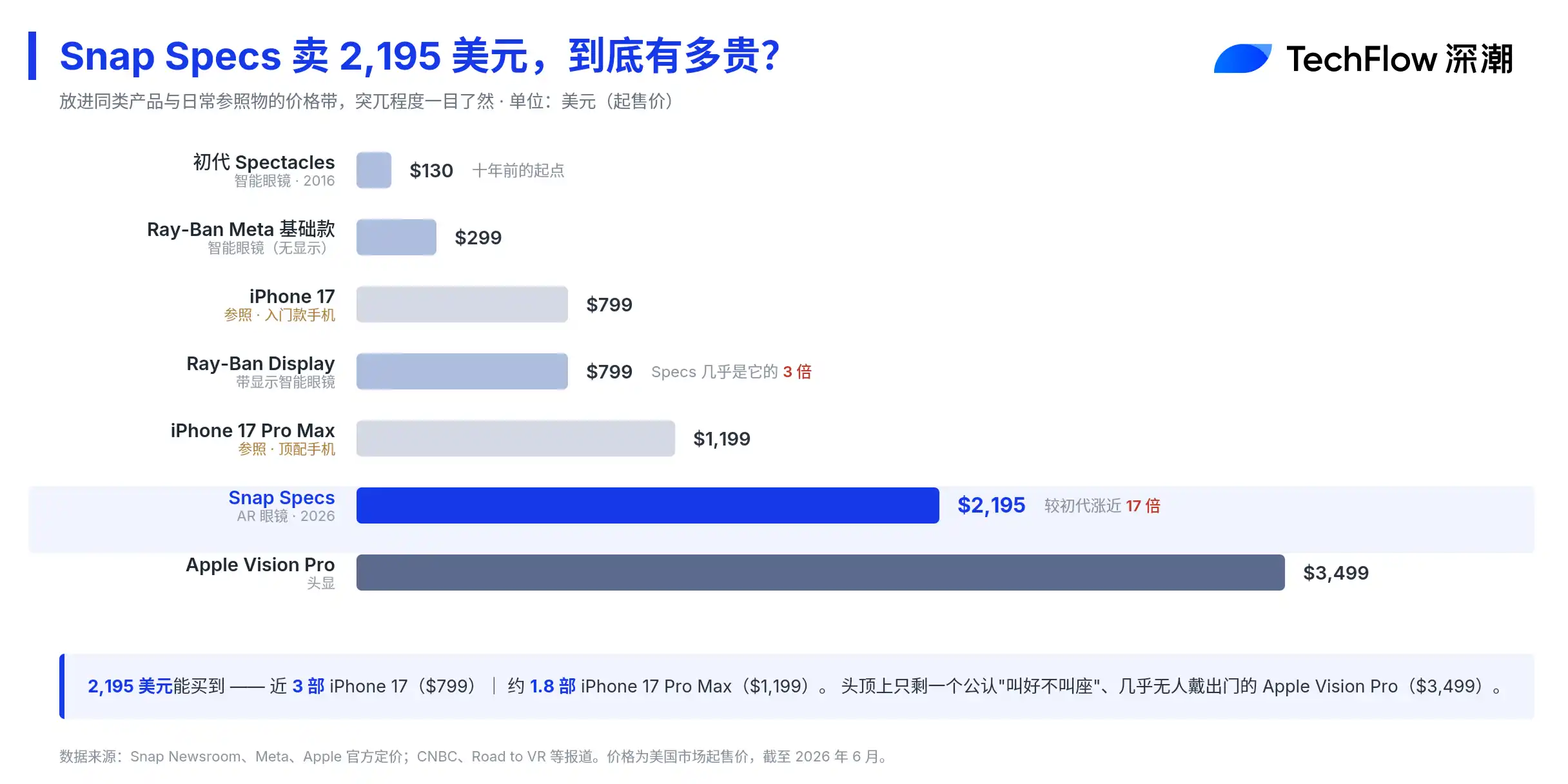
The question is, what do you get for the extra money?

Compared to the $799 Ray-Ban Display, which only has a small HUD crammed into a corner of the lens, Specs is true AR, capable of overlaying digital content into reality, recognizing gestures, and running independently of a phone. Functionally, it is indeed a tier higher.

But it weighs about 132 grams (almost twice as heavy as the former), has a battery life of only about 4 hours, and its main features—navigation, measurement, AI queries—are things a phone can already do. The $2,195 buys a "category leap," but not necessarily a mature product that fits into daily life. This might be the real source of investor unease.

When activist investor Irenic Capital publicly pressured the company to shut down or spin off the Specs division to preserve cash flow, Spiegel publicly refused, insisting on viewing it as part of the company's long-term model.

Cutting costs by laying off people on one hand, while heavily betting on a vision that hasn't seen a return in a decade on the other.

This is Snapchat's most realistic portrayal at the moment.

Ending

In 2015, Snapchat captivated the world with an AR filter like a virtual puppy; eleven years later today, its heavily-backed AR glasses are almost universally dismissed.

However, not everyone views it as a farce.

Some view it through the lens of mobile phone evolution. From the brick-like "brick phones" to today's smartphones, that path took over thirty years. The currently expensive and heavy Specs might just be an awkward, necessary step before AR glasses mature.

But in an era that generally chases short-term returns and follows the herd, is a persistent entrepreneur like Spiegel a rare anomaly in the industry, or a gambler destined to be eliminated by the market?

This question might be worth answering for every observer themselves.

Preguntas relacionadas

QWhy did Snap's stock price drop significantly after the announcement of Specs?

ASnap's stock price dropped nearly 10% on the day the new AR glasses, Specs, were announced due to investor skepticism. The main concerns were the product's high price point of $2,195, which is unaffordable for Snap's core young user base, and doubts about whether the advanced AR features justified the cost when compared to more affordable alternatives like Meta's Ray-Ban glasses. Investors also questioned the wisdom of a consistently unprofitable company making such a large bet on an unproven, high-cost hardware product.

QWhat is the main challenge Snap faces in monetizing its user base?

ASnap's primary challenge in monetization stems from its core demographic: users aged 18-24 (Generation Z). While the platform is popular with this group, they are not the most favored demographic for advertisers, who prefer to target the 25-45 age range, which has higher disposable income. This 'youthful' user base has become a commercial burden, contributing to the company's ongoing annual net losses since its IPO in 2017.

QWhat technological evolution does Specs represent compared to Snap's first-generation Spectacles?

ASpecs represents a significant technological leap from the 2016 Spectacles. The original version was essentially a camera on glasses, allowing users to record short circular videos. In contrast, the new Specs are a true AR device. They can overlay digital information onto the real world, run AI functions, recognize gestures, and operate independently without a phone. This evolution marks a shift from a 'video-recording toy' to what CEO Evan Spiegel envisions as a 'spatial computer for your face.'

QHow has the competitive landscape and external factors contributed to Snap's financial struggles?

ASnap's financial struggles have been exacerbated by intense competition and external policy changes. Key competitors like Instagram and TikTok have copied its innovative features (like Stories) and captured market share. Furthermore, Apple's 2021 privacy policy update, which restricted ad tracking on iOS, severely damaged Snap's targeted advertising capabilities—a core part of its revenue model. These factors, combined with its inherent monetization challenges, have prevented Snap from regaining its 2021 stock price peak.

QWhat is the central dilemma or 'crucible moment' facing Snap and its CEO as described in the article?

AThe central dilemma, termed the 'crucible moment,' is the conflict between immediate financial pressure and long-term vision. CEO Evan Spiegel is simultaneously cutting costs (laying off 10% of the workforce) and doubling down on a massive, decade-long investment in AR hardware (over $3.5 billion for Specs) that has yet to show a return. He faces pressure from investors to abandon this costly bet to preserve cash but refuses, insisting that AR is fundamental to the company's long-term future. This positions him as either a rare visionary or a stubborn gambler in the eyes of the market.

Lecturas Relacionadas

Farewell to Speculation: The Graham Moment of the Crypto Industry

"Farewell to Speculation: The Graham Moment for the Crypto Industry" The article draws a parallel between today's cryptocurrency market and the speculative, unregulated US stock market of the 1920s. That era lacked mandatory corporate disclosure, enabling rampant manipulation and turning stocks into gambling tools. The 1929 crash led to foundational reforms: the Securities Acts of 1933/34 mandated transparent, audited financial reporting, and Benjamin Graham's "Security Analysis" provided a framework for fundamental valuation. Together, they created modern investing, requiring both reliable data and a methodology to value assets. Similarly, the crypto market is currently driven by narratives and speculation. However, it possesses a key advantage: unlike 1920s corporations, blockchain protocols have inherently transparent, on-chain data for revenue, treasury, and activity. The core obstacle is not transparency, but the lack of legal claim to that value. Due to regulatory uncertainty (primarily the Howey Test), most tokens are deliberately stripped of economic rights like profit-sharing to avoid being classified as securities. This creates a paradox where protocols generate revenue, but token holders have no right to it. The turning point, argues the author, is imminent US legislation. The already-passed GENIUS Act provides a framework for stablecoins. The crucial CLARITY Act, currently in advanced legislative stages, aims to clearly categorize digital assets and define their regulatory treatment (SEC vs. CFTC). This would allow developers to legally design tokens with enforceable economic rights, such as profit distribution. If passed, this would enable a shift from speculation to fundamental investment. Analysis would focus on protocol revenue sustainability, network effects, valuation multiples, and the specific rights encoded in a token's contract—mirroring traditional equity analysis. The article notes significant legislative hurdles and timelines (1-3 years for rulemaking post-passage), but emphasizes the direction is set. A deeper challenge remains: building decentralized, legally enforceable governance and ownership structures to protect token holder rights, akin to corporate law. This will be a core development focus. The transformation applies mainly to revenue-generating protocol tokens, not to assets like Bitcoin (digital gold). The article concludes that the industry's question has evolved from "can tokens create value?" to "who gets to allocate that value?". Solving the latter, as in the 1920s, will mark crypto's transition to a legitimate asset class for fundamental investment.

Foresight NewsHace 9 min(s)

Farewell to Speculation: The Graham Moment of the Crypto Industry

Foresight NewsHace 9 min(s)

Quantum Computing "Manhattan Project" Unveiled: Is the Encryption Industry at a Critical Turning Point?

"Quantum Computing 'Manhattan Project' Launched: Is the Crypto Industry at a Critical Juncture?" On June 22, former U.S. President Donald Trump signed two executive orders. The first mandates all federal agencies upgrade their cryptographic systems to new, quantum-resistant standards by 2030. The second orders the Department of Energy to lead the development of a national quantum computer, signaling a shift from laboratory research to a state-enforced national agenda. This creates a hard deadline. A powerful quantum computer could break current encryption. The threat is compounded by "harvest now, decrypt later" attacks, where encrypted data is stored today for future decryption. Federal agencies must appoint migration officers and complete post-quantum cryptography (PQC) upgrades for key establishment by 2030 and digital signatures by 2031. Procurement rules will also be changed, forcing government contractors to comply. The crypto industry faces a direct threat. Bitcoin's ECDSA signatures are theoretically vulnerable. Research indicates millions of Bitcoin with exposed public keys are at risk if quantum computers advance. While projects like Bitcoin Quantum testnets and efforts by Ethereum, Solana, NEAR, and Zcash are exploring quantum-resistant solutions, achieving consensus in decentralized networks remains a major challenge. The centralized U.S. government has started a 5-year countdown. For decentralized crypto networks, the real test is whether they can complete this anti-quantum upgrade before the theoretical threat becomes a practical reality.

Foresight NewsHace 30 min(s)

Quantum Computing "Manhattan Project" Unveiled: Is the Encryption Industry at a Critical Turning Point?

Foresight NewsHace 30 min(s)

Coin Stock Barometer丨BitMine's Total Assets and Investment Reach $10.7 Billion, Exceeding ~$9.3 Billion Floating Loss; Strategy Buys Only 520 BTC, Strive Adds Positions Against the Trend (June 23)

This article provides a weekly market update on "coin-equity" trends, focusing on listed companies holding major cryptocurrencies. Key highlights include: **General Market Trends:** Global equities, particularly in the US, Japan, and South Korea, faced significant sell-offs, led by large tech and AI-related stocks. Analysts cite profit-taking and a shift from hype-driven to performance-driven valuation for AI companies. Market focus is on upcoming Micron Technology's earnings. **Cryptocurrency Treasury Updates:** * **Bitcoin (BTC):** Net weekly BTC purchases by listed companies (excluding miners) totaled approximately $86 million, down 13.97% from the prior week. Strategy (formerly MicroStrategy) purchased only 520 BTC for ~$34.9 million, while Strive Asset Management increased its holdings by 759 BTC for ~$50 million. Other notable actions include Mara Holdings adding 1,000 BTC and Capital B shareholders approving a massive financing plan (up to ~$1.2 trillion) to potentially expand its Bitcoin reserves. * **Ethereum (ETH):** BitMine emerged as the largest corporate ETH treasury, holding 5.67 million ETH (4.7% of supply). It purchased an additional 52,203 ETH ($92 million) in the past week. Sharplink completed a $75 million private placement to fund further ETH accumulation and stock buybacks. * **Solana (SOL):** The top five listed companies hold over 15.7 million SOL combined. However, Solmate Infrastructure, a SOL treasury firm, faces a lawsuit from its largest external shareholder alleging board misconduct and self-dealing. * **Other:** Updates include Canton Strategic's $50 million stock buyback plan and Lite Strategy's $1 million strategic investment in LitVM, a Layer-2 network for Litecoin. The article notes that while crypto treasury firms continue fundraising and accumulation, their stocks may struggle to rise against the broader market downturn until Q4.

marsbitHace 44 min(s)

Coin Stock Barometer丨BitMine's Total Assets and Investment Reach $10.7 Billion, Exceeding ~$9.3 Billion Floating Loss; Strategy Buys Only 520 BTC, Strive Adds Positions Against the Trend (June 23)

marsbitHace 44 min(s)

Trading

Spot
Futuros
活动图片