Snap, Unprofitable for Nine Years, and a Decade-Long AR Obsession Without Return

marsbitPublicado a 2026-06-22Actualizado a 2026-06-22

Resumen

Snap's AR Obsession: A Decade of Betting Against the Odds On June 16, Snap CEO Evan Spiegel unveiled the new AR glasses, Specs, priced at $2,195, causing the company's stock (SNAP) to plummet nearly 10%. The launch was met with intense criticism online, with investors questioning why a consistently unprofitable company would stake its future on an expensive product its core young user base can't afford. Snapchat, known for pioneering features like ephemeral Stories and popular AR lenses (like the iconic dog filter), has a history of innovation often copied by rivals like Instagram and Meta. Despite this, it has struggled to translate first-mover advantage into commercial success. Since its 2017 IPO, Snap has reported annual net losses, with a Q1 2026 loss of $89 million. Its stock is down 94% from its 2021 peak, hampered by iOS privacy changes, competition, and a young demographic less attractive to major advertisers. In this challenging context, Spiegel is doubling down on AR. He calls 2026 a "crucible moment," having recently laid off 16% of staff while reportedly investing over $3.5 billion cumulatively in its AR glasses line over nearly a decade. The new Specs represent a significant leap from the 2016 camera-focused Spectacles, offering true AR overlays, gesture control, and standalone operation. However, at $2,195, it faces tough comparisons. While more advanced than Meta's $799 Ray-Ban smart glasses, critics point to its heavier weight, short battery life, and featu...

Author: June, Deep Tide TechFlow

On June 16th, Snap CEO Evan Spiegel officially launched the AR glasses 'Specs' at the Augmented Reality World Expo, priced at $2,195.

On the day of the announcement, SNAP's stock price plummeted nearly 10%, closing at $5.16.

Soon, a popular post appeared on the famous Reddit retail investor community r/wallstreetbets:
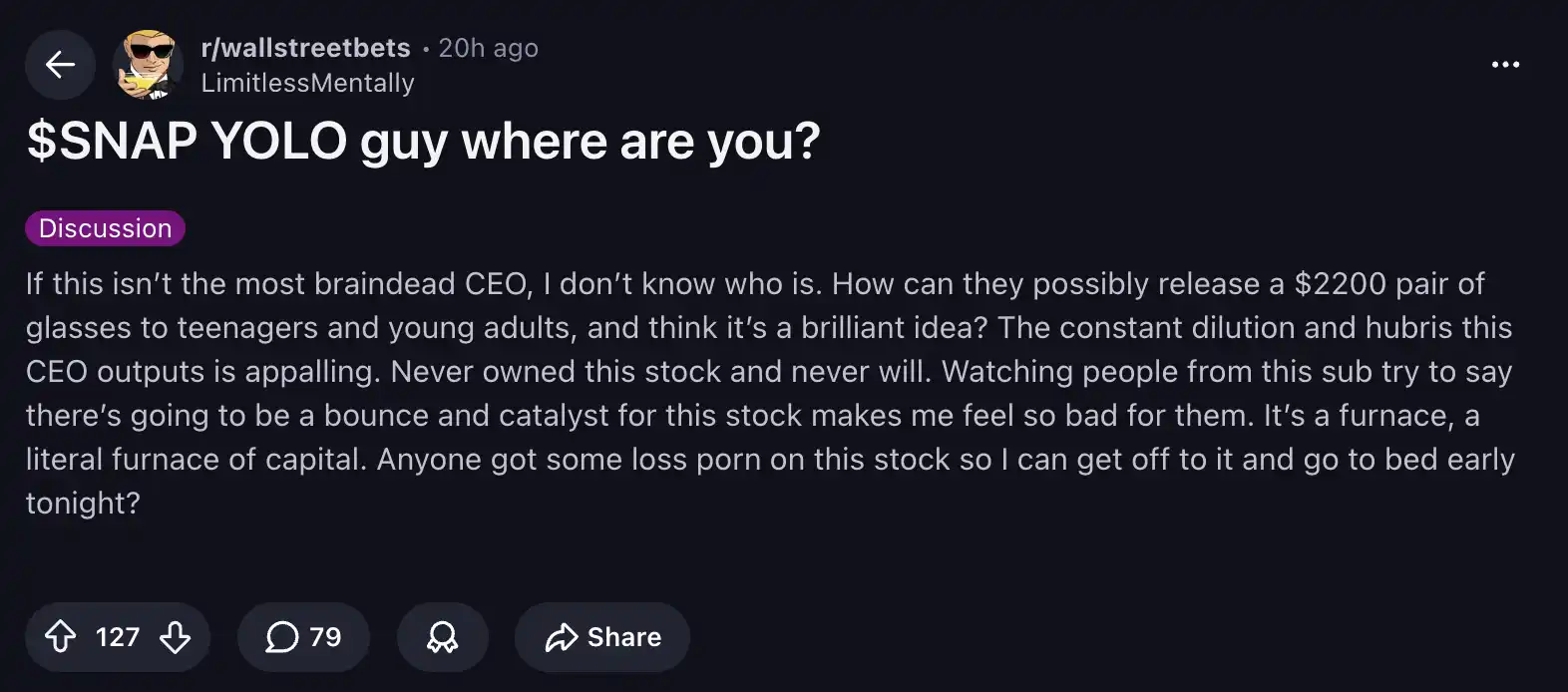
The poster called the CEO "brain-dead," compared the company to a "capital furnace," and even asked for someone to post some "pictures of miserable losses" to help him sleep soundly.

He voiced the most direct question for the entire market: How can a company with years of losses stake its turnaround on a pair of glasses that young people can't even afford?

A Product You Might Not Have Used, But Have Certainly Seen

Talking about Snapchat, friends in China might not be very familiar, but you've probably seen this once wildly popular "dog filter":

That virtual puppy sticking out its tongue, with ears moving with the head, was one of the most viral among the Lenses (AR filters) launched by Snapchat in 2015.

The real-time facial tracking technology behind it came from Looksery, a Ukrainian startup acquired by Snap for approximately $150 million that same year. This was the largest acquisition deal in Ukraine's tech history at the time, but the one that truly turned this technology into a global phenomenon, making it a plaything imitated by celebrities and ordinary users alike, was Snapchat.

A Pioneer Repeatedly Copied

To some extent, looking back at Snapchat's history, it reads more like a "history of being copied."

Its pioneering ephemeral Stories feature was almost copied verbatim by Instagram, and now almost every social app has it; its camera-first interface and left-right swipe navigation were adopted by the entire industry for nearly a decade; even its early bet on AR glasses was beaten to the market as a hit product by Meta's Ray-Ban smart glasses.

Time and again, Snapchat stood at the technological forefront but consistently failed to turn "first-mover advantage" into "commercial victory."

This is also evident from its stock performance.

From its all-time high of $83.34 in September 2021, SNAP has plunged by 94% over the past five years, starkly contrasting with the record-breaking U.S. stock market during the same period.

2021 happened to be the peak of the pandemic's benefits but also a turning point. That same year, Apple tightened iOS privacy tracking permissions, directly crippling Snap's core advertising targeting capabilities. In the following years, TikTok and Instagram rose strongly, while Snap, with its persistently weak profitability, never saw its stock price return to its former levels.

Back to the popular post mentioned at the beginning.

Why did Snap's stock price drop immediately after announcing a new product, and why were these AR glasses almost universally ridiculed on X and Reddit?

First, we have to mention its core user base. Snapchat's main users are Gen Z, aged 18 to 24. Selling a $2,195 pair of glasses to a group of young people who largely can't afford them is clearly unrealistic.

Placing it within the context of its peers makes this dilemma clearer.
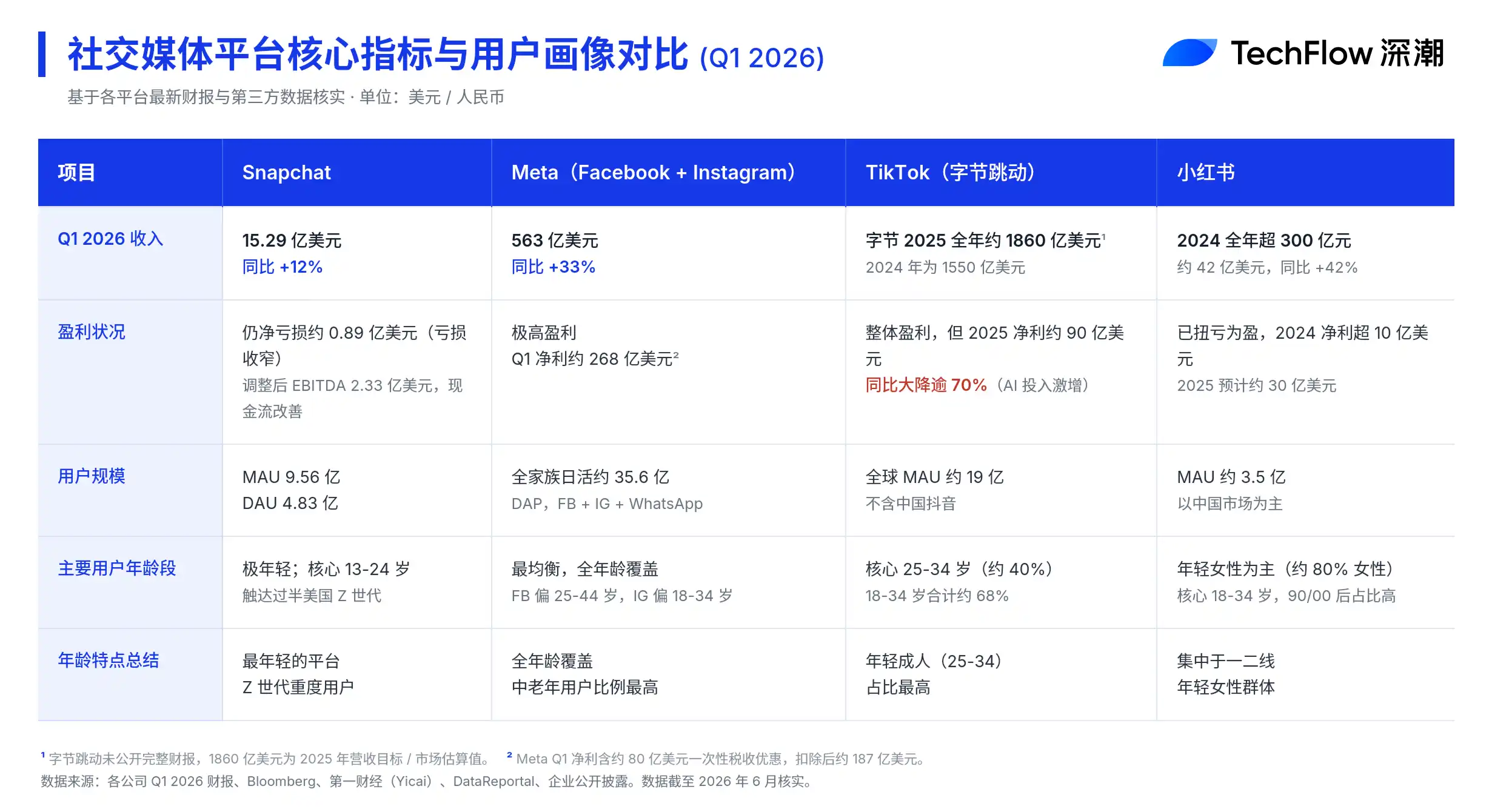
Also in content and social networking, Meta generates $56.3 billion in revenue and nearly $27 billion in net profit per quarter; ByteDance and Xiaohongshu are also already profitable.

Snapchat alone, despite growing users and revenue, still reported a net loss of $89 million in the first quarter of 2026. It has reported annual net losses every year since its IPO in 2017. The root cause is that young users are not advertisers' most favored demographic; brands prefer to allocate budgets to the main consumer group aged 25 to 45.

Youth, ironically, has become Snap's monetization burden.

A Nearly Decade-Long AR Gamble

In such a predicament, Spiegel chose to double down.

He called 2026 the company's "crucible moment." In April this year, Snap laid off about 1,000 employees, 16% of its workforce, citing AI's ability to handle a large amount of repetitive work.

Simultaneously, the company has accumulated investments exceeding $3.5 billion in the Specs AR glasses product line. Counting from the first-generation Spectacles in 2016, this high-stakes gamble has lasted nearly a decade.

To see how far this decade has taken them, we must go back to that first-generation pair of glasses.
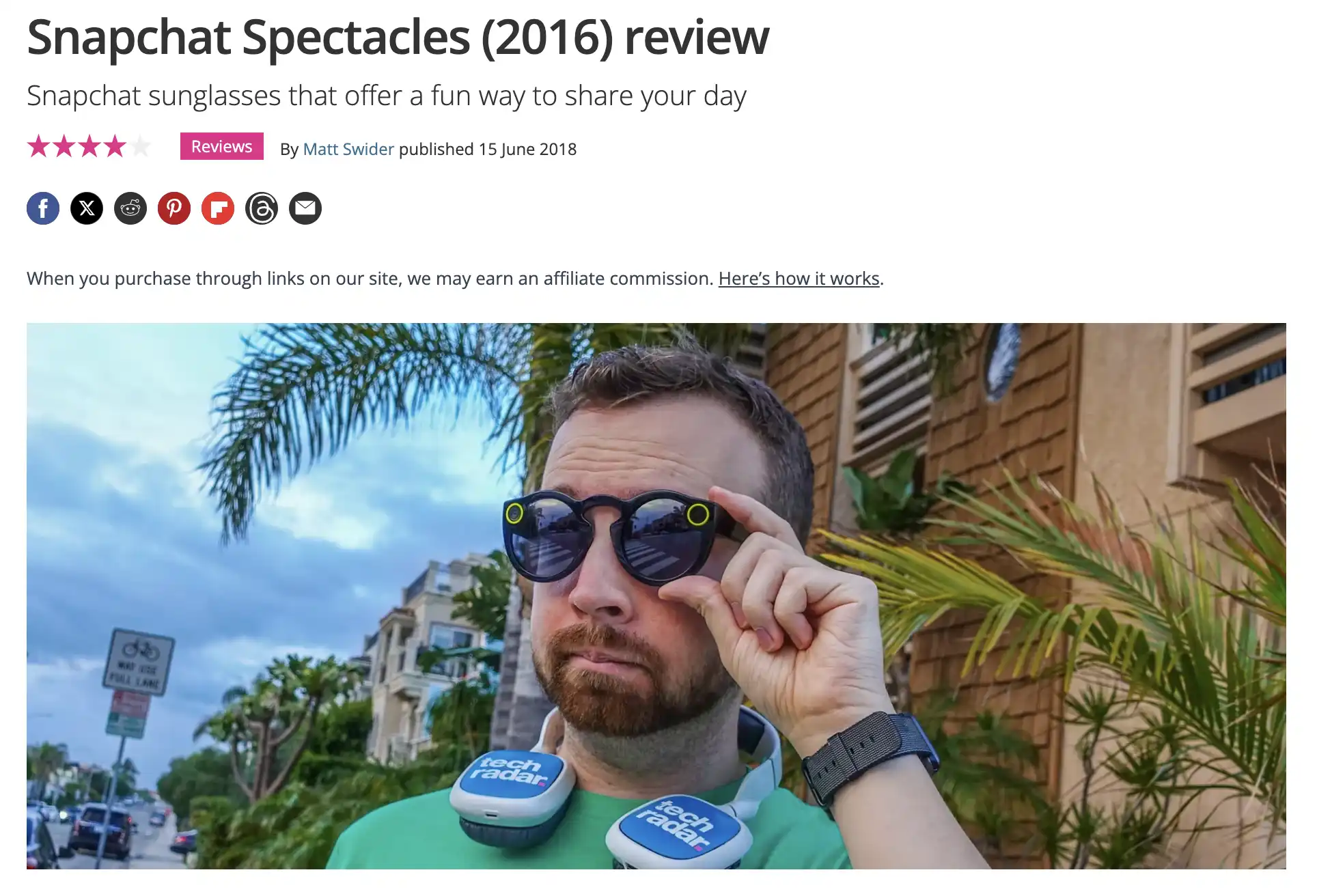
Image: The first-generation glasses from 2016

Launched in September and released in November that year, it was a pair of iconic bright yellow glasses sold via street vending machines, with a camera embedded in the frame. Strictly speaking, it wasn't truly AR; wearing it, you could only record a short circular video hands-free and share it on Snapchat. Essentially, it was more like a fun toy worn on your face.
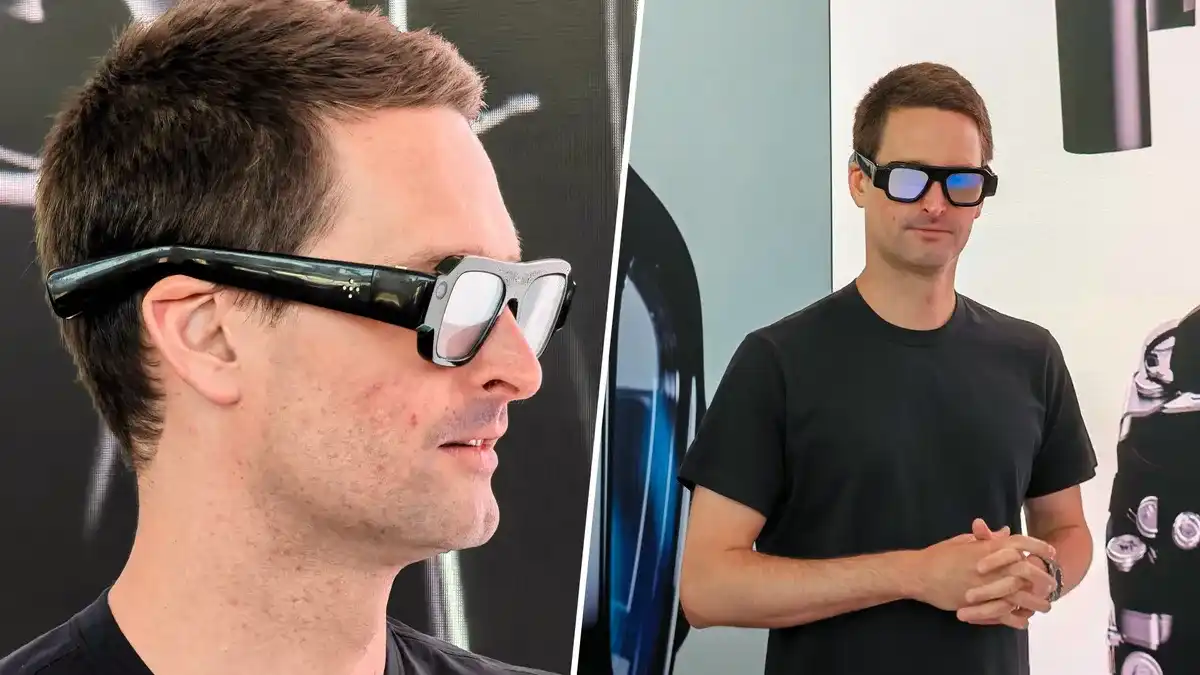
Image: Specs launched in 2026

Ten years later, Specs can overlay digital information onto real-world scenes, run AI functions, recognize gestures, and operate independently of a phone. From "glasses for recording videos" to "a spatial computer worn on the face," this is a leap spanning a decade, and it's what Spiegel truly wants to bet on.

In this whole event, what truly made investors collectively furious was the pricing, widely considered outrageous.
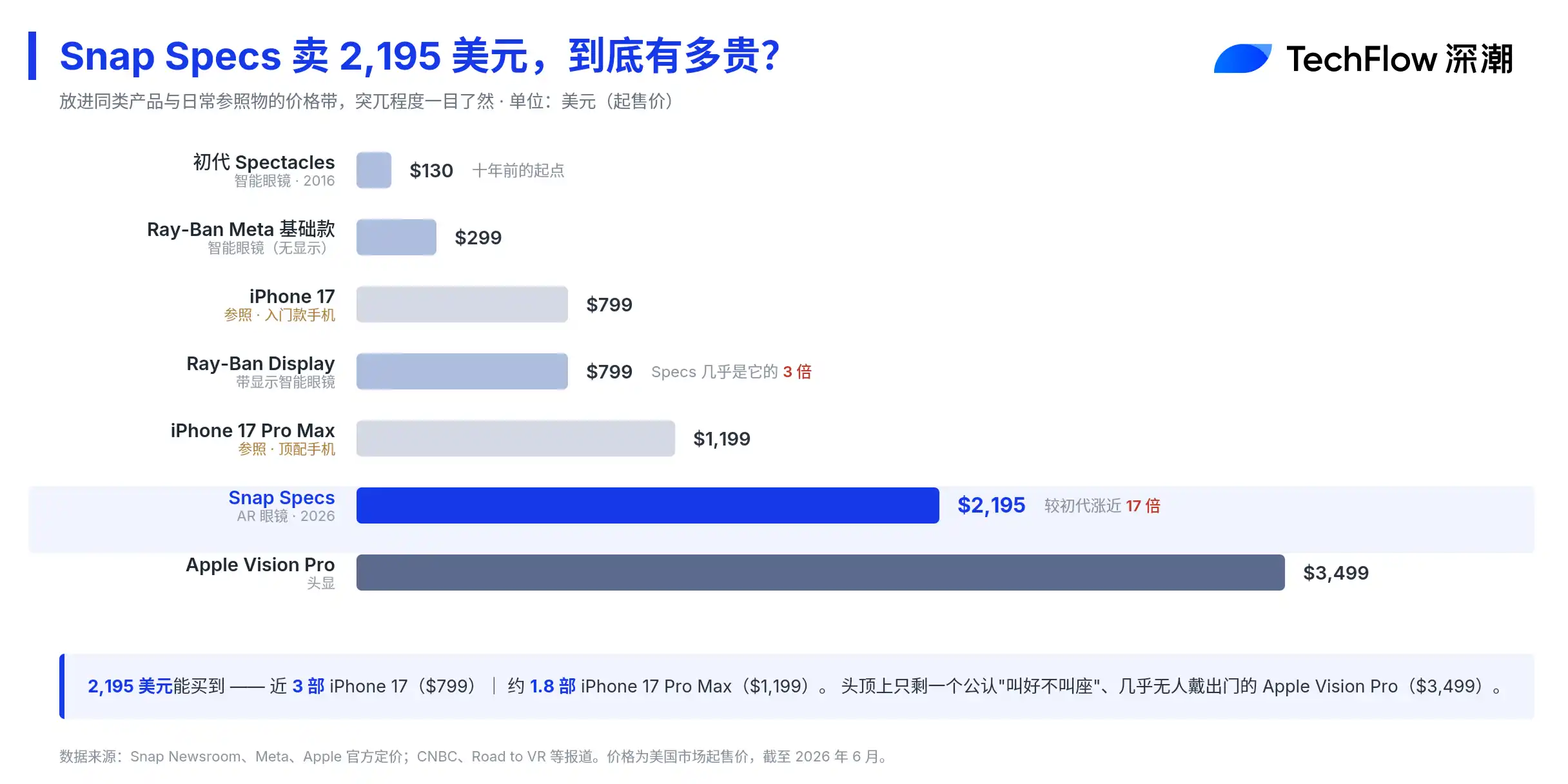
The question is, what do you get for the extra money?

Compared to the $799 Ray-Ban Display, which only has a small HUD crammed into a corner of the lens, Specs is true AR, capable of overlaying digital content into reality, recognizing gestures, and running independently of a phone. Functionally, it is indeed a tier higher.

But it weighs about 132 grams (almost twice as heavy as the former), has a battery life of only about 4 hours, and its main features—navigation, measurement, AI queries—are things a phone can already do. The $2,195 buys a "category leap," but not necessarily a mature product that fits into daily life. This might be the real source of investor unease.

When activist investor Irenic Capital publicly pressured the company to shut down or spin off the Specs division to preserve cash flow, Spiegel publicly refused, insisting on viewing it as part of the company's long-term model.

Cutting costs by laying off people on one hand, while heavily betting on a vision that hasn't seen a return in a decade on the other.

This is Snapchat's most realistic portrayal at the moment.

Ending

In 2015, Snapchat captivated the world with an AR filter like a virtual puppy; eleven years later today, its heavily-backed AR glasses are almost universally dismissed.

However, not everyone views it as a farce.

Some view it through the lens of mobile phone evolution. From the brick-like "brick phones" to today's smartphones, that path took over thirty years. The currently expensive and heavy Specs might just be an awkward, necessary step before AR glasses mature.

But in an era that generally chases short-term returns and follows the herd, is a persistent entrepreneur like Spiegel a rare anomaly in the industry, or a gambler destined to be eliminated by the market?

This question might be worth answering for every observer themselves.

Preguntas relacionadas

QWhy did Snap's stock price drop significantly after the announcement of Specs?

ASnap's stock price dropped nearly 10% on the day the new AR glasses, Specs, were announced due to investor skepticism. The main concerns were the product's high price point of $2,195, which is unaffordable for Snap's core young user base, and doubts about whether the advanced AR features justified the cost when compared to more affordable alternatives like Meta's Ray-Ban glasses. Investors also questioned the wisdom of a consistently unprofitable company making such a large bet on an unproven, high-cost hardware product.

QWhat is the main challenge Snap faces in monetizing its user base?

ASnap's primary challenge in monetization stems from its core demographic: users aged 18-24 (Generation Z). While the platform is popular with this group, they are not the most favored demographic for advertisers, who prefer to target the 25-45 age range, which has higher disposable income. This 'youthful' user base has become a commercial burden, contributing to the company's ongoing annual net losses since its IPO in 2017.

QWhat technological evolution does Specs represent compared to Snap's first-generation Spectacles?

ASpecs represents a significant technological leap from the 2016 Spectacles. The original version was essentially a camera on glasses, allowing users to record short circular videos. In contrast, the new Specs are a true AR device. They can overlay digital information onto the real world, run AI functions, recognize gestures, and operate independently without a phone. This evolution marks a shift from a 'video-recording toy' to what CEO Evan Spiegel envisions as a 'spatial computer for your face.'

QHow has the competitive landscape and external factors contributed to Snap's financial struggles?

ASnap's financial struggles have been exacerbated by intense competition and external policy changes. Key competitors like Instagram and TikTok have copied its innovative features (like Stories) and captured market share. Furthermore, Apple's 2021 privacy policy update, which restricted ad tracking on iOS, severely damaged Snap's targeted advertising capabilities—a core part of its revenue model. These factors, combined with its inherent monetization challenges, have prevented Snap from regaining its 2021 stock price peak.

QWhat is the central dilemma or 'crucible moment' facing Snap and its CEO as described in the article?

AThe central dilemma, termed the 'crucible moment,' is the conflict between immediate financial pressure and long-term vision. CEO Evan Spiegel is simultaneously cutting costs (laying off 10% of the workforce) and doubling down on a massive, decade-long investment in AR hardware (over $3.5 billion for Specs) that has yet to show a return. He faces pressure from investors to abandon this costly bet to preserve cash but refuses, insisting that AR is fundamental to the company's long-term future. This positions him as either a rare visionary or a stubborn gambler in the eyes of the market.

Lecturas Relacionadas

Conversation with Co-founder of Hyperdash: Why is Hyperliquid Still Severely Undervalued?

Interview Summary with Hanson Birringer, Co-founder of Hyperdash: Why Hyperliquid Remains Undervalued In an interview on *The Rollup*, Hanson Birringer, Co-founder and Chief Revenue Officer of Hyperdash—a trading data analytics platform for Hyperliquid—shared his investment thesis on the Hyperliquid ecosystem. He described Hyperliquid as a pure play on three key crypto super-trends: perpetual contracts, real-world assets (RWAs), and stablecoins. The platform is an open-source, decentralized, and high-performance financial system uniquely positioned to bridge traditional institutional capital with decentralized finance. Birringer highlighted Hyperliquid's leadership in perpetual DEX trading and its recent innovation of RWA perpetual contracts. He emphasized the significance of USDC becoming a core quoting asset, which, by allocating 90% of its backend yield from assets like US treasuries to a protocol buyback fund, creates substantial, programmatic buy pressure for the Hype token. He addressed regulatory challenges, noting that Hyperliquid's policy team is actively engaging with US regulators like the CFTC to establish clear rules for decentralized venues. Once achieved, regulated brokers could route orders directly to Hyperliquid's backend, tapping into its low-cost liquidity layer. Regarding revenue, Birringer was optimistic, citing the immense size of traditional financial markets. Even capturing a small fraction of global trading volume in products like RWA perpetuals could lead to exponential growth for the protocol. The recently launched Grayscale Hyperliquid ETF, seeded by their SPV (Hyper Holdings Global), provides a compliant on-ramp for institutional investors drawn to the clear "cash flow + token buyback" model. Finally, he discussed Hyperdash's acquisition of Imperator, enhancing its data and node infrastructure to serve both retail traders and traditional asset managers. His bullish case rests on Hyperliquid's potential to provide unprecedented global access to dollar-based capital markets. He struggled to articulate a bear case, seeing the long-term trends of internet adoption and financial inclusion as powerful tailwinds.

marsbitHace 48 min(s)

Conversation with Co-founder of Hyperdash: Why is Hyperliquid Still Severely Undervalued?

marsbitHace 48 min(s)

DeepSeek V4 'Full-Blooded Edition' Leaked, Could Be Released As Early As Tomorrow

The highly anticipated full release of DeepSeek V4 is imminent, expected to launch as early as tomorrow after nearly three months of waiting. A select group has already received access to the GA (General Availability) beta, which includes two versions: DeepSeek V4 Flash and DeepSeek V4 Pro. Early testers report that V4's overall performance is close to the level of Opus 4.8, with coding capabilities rivaling GPT-5.6 Sol. Its agent abilities are significantly enhanced, and 3D/SVG generation has improved notably. While it may not surpass the recently released Kimi K3 in performance, its expected price point is significantly lower. The official release will introduce a new "peak/off-peak" pricing model for its API. For example, deepseek-v4-pro will cost $0.87 per million output tokens during standard times and $1.74 during peak hours. The flash version is even more aggressive at $0.28/$0.56 per million tokens, with cached input tokens priced extremely low at $0.0028. This makes V4 a strong contender in terms of cost-effectiveness, potentially offering Opus-level capabilities at a fraction of the cost, continuing DeepSeek's reputation as a "price disruptor" in the AI market. Initial demos showcasing V4's capabilities have begun circulating, including generated 3D simulation games, HTML games blending elements of Minecraft and No Man's Sky, and classic games like a "Cut the Rope" clone. The final GA version is set to replace the older deepseek-chat and deepseek-reasoner models, which will be retired on July 24th.

marsbitHace 57 min(s)

DeepSeek V4 'Full-Blooded Edition' Leaked, Could Be Released As Early As Tomorrow

marsbitHace 57 min(s)

WEEX Labs Weekly Observation: The 'Power Restructuring' of AI Infrastructure and the 'Deep Dive Movement' into the Real Economy

WEEX Labs Weekly Review: AI Infrastructure's "Power Restructuring" and the "Deep Dive" into the Real Economy Mid-July 2026 marks a pivotal shift in the global AI industry. The allocation of computing power is transferring from cloud giants to compute resource owners, while the core value of AI is solidifying around its penetration into physical industry, moving beyond the race for model parameters. The era of fragmented model development is over, replaced by a capital-intensive, integrated chain driven by hard tech. Key developments this week include Meta's planned entry into the cloud computing market with "MetaCompute." This move by social media giants with massive GPU clusters challenges traditional cloud providers like AWS, integrating compute, models, and data into one-stop services, which will squeeze smaller rental providers and shift enterprise focus towards underlying model ecosystems. Chinese foundational models like DeepSeek-V4 and Tencent's Hy-3 are pushing towards "utility" status through open-source releases and extreme cost reductions via MoE architectures. This lowers entry barriers for enterprises, allowing them to focus resources on private deployment and deep business integration. Embodied intelligence, particularly humanoid robots, is transitioning from lab demos to real-world factory applications, driven by policies promoting large-scale, practical deployment in logistics and manufacturing. The value focus is shifting from spectacle to stable industrial data and real operational efficiency. Global governance, through forums like WAIC, is evolving from theoretical ethics to practical operational frameworks for "Sovereign AI," raising geopolitical compliance barriers and making auditability and data sovereignty core design requirements from the outset. WEEX Labs Insights: The current transformation shows AI's prosperity is deeply embedding into the fabric of global manufacturing. Strategic recommendations include: 1) leveraging open-source models for private, proprietary knowledge bases; 2) maintaining cloud provider diversity to avoid vendor lock-in from integrated model ecosystems; and 3) seeking opportunities in the "embodied infrastructure" supporting robots, such as data collection, industrial simulation, and factory AI adaptation services.

marsbitHace 1 hora(s)

WEEX Labs Weekly Observation: The 'Power Restructuring' of AI Infrastructure and the 'Deep Dive Movement' into the Real Economy

marsbitHace 1 hora(s)

Is WEEX TradFi Reliable? What You Should Know Before Your First Trade of U.S. Stock Tokens

In recent years, cryptocurrency users have expanded their focus beyond Bitcoin and Ethereum to include popular traditional financial (TradFi) assets like Nvidia, Apple, and Tesla stocks. This shift raises key questions: What do these TradFi assets represent on crypto trading platforms? How do they differ from traditional stock ownership? And how can users assess the reliability of platforms offering such products? TradFi products, such as those offered by WEEX TradFi (including NVDA, MSFT, AAPL, TSLA, and QQQ tokens), are blurring the lines between crypto and traditional markets. They allow users to trade based on the price movements of traditional assets within a familiar digital asset trading environment. However, it's crucial to understand that trading a "stock token" is not equivalent to owning the actual stock. Users are participating in price speculation, not gaining shareholder rights like dividends or voting. A key feature of these products is 7x24 trading, offering flexibility beyond traditional market hours. While convenient, this also introduces unique risks, such as potential liquidity gaps and volatility when underlying markets are closed. For users evaluating TradFi products, reliability hinges on transparency and risk management. Critical factors include understanding the product mechanism, how prices track the underlying assets, and the associated risks—especially when using leverage. Popular stocks and indices are still subject to company performance, macroeconomic shifts, and sector trends. Ultimately, TradFi represents a new gateway connecting crypto users to global markets. The future points toward integrated trading environments where the distinction between "crypto investor" and "traditional investor" fades. For newcomers, a platform's reliability stems not from promises, but from a clear understanding of the product, a comprehensive view of risks, and informed judgment of the platform's capabilities.

marsbitHace 1 hora(s)

Is WEEX TradFi Reliable? What You Should Know Before Your First Trade of U.S. Stock Tokens

marsbitHace 1 hora(s)

Trading

Spot
活动图片