Small-Cap Tokens Hit Four-Year Low, Is the 'Altcoin Bull Run' Completely Hopeless?

marsbitPublicado a 2025-12-16Actualizado a 2025-12-16

Resumen

Small-cap cryptocurrency tokens have plummeted to multi-year lows, with indices tracking altcoins significantly underperforming both major cryptocurrencies and traditional equities. In 2024–2025, while the S&P 500 and Nasdaq 100 delivered strong double-digit returns with limited drawdowns, altcoin indices like the CoinDesk 80 and MarketVector Small-Cap Index fell sharply—by nearly 40% and to November 2020 lows, respectively. These altcoin indices showed high correlation (0.9) with large-cap crypto assets like Bitcoin and Ethereum but delivered deeply negative returns, higher volatility, and worse risk-adjusted performance (negative Sharpe ratios). Liquidity is increasingly concentrated in high-value, institutionally supported assets such as Bitcoin, Ethereum, SOL, and XRP, indicating a structural shift away from speculative small-cap tokens. The data suggests that altcoins offered no diversification benefits and instead magnified losses during a period of broader market growth.

Author: Gino Matos

Compiled by: Luffy, Foresight News

Since January 2024, the performance comparison between cryptocurrencies and stocks indicates that the so-called new "altcoin trading" is essentially just a substitute for stock trading.

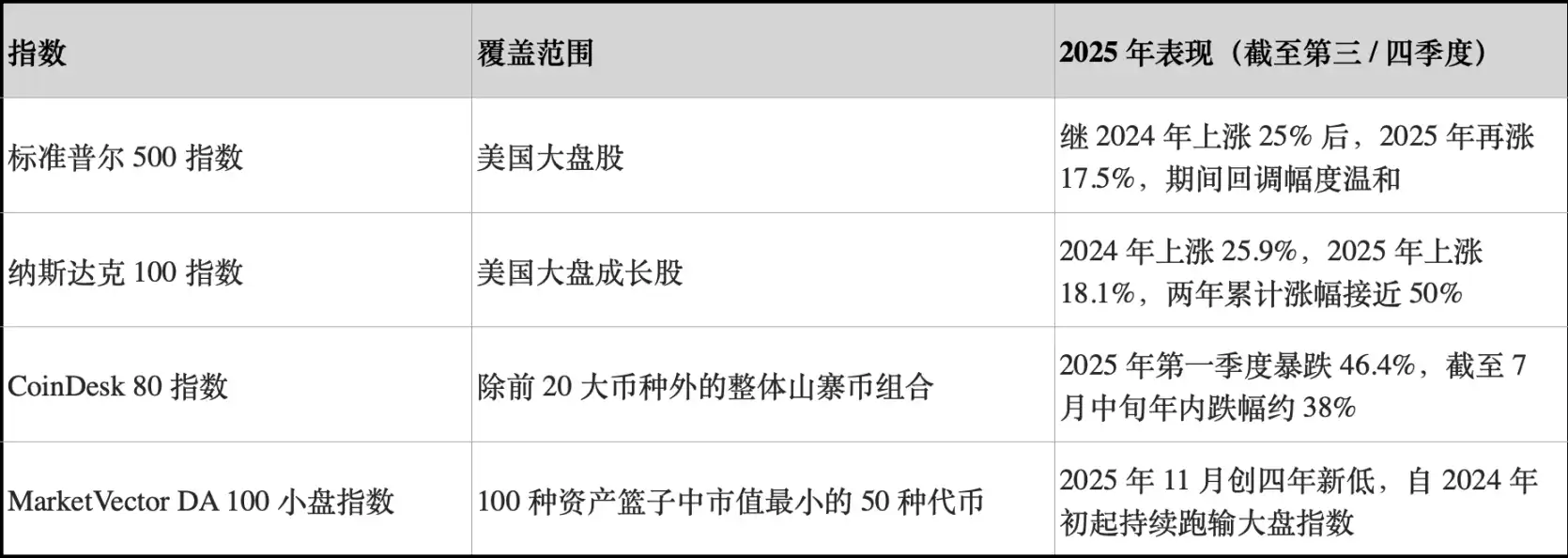
In 2024, the S&P 500 index had a return of approximately 25%, and in 2025 it reached 17.5%, with a cumulative two-year increase of about 47%. During the same period, the Nasdaq 100 index rose by 25.9% and 18.1% respectively, with a cumulative increase of nearly 49%.

The CoinDesk 80 Index, which tracks 80 assets outside the top 20 cryptocurrencies by market capitalization, plummeted 46.4% in the first quarter of 2025 alone, and by mid-July, its year-to-date decline was about 38%.

By the end of 2025, the MarketVector Digital Assets 100 Small-Cap Index fell to its lowest level since November 2020, wiping out over $1 trillion in total cryptocurrency market capitalization.

This divergence in performance is by no means a statistical error. Not only did the overall altcoin portfolio have a negative return, but its volatility was comparable to or even higher than that of stocks; in contrast, major U.S. stock indices achieved double-digit growth with controllable drawdowns.

For Bitcoin investors, the core question is: Can allocating to small-cap tokens deliver risk-adjusted returns? Or is such an allocation merely taking on exposure to a negative Sharpe ratio while maintaining similar correlations to stocks? (Note: The Sharpe ratio is a core metric for measuring the risk-adjusted return of an investment portfolio. Its calculation formula is: Annualized portfolio return - Annualized risk-free rate / Annualized volatility of the portfolio.)

Choosing a Reliable Altcoin Index

For analysis, CryptoSlate tracked three altcoin indices.

The first is the CoinDesk 80 Index, launched in January 2025. This index covers 80 assets outside the CoinDesk 20 Index, providing a portfolio of diversified assets beyond Bitcoin, Ethereum, and other major tokens.

The second is the MarketVector Digital Assets 100 Small-Cap Index. This index selects the 50 smallest tokens by market cap from a basket of 100 assets, serving as a barometer for the market's "junk assets."

The third is a small-cap index launched by Kaiko. This is a research product, not a tradable benchmark, offering a clear sell-side quantitative perspective for analyzing the small-cap asset group.

These three depict the market landscape from different dimensions: the overall altcoin portfolio, high-beta small-cap tokens, and a quantitative research perspective. Yet, the conclusions they point to are highly consistent.

In contrast, the benchmark performance of the stock market shows a completely opposite trend.

In 2024, major U.S. indices achieved gains of around 25%, and in 2025, they also saw double-digit increases, with relatively limited drawdowns during the period. During this time, the maximum intra-year drawdown of the S&P 500 index was only in the mid-to-high single digits, while the Nasdaq 100 index maintained a strong upward trend throughout.

Both major indices achieved compounded annual growth without significant givebacks of gains.

The trend of the overall altcoin indices, however, is vastly different. Reports from CoinDesk Indices show that the CoinDesk 80 Index plummeted 46.4% in the first quarter alone, while the large-cap tracking CoinDesk 20 Index fell 23.2% during the same period.

By mid-July 2025, the CoinDesk 80 Index was down 38% year-to-date, whereas the CoinDesk 5 Index, which tracks Bitcoin, Ethereum, and three other major tokens, achieved a gain of 12% to 13% during the same period.

Andrew Baehr of CoinDesk Indices, in an interview with ETF.com, described this phenomenon as "identical correlation, vastly different profit and loss performance."

The correlation between the CoinDesk 5 Index and the CoinDesk 80 Index is as high as 0.9, meaning their price movements are completely aligned in direction, but the former achieved a slight double-digit growth while the latter plunged nearly 40%.

It turns out that the diversification benefits of holding small-cap altcoins are minimal, while the performance cost is extremely heavy.

The performance of the small-cap asset sector is even worse. According to Bloomberg, by November 2025, the MarketVector Digital Assets 100 Small-Cap Index had fallen to its lowest level since November 2020.

Over the past five years, the return of this small-cap index has been approximately -8%, while the corresponding large-cap index has surged about 380%. Institutional funds clearly favor large-cap assets and avoid tail risks.

Looking at the performance of altcoins in 2024, the Kaiko small-cap index fell over 30% for the year, and mid-cap tokens also struggled to keep up with Bitcoin's gains.

Market winners were highly concentrated in a few top tokens, such as SOL and Ripple. Although the share of altcoin trading volume once rebounded to the 2021 high in 2024, 64% of the trading volume was concentrated in the top ten altcoins.

Liquidity in the cryptocurrency market has not disappeared but has shifted towards higher-value assets.

Sharpe Ratio and Drawdown Magnitude

If compared from the perspective of risk-adjusted returns, the gap widens further. The CoinDesk 80 Index and various small-cap altcoin indices not only have returns deep in negative territory but also have volatility comparable to or even higher than stocks.

The CoinDesk 80 Index plummeted 46.4% in a single quarter; the MarketVector small-cap index fell to pandemic-era lows in November after another round of declines.

The overall altcoin index experienced multiple index-level halving drawdowns: the Kaiko small-cap index fell over 30% in 2024, the CoinDesk 80 Index crashed 46% in Q1 2025, and the small-cap index fell again to 2020 lows by the end of 2025.

In contrast, the S&P 500 and Nasdaq 100 indices achieved cumulative returns of 25% and 17% over two years, with maximum drawdowns only in the mid-to-high single digits. The U.S. stock market had fluctuations, but they were overall controllable; the volatility of cryptocurrency indices, however, was highly destructive.

Even if the high volatility of altcoins is considered a structural feature, their unit risk return from 2024 to 2025 was still far lower than that of holding major U.S. stock indices.

From 2024 to 2025, the overall altcoin index had a negative Sharpe ratio; meanwhile, the S&P and Nasdaq indices had strong Sharpe ratios even without volatility adjustment. After volatility adjustment, the gap between them further widened.
Bitcoin Investors and Cryptocurrency Liquidity

The first insight from the above data is the trend of liquidity concentration and migration towards high-value assets. Reports from Bloomberg and Whalebook on the MarketVector small-cap index both pointed out that since early 2024, small-cap altcoins have consistently underperformed, and institutional funds have instead flowed into Bitcoin and Ethereum ETFs.

Combined with Kaiko's observations, although the share of altcoin trading volume rebounded to 2021 levels, funds were concentrated in the top ten altcoins. The market trend is already clear: liquidity has not completely left the cryptocurrency market but has shifted towards higher-value assets.

The previous altcoin bull market was essentially just a basis trade strategy, not a structural outperformance of assets. In December 2024, the CryptoRank Altcoin Bull Index once soared to 88 points, then plummeted to 16 points in April 2025, completely giving back all gains.

The 2024 altcoin bull market ultimately turned into a typical bubble burst; by mid-2025, the overall altcoin portfolio had almost given back all its gains, while the S&P and Nasdaq indices continued to compound growth.

For wealth advisors and asset allocators considering diversification beyond Bitcoin and Ethereum, the data from CoinDesk provides a clear case reference.

As of mid-July 2025, the large-cap tracking CoinDesk 5 Index achieved a slight double-digit growth year-to-date, while the diversified altcoin index CoinDesk 80 plummeted nearly 40%, yet their correlation was as high as 0.9.

Investors allocating to small-cap altcoins did not obtain substantial diversification benefits but instead suffered far higher return losses and drawdown risks compared to Bitcoin, Ethereum, and U.S. stocks, while still being exposed to the same macro drivers.

Current capital views most altcoins as tactical trading targets, not strategic allocation assets. From 2024 to 2025, Bitcoin and Ethereum spot ETFs had significantly better risk-adjusted returns, and U.S. stocks also performed brilliantly.

Liquidity in the altcoin market is increasingly concentrating towards a few "institutional-grade coins," such as SOL, Ripple, and other tokens with independent positive factors or clear regulatory prospects. Asset diversity at the index level is being squeezed by the market.
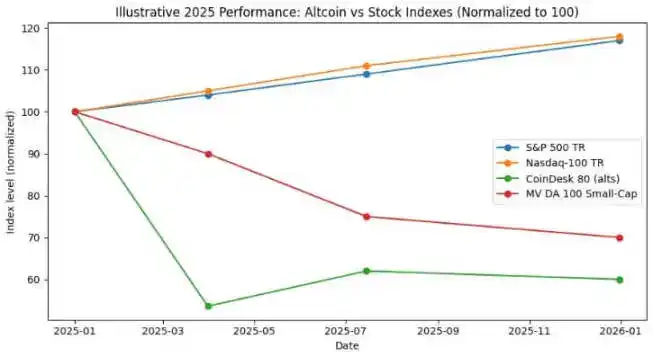
In 2025, the S&P 500 and Nasdaq 100 indices rose about 17%, while the CoinDesk 80 cryptocurrency index fell 40%, and small-cap cryptocurrencies fell 30%

What Does This Mean for Liquidity in the Next Market Cycle?

The market performance from 2024 to 2025 tested whether altcoins could achieve diversification value or outperform in an environment of rising macro risk appetite. During this period, U.S. stocks achieved double-digit growth for two consecutive years with controllable drawdowns.

Bitcoin and Ethereum gained institutional recognition through spot ETFs and benefited from a moderating regulatory environment.

In contrast, the overall altcoin index not only had negative returns and larger drawdowns but also maintained high correlations with major crypto tokens and stocks, yet failed to provide corresponding compensation for the additional risks investors undertook.

Institutional capital always chases performance. The five-year return of the MarketVector small-cap index is -8%, while the corresponding large-cap index surged 380%. This gap reflects the migration of capital towards assets with clear regulation, sufficient derivatives market liquidity, and well-developed custody infrastructure.

The CoinDesk 80 Index's 46% plunge in the first quarter and its 38% year-to-date decline by mid-July indicate that the trend of capital migration towards high-value assets is not reversing but accelerating.

For Bitcoin and Ethereum investors evaluating whether to allocate to small-cap crypto tokens, the data from 2024 to 2025 provides a clear answer: the absolute returns of the overall altcoin portfolio underperformed U.S. stocks, and the risk-adjusted returns were inferior to Bitcoin and Ethereum; despite a correlation as high as 0.9 with major crypto tokens, it provided no diversification value.


Preguntas relacionadas

QWhat was the performance difference between the S&P 500 and the CoinDesk 80 Index in 2025?

AIn 2025, the S&P 500 index rose by approximately 17.5%, while the CoinDesk 80 Index plummeted by 40%.

QAccording to the article, what is the main reason for the poor performance of small-cap altcoins?

AThe main reason is that institutional capital is migrating towards high-value assets like Bitcoin and Ethereum ETFs, which are seen as having clearer regulatory prospects and better infrastructure, leaving small-cap altcoins with negative returns and high volatility.

QWhat was the correlation between the CoinDesk 5 Index and the CoinDesk 80 Index, and what does this imply?

AThe correlation between the CoinDesk 5 Index and the CoinDesk 80 Index was as high as 0.9. This implies that their price directions moved almost identically, yet the performance was drastically different, with the former achieving double-digit gains while the latter fell nearly 40%, offering no meaningful diversification benefit.

QTo what level did the MarketVector Digital Assets 100 Small-Cap Index fall by the end of 2025?

ABy the end of 2025, the MarketVector Digital Assets 100 Small-Cap Index fell to its lowest level since November 2020.

QWhat does the article conclude about allocating to small-cap tokens for Bitcoin investors?

AThe article concludes that allocating to small-cap tokens did not provide a risk-adjusted return benefit. Instead, it resulted in significantly worse returns and higher drawdown risks compared to holding Bitcoin, Ethereum, or U.S. stocks, while still being exposed to the same macroeconomic factors.

Lecturas Relacionadas

After Developer Numbers Halved: Crypto Isn't Dead, It's Just Giving Up Talent to AI

The title "After a 50% Drop in Developer Count: Crypto Isn't Dead, It's Just Ceding Talent to AI" suggests a shift, not an end. The article analyzes GitHub data showing a significant drop in overall Crypto developer activity from a peak of 45K monthly active developers in 2022 to about 23K in 2026. However, this masks a deeper trend of "talent deleveraging." The exodus consists mainly of newcomers who entered during the bull market for hype-driven roles (e.g., NFT contracts, forked DeFi protocols), with over 50% of developers with less than one year of experience leaving. In contrast, established developers (2+ years of experience) have hit record highs, contributing roughly 70% of the code. They are consolidating in ecosystems with real users and revenue, like Bitcoin and Solana. These experienced builders possess unique skills forged in Crypto's "code is law" environment: the ability to build trust and functional systems from scratch in the absence of external authority or rules, with zero tolerance for error. The article argues that AI's scaling faces structurally similar trust, coordination, and verification problems—particularly regarding compute aggregation, multi-agent incentive alignment, and autonomous payments. Crypto builders are already applying these skills in AI. Examples include CoreWeave (mining to AI compute), OpenRouter (NFT marketplace routing to AI model routing), and projects like Hyperbolic (using crypto-native mechanisms for decentralized compute verification) and EigenLayer (applying restaking logic to AI agent governance). Stablecoin infrastructure is becoming critical for AI agent micro-payments (e.g., x402 protocol). The role of these builders is evolving from writing smart contracts to "designing trusted mechanisms for autonomous AI systems." This shift is reflected in new hiring trends at major exchanges and significant venture capital flowing into the crypto-AI convergence (e.g., funds from Paradigm, Haun Ventures). The article concludes that while developer numbers have halved, the core density of talent has increased, and their uniquely cultivated skills are finding a new, larger stage in the AI era.

marsbitHace 2 min(s)

After Developer Numbers Halved: Crypto Isn't Dead, It's Just Giving Up Talent to AI

marsbitHace 2 min(s)

After the Developer Count Halved: Crypto Is Not Dead, It's Just Ceding Talent to AI

Following a significant decline in the total number of open-source crypto developers, from a peak of 45K in 2022 to approximately 23K by 2026, this article argues the industry is undergoing a "talent deleveraging" rather than a collapse. The exodus primarily consists of newcomers who entered during the bull market, while the core of experienced developers (2+ years) has grown to a record high, contributing around 70% of code. These established builders are concentrating in ecosystems with real users and revenue, like Bitcoin and Solana. The article posits that crypto has cultivated a unique skill set in building trustless, autonomous systems with near-zero tolerance for error—a capability now finding high demand in the AI era. As AI scales, it faces structural gaps in decentralized compute aggregation, multi-agent coordination/incentive alignment, and autonomous payment infrastructure. Crypto builders are transitioning their expertise to address these exact problems. Examples include CoreWeave (mining to AI compute), Hyperbolic (decentralized compute verification), EigenLayer (extending restaking mechanisms to AI agent governance), and the x402 protocol (enabling AI agent micro-payments via stablecoins). The role of the crypto builder is evolving from writing smart contracts to designing the rule-based, trust-minimized frameworks necessary for AI-native systems. Venture capital is increasingly funding this convergence, viewing it as a structural opportunity rather than a narrative shift. The core talent and systemic design principles from crypto are not disappearing but being re-priced and applied to the foundational challenges of scalable AI.

链捕手Hace 6 min(s)

After the Developer Count Halved: Crypto Is Not Dead, It's Just Ceding Talent to AI

链捕手Hace 6 min(s)

A Quick Look at the Latest Moves of the 24-Year-Old 'AI Stock God': Sixty Percent of the Portfolio Hedging Against Semiconductor Downturn

24-year-old AI investing prodigy Leopold Aschenbrenner's fund, Situational Awareness LP, has disclosed its Q1 2026 13F holdings. The fund's total portfolio nominal value surged 148% to $13.7 billion, driven by both investment gains and significant new capital inflows. The most striking move was the establishment of massive short-term hedges against potential volatility in the AI semiconductor sector. Over 60% of the fund's nominal exposure is now in put options (bets on declines) targeting major AI hardware stocks like NVIDIA (NVDA), VanEck Semiconductor ETF (SMH), Broadcom (AVGO), and AMD. Notably, the fund also holds call options (bets on rises) on some names like Micron (MU) and TSMC, indicating it expects extreme price swings in these stocks. Alongside these hedges, the fund remains a long-term bull on AI infrastructure. It significantly increased its equity stakes in companies like GPU cloud provider CoreWeave (CRWV) and added to positions in power/energy infrastructure firms like Bloom Energy (BE), albeit after taking substantial profits on the latter. The fund also exited positions in optical communication hardware (LITE, COHR) and reduced leverage by clearing out large call option positions on Intel and CoreWeave. In essence, the portfolio reflects a dual strategy: cautious on near-term semiconductor valuations and potential over-extension, while maintaining a conviction that the true long-term bottlenecks and value will be in the underlying infrastructure powering the AI revolution—such as energy, data centers, and compute availability.

marsbitHace 12 min(s)

A Quick Look at the Latest Moves of the 24-Year-Old 'AI Stock God': Sixty Percent of the Portfolio Hedging Against Semiconductor Downturn

marsbitHace 12 min(s)

A Quick Look at the Latest Portfolio of the 24-Year-Old 'AI Stock God': 60% Allocation Hedges Against Semiconductor Downturn

Summary: The article analyzes the latest 13F filing from "AI stock prodigy" Leopold Aschenbrenner's fund, Situational Awareness LP, for Q1 2026. The fund's holdings surged to $13.7 billion, with a significant 32.5% net inflow. Key portfolio adjustments reveal a dual strategy: * **Hedging Semiconductor Downturn:** Over 60% of the fund's *notional value* is allocated to massive put options on major AI semiconductor and hardware stocks (e.g., NVDA, AVGO, AMD, SMH ETF). This acts as a high-leverage hedge against potential short-term volatility or correction in the chip sector. * **Long-term Bullishness on AI Infrastructure:** Alongside the hedges, the fund maintains and increases core long positions in companies providing critical AI infrastructure. This includes substantial equity stakes in CoreWeave (GPU cloud services), Bloom Energy (on-site power), and various power/electrical/data center firms (KEEL, IREN, etc.). Other notable moves include switching Intel exposure from high-leverage calls to minimal stock, exiting optical networking stocks (LITE, COHR), and taking profits in some positions like Bloom Energy and CoreWeave calls. The analysis concludes that Aschenbrenner is not simply turning bearish on AI. Instead, the strategy reflects a nuanced view: extreme caution toward near-term "chip maker" valuations deemed potentially frothy, coupled with strong conviction in the long-term scarcity and value of the underlying *infrastructure* (power, data centers, cloud capacity) required to sustain the AI boom. The fund is preparing for industry volatility while betting on the next potential bottlenecks in the AI supply chain.

Odaily星球日报Hace 13 min(s)

A Quick Look at the Latest Portfolio of the 24-Year-Old 'AI Stock God': 60% Allocation Hedges Against Semiconductor Downturn

Odaily星球日报Hace 13 min(s)

Trading

Spot
Futuros
活动图片