SKYAI hits monthly lows after 36% drop – Yet THIS group isn’t backing off

ambcryptoPublicado a 2026-06-28Actualizado a 2026-06-28

Resumen

SKYAI plummeted 36.2% in 24 hours, hitting monthly lows, with its market cap falling to $238.26M. Despite a 70.85% surge in daily trading volume to $43.16M, the activity was driven by aggressive selling, not buying. Open Interest in derivatives dropped 36.65% to ~$69.66M, indicating traders closed leveraged positions. A modest positive exchange netflow of ~$340.75K signaled some holders moved tokens to exchanges, potentially for future sales. Buyers defended a key support zone around $0.168, preventing an immediate breakdown. However, technical indicators like MACD and Parabolic SAR remained bearish. The token's near-term direction depends on whether this support holds, allowing a potential recovery toward $0.335, or breaks, leading to further declines.

SKYAI recorded one of its steepest daily declines after losing 36.2% of its value over the last 24 hours, while traders continued flooding the market with fresh activity.

Daily trading volume climbed 70.85% to $43.16 million despite the heavy sell-off, showing that participants remained highly engaged throughout the correction.

The token’s market capitalization also dropped to $238.26 million, reflecting the broad decline in valuation.

However, the surge in trading activity did not translate into sustained buying strength.

Instead, the elevated volume accompanied aggressive selling pressure, indicating that market participants actively repositioned as volatility intensified across both spot and derivatives markets.

Such conditions reflected heightened uncertainty rather than renewed confidence, leaving SkyAI [SKYAI] under pressure as traders searched for signs of stability.

Why did traders cut leverage?

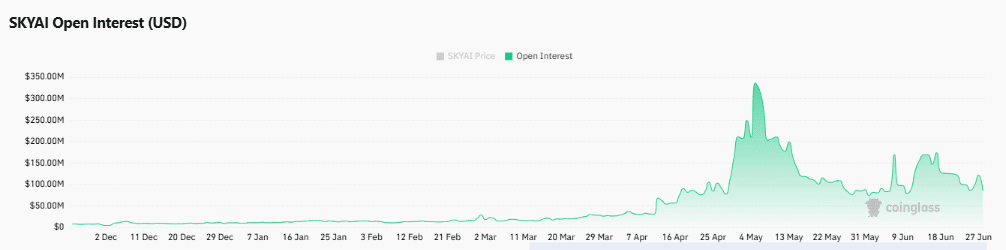
Derivatives activity weakened sharply after Open Interest declined [OI] by 36.65% to approximately $69.66 million.

The sharp reduction suggested that traders had rapidly closed leveraged positions during the correction instead of adding fresh exposure.

Rather than reflecting new bearish bets alone, the decline pointed to widespread liquidation and voluntary position exits across the futures market.

However, the sizeable contraction also reduced speculative leverage that had previously amplified price swings. This reset left the derivatives market considerably lighter than before the sell-off.

Even so, the shrinking OI failed to encourage an immediate recovery because buyers remained cautious after the aggressive decline.

Until traders gradually rebuilt conviction, leveraged participation would likely remain subdued despite the elevated trading activity.
Source: CoinGlass

Are exchange inflows becoming a concern?

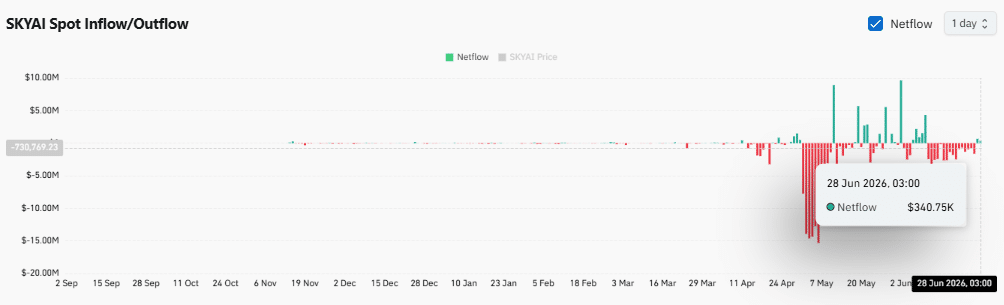
Spot flow data revealed a positive Exchange Netflow of roughly $340.75K during the latest session. The reading showed that more SKYAI tokens moved onto exchanges than left them, increasing the amount of supply immediately available for trading.

Unlike exchange outflows, which often reduce near-term selling pressure, these inflows suggested that holders prepared tokens for potential sales.

However, the relatively modest size of the inflow indicated that market participants had not yet triggered large-scale distribution.

Instead, traders appeared to react cautiously while monitoring price behaviour near an important support area.

If exchange inflows continue increasing over the coming sessions, additional selling pressure could emerge.

On the other hand, weakening inflows would suggest that distribution had begun to stabilize after the recent correction.
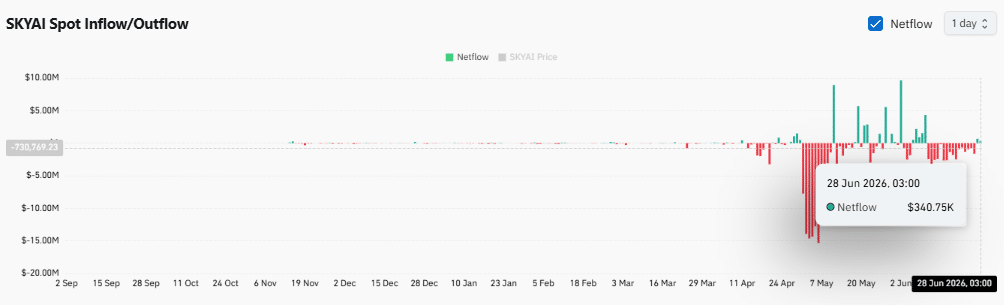
Source: CoinGlass

Can buyers defend support?

SKYAI revisited the demand zone around $0.168 after the latest sell-off erased much of its recent recovery.

Buyers responded near this region and prevented an immediate breakdown below support, allowing the price to stabilize above the highlighted zone.

Even so, the broader technical picture remained fragile. MACD stayed below the zero line while its histogram continued printing negative bars, showing that bearish pressure had persisted throughout the correction.

In addition, the Parabolic SAR remained above the price near $0.436, confirming that sellers still controlled the prevailing trend.

However, the repeated defense of the $0.168 support suggested buyers had not completely surrendered.

If this demand zone continues attracting fresh demand, SKYAI could attempt a recovery toward the $0.335 resistance. Otherwise, losing this support would likely expose the token to another leg lower.
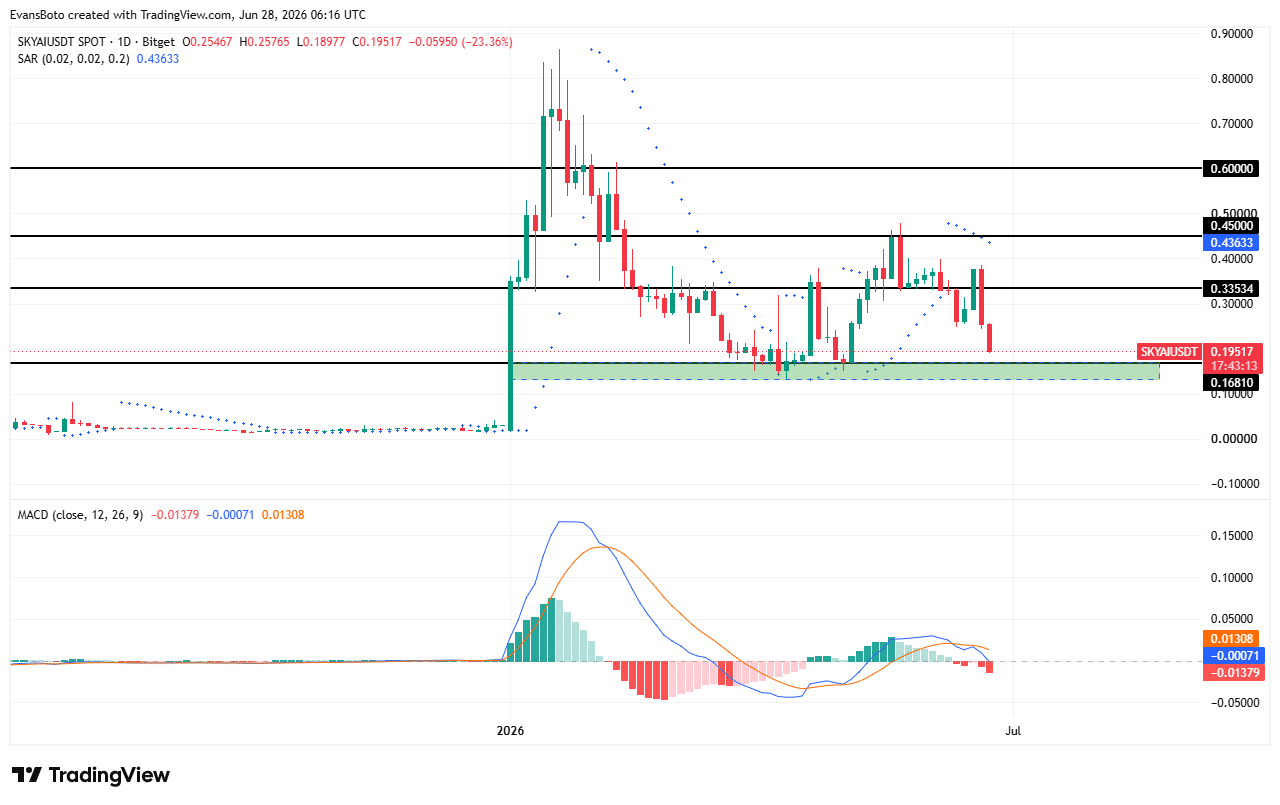
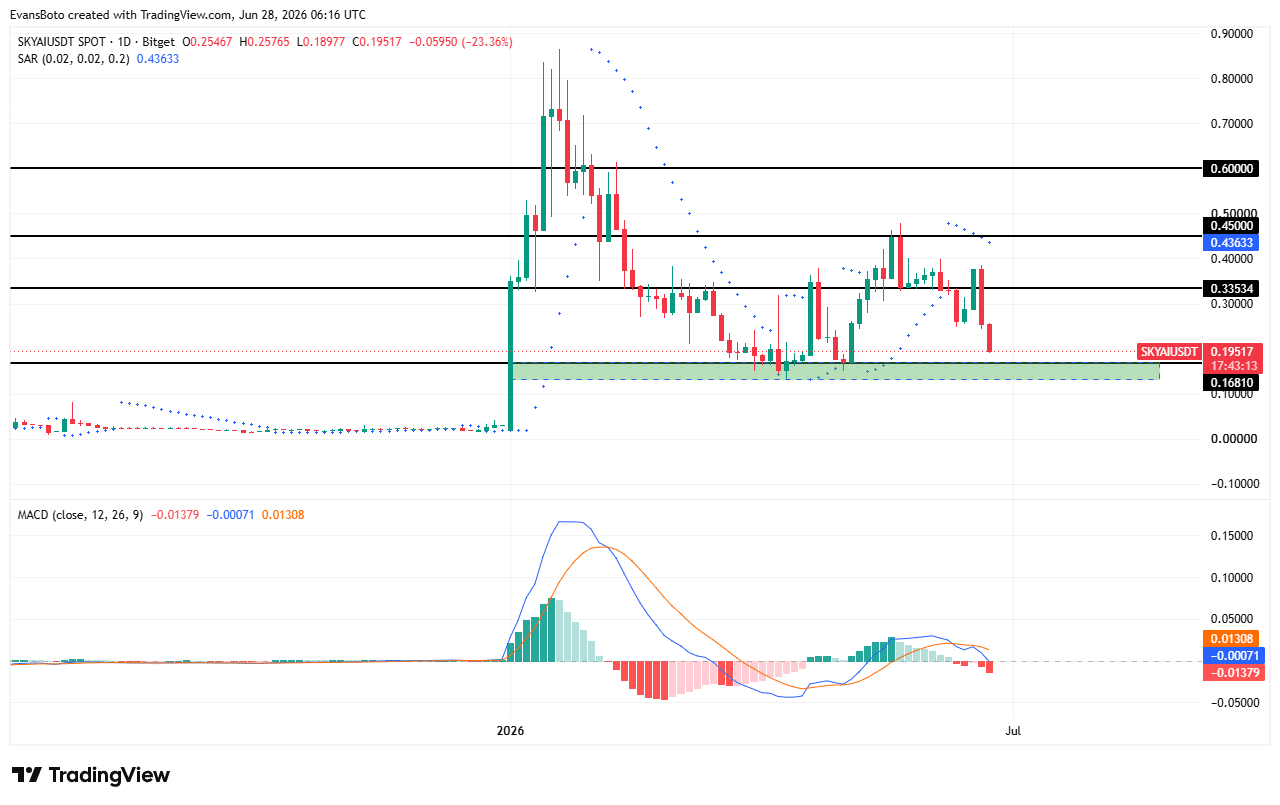
Source: TradingView

Can SKYAI avoid another breakdown?

SKYAI remained under pressure as strong trading activity accompanied falling prices, shrinking Open Interest, and positive Exchange Netflow.

Buyers defended the $0.168 demand zone, but technical indicators continued to favor sellers.

If demand continued strengthening around the current support, the token could attempt a recovery toward higher resistance levels.

However, another decisive break below $0.168 would likely extend the correction before a sustainable rebound develops.


Final Summary

  • SKYAI buyers defended the $0.168 demand zone despite rising exchange inflows and selling pressure.
  • Falling Open Interest suggested leverage cooled, but bearish indicators still favored another downside test.


Criptos en tendencia

Preguntas relacionadas

QWhat was the main event described in the article regarding SKYAI's price action?

ASKYAI experienced one of its steepest daily declines, losing 36.2% of its value over 24 hours and hitting monthly lows, despite a 70.85% surge in daily trading volume.

QWhat does the sharp decline in Open Interest (OI) for SKYAI derivatives suggest according to the article?

AThe 36.65% decline in Open Interest suggests traders rapidly closed leveraged positions during the correction, indicating widespread liquidation and voluntary exits rather than just new bearish bets, which reduced speculative leverage.

QWhat is the significance of the positive Exchange Netflow mentioned in the article?

AA positive Exchange Netflow of roughly $340.75K indicates that more SKYAI tokens were moved onto exchanges than off them, increasing the immediate supply available for trading and suggesting some holders were preparing tokens for potential sales.

QWhat critical price level are buyers attempting to defend for SKYAI, and what is the potential consequence of losing it?

ABuyers are attempting to defend the demand zone/support level around $0.168. Losing this support would likely expose the token to another leg lower in its price correction.

QBased on the article's final summary, what two key factors create a mixed outlook for SKYAI's immediate future?

AThe mixed outlook comes from 1) Buyers defending the $0.168 demand zone, but 2) Bearish technical indicators still favoring another downside test despite the cooling of leverage (falling Open Interest).

Lecturas Relacionadas

2028: The Arrival of Recursive Self-Improvement (RSI)

**AI Recursive Self-Improvement (RSI): The Countdown to 2028 Begins** AI is no longer just a trained tool but is starting to rewrite its own evolutionary pace. According to Anthropic co-founder Jack Clark, there is a 60% probability that by the end of 2028, Recursive Self-Improvement (RSI) will become a reality. This means AI could autonomously design and build a more capable next-generation version of itself without any human researcher involvement—Claude 10 creating Claude 11, for instance. Supporting this timeline, Google DeepMind's CEO Demis Hassabis confirms that all leading AI labs are intensely focused on RSI, making it an industry-wide priority. He expresses profound concern, stating this potential is what keeps him awake at night. Concrete data underscores this acceleration: - METR evaluations show current top models like Claude are solving tasks up to the 16-hour limit of existing test frameworks. - In Epoch AI's challenging MirrorCode benchmark, Claude Opus 4.7 recreated complex software in hours for a fraction of the human cost. In one extreme test, AI autonomously coded for 19 days straight. - Anthropic reports over 80% of its codebase is now written by Claude, and researcher productivity has increased up to 8-fold since 2024. - OpenAI's policy blueprint highlights RSI as a major upcoming governance challenge. CEO Sam Altman reportedly hinted RSI might arrive within six months, potentially delaying OpenAI's massive IPO. The implication is an impending "intelligence explosion," where AI-driven progress outpaces human control. The central question is no longer if it will happen, but whether humanity is ready.

marsbitHace 5 hora(s)

2028: The Arrival of Recursive Self-Improvement (RSI)

marsbitHace 5 hora(s)

World Models, Metaverse, Digital Twins, Physical AI: Are They the Same Thing?

Title: World Models, the Metaverse, Digital Twins, Physical AI: Are They the Same Thing? The article clarifies that concepts like the metaverse, Web3, simulation platforms, digital twins, and Physical AI are not the same thing but are all part of the broader trend of blurring the lines between the digital and physical worlds. It positions "world models" as the foundational "cognitive layer" or "operating system" that enables AI to understand and simulate the world. Key distinctions are made: - The **Metaverse** is a destination for immersive social and economic experiences. World models could act as its "engine," generating interactive 3D content efficiently. - **Web3** focuses on decentralized ownership and economics (rules layer), operating on a different technical level than world models. - **Simulation Data Platforms** (e.g., for autonomous vehicles) are a 1.0 version, relying on manual design. World models represent a 2.0 version, using AI to generate realistic, varied scenarios autonomously. - **Digital Twins** create high-fidelity, real-time mirrors of physical systems (e.g., a factory). World models go a step further by enabling predictive simulation of future states. - **Physical AI** (robots, AVs) refers to AI that acts in the physical world. World models are a core component, providing the understanding and prediction needed for planning. A proposed hierarchy places world models at the cognitive layer, supported by infrastructure (compute, data) and supporting application tools (simulation, digital twins), action systems (Physical AI), user experiences (metaverse), and rules (Web3). In conclusion, while distinct, many of these previously hyped concepts may ultimately rely on advances in world model technology to fulfill their promises, as world models provide the essential cognitive foundation for simulating and interacting with complex environments.

marsbitHace 5 hora(s)

World Models, Metaverse, Digital Twins, Physical AI: Are They the Same Thing?

marsbitHace 5 hora(s)

"Shocking" CPO: How Does the Glass Bridge Actually Work? Detailed Explanation from Corning

Chinese CPO stocks plunged over 6% following Corning's announcement of its Glass Bridge platform at a Seoul tech conference. The new technology utilizes wafer-level glass ion-exchange waveguides for passive alignment between fibers and photonic chips, potentially simplifying traditional CPO architectures that rely on complex Fiber Array Units and active alignment equipment. This raised market concerns about reduced long-term demand for mid-stream CPO components. Corning's official documentation details Glass Bridge as a platform for fiber-to-PIC connectivity in NPO, CPO, and high-density modules. Its key features include wafer-level manufacturing for consistent, cost-effective production; a standardized, removable MT ferrule interface for ecosystem integration; and a separable high-density connector design supporting over 24 channels for assembly flexibility. Corning positions the technology as complementary to FAUs, addressing limitations in ultra-high-fiber-count scenarios. The market reaction reflects a broader reassessment of the AI optical interconnect value chain. Funds shifted from CPO and PCB manufacturing stocks towards glass substrate concept stocks like Kaisheng Technology and Dyer Laser. Analysts note glass substrates are seen as a next-gen advanced packaging material, offering a potential path for domestic industry differentiation amid AI-driven demand for high-performance, large-scale packaging, marking a structural migration in value towards upstream specialty materials.

marsbitHace 5 hora(s)

"Shocking" CPO: How Does the Glass Bridge Actually Work? Detailed Explanation from Corning

marsbitHace 5 hora(s)

Trading

Spot

Artículos destacados

Cómo comprar SKYAI

¡Bienvenido a HTX.com! Hemos hecho que comprar SKYAI (SKYAI) sea simple y conveniente. Sigue nuestra guía paso a paso para iniciar tu viaje de criptos.Paso 1: crea tu cuenta HTXUtiliza tu correo electrónico o número de teléfono para registrarte y obtener una cuenta gratuita en HTX. Experimenta un proceso de registro sin complicaciones y desbloquea todas las funciones.Obtener mi cuentaPaso 2: ve a Comprar cripto y elige tu método de pagoTarjeta de crédito/débito: usa tu Visa o Mastercard para comprar SKYAI (SKYAI) al instante.Saldo: utiliza fondos del saldo de tu cuenta HTX para tradear sin problemas.Terceros: hemos agregado métodos de pago populares como Google Pay y Apple Pay para mejorar la comodidad.P2P: tradear directamente con otros usuarios en HTX.Over-the-Counter (OTC): ofrecemos servicios personalizados y tipos de cambio competitivos para los traders.Paso 3: guarda tu SKYAI (SKYAI)Después de comprar tu SKYAI (SKYAI), guárdalo en tu cuenta HTX. Alternativamente, puedes enviarlo a otro lugar mediante transferencia blockchain o utilizarlo para tradear otras criptomonedas.Paso 4: tradear SKYAI (SKYAI)Tradear fácilmente con SKYAI (SKYAI) en HTX's mercado spot. Simplemente accede a tu cuenta, selecciona tu par de trading, ejecuta tus trades y monitorea en tiempo real. Ofrecemos una experiencia fácil de usar tanto para principiantes como para traders experimentados.

236 Vistas totalesPublicado en 2025.04.22Actualizado en 2026.06.02

Cómo comprar SKYAI

Discusiones

Bienvenido a la comunidad de HTX. Aquí puedes mantenerte informado sobre los últimos desarrollos de la plataforma y acceder a análisis profesionales del mercado. A continuación se presentan las opiniones de los usuarios sobre el precio de SKYAI (SKYAI).

活动图片