Silicon Valley AI Status: Whoever Has the Compute is the Boss

marsbitPublished on 2026-10-12Last updated on 2026-10-12

Abstract

The Silicon Valley AI Power Crunch: Compute is King Silicon Valley's race for AI dominance has devolved into a desperate scramble for computing power. The situation has become so extreme that even top executives are resorting to unusual measures. Anthropic's CEO Dario Amodei was reportedly turned down by Meta's Mark Zuckerberg when seeking additional GPU resources, leading to a deal where SpaceX acts as a broker, reselling Nvidia GPUs to Anthropic. This venture reportedly generated $2.561 billion in quarterly AI revenue for SpaceX. The shortage is reshaping the industry's dynamics, creating a new "compute economy" where GPU access is the ultimate currency. This scarcity is causing internal strife at major firms and altering competitive landscapes. A high-profile example is Noam Shazeer, a key AI scientist whom Google re-hired for $2.7 billion, only for him to leave for OpenAI reportedly due to insufficient compute resources for his team. Similar frustrations over resource allocation have been cited within Google and DeepMind. For AI startups, the challenge is existential. Cloud providers are now demanding multi-year contracts with large upfront payments, making flexible, on-demand access nearly impossible. This has spurred innovative workarounds, including a new market for "global compute prospecting"—companies scavenging for underutilized server capacity worldwide—and venture capital firms like Y Combinator and Radical Ventures directly acquiring and allocating GPU cluste...

No other way! Silicon Valley has gone completely! insane! in the fight for AI compute.

Even Dario Amodei, CEO of A-something (presumably Anthropic), had to humbly beg at rival Meta's door:

Bro, can you spare some compute...

Guess what happened? Zuck politely declined, and Musk reaped the benefits:

SpaceX acted as a second-hand dealer for NVIDIA GPUs, reselling compute to Anthropic, making an absolute killing—

The August earnings report showed impressive growth, with quarterly AI business revenue alone reaching a staggering $2.561 billion, a 247% year-over-year increase, and more than doubling quarter-over-quarter.

Wow! For compute, Silicon Valley is going all out, the era of the Great Alliances has officially arrived.

No matter how viciously they trash-talked each other online before, they still have to bend the knee for GPU power offstage.

They have to bend. Just look at Google, which is falling behind.

Top scientist Noam Shazeer, lured back with a cool $2.7 billion, left for OpenAI within two years because of a lack of compute.

Others spend money and at least hear a sound; Google is just purely doing charity. (doge)

Anyway, Silicon Valley has finally gotten the taste:

Whether talent can be retained, whether models can stay ahead, whether AI can truly generate cash... these questions increasingly depend on how much compute one has left in hand.

GPUs Become Silicon Valley's Hard Currency

In the past, the shortages were money and talent; now it's the compute economy taking the spotlight.

Even a tech giant as strong as Google cannot guarantee its star researchers sufficient GPU resources.

Mention Noam Shazeer, and the first thing that comes to mind is one of the Transformer eight authors. He left Google in 2021 to found Character.AI, dedicated to developing generative AI chatbots.

In 2024, Google spent $2.7 billion in a deal to bring Shazeer back, appointing him as co-head of Gemini.

A researcher like this should be someone giants fight to guarantee resources for.

But according to the latest foreign media reports, his team also faced the difficult situation of having compute resources reassigned, forcing Shazeer to defect to rival OpenAI.

Similarly, Demis Hassabis had long expressed dissatisfaction with insufficient compute for projects, which to some extent also influenced his decision to step down as DeepMind CEO.

Currently within Google, there are significant disagreements about resource allocation. Sergey Brin sometimes directly intervenes, reallocating resources to projects he deems important.

But ultimately, it's still a shortage of compute resources, forcing them to cut costs and be frugal.

External competition has made industry relationships even more complex.

Top startups like OpenAI and Anthropic aren't just competing on model capabilities; they're also fighting for data centers, servers, and power supply capacity.

Take Anthropic as an example. Its model's compute demand has grown so large that it needs to discuss supply with another model company.

The cooperation agreement with SpaceX in May stipulated receiving over 300 megawatts of new capacity that month, involving 220,000 NVIDIA GPUs, while increasing usage quotas for Claude Code and the API.

In other words, the purpose is to let the backend secure more compute to supply the frontend. With compute secured, models become stronger, and users stay.

Thus, the competition among model companies now operates on two simultaneous logics:

At the product level, they still fight for users and development talent; at the infrastructure level, whoever can provide resources promptly could become a potential partner.

What about small AI startups surviving in the cracks?

Their situation is even more dramatic.

These companies struggle to build their own data centers, but in the past, they could rely on flexibly renting GPUs from cloud platforms like AWS, paying as they go.

However, as top AI labs lock down vast compute resources, some cloud service providers now demand multi-year contracts, with upfront payments as high as 30% of the contract value, even requiring startups to find payment guarantors.

All of the above puts startups in a dilemma.

Buy too much compute, and if future user growth falls short of expectations, the continuously burning cash is wasted; buy too little, and they might miss growth opportunities due to lack of computing resources to handle demand.

This situation has ironically spawned a new business: global compute gold rush.

That is, finding underutilized AI server resources around the world and then leasing this compute to needy companies.

For example, the representative company San Francisco Compute once went to old chicken coops in rural America to collect servers, and Musk also discussed further compute cooperation with TSMC.

Top VCs in Silicon Valley have also started hoarding GPUs themselves. YC launched a dedicated GPU cluster for its portfolio companies in July, and Radical Ventures helps its portfolio companies coordinate supplier contracts.

This slightly alleviates the urgent needs of small teams currently training or deploying models.

AI Compute War Spins Out of Control

But blocking isn't as good as channeling. The reasons for this compute shortage are actually quite complex.
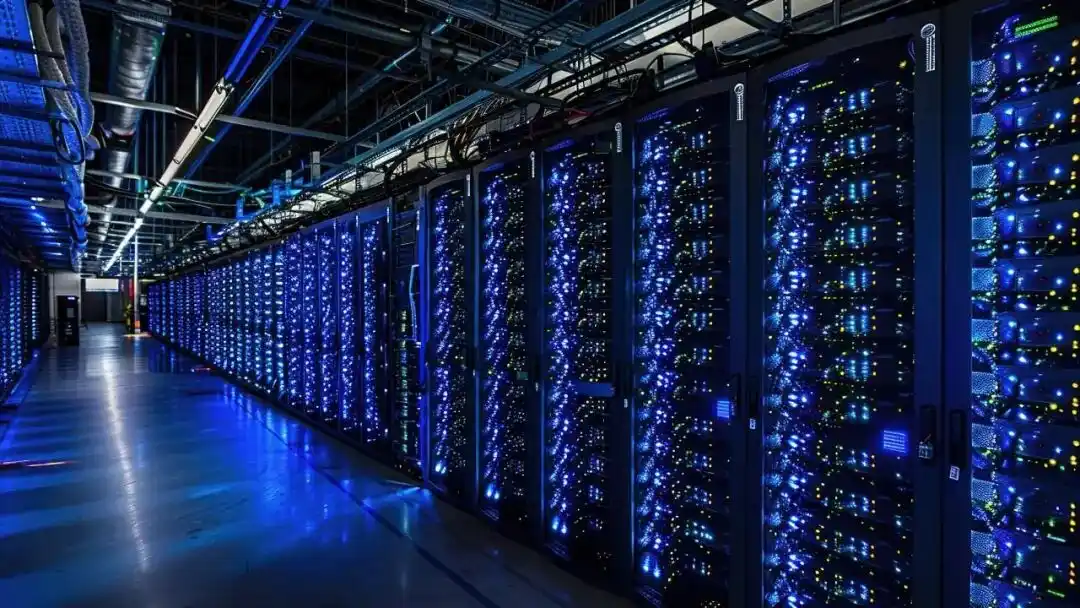
OpenAI, Meta, and even Google are actively building new data centers, promising future massive GPU resources.

But the rapidly growing demand from models can't wait. This time gap, or the big promises being made, is one reason companies still have to scrounge for compute everywhere.

The way users employ AI also unintentionally adds pressure on supply.

Starting this year, Agents began replacing Q&A as the core paradigm for user interaction. Continuous, long-duration work tasks force servers to handle more parallel computing.

After demand increased, even the leasing market for chips changed dramatically.

Data released by SemiAnalysis in April shows that the one-year lease contract price for H100 GPUs rose from a low of $1.70 per GPU per hour in October 2025 to $2.35 in March 2026, an increase of nearly 40%.
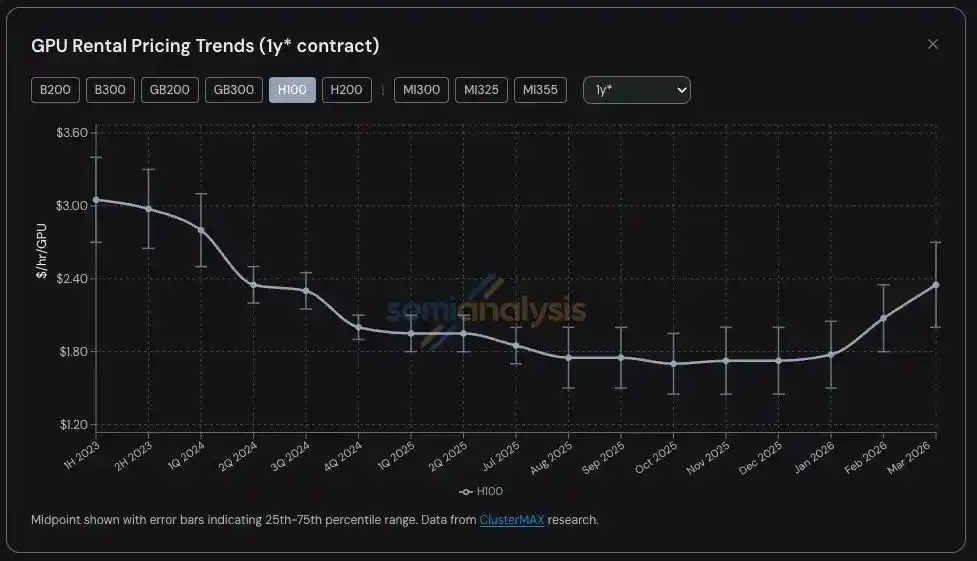
The saying that GPUs are like gold is not unfounded.

Truly available, immediately deliverable, and stably running compute is insufficient, while new compute is still a distant promise. Together, they create the predicament of the compute market.

Thus, compute hegemony becomes concrete.

The narrative of startups challenging industry giants will increasingly fade. Even if someone has a vision and a roadmap, without enough computing resources, it's game over.

It's clear that compute is becoming the entry barrier for the AI era, reinforcing the advantages of large companies with self-built infrastructure.

You could say: with compute, comes power.

Those making AI products also have more to consider. They must worry about products having no users, and also worry about user growth outpacing their own compute expansion.

But hardship is also opportunity; the middlemen selling shovels are overjoyed.

Isn't that right, Jensen?

References

[1]https://www.wsj.com/tech/ai/ai-computing-power-demand-a63da9b9?st=tzDj41

[2]https://www.anthropic.com/news/higher-limits-spacex

[3]https://newsletter.semianalysis.com/p/the-great-gpu-shortage-rental-capacity

This article is from the WeChat public account "QbitAI", author: Lu Yu

Related Questions

QAccording to the article, why did Anthropic's CEO approach Meta, and what was the outcome?

AAnthropic's CEO Dario Amodei approached Meta to request computing power (算力) for AI development. The outcome was that Meta's Mark Zuckerberg politely declined. Consequently, SpaceX stepped in as a reseller of Nvidia GPUs to supply Anthropic, profiting significantly from the deal.

QWhat major shift is occurring in the Silicon Valley AI industry regarding competition, as described in the article?

AThe article describes a major shift towards a '大连横时代' or 'Great Horizontal Alliance Era' in Silicon Valley's AI industry. Competition is no longer just about product features or talent; it has fundamentally become a battle for computing power infrastructure. Former rivals are now forced to collaborate or transact for GPU resources, with infrastructure access becoming a critical competitive advantage.

QWhat was the consequence for Google after acquiring top scientist Noam Shazeer for $2.7 billion?

ADespite acquiring top AI scientist Noam Shazeer for $2.7 billion in 2024, Google was unable to provide his team with sufficient GPU computing resources. This lack of resources led Shazeer to leave Google and join its competitor, OpenAI, illustrating how a shortage of computing power can cause even major tech giants to lose top talent.

QHow has the GPU rental market changed, and what impact does this have on small AI startups?

AThe GPU rental market has tightened significantly. The one-year lease price for an H100 GPU increased by nearly 40% between October 2025 and March 2026. For small AI startups, cloud providers now often require multi-year contracts with large upfront payments (up to 30% of the contract value) and even payment guarantors. This creates a dilemma: securing too much compute risks financial loss if growth is slow, while securing too little risks missing growth opportunities.

QWhat new business model has emerged as a result of the AI computing power shortage?

AA new business model of 'global compute prospecting' or '算力淘金' has emerged. Companies now seek out underutilized AI server resources globally and rent this computing power to enterprises in need. Examples include firms searching for servers in places like old chicken coops in rural America, and collaborations like the one between Elon Musk and TSMC. Venture capital firms are also directly hoarding GPUs to support their portfolio companies.

Related Reads

Xsolla ZK Introduces a Gas Token Designed to Let Digital Items Move Between Games and Players

Xsolla ZK, Inc. has introduced Xsolla Gas (XLA), the native token of Xsolla ZK, an Ethereum Layer 2 ZK rollup network for games. XLA is designed to pay network fees when players transfer or share eligible digital items on the network. Players who prefer not to set up a separate wallet can buy XLA-NT, a non-transferable gas credit usable only for network fees on Xsolla ZK, through Xsolla Gas Station using familiar payment methods. XLA is also available on crypto exchanges including Kraken, LBank, and Biconomy in supported markets. The initiative addresses a key limitation: most digital items today live on a single game's backend and cannot be transferred to friends or used in other games, and they become inaccessible if a game shuts down. Blockchain-backed items stay with players, but transferring them typically requires a separate wallet and the right token. Xsolla ZK aims to lower these barriers. Players use Xsolla Backpack, an inventory for owned digital items; items issued in transferable form are designed to remain available even if the issuing game shuts down, and players can give them to others. Players sign in with their usual account, without needing a seed phrase or separate wallet setup. Chris Hewish, President of Xsolla (USA), said players should be able to share and gift digital items they own anytime, anywhere, with anyone they know, and that developers gain a new way to monetize games while players gain items that are theirs to keep. Developers and partners can also use XLA to pay network fees for their item activity. More than 1,500 game teams use Xsolla's tools, and Xsolla Backpack and Xsolla Gas Station are available without additional development for teams using compatible Xsolla products, integrating with existing player and payment flows. XLA is an ERC-20 token on Ethereum mainnet with a total supply of 1 billion and becomes the base token of Xsolla ZK through the canonical bridge.

TheNewsCrypto30m ago

Xsolla ZK Introduces a Gas Token Designed to Let Digital Items Move Between Games and Players

TheNewsCrypto30m ago

Hyperliquid API Wallet Permissions Keep Expanding: Once an AI Agent Is Attacked, It Could Drain the Main Account

As personal AI agents take over everyday financial decisions, Hyperliquid is seen as an ideal decentralized trading foundation thanks to its deep liquidity and composability. However, the API wallets that underpin automated trading have quietly seen their security boundaries erode across network upgrades over the past year. Lacking fine-grained permission policies, a compromised API wallet can even trigger staking slashing, spot locking, and priority fee burning, exposing the main account to total loss. The article traces how API wallets—originally scoped to prevent direct withdrawals or external transfers—have accumulated expanded permissions through successive upgrades, with no cap on margin exposure. A maliciously altered API wallet controlling an account with over ~$40M could buy 500,000 HYPE, stake it, link it to a malicious HIP-3 market, invite slashing, and lock the main account's funds for 183 days. Because API wallets are now the default trading method across the Hyperliquid frontend and third-party apps, and agents must interact with untrusted internet environments, prompt injection or key leakage can let attackers drain funds without ever stealing a private key. Existing fine-grained control via HyperEVM smart contracts introduces too much latency for high-frequency trading, while custodial solutions outsource trust to centralized middleware. The proposed fix is a lightweight bitmap permission field set at API wallet creation, recording which operation types the wallet may trigger—mirroring the mechanism already used in HIP-3 deployer sub-lists. Validating the signer against the main account's bitmap adds negligible overhead, and critically, old API wallets would never auto-inherit new permissions from future L1 upgrades. This would safely unlock staking and transfer interfaces, remove reliance on centralized custody, and pave the way for large-scale personal AI agent adoption on HyperCore.

marsbit1h ago

Hyperliquid API Wallet Permissions Keep Expanding: Once an AI Agent Is Attacked, It Could Drain the Main Account

marsbit1h ago

Upbit and Bithumb Customer Deposits Plunge 31.86%, Falling $1.87 Billion in 2026

Customer deposits in South Korean won at Upbit and Bithumb, South Korea's two largest crypto exchanges, fell 31.86% in the first nine months of 2026, according to regulatory disclosures published November 17. The platforms held about ₩5.36 trillion ($4 billion) in customer cash at end-September, down from ₩7.87 trillion at end-2025—a reduction of roughly ₩2.51 trillion ($1.87 billion). Upbit operator Dunamu saw deposits drop 31.9% from ₩5.83 trillion to ₩3.97 trillion, while Bithumb fell 31.8% from ₩2.04 trillion to ₩1.39 trillion. The figures were disclosed via South Korea's Financial Supervisory Service electronic filing system. Customer crypto holdings also lost value: Upbit's book value fell 10.9% from ₩62.23 trillion to ₩55.46 trillion, and Bithumb declined 13.1% from ₩17.90 trillion to ₩15.56 trillion. However, quantities of several major cryptocurrencies held for customers increased despite lower valuations—Upbit added 13,259 Bitcoin, 337,609 Ether and 1.22 million Solana versus year-end levels, and Bithumb reported higher holdings of Bitcoin, Ether, XRP and Solana. The data indicate the deposit decline does not necessarily mean investors withdrew entirely from the crypto market; disclosures do not explain whether funds went to bank accounts, crypto purchases or elsewhere. The drop comes amid weaker trading activity in South Korea's digital asset market, adding pressure on major exchanges.

TheNewsCrypto1h ago

Upbit and Bithumb Customer Deposits Plunge 31.86%, Falling $1.87 Billion in 2026

TheNewsCrypto1h ago

Trading

Spot
活动图片