Show me 'The Lord of the Rings', Karpathy Recommends New Benchmark for Large Model Evaluation

marsbitPublicado a 2026-08-03Actualizado a 2026-08-03

Resumen

In a new benchmark for evaluating large language models, Andrej Karpathy proposes replacing the once-popular "pelican riding a bicycle" SVG test with a more complex challenge: generating a 3D scene from the opening text of *The Lord of the Rings*. Using Anthropic's Opus 5 model and the Three.js library, the task consumed approximately 1 million tokens, 2 hours, and 5,500 lines of code to produce a rudimentary, low-polygon animation of the Shire. While the output is visually crude with notable glitches like floating characters, it demonstrates the model's ability to parse narrative text and translate it into a functional, programmatic 3D world with defined objects, cameras, lighting, and basic animation. This "Lord of the Rings benchmark" is argued to test a model's capacity for long-horizon project planning, spatial reasoning, and maintaining consistency across thousands of code lines—capabilities not fully captured by simpler single-output tests. The initiative has sparked community experimentation, with users generating other 3D worlds like a low-poly San Francisco, a data-driven New York City model, and even a virtual Kanye West concert. Karpathy suggests a future pipeline where code-generated scenes provide the structural "bones" for video-to-video models to enhance visual fidelity. While some debate the computational cost and specificity to Three.js, proponents see it as a test of a model's general ability to structure its understanding of the world into an executable ...

Without further ado, let's start the daily slump (doge)!

Just moments ago, the great Karpathy announced that "we" at Anthropic have started using a brand new way to push large models to their limits—

"The Lord of the Rings."
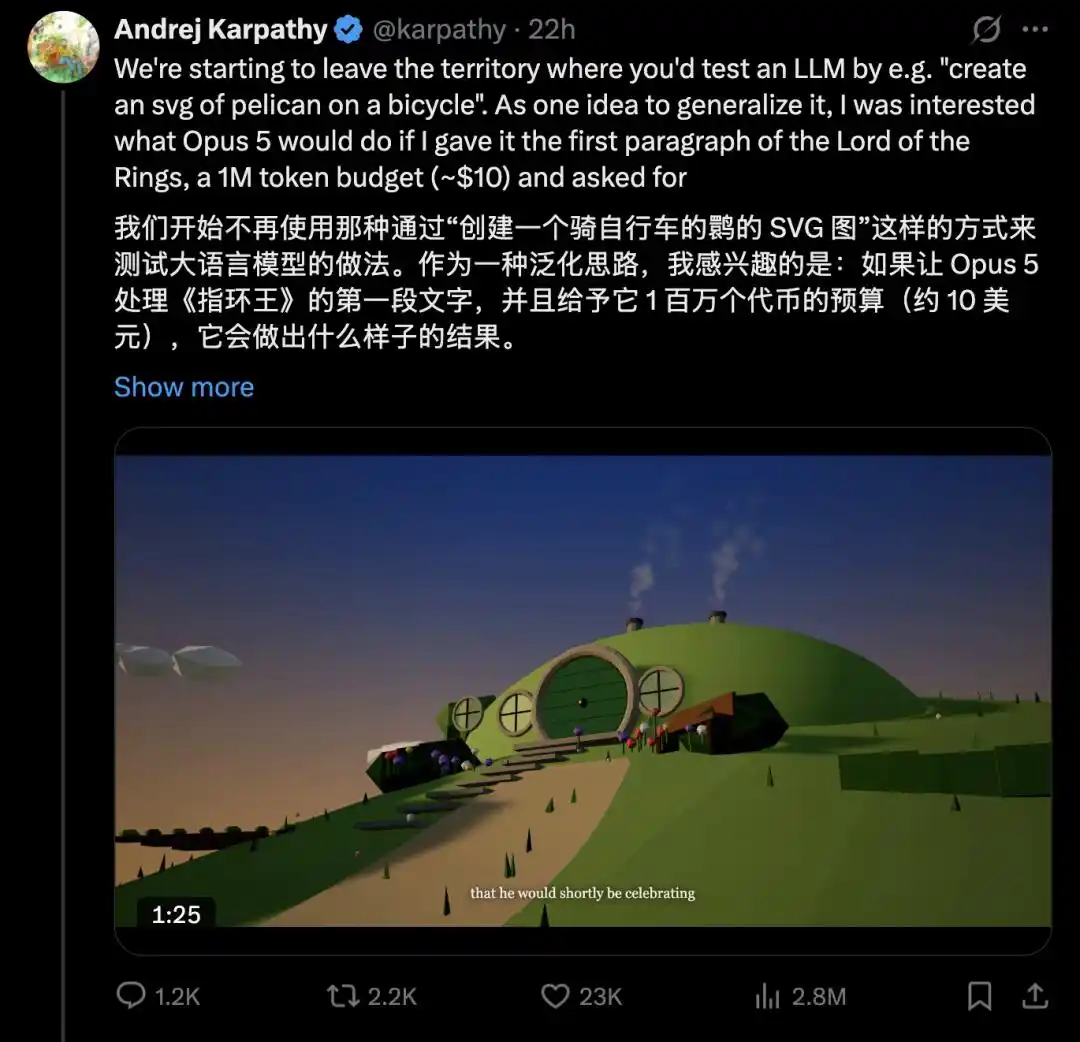
According to Karpathy, this "Lord of the Rings benchmark" is taking over from the once-popular "Pelican Riding a Bicycle" SVG test.
Specifically, Karpathy directly fed the beginning of "The Lord of the Rings" to Opus 5, instructing the model to use Three.js to craft an entire "Middle-earth" world on the spot.

As for the final effect... well, it somewhat resembles domestic 3D animations from the late 1990s and early 2000s: very rough and quite abstract.

But objectively speaking, if you look closely for a while and happen to be familiar with the "Lord of the Rings" filming location Hobbiton in New Zealand, you can indeed catch a hint of its flavor~

However, this seemingly unpolished creation genuinely cost Opus 5: 1 million tokens, 2 hours, and 5,500 lines of code.

Of course, it's not just the Claude model shining solo on this stage.

The most hilarious part is probably the new offering from netizens—a DeepSeek V4 Flash version.

It's a complete "Chinese people can fly" situation, with all characters floating in the air.

Faced with these currently obvious goofs, Karpathy was quite fair.

He pointed out that Opus 5 still cannot truly "enter" the world it generates; it can only continuously take screenshots at different time points and slowly check where things went wrong.

And this precisely exposes a significant shortcoming of current large models:

They can already write code, build scenes, and generate games, but they still cannot truly understand videos, nor can they actually play the games they create.

Two Hours, Crafting Middle-earth by Hand

Let's first look at how this "Lord of the Rings" test was conducted.

If taken literally from Karpathy's tweet, the main prompt input for Opus 5 should be the beginning of Chapter One, "A Long-expected Party," from "The Lord of the Rings" novel.

When Mr. Bilbo Baggins of Bag End announced that he would shortly be celebrating his eleventy-first birthday with a party of special magnificence, there was much talk and excitement in Hobbiton...

Interested folks can try it themselves.

In addition, Karpathy also specified Three.js in the prompt—a JavaScript library for building 3D scenes with code.

Thus, the task for Opus 5 was to first comprehend the text at the beginning of "The Lord of the Rings," and then translate it into a 3D world that could run in real-time in a browser.
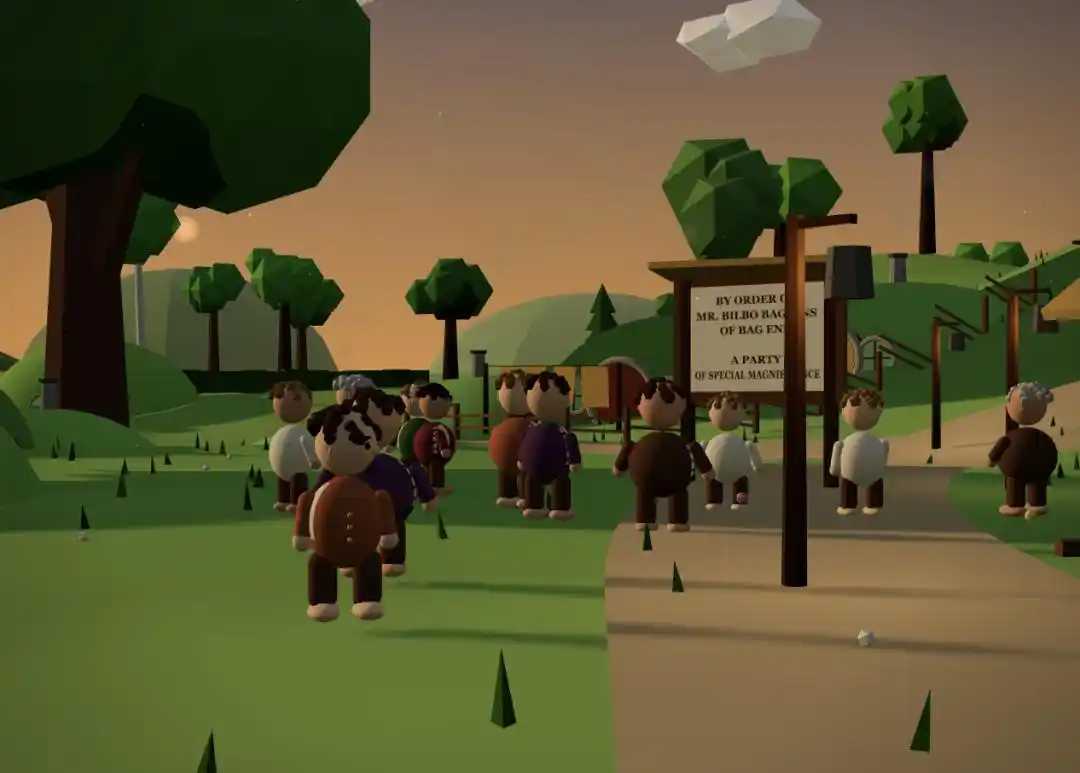
Throughout the process, Opus 5 needed to use polygons to piece together characters, buildings, and props, place them one by one into x, y, z coordinate systems, and then arrange cameras, lighting, and animations.

When characters should move, where the camera should turn, how lighting should change, and how objects in the scene should interact—all needed to be defined by the model using code.

Although the final visuals aren't exactly refined, and issues like clipping and floating frequently occur—for example, characters' bodies and heads separating... but at least the entire scene was genuinely built.
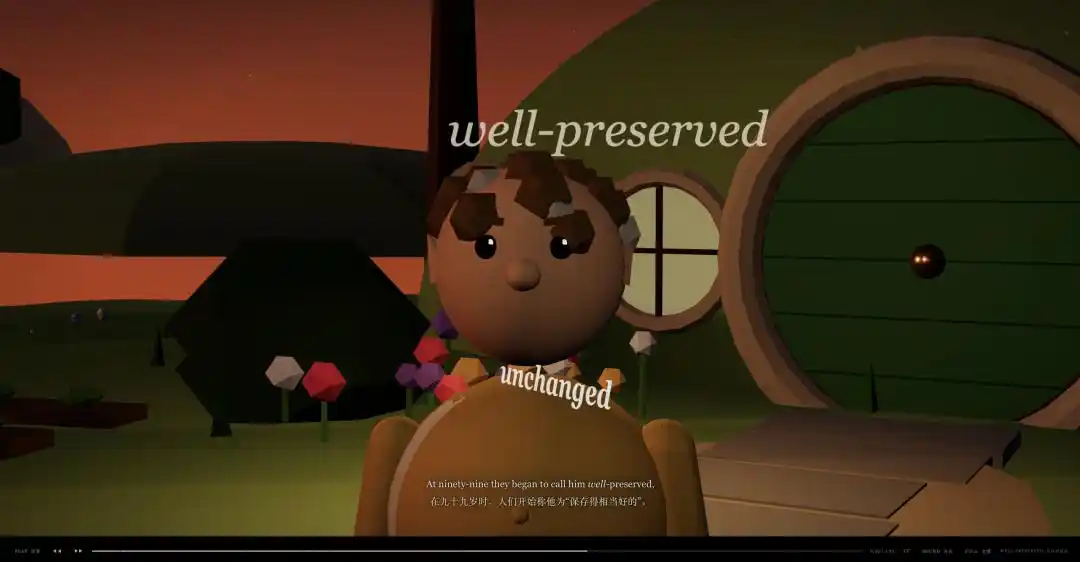
It's important to note that this is not the same as video models directly generating pixel frames.

Three.js first needs to build characters, objects, and scenes as 3D objects, then calculate their positions, angles, and motion states in real-time based on the code.

Therefore, the demo we see is not a regular AI-generated video, but a recording of a running 3D web scene.

However, Karpathy also mentioned in the comments that procedural 3D and video generation are not an either-or choice.

A netizen suggested that this rough Three.js recording could be fed to Sora as a reference video, letting the video model render it again with higher visual quality.
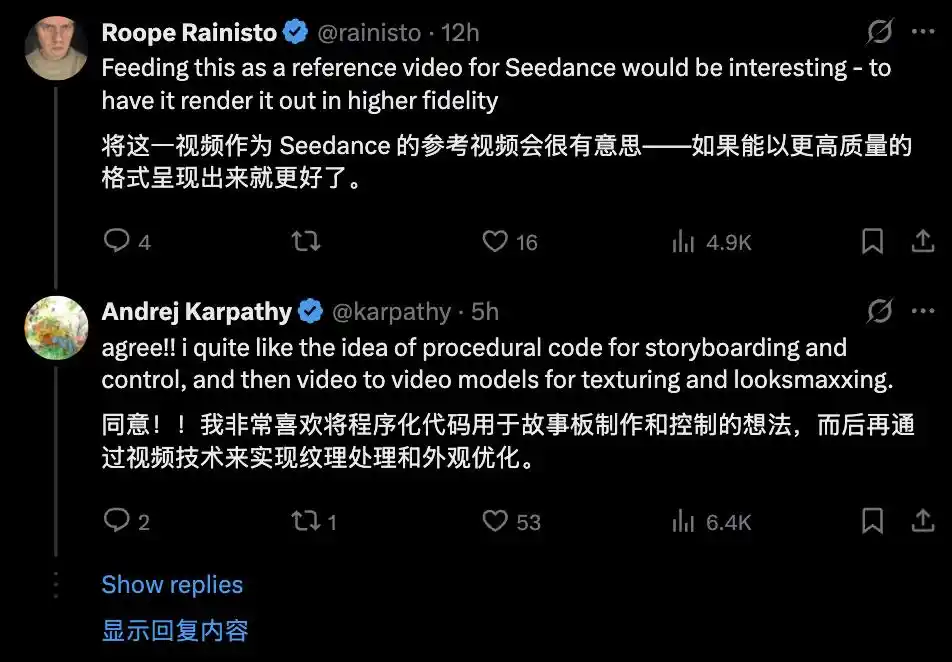
Karpathy quickly agreed.

According to his vision, procedural code could handle storyboarding and control, first finalizing the skeleton: where characters stand, how the camera moves, and how the plot progresses.

Then, the recording could be passed to a Video-to-Video model to add textures, lighting, shadows, and details, enhancing the overall "appeal" of the Middle-earth world.

As for audio, Opus 5 didn't handle it all this time.

Karpathy stated that, due to personal requirements for sound quality, he ultimately used ElevenLabs.
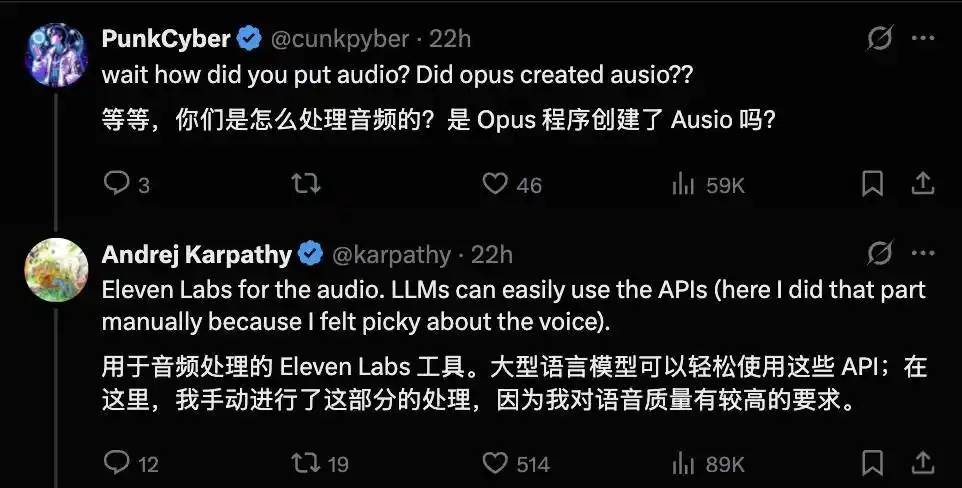
Thus, that "Lord of the Rings" demo with visuals, camera work, and narration at the beginning came into being.

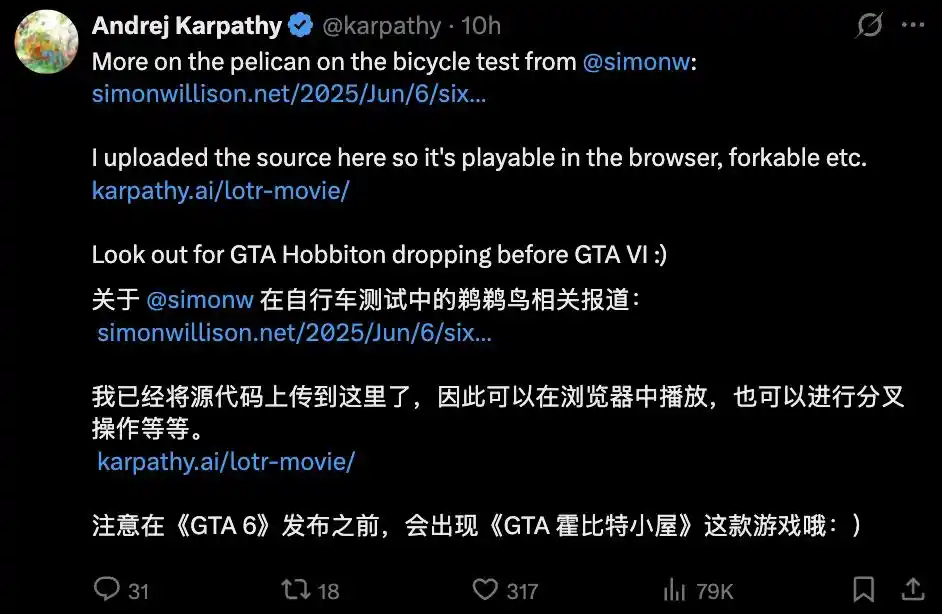
Karpathy has also open-sourced the entire project; the specific link can be found at the end.
Netizens Are More Interesting Than Karpathy

After Karpathy released the demo, many netizens also rushed to test it out.

Looking at the overall response, one can only say:

This bunch of netizens is more imaginative than Karpathy.

Someone used Claude to launch an 'Earth Online' project, aiming to build the entire Earth bit by bit with a group of AI Agents.

Currently, the Agents haven't finished the whole Earth, having only built a low-poly-style San Francisco waterfront area. But from the available visuals, the building proportions, character scales, and overall style remain quite consistent.

This effect is somewhat like those Lego-world animations. The art style isn't complex, but characters, scenes, and actions can operate stably within the same world.

Continuing in this direction, simple-styled animations and lightweight games are already showing a hint of AI-native potential.

Another netizen used Fable 5 and GPT-5.6 Sol to build a 3D digital model of New York City, incorporating real-time data into it.

The model not only had to position New York's streets and buildings correctly but also maintain spatial relationships between different areas. The author thus proposed that this task of generating virtual worlds could perhaps become a new benchmark for spatial reasoning.

Even more exaggerated examples followed.

One netizen couldn't get tickets to Kanye West's concert, so they simply used AI to host a private concert for themselves in the browser.

The entire project was still built with Three.js. It consisted of a single HTML file, without calling any pre-made 3D models; the stage, characters, and lighting were all generated by code.

The concert prepared 14 songs in total, each with independent lighting design and a dedicated set of spherical stage visuals.

Regular users could listen to clips; after connecting a Spotify Premium account, they could play full songs and the entire show.

Couldn't get tickets? Just generate a private show for yourself. Incredible!

And there's more!!!

Karpathy also envisioned in the original post that gameplay could be added to these 3D worlds later, allowing players to enter as observers, NPCs, or even story characters.

Before Karpathy could arrange a game version, netizens had already made one.
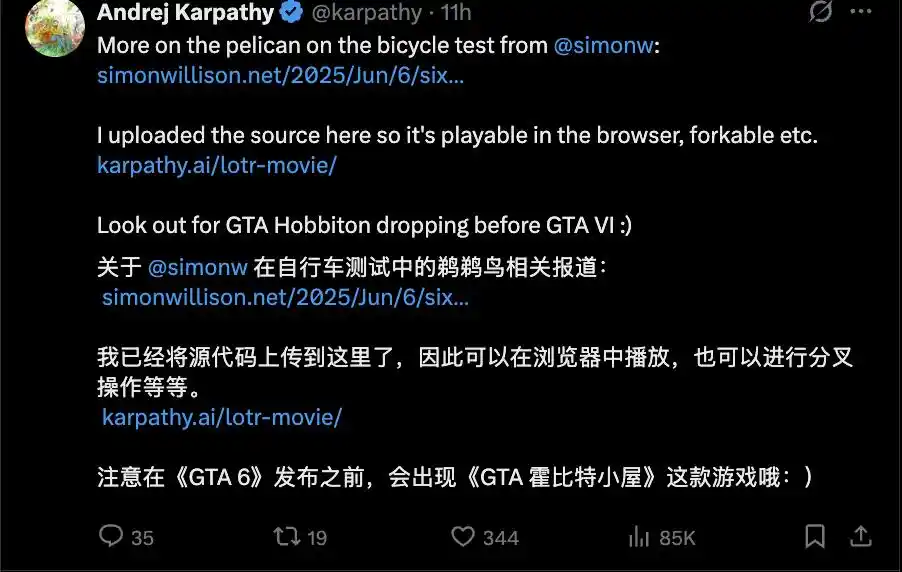
This project also used Opus 5 and Three.js. It could not only run and be interactive but also had audio added.

More 3D design cases kept appearing. From building proportions and spatial layouts to scene style, Opus 5 could already maintain relatively stable consistency across fairly large-scale projects.

There are many similar examples; we won't showcase them all here.

Objectively speaking, these works still have some distance from truly mature games.

Whether the dazzling array of gameplay is fun, if it runs stably over long periods, and if players would genuinely stay for 15 minutes—all these questions currently lack answers.

But the barrier to creating real-time 3D content and playable prototypes has indeed been significantly lowered.

Moreover, having a new way to test model capabilities that is also sufficiently fun and interesting—isn't that a beautiful thing?

The Pelican Has Ridden Far Enough

So, why suddenly ask large models to generate "The Lord of the Rings"?

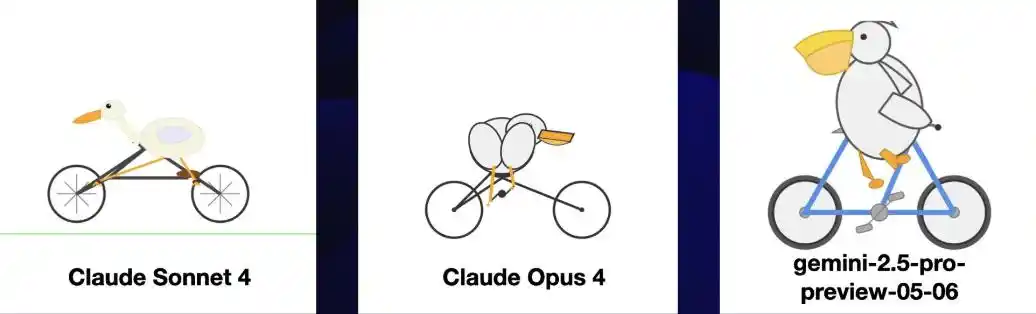
This goes back to the wildly popular "Pelican Riding a Bicycle" test from a few years ago.

This problem originated from developer Simon Willison, with only one sentence as the requirement:

Generate an SVG image of a pelican riding a bicycle.

Although this problem seems simple, it actually tests models quite significantly.

Because an SVG looks like an image, but its underlying structure is a string of code.

The model not only needs to know what a pelican and a bicycle look like separately but also must break them down into lines, circles, and polygons, then arrange the positional relationships of each component using coordinates.
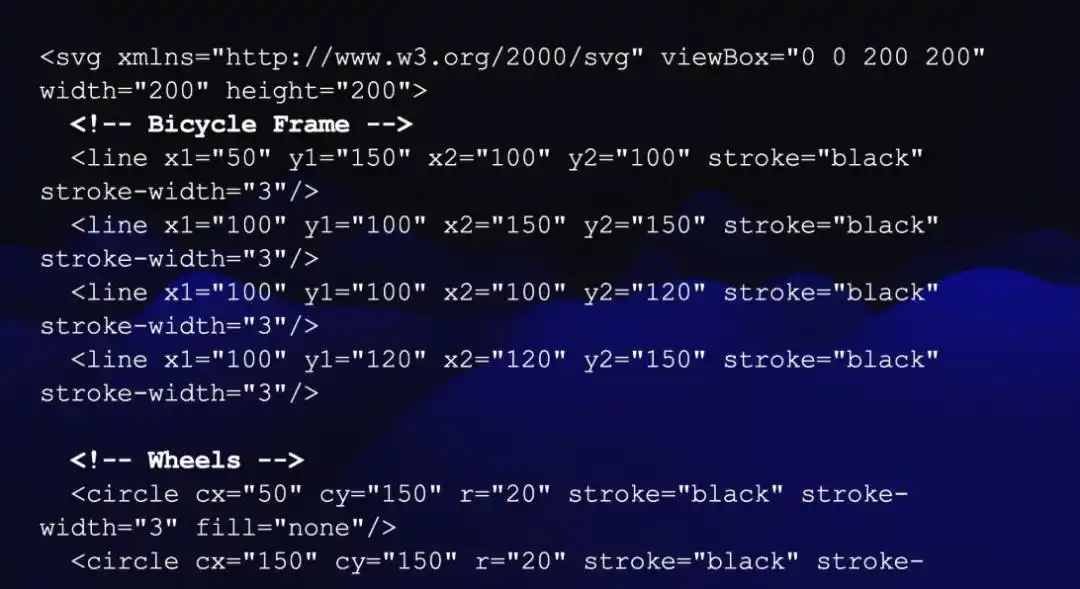
More crucially, pelicans and bicycles themselves are not a natural fit.

The bicycle's frame, tires, and pedals must maintain correct geometric structures; the pelican has a large beak, short legs, and a physique that doesn't look at all suited for pedaling.
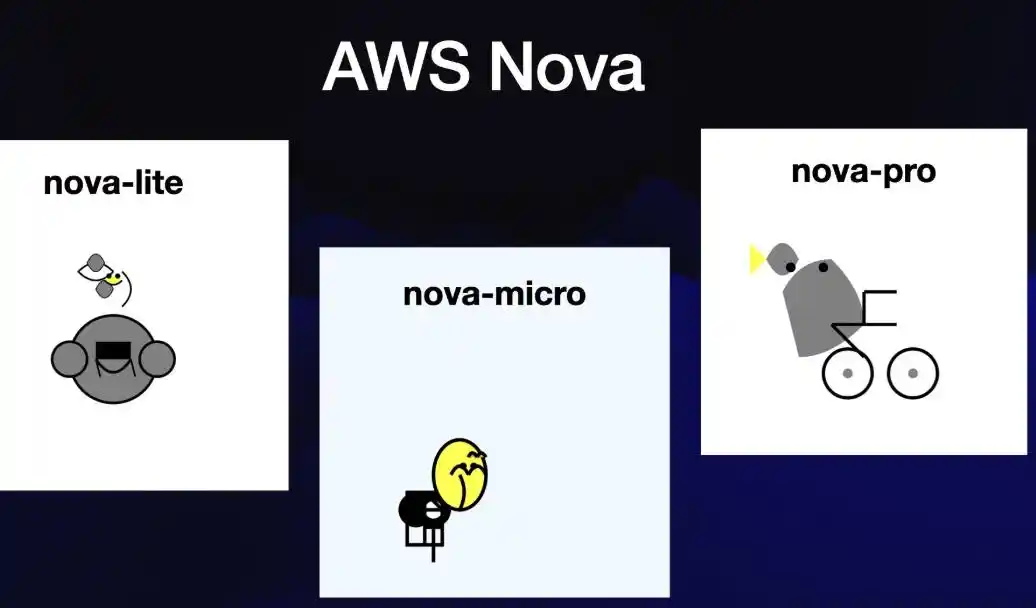
Combined, whether the model truly understands spatial relationships becomes almost immediately apparent:

Are the wheels crooked? Are the feet stepping on the pedals? Is the bird actually riding, or has it been dismembered by the bike frame?

Take a look at these demos from late 2024 above~

For this reason, "Pelican Riding a Bicycle" once became a classic folk test for observing large models' spatial understanding, object composition, and code generation abilities.
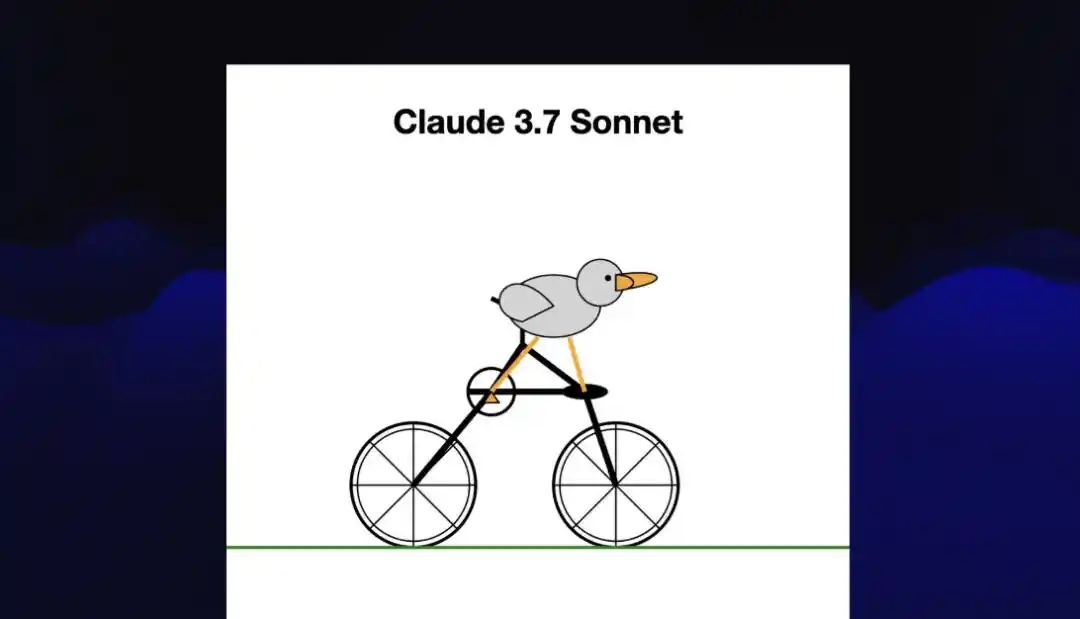
But as models grew stronger, this pelican's ride is nearing its end.

Just look at the performance of DeepSeek R1 and DeepSeek V4 below. Nowadays, models can handle this problem quite decently.
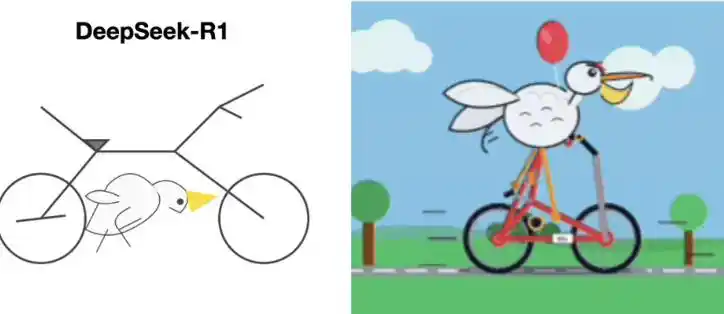
More importantly, a single SVG can only test a model's one-time output.

It cannot measure whether a model can plan a complex project, work continuously for hours, and repeatedly check and correct its own mistakes across thousands of lines of code.

Thus, Karpathy replaced a small "draw a picture" problem with a major "build a world" project—

The pelican can dismount now; Middle-earth officially takes over.
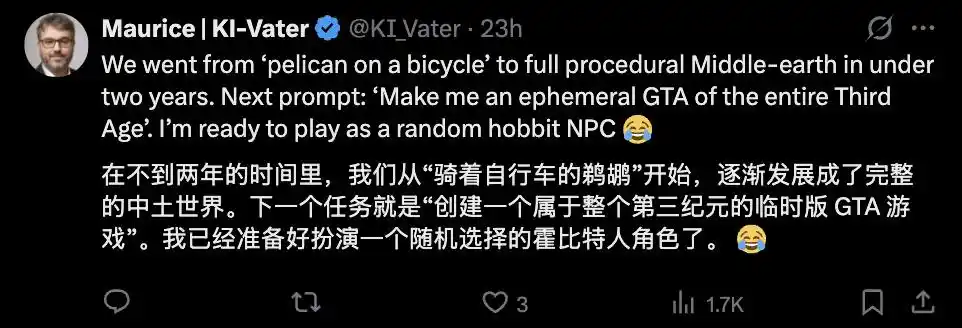
Karpathy's Pelican

Soon, news that Karpathy was preparing to change the "Pelican test" problem also spread to various communities.

High-rated comments on Hacker News argued that although the visual quality of these demos is generally low, this precisely indicates we need a new test more challenging than generating a single image.

The new benchmark shouldn't just see if the model can draw the picture correctly; it should also examine whether it can comprehend a world.
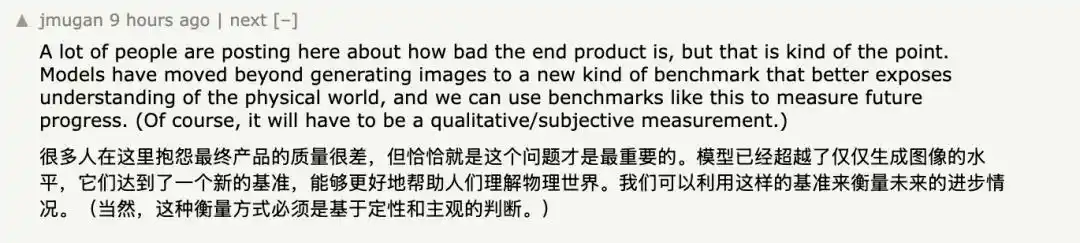
After all, "Pelican Riding a Bicycle" has been used for too long.

Models continuously optimize for this type of task on leaderboards, making the differences between them harder to discern.

In contrast, generating a complete 3D world requires the model to understand spatial relationships between characters and objects, handle camera, motion, and scene changes—not simply call a video generation model to spit out a sequence of frames.
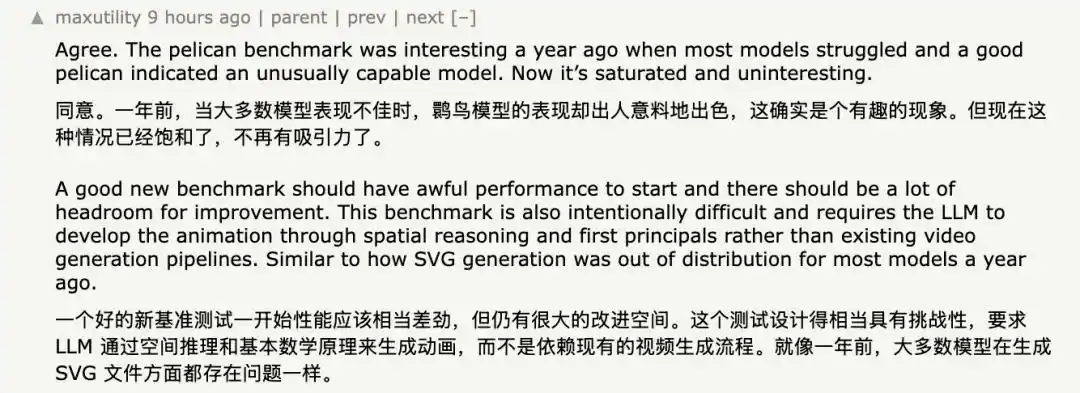
Of course, there were opposing opinions as well.

The Pelican test is sufficiently concise, low-cost, and its results are easy to compare.

Consuming so many Tokens to generate an entire 3D world just to test a model once seems a bit like setting off fireworks with computing power.
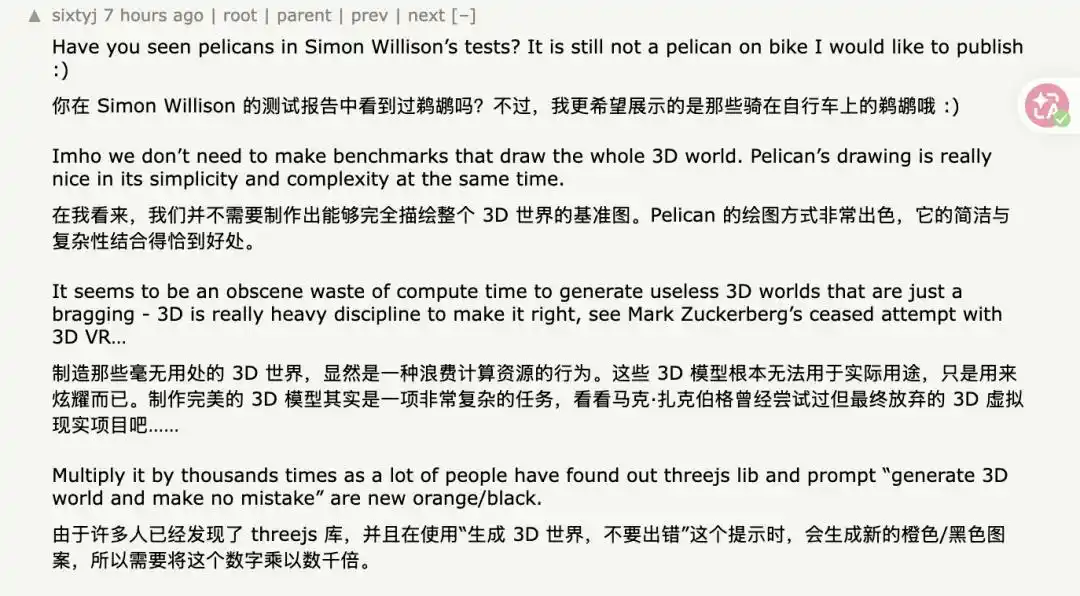
Simultaneously, whether Three.js itself can measure a large model's comprehensive abilities was also questioned.

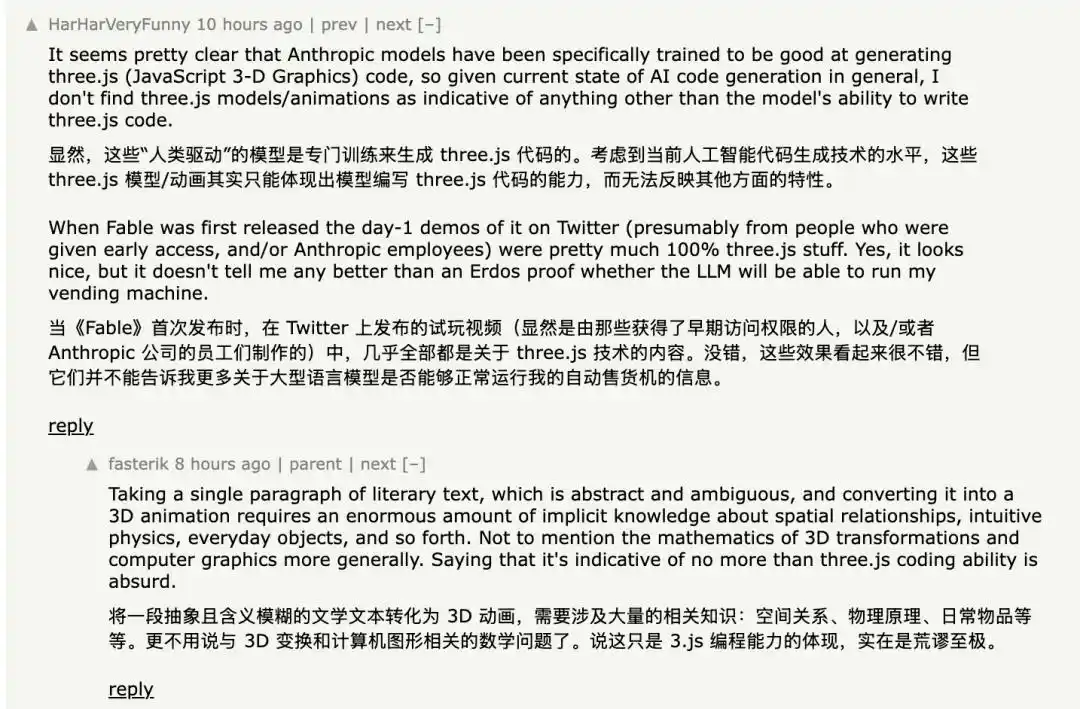
Some argued that such demos can at most prove that Anthropic has trained well on Three.js code, not that the model truly understands space and the physical world.

But soon, netizens rebutted:

Transforming an abstract, ambiguous literary text into a 3D animation requires the model to simultaneously handle spatial relationships, physical laws, everyday objects, as well as mathematical problems in 3D transformations and computer graphics.

If this is still considered merely "knowing how to write Three.js," that somewhat underestimates these 5,500 lines of code.
Another netizen raised an even more open question:

Is so-called "spatial reasoning" truly different from the reasoning large models typically perform when processing text and code?

One view holds that whether a scene holds up depends on whether the model understands spatial relationships like "front/back, inside/outside, near/far, occlusion," as well as the distance, angles, and relative sizes of objects from different viewpoints.
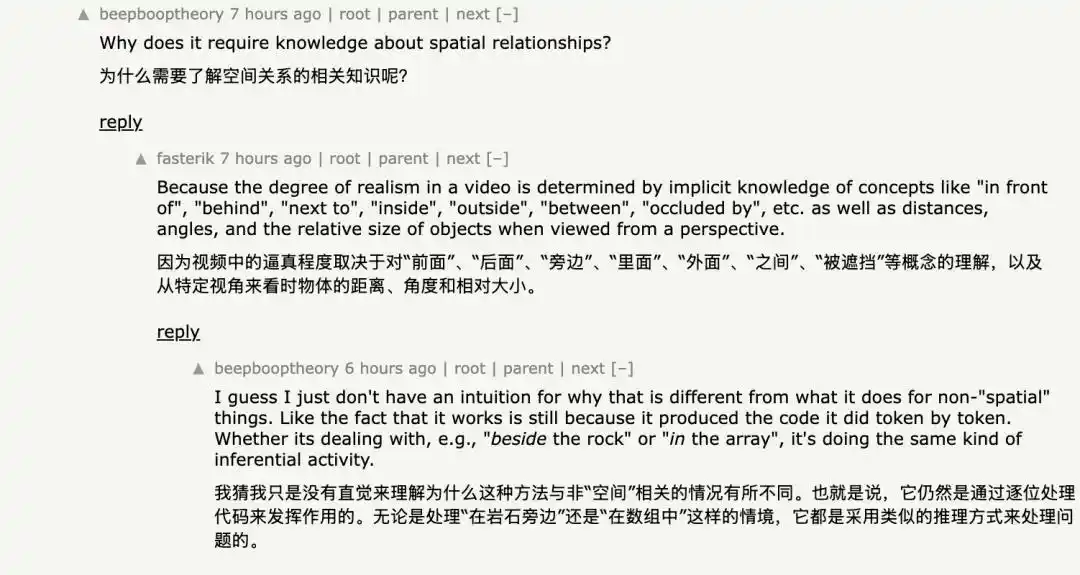
But another view argues that whether the model processes "beside a stone" or "inside an array," it might be doing the same thing: generating Tokens one by one based on context, completing reasoning in the process.

If so, then what Opus 5 demonstrates is not just a suddenly emerging "spatial ability."

A more likely scenario is that the general reasoning ability originally used by large language models to understand text and code has begun naturally extending into the three-dimensional world.

From drawing a pelican to building Middle-earth, the problem seems to have changed, but what's being tested behind the scenes might always be the same question:

Can the model transform its understanding of the world into a structure that can truly run.

And finally, perhaps there's an even more outrageous question—

If general large models can already write code to build 3D worlds themselves, then call APIs like Sora and ElevenLabs to complete visuals and audio, how much need is there left for users to personally open a specialized video generation product and input a Prompt?

Reference Links

[1]https://karpathy.ai/lotr-movie/

[2]https://simonwillison.net/2025/Jun/6/six-months-in-llms/

[3] https://x.com/wizardbrainz/status/2083012159341203708

[4]https://x.com/aniketjart/status/2083645765097033845

[5]https://x.com/davidfromkansas/status/2075691129899528254

[6]https://x.com/MindaugasLT/status/2083488027343470939

This article is from the WeChat public account "QbitAI," author: henry

Criptos en tendencia

Preguntas relacionadas

QWhat is the 'Lord of the Rings benchmark' proposed by Karpathy, and what does it test?

AThe 'Lord of the Rings benchmark' is a new test proposed by Andrej Karpathy for evaluating large language models. It involves giving a model, like Anthropic's Opus 5, the opening text from 'The Lord of the Rings' and instructing it to generate an interactive 3D scene using Three.js code. This benchmark tests a model's ability to comprehend complex narratives, understand and reason about spatial relationships, plan and execute large-scale projects (generating thousands of lines of code over hours), and translate abstract textual descriptions into a functional, multi-element digital world.

QHow does the 'Lord of the Rings' benchmark differ from the previous 'Pelican Riding a Bicycle' SVG test?

AThe 'Pelican Riding a Bicycle' test required models to generate a single SVG image, testing basic spatial understanding and object composition in a simple, static output. The new 'Lord of the Rings' benchmark is significantly more complex. It replaces a simple image generation task with the creation of a dynamic, multi-scene 3D world. It assesses a model's capability for long-term planning, multi-step reasoning, maintaining consistency across a large codebase, and managing interactive elements like camera angles, lighting, and character animations over time.

QWhat were some limitations or humorous failures observed when other models attempted the new benchmark?

AWhen other models attempted the task, notable failures included the DeepSeek V4 Flash version generating a scene where all characters were floating in the air, humorously described as 'Chinese people can fly.' Other common issues across demos included characters' bodies detaching from their heads, objects clipping through each other ('穿模'), and generally rough, abstract 3D graphics reminiscent of early 2000s animations. These highlight current model shortcomings in precise spatial reasoning and physical consistency.

QAccording to the article, what major shortcoming of current large models does this benchmark expose?

AThe benchmark exposes that while current large models can write code, build scenes, and generate game prototypes, they lack the ability to truly 'understand' or interact with the worlds they create. Karpathy pointed out that Opus 5 cannot 'enter' its generated world to playtest it; it can only inspect it by taking screenshots at different points in time. This reveals a gap in capabilities: models can create interactive content but cannot perceive it visually (understand video) or agency-based understanding (play the game) to debug or refine the experience autonomously.

QWhat future applications or possibilities does the article suggest based on the success of these 3D world-generation demos?

AThe article suggests several future possibilities: 1) Lowering the barrier for creating real-time 3D content and playable prototypes, enabling more AI-native simple animations and lightweight games. 2) A hybrid workflow where procedural code (from the LLM) handles scene composition and camera control, and a video-to-video model enhances the visual fidelity. 3) The potential for users to rely on general-purpose LLMs that can orchestrate multiple specialized APIs (for 3D, video, audio) to create complex media, reducing the need to use separate, specialized tools for each task. 4) The concept of AI agents collaboratively building large-scale virtual worlds like an 'Earth Online.'

Lecturas Relacionadas

Soaring 20% Then Dropping 5%: When Will the Bottom of the Korean Stock Market Be?

"South Korean stocks face a turbulent period as the KOSPI index, after a 20% surge, fell 5% to 6257 points. The market is grappling with severe issues: over 500,000 leveraged retail accounts have been liquidated, and more than 24 trillion won has flowed from stocks into bank deposits for safety. This reflects a significant loss of market liquidity and shaken investor confidence. In response, Korean financial regulators are taking action. They have tripled the minimum保证金 (margin) requirement for single-stock leveraged ETF trades to 30 million won and are considering granting themselves "emergency intervention" powers. These could include capping leverage ratios and setting investment limits on these ETFs, seen by many as amplifying market volatility. Initial results show a 75% drop in these products' trading volume post-regulation. The market downturn has political repercussions, pushing President Yoon Suk-yeol's approval rating to a new low. Meanwhile, foreign investors made a record net purchase of 7.18 trillion won during a recent rebound, while domestic retail investors sold off massively. Morgan Stanley has upgraded South Korean stocks to "overweight," citing the ongoing "leverage unwinding" and potential for a 36% upside, with giants like Samsung Electronics and SK Hynix providing valuation support. However, analysts caution that the market's structure remains vulnerable to foreign capital flows, and the current low may not be the bottom."

marsbitHace 10 min(s)

Soaring 20% Then Dropping 5%: When Will the Bottom of the Korean Stock Market Be?

marsbitHace 10 min(s)

Goldman Sachs Stakes a Clear Position: This Is the Largest Capital Demand Cycle in Human History, and the Fed Is Just an Observer

Goldman Sachs argues that the world is entering the most capital-intensive investment cycle in history, driven by concurrent massive demands from AI infrastructure, reindustrialization, defense reinvestment, power grid rebuilding, supply chain realignment, and sovereign debt financing. This structural competition for capital is pushing its cost higher, fundamentally altering investment paradigms. Goldman's Mark Wilson states that the Federal Reserve is merely a "passenger, not the driver" in this shift, with rising yields rooted in these real economy demands rather than just monetary policy. While major indices appeared calm in July, underlying market movements were historic, featuring extreme stock dispersion and a severe momentum factor crash, leading to significant de-risking by fund managers. Wilson cautions against expecting a quick reversal in August, citing ongoing digestion of higher rates, disrupted risk models, and typically muted market performance ahead of US midterm elections. Corporate fundamentals remain robust with strong earnings, though growth rates are peaking in the US while accelerating in Europe. Notably, hyperscale cloud companies like Amazon and Microsoft are announcing staggering capital expenditure projections for 2027-2028, justified by explosive AI-related revenue growth and high returns. Amazon revealed its AI revenue run-rate exceeds $25 billion, growing triple-digits annually, and expressed confidence that AWS could become a trillion-dollar revenue business. The report concludes that a transitional period is underway, marked by a growing tension between aggressively investing private tech giants and increasingly capital-constrained sovereign governments. The AI super-cycle continues, with August likely being a consolidation phase.

marsbitHace 15 min(s)

Goldman Sachs Stakes a Clear Position: This Is the Largest Capital Demand Cycle in Human History, and the Fed Is Just an Observer

marsbitHace 15 min(s)

Outflow of Stablecoins from South Korea Continues for 18 Consecutive Months, Exceeding $360 Million in June

In June 2026, South Korea experienced a net outflow of stablecoins to overseas crypto exchanges, amounting to 560.3 billion won ($367 million). This represents approximately 78% of the net value of foreign stocks purchased by Korean investors in the same period. According to the Financial Supervisory Service (FSS), this marks the 18th consecutive month of net outflows, a trend ongoing since January 2025. The FSS reported that 2.76 trillion won ($1.8+ billion) in stablecoins were withdrawn from the country's five major exchanges to foreign platforms in June, while 2.2 trillion won ($1.4 billion) flowed back in. The second quarter of 2026 saw a significant net outflow of 1.69 trillion won (~$1.1 billion), surpassing net sales of foreign stocks in the same period. Analysts cite access to unavailable domestic financial instruments as a primary driver. Foreign platforms offer crypto derivatives, spot and futures products tied to major Korean stocks like Samsung and Hyundai, along with RWA tokenization, DeFi, staking, and leveraged products. Lawmaker Lee Jong-wook warned that the stablecoin outflows constitute capital flight, exposing investors to risks on unregulated foreign platforms. He called for accelerated regulatory reform and enhanced investor protection measures. The government is reportedly working on a digital assets law to foster the blockchain sector.

cryptonews.ruHace 20 min(s)

Outflow of Stablecoins from South Korea Continues for 18 Consecutive Months, Exceeding $360 Million in June

cryptonews.ruHace 20 min(s)

Trading

Spot

Artículos destacados

Qué es G$

Entendiendo GoodDollar ($G$): Un Plano para Ingresos Básicos Universales Descentralizados Introducción En el panorama en constante evolución de las criptomonedas y la tecnología blockchain, las iniciativas que buscan abordar problemas sociales apremiantes han ganado una atención creciente. Uno de estos proyectos es GoodDollar ($G$), una solución de ingreso básico universal (UBI) basada en Web3. GoodDollar se esfuerza por abordar la desigualdad y cerrar la brecha de riqueza al crear y distribuir recursos económicos accesibles a aquellos que más los necesitan. A través de su innovador uso de las finanzas descentralizadas (DeFi), GoodDollar presenta un modelo único que podría reformar la forma en que se percibe y se entrega la asistencia financiera a nivel global. ¿Qué es GoodDollar ($G$)? GoodDollar es un protocolo de criptomonedas que facilita la emisión y distribución de tokens digitales, conocidos como $G$, a sus usuarios registrados a diario. Estos tokens funcionan como una forma de ingreso básico universal, promoviendo el empoderamiento financiero para individuos de diversos trasfondos, especialmente aquellos tradicionalmente excluidos del sistema financiero. Operando en la blockchain, GoodDollar utiliza múltiples cadenas, incluyendo Ethereum, Celo y Fuse, asegurando un acceso y una usabilidad amplios. El objetivo fundamental de GoodDollar es hacer que la criptomoneda sea accesible y beneficiosa para todos, independientemente de su punto de partida económico. El Creador de GoodDollar ($G$) Los detalles sobre el creador de GoodDollar permanecen algo oscuros. Sin embargo, se destaca notablemente que el proyecto cuenta con un fuerte respaldo de eToro, una plataforma de inversión ampliamente reconocida que proporcionó la financiación inicial y el apoyo fundamental para el desarrollo de GoodDollar. La visión detrás del proyecto no se basa únicamente en el lucro, sino que se inclina fuertemente hacia el emprendimiento social, buscando un cambio sistémico en la accesibilidad económica. Inversores de GoodDollar ($G$) GoodDollar disfruta del respaldo financiero y apoyo operativo de eToro. Esta asociación ha jugado un papel significativo en el lanzamiento del protocolo y sus desarrollos posteriores. Si bien eToro fue fundamental en el establecimiento de la base del proyecto, GoodDollar visualiza una transición hacia un modelo financiado por su comunidad a largo plazo. Este cambio hacia la financiación comunitaria está en línea con el compromiso de GoodDollar con la descentralización, permitiendo que sus usuarios tengan una participación directa en el futuro del proyecto. ¿Cómo Funciona GoodDollar ($G$)? El marco operativo de GoodDollar se basa en gran medida en los principios de DeFi para generar interés a partir de criptomonedas en staking. Este mecanismo permite al proyecto acuñar y distribuir tokens $G$ como un ingreso básico digital para usuarios en todo el mundo. Varios características clave contribuyen a la unicidad e innovación de GoodDollar: Ingreso Básico Universal (UBI): Cada día, los usuarios registrados reciben tokens gratuitos, estableciendo un flujo de ingresos automático destinado a aliviar las presiones financieras. Modelo Económico Sostenible: La tokenómica del proyecto busca equilibrar la oferta y la demanda de tokens $G$, asegurando que el valor permanezca estable a lo largo del tiempo. Tokens Respaladados por Reservas: Cada token $G$ está respaldado por una reserva de criptomonedas, proporcionándole un valor inherente y confiabilidad, un aspecto crucial para mantener la confianza de los usuarios. Gobernanza Descentralizada: GoodDollar incorpora un enfoque democrático para la toma de decisiones a través de una gobernanza descentralizada impulsada por tokens. Esto permite que los miembros de la comunidad participen activamente en la conformación de la trayectoria del proyecto, haciéndolo verdaderamente impulsado por la comunidad. Accesibilidad Global: GoodDollar ha establecido una considerable huella comunitaria, contando con más de 640,000 miembros en 181 países. Tal alcance generalizado es instrumental para facilitar UBI a escala global. Línea de Tiempo de GoodDollar ($G$) La evolución de GoodDollar está marcada por varios hitos significativos a lo largo de su historia: 2019: El lanzamiento de la billetera GoodDollar marcó el primer paso en la operacionalización de su visión de entregar UBI a través de criptomonedas. 2020: Tras el exitoso lanzamiento de la billetera, el protocolo GoodDollar se presentó oficialmente. Esto marcó una fase crucial en su misión de proporcionar ingresos distribuidos diariamente. 2021: El proyecto avanzó aún más con la introducción de su Organización Autónoma Descentralizada (DAO), fomentando un mayor nivel de participación y gobernanza comunitaria. 2022: GoodDollar presentó su versión 2 (V2) amigable con DeFi, esforzándose por una mayor participación del usuario y eficiencia operativa. El mismo año también se vio el cambio a una estructura de gobernanza descentralizada a través de GoodDAO. 2022: Se conceptualizó una nueva hoja de ruta, enfocándose en iniciativas como un programa de subvenciones diseñado para promover emprendimientos relacionados con $G$ y un Mercado GoodDollar mejorado. Características Clave de GoodDollar ($G$) El proyecto GoodDollar introduce numerosas características críticas destinadas a redefinir el panorama del ingreso básico: Ingreso Básico Universal: Entregar tokens gratuitos diarios a sus usuarios resalta fundamentalmente su misión de eliminar la precariedad económica. Operación Multi-Cadena: Aprovechar múltiples redes de blockchain mejora la accesibilidad y escalabilidad, asegurando una participación más amplia. Compromiso con las Finanzas Descentralizadas: El uso de DeFi permite la financiación sostenible del modelo UBI, reforzando su viabilidad como solución económica. Compromiso y Gobernanza Comunitaria: GoodDollar visualiza un modelo en el que la comunidad influencia las operaciones a través de la participación democrática, fomentando la transparencia y la rendición de cuentas. Comunidad Global: Contar con una comunidad global diversa permite al proyecto implementar soluciones UBI adaptadas a diversos contextos culturales y económicos. Conclusión GoodDollar representa un salto transformador hacia la incorporación de los principios de ingreso básico universal a través del innovador lente de la tecnología blockchain. Al aprovechar las finanzas descentralizadas, el proyecto no solo proporciona una solución a la desigualdad financiera sino que también involucra activamente a los usuarios en su gobernanza y operaciones. Con una comunidad en crecimiento y una hoja de ruta en evolución, GoodDollar se posiciona como un actor significativo en la intersección de las criptomonedas y el bien social, allanando el camino hacia un futuro financiero más equitativo. A medida que continúa evolucionando, el viaje de GoodDollar podría, en última instancia, inspirar otras iniciativas a considerar modelos similares, promoviendo así la causa del empoderamiento económico para todos.

150 Vistas totalesPublicado en 2024.04.05Actualizado en 2024.12.03

Qué es G$

Cómo comprar G

¡Bienvenido a HTX.com! Hemos hecho que comprar Gravity (G) sea simple y conveniente. Sigue nuestra guía paso a paso para iniciar tu viaje de criptos.Paso 1: crea tu cuenta HTXUtiliza tu correo electrónico o número de teléfono para registrarte y obtener una cuenta gratuita en HTX. Experimenta un proceso de registro sin complicaciones y desbloquea todas las funciones.Obtener mi cuentaPaso 2: ve a Comprar cripto y elige tu método de pagoTarjeta de crédito/débito: usa tu Visa o Mastercard para comprar Gravity (G) al instante.Saldo: utiliza fondos del saldo de tu cuenta HTX para tradear sin problemas.Terceros: hemos agregado métodos de pago populares como Google Pay y Apple Pay para mejorar la comodidad.P2P: tradear directamente con otros usuarios en HTX.Over-the-Counter (OTC): ofrecemos servicios personalizados y tipos de cambio competitivos para los traders.Paso 3: guarda tu Gravity (G)Después de comprar tu Gravity (G), guárdalo en tu cuenta HTX. Alternativamente, puedes enviarlo a otro lugar mediante transferencia blockchain o utilizarlo para tradear otras criptomonedas.Paso 4: tradear Gravity (G)Tradear fácilmente con Gravity (G) en HTX's mercado spot. Simplemente accede a tu cuenta, selecciona tu par de trading, ejecuta tus trades y monitorea en tiempo real. Ofrecemos una experiencia fácil de usar tanto para principiantes como para traders experimentados.

167 Vistas totalesPublicado en 2024.12.10Actualizado en 2026.06.02

Cómo comprar G

Qué es @G

Graphite Network, $@G: Conectando TradFi y Web3 Introducción a Graphite Network, $@G En el vibrante mundo de las criptomonedas y los proyectos web3, Graphite Network emerge como un faro de innovación. Con su token nativo, $@G, esta blockchain de Capa-1, Prueba de Autoridad (PoA) está diseñada para cerrar la brecha entre las finanzas tradicionales (TradFi) y el ecosistema Web3 en rápida evolución. A medida que las monedas digitales ganan tracción, Graphite Network se esfuerza por ofrecer una plataforma blockchain que prioriza la seguridad, el cumplimiento y la velocidad, presentándose como un facilitador de confianza y responsabilidad. ¿Qué es Graphite Network, $@G? Graphite Network no es simplemente otro proyecto de blockchain; busca redefinir cómo se perciben la descentralización, la seguridad y la responsabilidad del usuario en el ámbito de las finanzas digitales. El proyecto cuenta con una serie de características distintivas: Blockchain Basada en Reputación: En su núcleo, Graphite Network implementa una política de un usuario, una cuenta, reforzada con mecanismos integrados de Conozca a su Cliente (KYC) y verificación de puntuación. Este diseño asegura un equilibrio entre la privacidad del usuario y la transparencia, un aspecto crítico de las operaciones financieras en el mundo digital actual. Ingreso por Nodos de Punto de Entrada: La red incentiva a los usuarios a establecer nodos de punto de entrada, permitiendo a los operadores ganar recompensas de las transacciones de la red. Este modelo de generación de ingresos no solo aumenta el compromiso del usuario, sino que también refuerza la salud y descentralización de la red. Compatibilidad con EVM: Con una máquina virtual (VM) compatible con Ethereum, Graphite Network permite la integración fluida de aplicaciones descentralizadas (dApps) y contratos inteligentes existentes en Solidity, invitando a los desarrolladores a aprovechar sus capacidades sin modificaciones extensas. Integración de KYC: En una era donde el cumplimiento es primordial, el marco KYC integrado con múltiples niveles de verificación mejora el control sobre las operaciones financieras sin participación obligatoria, estableciendo un precedente para la autonomía del usuario. ¿Quién es el Creador de Graphite Network, $@G? Graphite Network nace de los esfuerzos de la Fundación Graphite, una organización sin fines de lucro dedicada al desarrollo, mantenimiento y evolución de Graphite Network. El compromiso de la fundación subraya la visión del proyecto de crear un entorno blockchain seguro y sostenible enfocado en un compromiso genuino del usuario y el cumplimiento. ¿Quiénes son los Inversores de Graphite Network, $@G? Actualmente, hay información limitada disponible sobre los inversores específicos que respaldan la iniciativa Graphite Network. La organización fundadora, la Fundación Graphite, funciona de manera independiente en la promoción del crecimiento del proyecto mientras busca asociaciones que resuenen con su visión de una plataforma blockchain accesible y en cumplimiento. ¿Cómo Funciona Graphite Network, $@G? La operación de Graphite Network se basa en su único mecanismo de consenso de Prueba de Autoridad, que logra un impresionante equilibrio entre un alto rendimiento y la descentralización. Vamos a profundizar en los diversos componentes que definen su operación: Nodos de Transporte: Sirviendo como nodos de punto de entrada, estos son críticos para el ecosistema. Los operadores pueden ganar ingresos de las transacciones que atraviesan la red, lo que no solo empodera a los usuarios individuales, sino que también refuerza la descentralización de la red. Nodos Autorizados: En el corazón de Graphite Network se encuentran los validadores centrales que se someten a rigurosas pruebas de cumplimiento, que abarcan una sólida verificación KYC junto con evaluaciones técnicas. Este nivel de confianza es esencial para garantizar que las transacciones dentro de la red mantengan un alto nivel de integridad. Sistema de Tickers: Graphite Network emplea un sistema de ticker distintivo para sus tokens envueltos, denotados como @G. Esta característica mejora la claridad en la integración de activos, haciendo que las transacciones de los usuarios sean comprensibles y directas. El enfoque innovador de Graphite Network refleja un paso significativo para abordar los problemas cruciales de las finanzas digitales, posicionándose favorablemente para el futuro a medida que más usuarios transicionan de las formas tradicionales de finanzas al mundo de las aplicaciones descentralizadas. Cronología de Graphite Network, $@G Para entender la progresión y los hitos de Graphite Network, es beneficioso revisar los eventos clave en su cronología: 2021: La creación de Graphite Network por la Fundación Graphite marca el inicio de un nuevo capítulo en el desarrollo de blockchain, centrado en el cumplimiento y el empoderamiento del usuario. Desarrollos Clave: Tras su lanzamiento, la introducción de ingresos por nodos de punto de entrada, el establecimiento de un modelo basado en reputación, la verificación KYC integrada y la provisión de compatibilidad con EVM representan avances significativos en el proyecto. Actividades Recientes: Los esfuerzos continuos de desarrollo y cuidado de la Fundación Graphite se han centrado en aumentar las características de la red mientras fomentan el crecimiento del ecosistema, demostrando un compromiso a largo plazo con la sostenibilidad y la innovación. Puntos Clave Adicionales Más allá de sus componentes fundamentales, Graphite Network abarca varias herramientas y características que refuerzan su usabilidad: Graphite Wallet: Una extensión de Chrome fácil de usar que facilita el acceso a diversas características y aplicaciones de la red a través de cadenas compatibles con Ethereum, mejorando la conveniencia del usuario. Graphite Bridge: Esta utilidad permite transferencias sin problemas de activos de Graphite a través de diferentes redes, fomentando un ecosistema integrado e interoperable. Graphite Explorer: Sirviendo como una herramienta esencial dentro del ecosistema, esta característica permite a los usuarios ver y verificar el código fuente de contratos inteligentes, rastrear transacciones y explorar otra información vital en tiempo real. Graphite Testnet: El proyecto proporciona un entorno de pruebas robusto para los desarrolladores, permitiéndoles asegurar la estabilidad y escalabilidad antes del despliegue en la red principal. Esta iniciativa no solo empodera a los desarrolladores, sino que también mejora la confiabilidad de toda la red. Conclusión Graphite Network, con su token nativo $@G, representa un avance significativo hacia la conexión entre las finanzas tradicionales y la tecnología blockchain de vanguardia. Al centrarse en la seguridad, el cumplimiento y la descentralización, esta plataforma innovadora está lista para liderar la transición hacia la era Web3. A medida que el compromiso del usuario crece y más proyectos aprovechan sus capacidades, Graphite Network está preparada para hacer contribuciones duraderas al paisaje digital en rápida evolución. En conclusión, Graphite Network se erige como un testimonio de lo que se puede lograr cuando el pensamiento innovador se encuentra con las crecientes demandas de las finanzas y la tecnología modernas. A medida que el mundo explora el potencial de las finanzas descentralizadas, Graphite Network sin duda seguirá siendo un jugador notable en este ámbito.

32 Vistas totalesPublicado en 2025.01.06Actualizado en 2025.01.06

Qué es @G

Discusiones

Bienvenido a la comunidad de HTX. Aquí puedes mantenerte informado sobre los últimos desarrollos de la plataforma y acceder a análisis profesionales del mercado. A continuación se presentan las opiniones de los usuarios sobre el precio de G (G).

活动图片