Author: Bankless
Compiled by: Deep Tide TechFlow
Deep Tide's Take: Ethereum's staking rate has exceeded 33% and continues to rise. An EF researcher has proposed capping the staking rate below 50% through a burn mechanism. Supporters argue this can prevent staking giants from monopolizing and protect non-staking ETH holders; opponents warn it could undermine the DeFi yield benchmark and stifle independent stakers. This debate concerns the direction of Ethereum's economic model for the next decade.

The Ethereum community has been engaged in a heated debate this week surrounding the EIP-8363 proposal.
The concept of "decremental issuance burn" can be traced back to 2023, when Ethereum Foundation researchers began expressing public concerns about the lack of a ceiling on ETH staking rates. The Bankless Summit hosted a related discussion in 2024.
Why EIP-8363, and Why Now?
Under Ethereum's current issuance curve, the incentive to stake has no stopping point. As more ETH is staked, yields decrease, but researchers indicate that yields would only bottom out around 1.5% even if nearly 100% of ETH supply were locked.
Currently, Ethereum's staking rate has surpassed 33% of the ETH supply, with no signs of slowing down. The issue is, if this trend continues, two risks emerge:
It could lead to the concentration of most ETH in the hands of a few companies and liquid staking providers, weakening the Ethereum community's ability to resist a manipulated validator set through forking.
Beyond a certain staking threshold, issuance essentially becomes a permanent dilution tax on all non-stakers, forcing every ETH holder to choose between joining the stake or watching their share shrink.
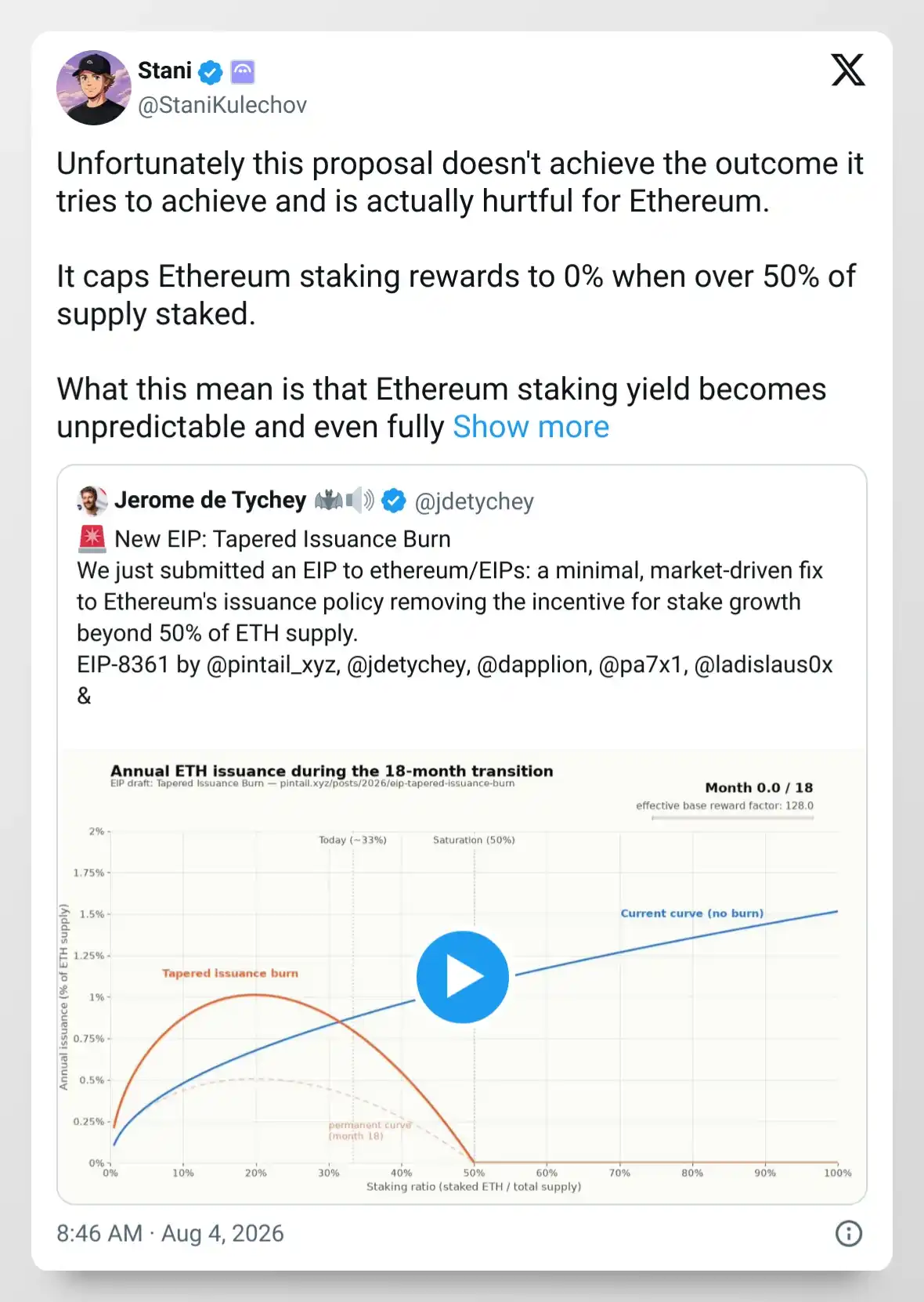
EIP-8363 was born to address this problem. If implemented, this mechanism would continue to calculate validator rewards as it does now, then burn an increasingly larger portion of them. The burn ratio increases with the total amount staked, until it completely offsets the consensus rewards when staked ETH reaches approximately 50% of the total supply.
Once this line is crossed, EIP-8363 would cause validators to profit solely from transaction tips and MEV (the extra value block producers gain by including, excluding, or reordering transactions), rather than new issuance, until the staking rate falls back below 50%.
Therefore, validators would still have incentives under this model, but less ETH would be minted. The core goal of this model is to control the staking rate and the risk of ETH dilution. Although well-intentioned, the proposal has recently faced criticism from detractors who argue its design is flawed.
The main opposing argument I've seen is that EIP-8363 threatens DeFi vitality. Staking yield has become the benchmark rate for ETH, with on-chain lending, liquid staking tokens, and more priced against it. Aave founder Stani Kulechov believes the proposal would make it difficult for institutional buyers to predict staking yields, potentially killing the rationale for borrowing ETH.
"Ethereum should not be penalized for its growth," he wrote.
I've also seen skeptics argue that EIP-8363 would destroy the viability of independent staking. The key point is that home stakers' hardware and electricity costs do not shrink with reduced earnings, so any downward pressure on net rewards would erode their profit margins more than for centralized exchanges running thousands of validators.
Furthermore, as consensus issuance decreases, MEV would constitute a larger portion of validators' remaining income. Critics point out that this dynamic itself could foster centralization effects, as MEV capture rewards scale and sophistication more than raw issuance.
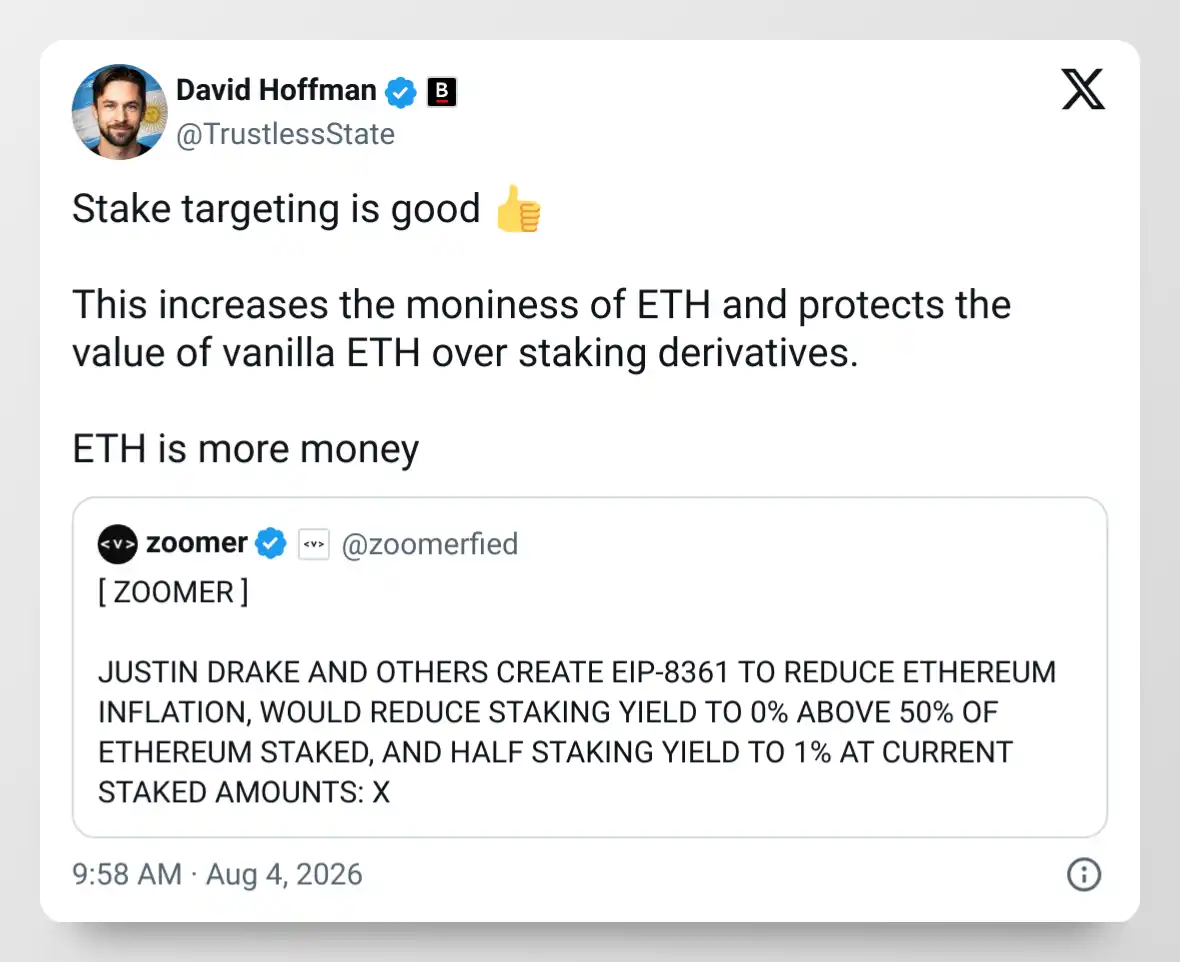
On the other hand, supporters of EIP-8363 insist it would enhance ETH's monetary properties by protecting non-staking ETH from dilution while giving ETH a true supply cap, further solidifying ETH's status as "hard money."
Supporters also counter the argument that independent stakers would be disproportionately impacted, arguing that because the burn scales with total stake, the inflection point where adding more validators is no longer worthwhile arrives earliest for those who already hold the largest shares.
This means home stakers would still have incentive to grow all the way to the 50% threshold, while large stakers would not. In contrast, today's curve rewards growth regardless of who you are or how much you've already staked.
That said, the best discussion I've seen on EIP-8363 so far comes from the EF's DeFi expert ivangbi, who today (in a personal, not official EF capacity) presented a reasonable middle ground in a new post. He believes the model is theoretically workable and DeFi could survive it, but only if the "fix and argument are more robust," not based on "pseudo-economics." It's worth a full read.

To my knowledge, today is the deadline for EIP-8363 to attain PFI status (i.e., "Proposed for Inclusion," Ethereum's lowest procedural threshold, meaning "put this on the agenda for discussion") for the Hegotá upgrade. That said, nothing is approved yet, and Hegotá itself isn't expected to hit mainnet until next year.
If EIP-8363 does move forward, there will be a long lead time regardless, as its arrival would kick off an 18-month transition period. However, the proposal could also stall after this week, with the staking rate continuing its upward trend. Then we'll see if this debate resurfaces in the future.
Regardless of the outcome, the grand question is whether Ethereum is currently overpaying for security, and if so, is this fix worth the validator pain? No one has the definitive answer yet, so keep an eye on this topic in the coming months.