Shiba Inu Whales Are On The Move Again, But In What Direction?

bitcoinistPublicado a 2026-03-10Actualizado a 2026-03-10

Resumen

Shiba Inu whale activity has intensified as large holders move billions of SHIB tokens away from centralized exchanges, causing exchange reserves to hit a record low of 80.9 trillion SHIB. This significant withdrawal, coupled with a dramatic spike in the SHIB burn rate—including a 53,950% surge in a single day—suggests growing deflationary pressure and reduced circulating supply. While SHIB continues to trade weakly amid broader market uncertainty, these movements indicate that whales may be accumulating in anticipation of a potential price rebound or major market shift.

Shiba Inu (SHIB) whale activity has intensified as major token holders shift their assets away from centralized exchanges (CEXs). Exchange reserves have plummeted to record lows, while the SHIB burn rate has accelerated dramatically, suggesting these investors may be preparing for significant market movements. These developments raise the question of whether the whales are positioning ahead of a potential market rebound or simply taking advantage of price declines to accumulate.

Shiba Inu Whales Execute Massive Exchange Withdrawals

Shiba Inu has experienced a dramatic shift in whale behavior, as billions of SHIB tokens have recently moved away from crypto exchanges. This shift comes at a time when the broader cryptocurrency and meme coin market faces major headwinds, with Shiba Inu continuing to trade without clear directional momentum even as its price weakens.

On March 8, on-chain analytics platform CryptoQuant detected a sharp decline in exchange net flow, with a total outflow of 166.16 billion SHIB tokens across major exchanges, nearly double the previous day’s 88 billion tokens. Even earlier, on March 6, exchanges recorded a negative net flow of 170.53 billion tokens, indicating sustained large-scale withdrawals by whales.
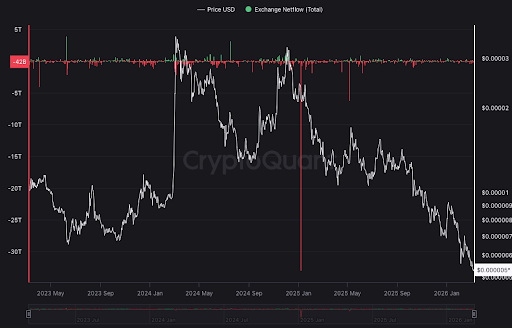
Source: Chart from CryptoQuant

Reports from WhaleScan on X have revealed that these whales have been active for a while now, securing their positions ahead of any major market movement. Usually, when whales move tokens from exchanges, it means those tokens are being removed from circulation. This reduces the supply of tokens available for trading on markets, which can create upward price pressure if demand continues to rise.

The recent whale movement also signals conviction in Shiba Inu despite its weakened fundamentals and recent sideways trading. Notably, WhaleScan has reported that due to the massive token exodus from exchanges, reserves on these crypto platforms have hit a record low of 80.9 trillion SHIB. This suggests that while weak hands are watching short-term price action, whales are accumulating, contributing to the decreasing supply.

SHIB Deflationary Pressures Build As Burn Rate Spikes

In addition to declining reserves, Shiba Inu’s burn rate has accelerated dramatically, increasing by 27.4% just last week. Most notably, on March 6, the burn rate skyrocketed by over 53,950% in just 24 hours, reflecting a staggering increase in tokens being removed from circulation.

Combined with the billions of tokens that recently flowed out of exchanges, Whale Scan has noted that Shiba Inu’s supply crunch is becoming increasingly clear and difficult to ignore. Recent burn statistics paint the picture of token holders seeking deflation amid weakening price action.

Approximately 337 billion SHIB tokens were burned on March 3, last week, as the Shibarium ecosystem prepared for the anticipated FHE privacy upgrade for Q2 2026. These developments indicate that Shiba Inu’s deflationary pressure is building as supply continues to decrease on exchanges.

SHIB trading at $0.000005 on the 1D chart | Source: SHIBUSDT on Tradingview.com

Preguntas relacionadas

QWhat is the main reason for the recent significant drop in Shiba Inu (SHIB) exchange reserves?

AThe main reason is that Shiba Inu whales have been executing massive withdrawals, moving billions of SHIB tokens away from centralized exchanges, which has caused the reserves to plummet to a record low of 80.9 trillion SHIB.

QAccording to the article, what are the two possible motivations behind the whales' movement of SHIB off exchanges?

AThe two possible motivations are that the whales are either positioning ahead of a potential market rebound or simply taking advantage of price declines to accumulate more tokens.

QHow did the SHIB burn rate change on March 6, and what does this indicate?

AOn March 6, the SHIB burn rate skyrocketed by over 53,950% in 24 hours, indicating a massive and accelerated removal of tokens from circulation, which increases deflationary pressure.

QWhat on-chain analytics platform detected the sharp decline in SHIB exchange net flow, and what was the outflow amount on March 8?

AThe on-chain analytics platform CryptoQuant detected the sharp decline. On March 8, the total outflow was 166.16 billion SHIB tokens across major exchanges.

QWhat broader market context is Shiba Inu facing, as mentioned in the article?

AShiba Inu is facing major headwinds in the broader cryptocurrency and meme coin market, continuing to trade without clear directional momentum even as its price weakens.

Lecturas Relacionadas

The Essence of AI Layoffs: Why More AI Adoption Leads to More Corporate Anxiety?

The author, awaiting potential inclusion on an 8000-person layoff list, analyzes the true nature of recent "AI-driven" layoffs. They argue that while AI use, particularly tools like Claude for code generation, has skyrocketed and boosted developer output (e.g., 2-5x more code commits), this has not translated into proportional business growth or revenue. The core issue is a misalignment between increased "Input" (code) and tangible "Outcomes" (user value, revenue). AI acts as a costly B2B SaaS, inflating operational expenses without guaranteed returns. Two key problems emerge: 1) The friction that once filtered out bad ideas is gone, as AI allows cheap pursuit of even weak concepts. 2) Organizational "alignment tax"—the difficulty of coordinating across teams—becomes crippling when development velocity outpaces consensus-building. Thus, layoffs serve two immediate purposes: 1) To offset ballooning AI costs (Token consumption) and maintain cash flow, as rising input costs without outcome growth destroys unit economics. 2) To reduce organizational bloat and alignment friction by simply removing teams, thereby speeding up execution in the short term. Therefore, these layoffs are fundamentally caused by AI, even if AI doesn't directly replace roles. They represent a painful correction until companies learn to convert AI-driven productivity into real business outcomes and streamline organizational coordination to match the new pace of work. The cycle will continue until this learning curve is mastered.

marsbitHace 1 hora(s)

The Essence of AI Layoffs: Why More AI Adoption Leads to More Corporate Anxiety?

marsbitHace 1 hora(s)

Can the Solana Foundation and Google's Collaboration on Pay.sh Bridge the Payment Link Between Web2 and Web3 in the Agent Economy?

Solana Foundation, in collaboration with Google Cloud, has launched Pay.sh, a payment gateway designed to bridge the gap between AI agents and enterprise-grade service infrastructure. The initiative aims to solve a key bottleneck in the "agent economy": existing payment systems are ill-suited for autonomous AI agents. Traditional methods like credit cards require human verification, while newer on-chain protocols like x402 and MPP create a separate, Web3-native system that raises barriers for service providers. Pay.sh functions as a universal payment layer. It allows users to fund a Solana wallet via credit card or stablecoin, which then acts as an identity and payment proxy for AI agents. When an agent needs to access a paid API service (e.g., Google Cloud, Alibaba Cloud), Pay.sh handles the transaction seamlessly. It leverages the HTTP 402 status code ("Payment Required") to initiate payments, intelligently choosing between one-time transfers (x402-style) or session-based authorizations (MPC-style) based on the service's billing model. This spares agents from manual account registration and API key management. A key feature for service providers is low integration effort. They can adopt Pay.sh by providing a declarative configuration file, enabling features like tiered pricing, free tiers, and automatic revenue splitting to multiple addresses (e.g., for royalties, cloud costs). Providers can also list their APIs in a central Pay Skill Registry for agent discovery. The collaboration with Google Cloud provides crucial infrastructure for API proxying, traffic routing, and compliance logging, aiming to keep agent activities within regulated boundaries. By connecting Web2 services with Web3 payment rails, Pay.sh positions the Solana wallet as a foundational identity and payment tool for AI agents, potentially driving more transaction volume to the Solana ecosystem. However, the report notes challenges. The service registry currently lacks robust vetting, risking exposure to unauthorized or malicious third-party APIs. Pay.sh also inherits security and compatibility risks from its underlying payment protocols (x402, MPC). Furthermore, adoption may be hindered by varying regional data privacy and payment compliance regulations among API providers. Despite these hurdles, Pay.sh represents a significant step towards integrating Web2 and Web3 for autonomous agent commerce.

marsbitHace 1 hora(s)

Can the Solana Foundation and Google's Collaboration on Pay.sh Bridge the Payment Link Between Web2 and Web3 in the Agent Economy?

marsbitHace 1 hora(s)

Trading

Spot
Futuros

Artículos destacados

Cómo comprar MOVE

¡Bienvenido a HTX.com! Hemos hecho que comprar Movement (MOVE) sea simple y conveniente. Sigue nuestra guía paso a paso para iniciar tu viaje de criptos.Paso 1: crea tu cuenta HTXUtiliza tu correo electrónico o número de teléfono para registrarte y obtener una cuenta gratuita en HTX. Experimenta un proceso de registro sin complicaciones y desbloquea todas las funciones.Obtener mi cuentaPaso 2: ve a Comprar cripto y elige tu método de pagoTarjeta de crédito/débito: usa tu Visa o Mastercard para comprar Movement (MOVE) al instante.Saldo: utiliza fondos del saldo de tu cuenta HTX para tradear sin problemas.Terceros: hemos agregado métodos de pago populares como Google Pay y Apple Pay para mejorar la comodidad.P2P: tradear directamente con otros usuarios en HTX.Over-the-Counter (OTC): ofrecemos servicios personalizados y tipos de cambio competitivos para los traders.Paso 3: guarda tu Movement (MOVE)Después de comprar tu Movement (MOVE), guárdalo en tu cuenta HTX. Alternativamente, puedes enviarlo a otro lugar mediante transferencia blockchain o utilizarlo para tradear otras criptomonedas.Paso 4: tradear Movement (MOVE)Tradear fácilmente con Movement (MOVE) en HTX's mercado spot. Simplemente accede a tu cuenta, selecciona tu par de trading, ejecuta tus trades y monitorea en tiempo real. Ofrecemos una experiencia fácil de usar tanto para principiantes como para traders experimentados.

246 Vistas totalesPublicado en 2024.12.13Actualizado en 2025.03.21

Cómo comprar MOVE

Discusiones

Bienvenido a la comunidad de HTX. Aquí puedes mantenerte informado sobre los últimos desarrollos de la plataforma y acceder a análisis profesionales del mercado. A continuación se presentan las opiniones de los usuarios sobre el precio de MOVE (MOVE).

活动图片













