Shiba Inu Whales Are On The Move Again, But In What Direction?

bitcoinistPublicado a 2026-03-10Actualizado a 2026-03-10

Resumen

Shiba Inu whale activity has intensified as large holders move billions of SHIB tokens away from centralized exchanges, causing exchange reserves to hit a record low of 80.9 trillion SHIB. This significant withdrawal, coupled with a dramatic spike in the SHIB burn rate—including a 53,950% surge in a single day—suggests growing deflationary pressure and reduced circulating supply. While SHIB continues to trade weakly amid broader market uncertainty, these movements indicate that whales may be accumulating in anticipation of a potential price rebound or major market shift.

Shiba Inu (SHIB) whale activity has intensified as major token holders shift their assets away from centralized exchanges (CEXs). Exchange reserves have plummeted to record lows, while the SHIB burn rate has accelerated dramatically, suggesting these investors may be preparing for significant market movements. These developments raise the question of whether the whales are positioning ahead of a potential market rebound or simply taking advantage of price declines to accumulate.

Shiba Inu Whales Execute Massive Exchange Withdrawals

Shiba Inu has experienced a dramatic shift in whale behavior, as billions of SHIB tokens have recently moved away from crypto exchanges. This shift comes at a time when the broader cryptocurrency and meme coin market faces major headwinds, with Shiba Inu continuing to trade without clear directional momentum even as its price weakens.

On March 8, on-chain analytics platform CryptoQuant detected a sharp decline in exchange net flow, with a total outflow of 166.16 billion SHIB tokens across major exchanges, nearly double the previous day’s 88 billion tokens. Even earlier, on March 6, exchanges recorded a negative net flow of 170.53 billion tokens, indicating sustained large-scale withdrawals by whales.
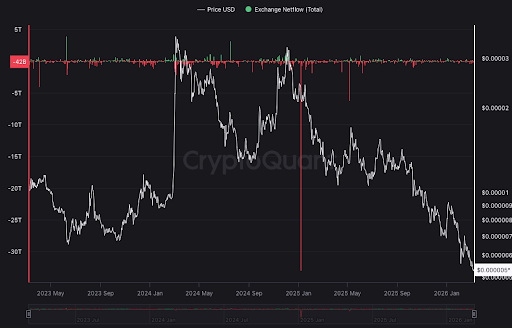
Source: Chart from CryptoQuant

Reports from WhaleScan on X have revealed that these whales have been active for a while now, securing their positions ahead of any major market movement. Usually, when whales move tokens from exchanges, it means those tokens are being removed from circulation. This reduces the supply of tokens available for trading on markets, which can create upward price pressure if demand continues to rise.

The recent whale movement also signals conviction in Shiba Inu despite its weakened fundamentals and recent sideways trading. Notably, WhaleScan has reported that due to the massive token exodus from exchanges, reserves on these crypto platforms have hit a record low of 80.9 trillion SHIB. This suggests that while weak hands are watching short-term price action, whales are accumulating, contributing to the decreasing supply.

SHIB Deflationary Pressures Build As Burn Rate Spikes

In addition to declining reserves, Shiba Inu’s burn rate has accelerated dramatically, increasing by 27.4% just last week. Most notably, on March 6, the burn rate skyrocketed by over 53,950% in just 24 hours, reflecting a staggering increase in tokens being removed from circulation.

Combined with the billions of tokens that recently flowed out of exchanges, Whale Scan has noted that Shiba Inu’s supply crunch is becoming increasingly clear and difficult to ignore. Recent burn statistics paint the picture of token holders seeking deflation amid weakening price action.

Approximately 337 billion SHIB tokens were burned on March 3, last week, as the Shibarium ecosystem prepared for the anticipated FHE privacy upgrade for Q2 2026. These developments indicate that Shiba Inu’s deflationary pressure is building as supply continues to decrease on exchanges.

SHIB trading at $0.000005 on the 1D chart | Source: SHIBUSDT on Tradingview.com

Criptos en tendencia

Preguntas relacionadas

QWhat is the main reason for the recent significant drop in Shiba Inu (SHIB) exchange reserves?

AThe main reason is that Shiba Inu whales have been executing massive withdrawals, moving billions of SHIB tokens away from centralized exchanges, which has caused the reserves to plummet to a record low of 80.9 trillion SHIB.

QAccording to the article, what are the two possible motivations behind the whales' movement of SHIB off exchanges?

AThe two possible motivations are that the whales are either positioning ahead of a potential market rebound or simply taking advantage of price declines to accumulate more tokens.

QHow did the SHIB burn rate change on March 6, and what does this indicate?

AOn March 6, the SHIB burn rate skyrocketed by over 53,950% in 24 hours, indicating a massive and accelerated removal of tokens from circulation, which increases deflationary pressure.

QWhat on-chain analytics platform detected the sharp decline in SHIB exchange net flow, and what was the outflow amount on March 8?

AThe on-chain analytics platform CryptoQuant detected the sharp decline. On March 8, the total outflow was 166.16 billion SHIB tokens across major exchanges.

QWhat broader market context is Shiba Inu facing, as mentioned in the article?

AShiba Inu is facing major headwinds in the broader cryptocurrency and meme coin market, continuing to trade without clear directional momentum even as its price weakens.

Lecturas Relacionadas

Annual Salary of Millions Competing for Electricians, Meta Rushes to Open Its Own Technical School

The AI boom is facing an unexpected bottleneck: a severe shortage of skilled construction workers and electricians. As tech giants like Meta, OpenAI, and Alphabet race to build massive data centers—such as OpenAI's $16 billion "Stargate" project—they are hitting a critical labor wall. The U.S. needs an estimated 130,000 more electricians, 240,000 construction workers, and 150,000 supervisors by 2030 for AI infrastructure alone, but tens of thousands of electrician jobs go unfilled each year. While AI companies offer high premiums, with electricians earning up to $280,000 annually, worker scarcity still causes massive losses—delays on a single project can cost $14.2 million per month. The complexity of building AI data centers, which require immense power (equivalent to powering hundreds of thousands of homes), sophisticated electrical systems, and advanced liquid cooling solutions, demands highly skilled technicians who are in short supply. To combat this, companies are investing heavily in training. Meta has committed $115 million to a free training school offering tuition, housing, and stipends, targeting 5,000 new workers. OpenAI is partnering with unions to secure skilled labor. These efforts are paying off, with a significant rise in Gen Z interest in trade schools over college. However, the power demands are staggering. AI data centers are driving a rapid surge in electricity consumption, projected to account for up to 12% of U.S. power use by 2028 and raising costs for consumers. Furthermore, the construction boom is project-based, leading to a potential future glut of trained workers once building peaks, which could depress wages industry-wide. The race for AI supremacy now depends as much on skilled hands as on advanced chips.

marsbitHace 8 min(s)

Annual Salary of Millions Competing for Electricians, Meta Rushes to Open Its Own Technical School

marsbitHace 8 min(s)

OpenAI No Longer Sells Its Most Expensive Model for Profit

OpenAI is shifting its business strategy away from promoting its most expensive, flagship models for every task. Recent price cuts—80% for GPT-5.6 Luna and 20% for Terra—signal a deeper change: the company now actively advises users that many tasks don't require the most powerful model. Instead, OpenAI recommends a tiered approach: use the high-end GPT-5.6 Sol for complex planning and analysis, then delegate execution to cheaper models like Luna. This mirrors moves by Anthropic, which recently launched Claude Opus 5 at half the price of its top model, Fable 5. Both companies are de-emphasizing flagship models as primary revenue drivers, using them instead for brand prestige and technological showcases. The industry is entering a "mass-market" phase, similar to automotive, where high-volume, cost-effective models handle daily operations and drive scale. OpenAI's price reductions are partly enabled by AI models themselves optimizing underlying code and infrastructure, creating a self-reinforcing cycle of efficiency gains and cost reduction. Competition is shifting from "who is smartest" to "who offers the best value." The goal is no longer selling individual models but fostering widespread API adoption and ecosystem lock-in. By making AI calls cheap and ubiquitous, companies like OpenAI aim to become the indispensable, utility-like infrastructure powering automated workflows—the "water and electricity" of software, quietly embedded everywhere.

marsbitHace 8 min(s)

OpenAI No Longer Sells Its Most Expensive Model for Profit

marsbitHace 8 min(s)

Will the Fed Definitely Raise Interest Rates in September? How Will Crypto and U.S. Stocks Withstand the Pressure?

The market's expectation for a September Fed rate hike surged dramatically in early August, jumping from under 50% to over 80% within a week. This shift followed a contentious July FOMC meeting, where a 9-3 vote to hold rates revealed growing dissent from hawkish members advocating for an immediate hike to combat persistent inflation. The primary catalyst for this repricing is rising oil prices, driven by renewed geopolitical tensions around the Strait of Hormuz, which threaten global supply. Energy costs directly influence inflation metrics, making the upcoming July CPI report (due August 12th) a critical data point. If it shows inflation reaccelerating, the probability of a September hike will solidify. For Bitcoin and crypto assets, this is typically bearish news. Bitcoin continues to behave as a high-beta, liquidity-sensitive risk asset. A rate hike raises the opportunity cost of holding non-yielding assets and could drive capital toward money markets, pressuring crypto prices in the short term. However, historical patterns suggest that if a hike is perceived as the end of a tightening cycle rather than the start, any negative price impact may be brief. U.S. stocks, particularly crypto-linked equities like Coinbase and growth-oriented tech stocks, are also vulnerable. Higher rates increase discount rates in valuation models, putting pressure on high-multiple companies. This coincides with a pivotal tech earnings season where investor focus has shifted from massive AI capital expenditure to tangible revenue and cash flow generation. Companies with negative cash flow and weak growth narratives could face heightened volatility if borrowing costs rise in September. In summary, a September Fed hike has evolved into a mainstream market scenario. Key factors to watch are oil prices, the July CPI report, and Fed communications, which will determine the final decision and its impact on volatile crypto and equity markets.

marsbitHace 18 min(s)

Will the Fed Definitely Raise Interest Rates in September? How Will Crypto and U.S. Stocks Withstand the Pressure?

marsbitHace 18 min(s)

Trading

Spot

Artículos destacados

Cómo comprar MOVE

¡Bienvenido a HTX.com! Hemos hecho que comprar Movement (MOVE) sea simple y conveniente. Sigue nuestra guía paso a paso para iniciar tu viaje de criptos.Paso 1: crea tu cuenta HTXUtiliza tu correo electrónico o número de teléfono para registrarte y obtener una cuenta gratuita en HTX. Experimenta un proceso de registro sin complicaciones y desbloquea todas las funciones.Obtener mi cuentaPaso 2: ve a Comprar cripto y elige tu método de pagoTarjeta de crédito/débito: usa tu Visa o Mastercard para comprar Movement (MOVE) al instante.Saldo: utiliza fondos del saldo de tu cuenta HTX para tradear sin problemas.Terceros: hemos agregado métodos de pago populares como Google Pay y Apple Pay para mejorar la comodidad.P2P: tradear directamente con otros usuarios en HTX.Over-the-Counter (OTC): ofrecemos servicios personalizados y tipos de cambio competitivos para los traders.Paso 3: guarda tu Movement (MOVE)Después de comprar tu Movement (MOVE), guárdalo en tu cuenta HTX. Alternativamente, puedes enviarlo a otro lugar mediante transferencia blockchain o utilizarlo para tradear otras criptomonedas.Paso 4: tradear Movement (MOVE)Tradear fácilmente con Movement (MOVE) en HTX's mercado spot. Simplemente accede a tu cuenta, selecciona tu par de trading, ejecuta tus trades y monitorea en tiempo real. Ofrecemos una experiencia fácil de usar tanto para principiantes como para traders experimentados.

324 Vistas totalesPublicado en 2024.12.13Actualizado en 2026.06.02

Cómo comprar MOVE

Discusiones

Bienvenido a la comunidad de HTX. Aquí puedes mantenerte informado sobre los últimos desarrollos de la plataforma y acceder a análisis profesionales del mercado. A continuación se presentan las opiniones de los usuarios sobre el precio de MOVE (MOVE).

活动图片













