Shiba Inu has put its long-trailed SOU recovery framework into production, opening claims for users affected by last year’s Shibarium bridge exploit and turning those claims into transferable, on-chain NFTs on Ethereum. The launch matters because it moves the project’s compensation effort from a promised structure into a live system with visible balances, payout mechanics, and a secondary-market option for anyone who wants liquidity now.
The SOU concept itself isn’t new. In a year-end letter dated Dec. 29, 2025, Shibarium developer Kaal Dhairya introduced “SOU: Shib Owes You” while stressing it was “Not live yet, beware of scammers,” describing it as a system where “every affected user has an SOU NFT — an on-chain, verifiable record of exactly what the ecosystem owes them.”
Shiba Inu ‘Shib Owes You’ Goes Live
That warning is now being replaced by a go-live announcement. Via X, the official Shiba Inu account wrote:
“SOU is live. Introducing SOU (Shib Owes You) an onchain NFT built as a good-faith effort to support impacted users with payouts, donations, and occasional rewards. Transparent. Tradable. On-chain. You can transfer it, split it, merge it, or trade it on marketplaces. Claim your SOUs: https://shib.io/sou”
In Shib’s documentation, the system is framed as an attempt to make the recovery ledger public, auditable, and mechanically enforced rather than tracked in private databases. “SOU (Shib Owes You) is more than just a name; it is a commitment,” the docs say.“It represents the Shib ecosystem’s dedication to making users whole through a transparent, audited, and on-chain recovery system. Activity Notifications: The system provides a real-time activity feed, notifying the community whenever a new donation is received or a payout is distributed, ensuring complete visibility into the recovery progress.”
The mechanism hinges on two balances: “Original Principal,” the immutable historical record of what a user lost, and “Current Principal,” which declines as payouts are claimed or contributions flow in. The docs also draw a hard distinction between debt repayment and incentives. “Payout” reduces principal as compensation, while a “Reward” is additive and “No Change” to the owed balance, positioning rewards as bonuses on top of repayment rather than substitutes.
SOU is also designed to be a financial instrument, not just a receipt. Claims can be merged or split to manage position sizing, transferred between wallets, or sold on marketplaces, effectively enabling a market in discounted claims for users who don’t want to wait for recovery flows.
Shib’s docs also describe a funding model that routes ecosystem revenues and community donations into a common pool, with donations applied proportionally across affected claims, and optional creator fees on secondary sales directed back to payouts or rewards.
The backdrop is the September 2025 Shibarium bridge incident, where Shib’s own security update said “unauthorized validator signing power” was used to push a malicious exit through the PoS bridge, enabling withdrawals of multiple assets.
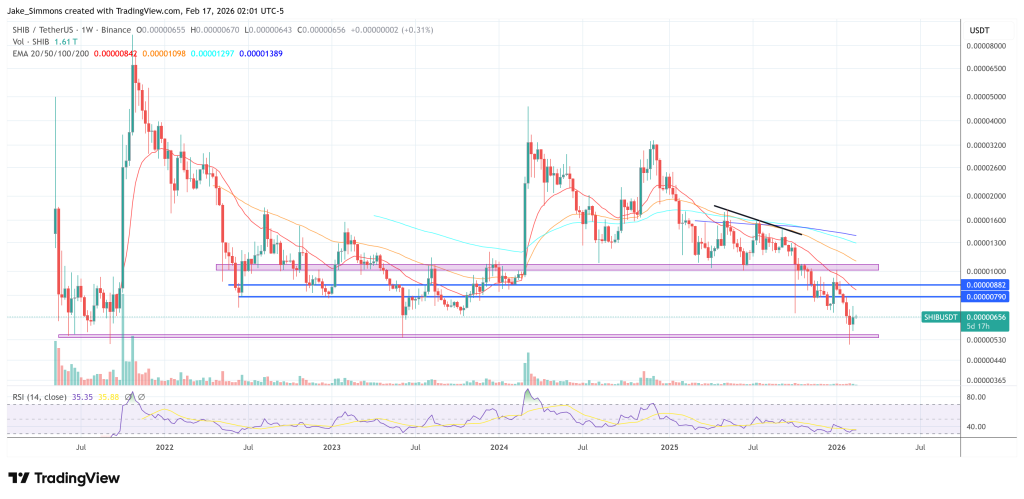
At press time, Shiba Inu traded at $0.00000656.