Shanghai Sees a Semiconductor Equipment IPO Emerge, Led by Former Grace Semiconductor Employee

marsbitPublicado a 2026-08-17Actualizado a 2026-08-17

Resumen

A Shanghai-based semiconductor equipment company, Mifee Technology, has filed for an IPO on the Shanghai Stock Exchange's STAR Market. The company specializes in developing and manufacturing Automatic Material Handling Systems (AMHS), a core automation system in semiconductor wafer fabrication that directly impacts production efficiency and yield. Mifee is one of the few domestic Chinese companies with proprietary AMHS technology, offering both hardware and software systems. While the global AMHS market is dominated by Japanese giants like Daifuku and Murata Machinery, which hold approximately 90% market share, Mifee has captured about 1.6% globally. The company's revenue has grown significantly, reaching 393 million yuan in 2025, and it achieved profitability that year with a net income of 60.45 million yuan, following losses in 2023 and 2024. Its revenue streams include sales of individual AMHS equipment and complete factory AMHS projects, with the latter starting to contribute revenue from 2024. The company faces risks including high customer concentration, with its top five clients accounting for over 90% of revenue in 2025, and significant fluctuations in gross margin, which was 48.97% in 2025 after dropping to 24.67% in 2024. Mifee is controlled by an 80s-born couple, Chairman/CEO Feng Miao and Deputy General Manager Na Ke, who previously worked at Shanghai Grace Semiconductor Manufacturing Co. The company plans to raise approximately 1.191 billion yuan from its IPO ...

As semiconductor chip processes continue to shrink, equipment expenditure for advanced process wafer fabs grows exponentially. The construction, expansion, and operation/maintenance of semiconductor wafer fabs provide broad development space for the Automatic Material Handling System (AMHS) industry.

AMHS equipment is part of semiconductor factory production automation and control equipment, falling under the category of semiconductor equipment. It is one of the core systems that directly impacts production efficiency and product yield in semiconductor wafer fabs. Recently, a company in this field is seeking an IPO.

According to news from Glonghui, recently, Meifei Technology (Shanghai) Co., Ltd. (referred to as "Meifei Technology") submitted its prospectus to the Shanghai Stock Exchange, aiming to list on the STAR Market, with Haitong Securities as the sponsor.

Meifei Technology is one of the very few domestic suppliers in mainland China that master core AMHS technology with independent intellectual property rights and can provide various AMHS hardware equipment and software systems for semiconductor wafer fabs, possessing a certain degree of scarcity. The company also achieved a turnaround to profitability in 2025, but faces risks such as high customer concentration and significant fluctuations in gross margin.

01 Significant Room for Import Substitution in AMHS Field, Company Faces High Customer Concentration

The upstream AMHS industry chain components include tracks and power supply equipment, overhead hoist transports (OHT), motors, controllers, control systems, industrial software, etc., with participants including Yaskawa, Panasonic, Mitsubishi, Siemens, Keyence, Omron, etc.

The midstream AMHS includes conveying systems, storage and purification equipment, and software systems. The market has long been monopolized by Japanese companies, leaving significant room for import substitution.

According to Gartner data, in 2025, Japan's Daifuku Group and Murata Machinery together hold about 90% of the global AMHS market share; SEMES, a subsidiary of South Korea's Samsung Group, holds about 9.1%; Meifei Technology's market share is about 1.6%.

Downstream application scenarios include semiconductor manufacturing, display panel manufacturing, and new energy battery manufacturing, with participants including TSMC, Samsung, Intel, BOE, etc.
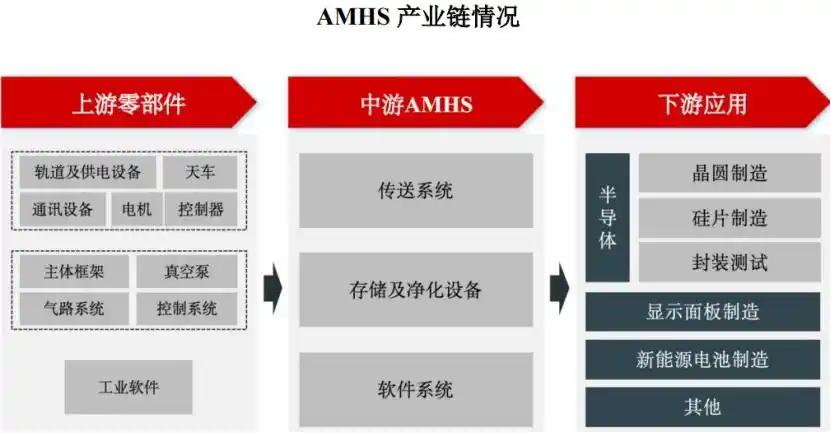
Image from the prospectus

Meifei Technology's main business revenue primarily comes from the sale of AMHS equipment and related services. Among these, AMHS equipment includes full-factory projects and individual equipment.

The company's full-factory projects involve system equipment where the entire AMHS uses products independently developed by the company, including OHT conveying systems, storage and purification equipment, and supporting software in each project. In 2024, the company's full-factory projects completed acceptance at the client for the first time, beginning to generate revenue.

Individual equipment includes storage equipment, purification equipment, other equipment, and software.

Specifically, during 2023, 2024, and 2025 (referred to as the "Reporting Period"), the revenue share of Meifei Technology's individual equipment decreased from 96.84% to 80.92%, still representing a large proportion. Additionally, the company generates a small amount of revenue from AMHS equipment-related maintenance services.
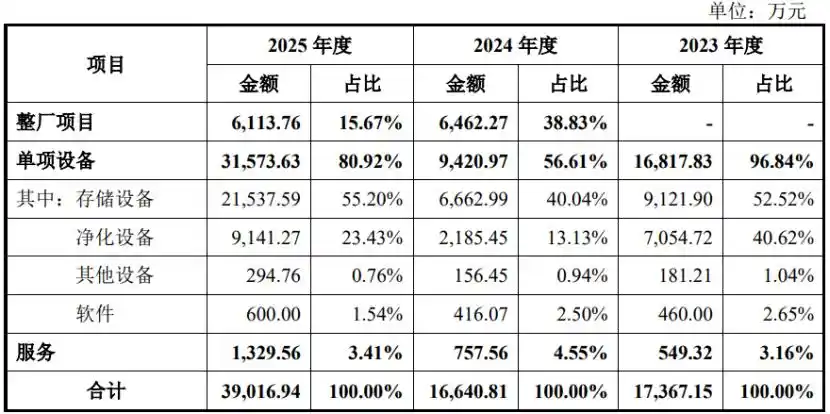
Composition of the company's main business revenue by product and service type, Source: Prospectus

Meifei Technology procures raw materials including stacker cranes, PCB boards, tooling, custom sheet metal parts and other non-standard processed parts; standard parts like control circuits, sensors, motors, pneumatic components, valves, reducers, bearings; as well as auxiliary items like tools and labor protection supplies.

Its suppliers include Shanghai Puzhi Precision Machinery Co., Ltd., Kunshan Chenyi Digital Technology Co., Ltd., Suzhou Magnoclean Cleanroom Materials Co., Ltd., Kunshan Jiulongfeng Precision Technology Co., Ltd., Shenzhen Hertz Innovation Technology Co., Ltd., etc.

The company's downstream customers are mainly semiconductor wafer fabs, including companies like SiEn (Qingdao) Integrated Circuit Co., Ltd., iRay Technology Company Limited, Guangdong GTA Semiconductor Co., Ltd. During the Reporting Period, revenue from Meifei Technology's top five customers accounted for 98.65%, 80.64%, and 92.42% of the period's revenue respectively, indicating high customer concentration, which may put the company in a weak position in business negotiations.

02 Turned Profit in 2025, Significant Gross Margin Fluctuations

In recent years, Meifei Technology's revenue has fluctuated. Benefiting from business scale expansion, recovery in operating income, and the push for import substitution demand due to trade frictions, the company achieved profitability in 2025.

In 2023, 2024, and 2025, Meifei Technology's operating revenue was approximately 174 million yuan, 167 million yuan, and 393 million yuan respectively, with corresponding net profits of -35.152 million yuan, -53.1105 million yuan, and 60.453 million yuan.

Among these, the company was not profitable in 2023 and 2024, mainly related to market conditions and the company's strategic planning. During these two years, affected by global economic weakness, escalating geopolitical conflicts, etc., the semiconductor industry experienced a significant downturn cycle, downstream market demand cooled, and the company's operating income declined. Additionally, the comprehensive gross margin was under pressure during the development stage of OHT conveying systems and full-factory projects, coupled with high expense levels due to the company's counter-cyclical expansion efforts.

As a key system for semiconductor wafer fab production and manufacturing, AMHS is characterized by being technology-intensive, having extremely stringent reliability requirements, and deep integration with customer production processes. The industry has long been dominated by two giants: Japan's Daifuku Group and Murata Machinery.

Compared to these two giants, Meifei Technology still lags in terms of revenue scale, brand influence, global service network, and high-end customer resources.
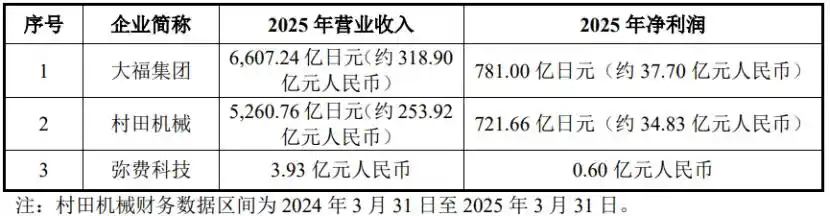
Comparison of the company with Daifuku Group and Murata Machinery regarding 2025 operating revenue and net profit, Image from the prospectus

The market demand for the AMHS industry where Meifei Technology operates is related to macroeconomic trends and the cyclicality of the downstream semiconductor industry.

In recent years, benefiting from the semiconductor market boom, the global semiconductor equipment market has grown significantly. According to SEMI data, the global semiconductor equipment market size reached 135.1 billion USD in 2025; during the same period, the semiconductor equipment market size in mainland China was 49.3 billion USD, making it the world's largest semiconductor equipment market.

According to CMI forecasts, the global semiconductor equipment market size will approach 200 billion USD by 2032, with a compound annual growth rate (CAGR) of about 5.76% from 2025 to 2032.

According to a report released by CCID Consulting, the global AMHS market size accounts for about 3% of total semiconductor equipment. The global AMHS market size in 2025 was 4.053 billion USD, with the AMHS market size in mainland China approximately 1.479 billion USD during the same period.
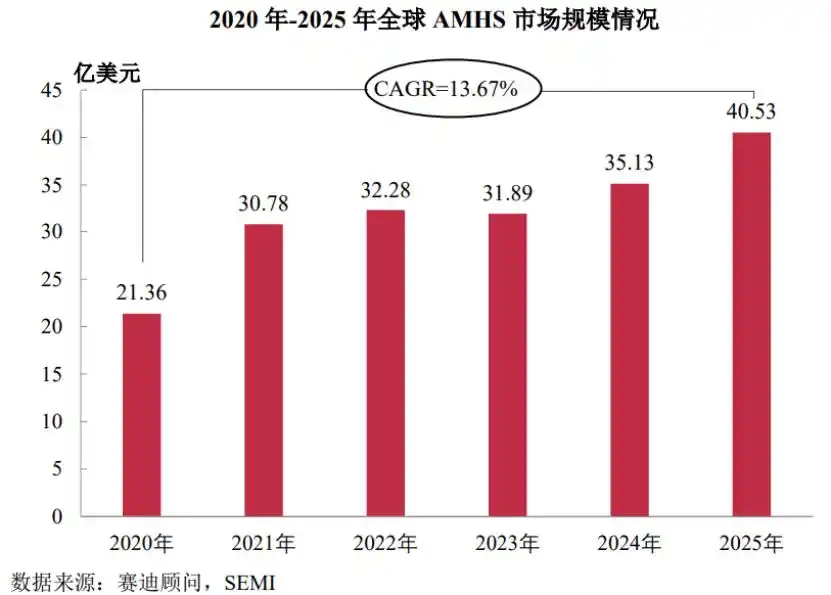
Image from the prospectus

With the development of the semiconductor industry, a company's technological capability has become a key factor in gaining a long-term competitive advantage.

During the Reporting Period, Meifei Technology's R&D expenses were 38.6044 million yuan, 46.645 million yuan, and 52.9481 million yuan, accounting for 22.18%, 27.91%, and 13.47% of operating revenue respectively.

Due to the company's relatively small revenue scale in 2023 and 2024, the R&D expense ratio was relatively high. As the company's operating revenue increased rapidly, the R&D expense ratio declined.

It is worth noting that during the Reporting Period, Meifei Technology's comprehensive gross margins were 49.68%, 24.67%, and 48.97%, showing significant fluctuations, with the 2024 gross margin lower than the industry average.

Among these, in 2024, the company was in a critical stage of market development for new products. The first batch of full-factory projects equipped with the company's self-developed OHT conveying system were accepted by customers. These projects had negative gross margins due to relatively favorable pricing and substantial manpower and material investments.
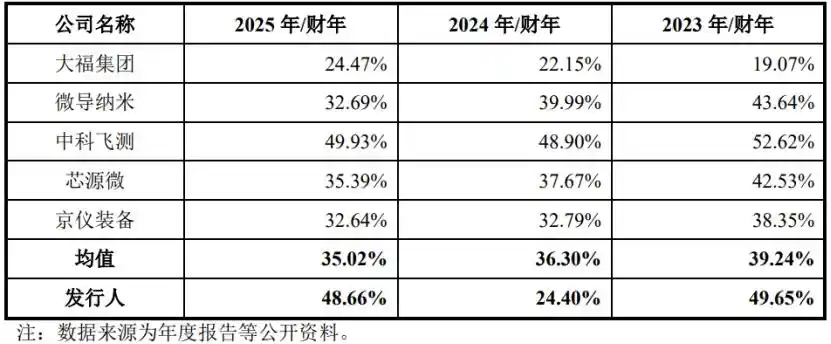
Comparison of AMHS product gross margin in the company's main business with that of comparable listed peers, Image from the prospectus

03 An IPO Emerges from Shanghai, Controlled by an 80s Couple

Meifei Technology is registered in the Lingang New Area of the Shanghai Pilot Free Trade Zone. Its predecessor, Meifei Limited, was established in 2014 by Miao Feng's mother, Zhao Xiufang, and was transformed into a joint-stock limited company in 2022.

Prior to this issuance, the husband-and-wife team Miao Feng, Ke Na, and their concert parties Shanghai Mizheng, Shanghai Mida, and Shanghai Mizhen collectively control approximately 41.98% of the voting rights of the company's shares and are the actual controllers.

Additionally, Wu Shuichang, Qiming Rongxin, General Industry Investment, Jiequan Mingyuan, Haitong Innovation, etc., are all shareholders of the company.

Miao Feng was born in 1982, holds a master's degree, and is a doctoral candidate at Huazhong University of Science and Technology. He previously served as a CIM Engineer at Shanghai Grace Semiconductor Manufacturing Co., Ltd., an EAP Engineer at Trina Solar Co., Ltd., an MES Engineer at Shanghai Lixin Integrated Circuit Manufacturing Co., Ltd., a Senior Automation Engineer at UMC (United Microelectronics Corporation), a Software Principal Engineer at Aikyu (Shanghai) Trading Co., Ltd., General Manager of the LED Division at Shanghai Glaway Software Co., Ltd., and other positions. He has served as Chairman and General Manager of Meifei Technology since January 2017.

Ke Na was born in 1984 and holds a master's degree. She has previously held positions including Senior Training Management Specialist at Shanghai Grace Semiconductor Manufacturing Co., Ltd., Human Resources Department Manager at Sumitomo Heavy Industries Drive Technology (China) Co., Ltd., Human Resources Director at Shanghai Baofeng Machinery Manufacturing Co., Ltd., Deputy General Manager of Meifei Limited, and General Manager of Reversable Management Consulting (Shanghai) Co., Ltd. She is currently the Deputy General Manager of Meifei Technology.

Company Director and Financial Officer Zhu Tiankai was born in 1981 and holds a doctoral degree. He has previously served as a Process Engineer at Aikyu (Shanghai) Trading Co., Ltd., Senior Process Engineer at Advanced Micro-Fabrication Equipment Inc. China (AMEC), Analyst at McKinsey & Company (Shanghai), and Financial Officer of Meifei Limited.

For this IPO, Meifei Technology plans to raise approximately 1.191 billion yuan, to be used for the Semiconductor AMHS Production and R&D (Yangzhou) Base Construction Project, the Malaysia Overseas Business Center Project, the R&D Center Construction Project, and supplementing working capital.

This article is from the WeChat public account "Glonghui New Stocks", author: Bro Says New Stocks


Criptos en tendencia

Preguntas relacionadas

QWhat does AMHS stand for in the semiconductor industry, and why is it important?

AAMHS stands for Automated Material Handling System. It is a core system in semiconductor wafer fabs that directly impacts production efficiency and product yield. It automates the transportation, storage, and purification of materials within the fab.

QWhat is the primary business and market position of Mifert Technology?

AMifert Technology is a Chinese supplier of semiconductor wafer fab AMHS hardware and software systems. It is one of the very few domestic companies with core AMHS intellectual property. In 2025, it held approximately 1.6% of the global AMHS market share, competing against dominant Japanese and Korean companies.

QWhat were the key financial performance highlights for Mifert Technology in 2023-2025?

AMifert Technology's revenue was approximately RMB 174 million in 2023, RMB 167 million in 2024, and RMB 393 million in 2025. It reported net losses of RMB -35.15 million and RMB -53.11 million in 2023 and 2024, respectively, but achieved profitability with a net income of RMB 60.45 million in 2025.

QWhat are the main risks or challenges faced by Mifert Technology according to the article?

AThe main risks include high customer concentration (over 90% of revenue from top 5 clients in some years), significant fluctuations in gross margin (ranging from 24.67% to 49.68% in 2023-2025), and intense competition from established global leaders like Japan's Daifuku and Murata Machinery.

QWho are the founders and key leaders of Mifert Technology, and what is their background?

AMifert Technology is controlled by the husband-and-wife team Miao Feng and Ke Na, who hold about 41.98% voting rights. Miao Feng, the Chairman and CEO, holds a master's degree and previously worked at Grace Semiconductor (now Hua Hong Grace). Ke Na, the Vice President, also holds a master's degree and previously worked at Grace Semiconductor. Zhu Tiankai is the Director and CFO.

Lecturas Relacionadas

Mass Production Timelines Shift Collectively, Is Glass Substrate Facing Its First Major Test?

The article discusses the shift in the glass substrate industry from initial announcements to practical delivery and reliability testing. In mid-to-late 2026, key developments include Intel and Lens Technology advancing AI-era glass substrate packaging cooperation, Avaco launching a TGV pilot line in South Korea, and reports that Samsung Electro-Mechanics is facing delays, potentially pushing mass production beyond 2028. The core challenge has moved from material comparisons to rigorous customer reliability certifications, focusing on thermal cycling, humidity resistance, and stable electrical performance post-processing. Samsung Electro-Mechanics' reported delay, linked to client sample reliability bottlenecks, reflects a broader industry trend where timelines are being adjusted. Other players like SKC/Absolics, LG Innotek, and DNP are also targeting initial supply systems or pilot lines between 2027-2028, with mainstream adoption potentially post-2030. The delays highlight that the current hurdle is supply-side technical maturity—particularly achieving stable yields and passing client certifications—rather than a lack of demand driven by AI and HPC. The collaboration between Intel and Lens Technology focuses on establishing design and verification standards. Meanwhile, Japanese firms like Shinko Electric and DNP are progressing with multi-layer wiring and stress control. Chinese panel makers, led by BOE, are rapidly entering with automated pilot lines and customer testing. On the material side, companies like Corning are exploring glass substrates for co-packaged optics (CPO), potentially offering an earlier application path than core substrates. Ultimately, the central barrier is TGV (Through Glass Via) yield, currently around 60-70%, lower than organic substrates, with higher costs due to glass brittleness and process complexity. The industry's current phase represents its first major test in transitioning from lab R&D to volume manufacturing, with success hinging on overcoming these yield and certification challenges.

marsbitHace 8 min(s)

Mass Production Timelines Shift Collectively, Is Glass Substrate Facing Its First Major Test?

marsbitHace 8 min(s)

Crypto Bull Is Back, Which Assets Bounced the Hardest?

The cryptocurrency market experienced a significant surge last week, with Bitcoin rallying over 26% to nearly $79,500, its strongest weekly gain since March 2023, fueling discussions of a renewed bull market. This rebound highlighted several key market dynamics. First, short-term directional shifts are increasingly tied to U.S. policy cycles. The rally was driven by two major catalysts: the U.S. Treasury's announcement to increase long-term bond buybacks, easing macro liquidity pressures, and former President Trump's push for clearer crypto legislation, boosting regulatory certainty and risk appetite. Second, Bitcoin spot ETFs solidified their role as a leading market indicator. In the week ending August 21, U.S. Bitcoin and Ethereum spot ETFs saw a combined net inflow of $2.6 billion, the highest since October 2025, signaling strong institutional re-entry. Third, the rally followed a clear capital rotation pattern: Bitcoin's breakout ignited broader gains, with Ethereum (up nearly 30%), major altcoins, and meme coins sequentially posting larger percentage increases. Analysis of the top performers among the top 50 altcoins by market cap revealed the week's biggest gainers: ENA (Ethena) led with a 100.75% surge, fueled by a Coinbase partnership. It was followed by PUMP (Pump.fun, up 88-99%), STX (Stacks, up 82-94%), TRUMP (Official Trump, up 79-91%), and ZEC (Zcash, up 75.15%), which uniquely reached a new all-time high. Meme coins like BOME on Solana also saw explosive gains, exemplifying the high-risk, high-reward sentiment. The rally illustrated a clear path: Bitcoin set the stage, major coins like Ethereum led the charge, and altcoins/meme coins delivered the most explosive returns, mapping the gradient of returning market enthusiasm.

marsbitHace 20 min(s)

Crypto Bull Is Back, Which Assets Bounced the Hardest?

marsbitHace 20 min(s)

Wuhan is About to Witness Its Largest IPO in History

Wuhan is poised for its largest-ever IPO as Yangtze Memory Technologies Co., Ltd. (YMTC) has officially applied for a listing on the Shanghai Stock Exchange's STAR Market, seeking to raise 33 billion yuan. The domestic leader in 3D NAND flash memory chips completed its IPO辅导 (tutoring) process in a record three months, with market expectations valuing the company at 300 billion yuan or higher. YMTC's roots trace back to 2006 with the founding of Wuhan Xinxin. After surviving the global financial crisis and periods of operational difficulty, the company was formally established in 2016 through a joint investment involving Tsinghua Unigroup, the National Integrated Circuit Industry Investment Fund (the "Big Fund"), and local Hubei government funds. With a distinct "national team" background, its major shareholders include provincial and municipal state-owned assets committees and the Big Fund. Based in Wuhan's Optics Valley (East Lake High-tech Development Zone), YMTC's potential listing highlights the region's rise as a tech hub. Optics Valley is already home to 72 listed companies and has ambitious plans to exceed 100 by 2030. The zone recently established four industry-focused母基金 (mother funds) totaling 18 billion yuan to further boost sectors like integrated circuits and optoelectronics. YMTC's IPO would complete the "Optics Valley Seven Stars," a group of leading local optoelectronic and communication giants.

marsbitHace 20 min(s)

Wuhan is About to Witness Its Largest IPO in History

marsbitHace 20 min(s)

Banks and Regulators Join Pilot Project to Test Quantum-Resistant Crypto Transfers

Banks and financial regulators from Europe, the Middle East, and Asia have joined a pilot project to test quantum-resistant crypto infrastructure for digital asset wallets and on-chain transactions. The initiative, announced by the Responsible Fintech Institute and infrastructure provider Safeheron, will use NEAR's quantum-resistant testnet. It will employ the ML-DSA-65 post-quantum digital signature standard, recently finalized by the U.S. National Institute of Standards and Technology (NIST). Participating regulators include the Abu Dhabi Global Market, Bhutan's Gelphu Financial Services Authority, and Malta's Financial Services Authority. Financial institutions involved are Bison Bank and DK Bank. In the pilot, banks will test wallet creation and transactions in a unified application environment, while regulators will initially observe and later contribute to governance mechanisms. The organizers plan to publish a technical paper detailing the research, protocol design, and test results, eventually open-sourcing the core technology. This effort comes as financial authorities prepare for the advent of quantum computers, which threaten current public-key cryptography. For instance, the Hong Kong Monetary Authority aims for the territory's banking sector to be fully prepared for quantum-related security risks by 2030. The Bank for International Settlements (BIS) also recommended in a 2025 document that financial institutions begin a coordinated, phased transition to post-quantum systems.

cryptonews.ruHace 22 min(s)

Banks and Regulators Join Pilot Project to Test Quantum-Resistant Crypto Transfers

cryptonews.ruHace 22 min(s)

Trading

Spot

Artículos destacados

Cómo comprar CHIP

¡Bienvenido a HTX.com! Hemos hecho que comprar USD.AI (CHIP) sea simple y conveniente. Sigue nuestra guía paso a paso para iniciar tu viaje de criptos.Paso 1: crea tu cuenta HTXUtiliza tu correo electrónico o número de teléfono para registrarte y obtener una cuenta gratuita en HTX. Experimenta un proceso de registro sin complicaciones y desbloquea todas las funciones.Obtener mi cuentaPaso 2: ve a Comprar cripto y elige tu método de pagoTarjeta de crédito/débito: usa tu Visa o Mastercard para comprar USD.AI (CHIP) al instante.Saldo: utiliza fondos del saldo de tu cuenta HTX para tradear sin problemas.Terceros: hemos agregado métodos de pago populares como Google Pay y Apple Pay para mejorar la comodidad.P2P: tradear directamente con otros usuarios en HTX.Over-the-Counter (OTC): ofrecemos servicios personalizados y tipos de cambio competitivos para los traders.Paso 3: guarda tu USD.AI (CHIP)Después de comprar tu USD.AI (CHIP), guárdalo en tu cuenta HTX. Alternativamente, puedes enviarlo a otro lugar mediante transferencia blockchain o utilizarlo para tradear otras criptomonedas.Paso 4: tradear USD.AI (CHIP)Tradear fácilmente con USD.AI (CHIP) en HTX's mercado spot. Simplemente accede a tu cuenta, selecciona tu par de trading, ejecuta tus trades y monitorea en tiempo real. Ofrecemos una experiencia fácil de usar tanto para principiantes como para traders experimentados.

634 Vistas totalesPublicado en 2026.04.21Actualizado en 2026.06.02

Cómo comprar CHIP

Discusiones

Bienvenido a la comunidad de HTX. Aquí puedes mantenerte informado sobre los últimos desarrollos de la plataforma y acceder a análisis profesionales del mercado. A continuación se presentan las opiniones de los usuarios sobre el precio de CHIP (CHIP).

活动图片