Serenity: LeaderDrive, the "Chinese Core" in the Robotics Race

marsbitPublicado a 2026-06-08Actualizado a 2026-06-08

Resumen

The author argues that LeaderDrive (688017) is a uniquely attractive investment in China's robotics sector as a high-barrier components leader, distinct from low-margin assemblers or low-value part makers. It is highlighted by Western institutions like Goldman Sachs for its technical expertise in areas like harmonic reducers and its potential to capture a high bill-of-materials cost per humanoid robot, including components like planetary roller screws. The investment thesis covers high-entry-barrier parts, significant value per unit, and low-cost mass-production capability. Key risks include competition from other emerging Chinese firms and potential margin compression from mass production. However, the author believes non-Chinese companies cannot match China's low-cost production scale, predicting a bifurcated supply chain: cheap robots from China and costly ones from the West. The current valuation may seem high, but the author views it through the lens of the future massive TAM for humanoid robots, with predictions of millions of units annually. The long-term investment case is that LeaderDrive's current market cap will appear small if it captures substantial share in the exponentially growing humanoid robotics market over the next 3-5 years. This is presented as a long-term hold, not a short-term trade.

Author: Serenity

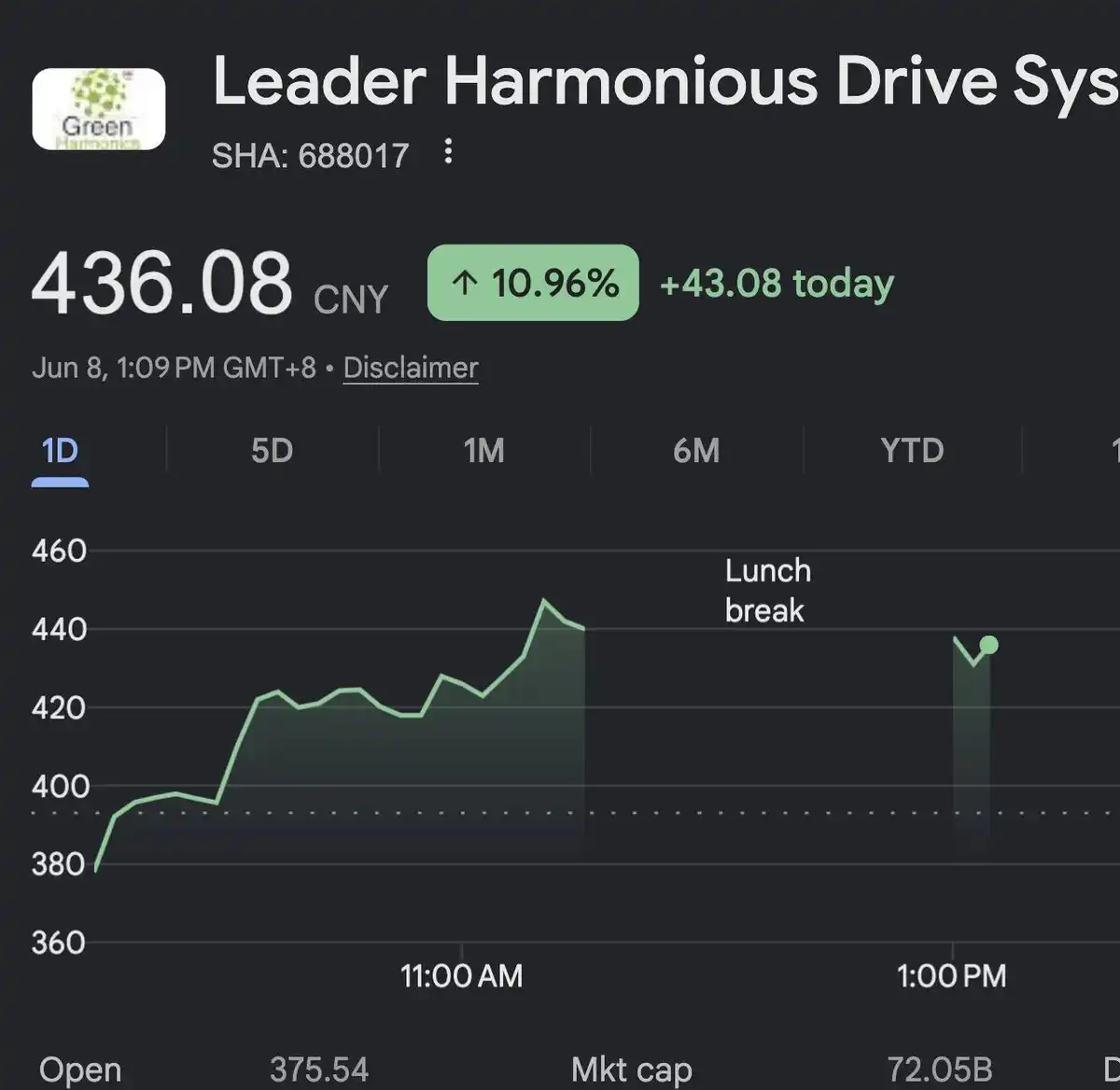
I do believe LeaderDrive (688017) is an outstanding component leader in the Chinese robotics industry.

I have done extensive research on other robotics targets / $TSLA Optimus suppliers, but LeaderDrive is extremely unique.

Compared to other companies engaged in low-margin assembly or low-value components, the latter also faces higher risks of design obsolescence.

Western institutions like Goldman Sachs Research have repeatedly named LeaderDrive:

-> As a company with high technological barriers (e.g., harmonic reducers).

-> And as one likely to capture the cost of high-value components like planetary roller screws per humanoid robot produced.

In simpler terms, by investing in LeaderDrive, you cover:

1. A variety of different components with high entry barriers.

2. High BOM per humanoid robot if they are combined.

3. Low-cost, large-scale production capability.

For every humanoid robot produced.

Do your own research on this topic before making any decisions; but in the long run, if you believe in the growth of the humanoid robotics industry: I find LeaderDrive (688017) very attractive.

The main risks come from other emerging Chinese companies capturing market share in different individual components.

And from large-scale production profits declining over time; just like $VPG's sensors dropped from $750 in the early pre-production stage to $150.

But overall, I don't believe companies outside China like Harmonic Drive (6324) can achieve the same large-scale production costs, which is why $TSLA Optimus is building a broad supply chain from China.

Therefore, we are likely to see a bifurcation in the supply chain: cheap, mass-produced $15k-$20k humanoid robots from the Chinese supply chain, and high-cost humanoid robots from Western supply chains.

Again, if you look at the current P/E ratio and think it's high; a lot of the misunderstanding comes from not seeing future growth:

There is no mass production yet. AGIbot recently achieved a production run of 10,000 units in March.

But over the next 3-5 years, the TAM for the humanoid robot/robotics industry as forecast by Elon Musk and others is enormous, if he expects to produce millions of humanoid robots annually.

Thus, my expectation is that the current $10.65 billion market cap will appear very small in retrospect, as LeaderDrive captures its share of the overall robotics market.

So I think arguments like this shouldn't be measured with a short-term timeframe (or people shouldn't actively trade a target like this).

Instead, this is more of a long-term investment thesis about how this company can capture a material share of the overall humanoid robotics market, which is expected to grow exponentially in the coming years.
Preguntas relacionadas

QWhat are the key reasons the author finds LeaderDrive (688017) to be a unique and attractive investment in the robotics industry?

AThe author highlights three main reasons: 1) LeaderDrive produces high-barrier-to-entry, high-value components like harmonic reducers and planetary roller screws, which capture a significant portion of a robot's Bill of Materials (BOM). 2) It possesses low-cost, large-scale manufacturing capabilities. 3) Its position as a likely key supplier to Chinese supply chains, which are expected to produce low-cost humanoid robots, gives it a competitive advantage over non-Chinese companies.

QAccording to the article, what are the primary risks associated with investing in LeaderDrive?

AThe primary risks identified are: 1) Competition from other emerging Chinese companies that could capture market share in individual component segments. 2) The potential for profit margins to decline over time due to mass production, similar to price reductions seen in other sensor components. The author does not see non-Chinese competitors like Harmonic Drive (6324) as a major risk due to their higher production costs.

QHow does the author justify LeaderDrive's current valuation and suggest investors should view the investment?

AThe author argues that the current high P/E ratio and valuation (10.65 billion USD market cap) are misunderstood if one does not consider future growth. Since mass production of humanoid robots hasn't begun at scale yet, the author believes the company's market share in the exponentially growing humanoid robot market (predicted to be millions of units annually) will make the current valuation seem small in retrospect. Therefore, it should be viewed as a long-term investment thesis, not traded actively based on short-term timeframes.

QWhat does the author predict about the future structure of the humanoid robot supply chain?

AThe author predicts a bifurcation (split) in the supply chain: low-cost humanoid robots (priced around $15k-$20k) will be produced from Chinese supply chains, while higher-cost humanoid robots will come from Western supply chains. This is because Chinese companies like LeaderDrive can achieve lower mass-production costs.

QWhich specific high-value components does the article mention LeaderDrive provides that are critical for humanoid robots?

AThe article specifically mentions harmonic reducers (harmonic drive) and planetary roller screws as the high-value, high-barrier-to-entry components that LeaderDrive produces, which are expected to capture a significant cost portion of each humanoid robot's Bill of Materials (BOM).

Lecturas Relacionadas

Farewell to Traditional Bull and Bear Markets, Deciphering the Logic of Today's Bubble Rotation

"Farewell to Traditional Bulls and Bears: Understanding Today's Market Logic of Bubble Rotation" The article draws a parallel between modern financial markets and a meteorological chain of thunderstorms, contrasting it with the past's slower-moving, more predictable 'layered cloud' systems of long bull/bear cycles and gradual sector rotations. The author argues that today's market has undergone a permanent structural shift, creating an environment where discrete, intense thematic bubbles (e.g., AI, GLP-1 drugs, crypto, robotics, quantum tech) sequentially form, swell, and burst. These 'storm cells' are triggered when capital fleeing a dying bubble acts like a meteorological 'cold air wedge,' forcing the warm, moist capital of latent interest in a new sector to rapidly rise and condense into the next speculative frenzy. This new 'convective' market regime is driven by eight fundamental changes: 1. Democratization of speculation via zero-commission trading, gamified apps, and heavy retail participation in instruments like 0DTE options. 2. Permanent, price-insensitive buying pressure from defined-contribution retirement plans (e.g., 401(k)s). 3. Passive investing creating inelastic market participants that amplify momentum, especially into mega-cap stocks. 4. The dominance of multi-strategy funds and high-frequency trading (HFT), weakening price discovery and creating fragile microstructure prone to synchronized sell-offs. 5. Artificially suppressed volatility that eventually erupts in violent spikes. 6. A transformed market index heavily weighted toward long-duration, narrative-driven tech companies instead of stable, cyclical industrials. 7. The total elimination of information delay, accelerating fear-of-missing-out (FOMO) and herd behavior. 8. A persistently loose fiscal and monetary policy environment. These structural shifts are deemed irreversible. The article outlines the common lifecycle of these thematic bubbles: latency, catalyzing event, narrative formation, peak divergence, and rupture—with outflowing capital seeding the next bubble. In this environment, two investor archetypes can thrive: deep domain experts who understand underlying technologies and business models, and disciplined trend-followers. The author concludes that while emotionally challenging, recognizing this new "climate" is crucial. The key is to elevate one's perspective above the immediate storm to see the cyclical chain of bubbles, avoiding being swept away by the emotions of any single thematic frenzy.

Foresight NewsHace 19 min(s)

Farewell to Traditional Bull and Bear Markets, Deciphering the Logic of Today's Bubble Rotation

Foresight NewsHace 19 min(s)

Michael Saylor's Latest Article: Bitcoin Must Find Balance Between Uniqueness and Universal Value

Michael Saylor outlines four key Bitcoin ideologies shaping its future: * **Bitcoin Maximalists** see Bitcoin as the dominant digital monetary network and a breakthrough in economic empowerment, emphasizing its superior property rights and role as a sound money solution. * **Bitcoin Capitalists** focus on integration, believing Bitcoin must embed into the global economy—through institutions, capital markets, and financial products—to reach its full potential as digital capital. * **Bitcoin Technologists** advocate for continuous protocol improvements in scalability, privacy, and security to adapt to evolving needs and threats, while acknowledging the high bar for change. * **Bitcoin Fundamentalists** guard Bitcoin's core principles of self-custody, decentralization, and censorship resistance, warning against dilution from institutions or risky modifications. Saylor argues that a healthy Bitcoin ecosystem requires a balance of these perspectives. Bitcoin's path forward involves disciplined expansion: preserving its immutable core (Fundamentalist insight), recognizing its dominant status (Maximalist view), integrating with the global economy (Capitalist drive), and enabling careful innovation, primarily in higher layers (Technologist role). The challenge is to maintain Bitcoin's unique properties while making it useful for the world, ensuring it remains Bitcoin as it grows.

Foresight NewsHace 51 min(s)

Michael Saylor's Latest Article: Bitcoin Must Find Balance Between Uniqueness and Universal Value

Foresight NewsHace 51 min(s)

Reddit Weekly Hot Stock Watch: RKLB/LUNR/ASTS Plunge Collectively, Is the Space Sector Still Worth Considering?

Reddit's stock communities witnessed a concentrated surge in discussion around space stocks last week, with SPCE, RKLB, LUNR, and ASTS leading the chatter. This often signals an underlying catalyst for investor attention. However, despite being grouped as "space plays," these companies have vastly different fundamentals and recent performances. While SPCE (Virgin Galactic) saw a 22% single-day surge—potentially fueled by short covering and fallout from Blue Origin's rocket test anomaly—the other three stocks declined sharply. RKLB dropped 15%, LUNR fell 13%, and ASTS was down 7%. This divergence highlights they are not a monolithic sector. The downturn for RKLB, LUNR, and ASTS stemmed from multiple headwinds converging: Blue Origin's New Glenn rocket explosion (directly impacting ASTS's launch plans), anticipation of SpaceX's massive IPO drawing funds away from these "alternative" public space stocks, and insider selling at RKLB after significant rallies. A closer look reveals key differences: RKLB stands out with substantial, growing revenue ($113.9M in Q1) and a $2.2B backlog, though its high valuation (~80x Forward P/S) prices in success for its upcoming Neutron rocket. LUNR's reported revenue growth is largely acquisition-driven, with its core moon landing business facing a crucial test with the upcoming IM-3 mission. ASTS has a large potential market in space-based cellular connectivity but faces significant execution risk, especially after the Blue Origin launch setback. SPCE, despite high discussion volume, has minimal revenue and its recent spike appears driven more by sentiment than fundamentals. The analysis suggests it's premature to call a "buying opportunity" for the sector broadly. RKLB is considered the most fundamentally sound but may be more attractive at a lower price point ($96-$102). For the others, investors are advised to wait for specific catalysts: LUNR's IM-3 mission outcome, clarity on ASTS's revised launch timeline, and for SPCE, to avoid the speculative frenzy. The long-term space thesis remains, but short-term valuations have run ahead of fundamentals for most names.

marsbitHace 1 hora(s)

Reddit Weekly Hot Stock Watch: RKLB/LUNR/ASTS Plunge Collectively, Is the Space Sector Still Worth Considering?

marsbitHace 1 hora(s)

Trading

Spot
Futuros

Artículos destacados

Cómo comprar CORE

¡Bienvenido a HTX.com! Hemos hecho que comprar CORE (CORE) sea simple y conveniente. Sigue nuestra guía paso a paso para iniciar tu viaje de criptos.Paso 1: crea tu cuenta HTXUtiliza tu correo electrónico o número de teléfono para registrarte y obtener una cuenta gratuita en HTX. Experimenta un proceso de registro sin complicaciones y desbloquea todas las funciones.Obtener mi cuentaPaso 2: ve a Comprar cripto y elige tu método de pagoTarjeta de crédito/débito: usa tu Visa o Mastercard para comprar CORE (CORE) al instante.Saldo: utiliza fondos del saldo de tu cuenta HTX para tradear sin problemas.Terceros: hemos agregado métodos de pago populares como Google Pay y Apple Pay para mejorar la comodidad.P2P: tradear directamente con otros usuarios en HTX.Over-the-Counter (OTC): ofrecemos servicios personalizados y tipos de cambio competitivos para los traders.Paso 3: guarda tu CORE (CORE)Después de comprar tu CORE (CORE), guárdalo en tu cuenta HTX. Alternativamente, puedes enviarlo a otro lugar mediante transferencia blockchain o utilizarlo para tradear otras criptomonedas.Paso 4: tradear CORE (CORE)Tradear fácilmente con CORE (CORE) en HTX's mercado spot. Simplemente accede a tu cuenta, selecciona tu par de trading, ejecuta tus trades y monitorea en tiempo real. Ofrecemos una experiencia fácil de usar tanto para principiantes como para traders experimentados.

232 Vistas totalesPublicado en 2024.12.13Actualizado en 2026.06.02

Cómo comprar CORE

Discusiones

Bienvenido a la comunidad de HTX. Aquí puedes mantenerte informado sobre los últimos desarrollos de la plataforma y acceder a análisis profesionales del mercado. A continuación se presentan las opiniones de los usuarios sobre el precio de CORE (CORE).

活动图片













