Senator Cynthia Lummis urges CLARITY Act rush: ‘Let’s get it done, once and for all’

ambcryptoPublicado a 2026-03-23Actualizado a 2026-03-23

Resumen

After months of stalemate over stablecoin yield regulations, a breakthrough has been reached on the CLARITY Act. Following intense negotiations in March, the White House and Senators agreed on a compromise: passive rewards for simply holding stablecoins are prohibited, but activity-based rewards for using them in transactions are permitted. Senator Cynthia Lummis urged swift passage, warning that if the Senate Banking Committee doesn't approve the bill by April's end, progress could stall until 2027 due to the upcoming midterm elections. Market sentiment has improved, with prediction markets showing a 10% increase in the act's passage odds. This legislation aims to establish clear crypto regulations, positioning the U.S. as a global digital asset hub.

For months, the U.S. crypto space has been stuck on one key issue: yield. This refers to the rewards people earn on stablecoins.

The clash between traditional banks and crypto firms went beyond slowing progress and nearly blocked the Digital Asset Market CLARITY Act. At one point, it even risked pushing innovation outside the U.S.

Now, things are starting to move. After intense meetings between the White House and lawmakers this March, a breakthrough seems close.

Executives are confident about the CLARITY Act passage

Senator Cynthia Lummis said negotiations are done, suggesting a deal on stablecoin rewards is almost here, but the obstacles are not over yet.

With an important Senate review coming in April and midterm elections approaching in 2026, time is running out. If a deal isn’t reached by May, progress on clear crypto rules could be delayed for a long time.

Senator Lummis said,

President Trump pledged to make America the digital asset capital of the world. The CLARITY Act is how we make that happen. Let’s get it done, once and for all.

What changed?

For those unaware, things took a big turn on the 20th of March. Patrick Witt, the White House’s top crypto advisor, said that the Senate and the administration had reached an “agreement in principle.”

He called it a major step forward, as it finally breaks the long-standing deadlock. He also gave credit to Senators Thom Tillis and Angela Alsobrooks for helping both sides reach a compromise.

The deal finally found a middle path. As per the latest discussion, it will not allow passive rewards, meaning users won’t earn interest just for holding stablecoins, which was a concern for banks.

But it will allow activity-based rewards, where users can earn benefits by using stablecoins for payments or on platforms.

Crypto community is optimistic

Nic Puckrin, CEO of Coin Bureau, also stressed that time is running out. He said that if the CLARITY Act doesn’t pass the Senate Banking Committee by the end of April, it could be “dead” until 2027, as lawmakers will soon shift focus to the 2026 midterm elections.

Still, Puckrin is cautiously hopeful, as he said,

Yesterday, the stablecoin yield deal happened. Senators + the White House reached a compromise on the exact issue that’s been blocking this for months.

He added,

This isn’t done yet. But the path just opened. Watch April closely.

Polymarket odds rise

This shift is already visible in market sentiment. On Polymarket, the chances of the CLARITY Act becoming law in 2026 jumped from 60% to 70% in just one day after the update on the 20th of March.
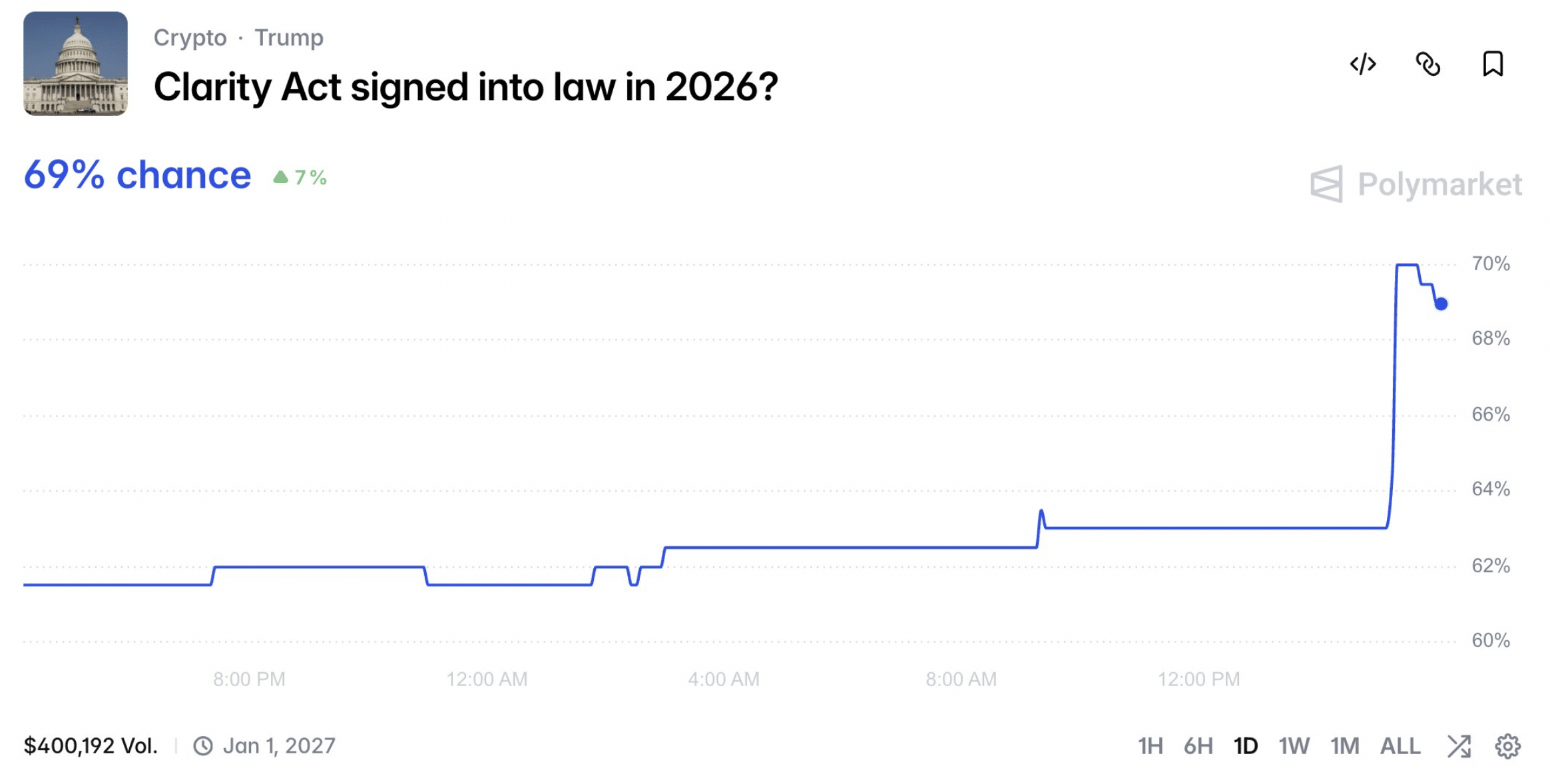
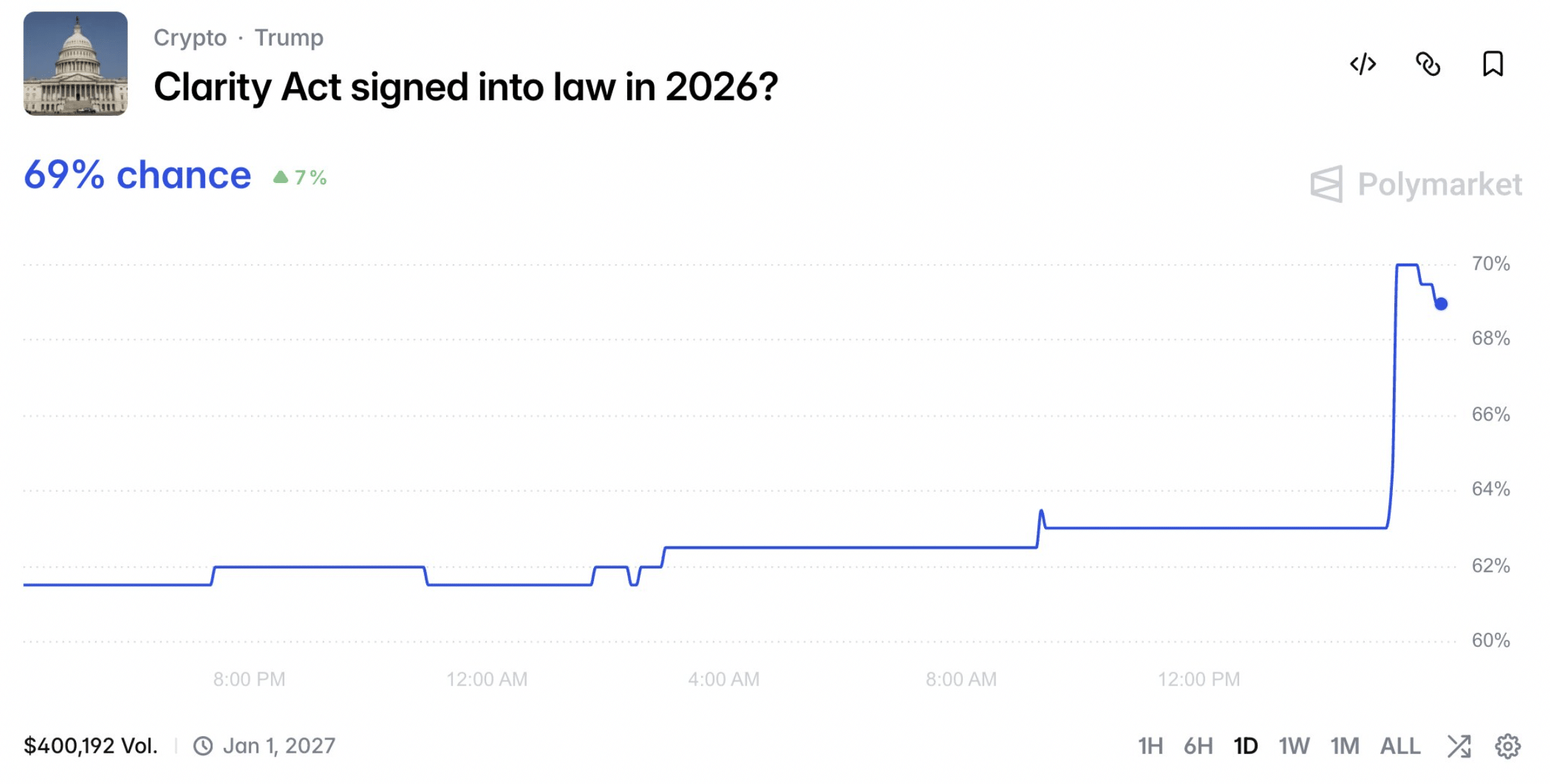
Source: Polymarket

This shows that more people now believe the long delay in decision-making might finally end.

If this momentum continues and the bill passes between April and May, it could have a massive impact. It may bring in large amounts of investment and make the crypto market work more efficiently.

More importantly, it would replace unclear regulation and position the U.S. as a global crypto hub. Ergo, as expected, all eyes are on what comes next for the CLARITY Act.


Final Summary

  • The stablecoin yield compromise has broken a months-long deadlock, bringing the CLARITY Act closer to reality.
  • Political pressure from the upcoming 2026 midterms could delay progress if deadlines are missed.

Preguntas relacionadas

QWhat is the main issue that has been stalling progress in the U.S. crypto space according to the article?

AThe main issue has been the debate over yield, specifically the rewards people earn on stablecoins.

QWhat key compromise was reached between the Senate and the White House regarding stablecoin rewards?

AThe compromise allows for activity-based rewards, where users can earn benefits by using stablecoins for payments or on platforms, but it will not allow passive rewards (earning interest just for holding stablecoins).

QWhy is there a sense of urgency to pass the CLARITY Act by the end of April?

AIf the act doesn't pass the Senate Banking Committee by the end of April, progress could be delayed until 2027 because lawmakers will soon shift their focus to the 2026 midterm elections.

QHow did the market prediction platform Polymarket react to the news of the compromise?

AOn Polymarket, the prediction odds of the CLARITY Act becoming law in 2026 jumped from 60% to 70% in just one day after the announcement on March 20th.

QWhat did Senator Cynthia Lummis say is the purpose of the CLARITY Act?

ASenator Lummis stated that the CLARITY Act is how the U.S. will achieve President Trump's pledge to make America the digital asset capital of the world.

Lecturas Relacionadas

Uncovering the Truth About Agent Commerce, Payments, and Infrastructure

Decoding Agent Commerce, Payments, and Infrastructure: The Reality Over the past year, I've been building infrastructure for the Agent economy, engaging with major players like Stripe, Visa, Coinbase, Google, and dozens of startups. A clear conclusion emerges: true, large-scale demand does not yet exist. Startups face structural challenges. Data points illustrate this gap. Stripe's Agent commerce platform has over 1,000 merchants but only single-digit transacting agents. Visa's Agent payment token requires 9-month KYC and a $250M revenue threshold, accessible only to giants like Amazon. On-chain analysis reveals actual daily Agent transaction volume is around $17k, half of which are test transactions. The article analyzes four potential markets: **1. Agent-to-Merchant (A2M):** Current AI shopping UX is often inferior to traditional e-commerce for visual, comparison-heavy purchases (clothing, electronics). Chat interfaces are a step back. Real merchant interest is defensive "Agent Engine Optimization," fearing future obsolescence, not current demand. Potential exists in high-frequency, low-decision purchases (e.g., food delivery) or simplifying terrible UX (complex checkouts, non-native shoppers), but these require massive consumer distribution channels dominated by giants like DoorDash and Amazon. **2. Agent-to-API (A2A):** Developers already have subscriptions and billing for core APIs (compute, data). The argument for micro-payments via crypto for sub-dollar API calls is addressed by pre-paid balances today. The deeper issue is supplier resistance; major SaaS firms rely on enterprise contracts, not fractional cent pricing. Opportunity lies in the long tail of niche services, but this is a smaller market catering to developers, a historically low-paying group. **3. Agent-to-Agent (A2A):** This remains a theoretical long-term vision with near-zero current transaction volume. It involves unique challenges: discovery, trust, negotiation, dispute resolution. When it materializes, it will require a fundamentally new settlement infrastructure for high-speed, variable-value, multi-party transactions. It's a real long-term bet, but not the current market. **4. Agent-to-Finance (A2F):** This is the only category with existing, paying demand. Integrating AI into financial workflows (trading, portfolio management) is a natural evolution and enables new capabilities like autonomous rebalancing. However, competition favors incumbents with regulatory licenses, compliance infrastructure, and existing client relationships. **The Real Issue:** Why is infrastructure still being built? Incumbents can afford long-term bets, and payment companies see every problem as a nail for their payment hammer. However, payment is just one piece. The core challenge is *coordination*—orchestrating work between Agents and humans, verifying outcomes, and settling results. Payment is part of settlement, which is part of coordination. Companies that solve the coordination problem will subsume payments, not the other way around. Startups lack the infinite runway of giants and must find today's real market, which, after a year of exploration, lies outside these four categories—in an area with real, growing, and underserved activity.

marsbitHace 57 min(s)

Uncovering the Truth About Agent Commerce, Payments, and Infrastructure

marsbitHace 57 min(s)

Kalshi, MTS, and a16z's Ambition

The article "Kalshi, MTS, and a16z's Ambition" explores prediction markets as a focal point of excitement in 2025 for investors, crypto enthusiasts, and media. It traces their intellectual lineage from Friedrich Hayek's ideas on dispersed knowledge and market coordination to Robin Hanson's Logarithmic Market Scoring Rule (LMSR), which incentivizes truthful information sharing. The piece argues that a16z's significant investment in prediction market platform Kalshi (valued at $220B) transcends mere financial speculation. a16z frames prediction markets as a new form of "media" that provides "presence"—a way for individuals to actively engage with and influence world events through financial stakes, countering postmodern detachment. By wagering on outcomes, users become "super observers," and the market's aggregated probabilities gain authoritative power to define event truth and importance. The article uses media company MTS ("Monitoring The Situation") as a case study of a16z's "new media" strategy: rapidly producing high-intensity, multi-format content to "take over the timeline." However, prediction markets like Kalshi are presented as the ultimate piece in this media empire. Their real-money, crowd-sourced probabilities possess a unique "reality distortion field" and perceived objectivity, potentially swaying public opinion and granting a private company unprecedented interpretive power over reality. Ultimately, Kalshi's immense valuation is attributed not just to its exchange model, but to its role as a foundational component in a16z's envisioned new media landscape, where prediction markets define narrative and truth.

链捕手Hace 57 min(s)

Kalshi, MTS, and a16z's Ambition

链捕手Hace 57 min(s)

Trading

Spot
Futuros

Artículos destacados

Cómo comprar ONE

¡Bienvenido a HTX.com! Hemos hecho que comprar Harmony (ONE) sea simple y conveniente. Sigue nuestra guía paso a paso para iniciar tu viaje de criptos.Paso 1: crea tu cuenta HTXUtiliza tu correo electrónico o número de teléfono para registrarte y obtener una cuenta gratuita en HTX. Experimenta un proceso de registro sin complicaciones y desbloquea todas las funciones.Obtener mi cuentaPaso 2: ve a Comprar cripto y elige tu método de pagoTarjeta de crédito/débito: usa tu Visa o Mastercard para comprar Harmony (ONE) al instante.Saldo: utiliza fondos del saldo de tu cuenta HTX para tradear sin problemas.Terceros: hemos agregado métodos de pago populares como Google Pay y Apple Pay para mejorar la comodidad.P2P: tradear directamente con otros usuarios en HTX.Over-the-Counter (OTC): ofrecemos servicios personalizados y tipos de cambio competitivos para los traders.Paso 3: guarda tu Harmony (ONE)Después de comprar tu Harmony (ONE), guárdalo en tu cuenta HTX. Alternativamente, puedes enviarlo a otro lugar mediante transferencia blockchain o utilizarlo para tradear otras criptomonedas.Paso 4: tradear Harmony (ONE)Tradear fácilmente con Harmony (ONE) en HTX's mercado spot. Simplemente accede a tu cuenta, selecciona tu par de trading, ejecuta tus trades y monitorea en tiempo real. Ofrecemos una experiencia fácil de usar tanto para principiantes como para traders experimentados.

279 Vistas totalesPublicado en 2024.12.12Actualizado en 2026.06.02

Cómo comprar ONE

Discusiones

Bienvenido a la comunidad de HTX. Aquí puedes mantenerte informado sobre los últimos desarrollos de la plataforma y acceder a análisis profesionales del mercado. A continuación se presentan las opiniones de los usuarios sobre el precio de ONE (ONE).

活动图片