Senate Judiciary flags DeFi oversight ‘gaps’ in U.S. crypto bill

ambcryptoPublicado a 2026-01-17Actualizado a 2026-01-17

Resumen

The Senate Judiciary Committee, led by Chuck Grassley and Dick Durbin, has raised concerns about the CLARITY Act, a broader crypto market structure bill. They warn that exemptions in the bill could allow DeFi software developers to avoid financial licensing requirements for money-transmitting businesses, potentially weakening federal criminal code enforcement tools used by the Department of Justice. The Judiciary Committee argues it was not consulted on these changes and urged the Senate Banking Committee to reject the exemptions, citing risks such as enabling money laundering. In response, the Banking Committee defended the protections for developers, stating the provisions fall under its jurisdiction and aim to prevent unfair prosecution of those without control over funds or transactions. The bill faces further uncertainty after Coinbase withdrew support, and the White House reportedly warned the exchange to return to negotiations or risk losing backing. The future of the legislation remains unclear.

The broader crypto market structure, the CLARITY Act, has hit another snag, this time from the Senate Judiciary Committee.

The Committee’s Chair, Chuck Grassley (R-Iowa), and ranking member, Dick Durbin (D-Illinois), raised an alarm about a section of the bill.

They pointed out that it would exempt some DeFi software developers from financial licensing requirements for money-transmitting businesses (MTBs).

In a letter to Senate Banking Committee Chair Tim Scott and Ranking Member Elizabeth Warren (D‐Massachusetts), Senators Grassley and Durbin emphasized that they had not been consulted. They argued that the mandate nonetheless falls within their jurisdiction.

The Senate Judiciary Committee went further, warning that the bill’s exemptions “weaken” the federal criminal code. They stressed that this code is a critical enforcement tool for the Department of Justice in combating serious crime.

“By providing a sweeping exemption to non-controlling developers or providers from critical portions of Titles 18 and 31.”

The letter further stated,

“The Senate Judiciary Committee, which has jurisdiction over Title 18, was not consulted or given the opportunity to meaningfully review the proposed changes in advance.”

The senators warned that the proposed exemptions could allow founders, such as Roman Storm of the crypto mixer Tornado Cash, to walk free, even after facilitating the laundering of large‐scale criminal proceeds.

As a consequence, the Judiciary Committee urged its banking colleagues to reject these exemptions. They emphasized the need to close potential DeFi oversight “gaps” in the bill to ensure accountability.

Senate Banking defends developer protections

For perspective, Storm was convicted of conspiracy to operate an unlicensed MTBs despite not having custody of funds or discretionary control over transactions.

This section of the bill, known as the Blockchain Regulatory Certainty Act (BRCA), was added to the broader crypto legislation.

Its purpose is to protect software developers from what lawmakers describe as “unfair” prosecution. Specifically, it seeks to shield them from liability under the Bank Secrecy Act and criminal law.

Even pro-crypto Cynthia Lummis backed these exemptions, provided the platforms don’t control the funds or transactions.
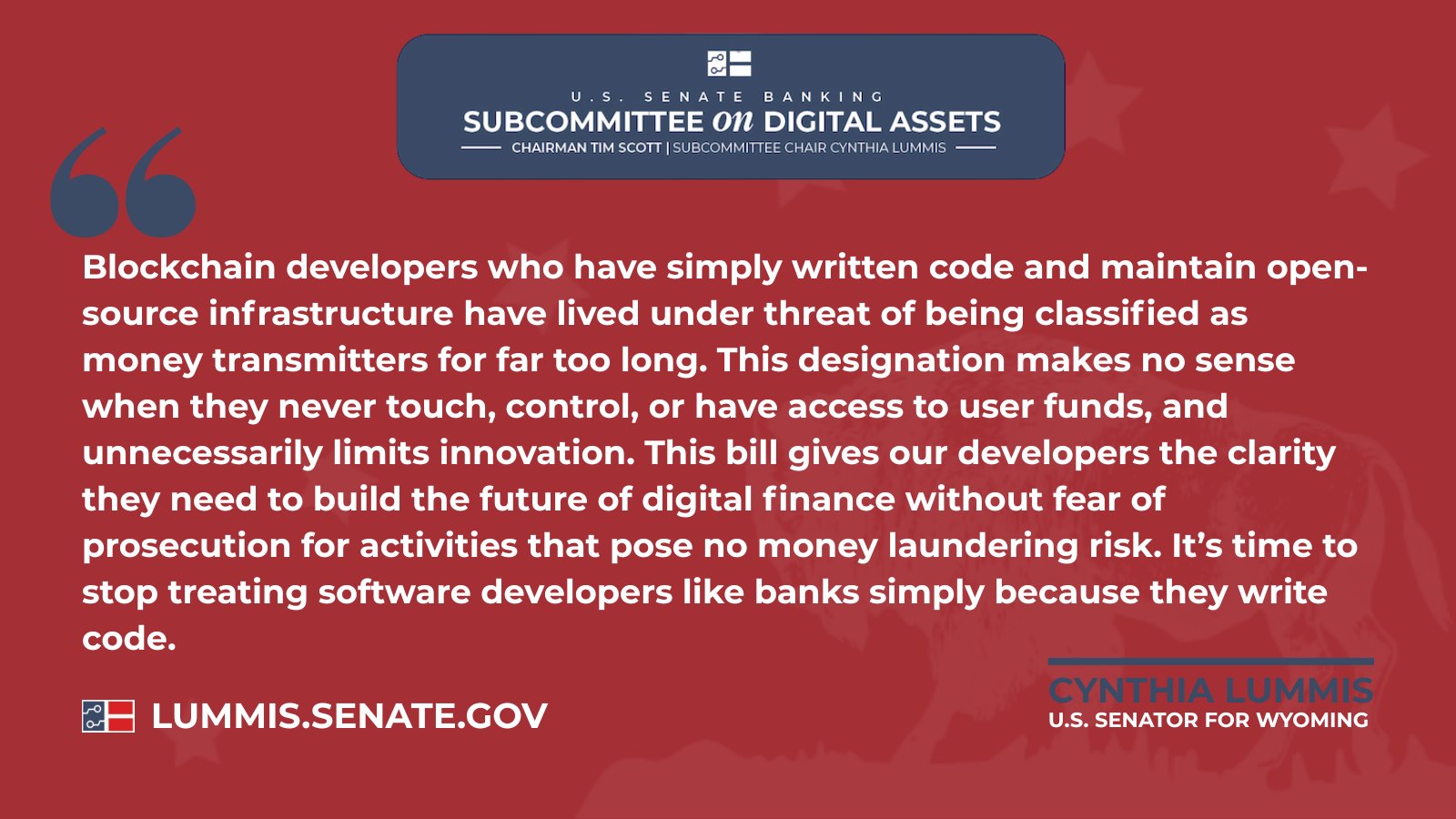
Source: X/Cynthia Lummis

In a response to Senate Judiciary claims, Tim Scott’s spokesperson, Jeff Naft, told Politico that BRCA falls within the Banking Committee and added,

“The Chairman (Scott) remains committed to protecting software developers while ensuring that law enforcement has the necessary tools to prosecute actual illegal money transmission operations.”

Uncertainty rocks crypto bill

The bill’s progress hit a roadblock after Coinbase withdrew support, citing ‘too many issues’ including a ban on stablecoin rewards.

Coinbase’s CEO Brian Armstrong’s “no bill, better than bad bill” stance has left the industry divided, intensifying uncertainty on the bill’s way forward.

That said, White House was reportedly unhappy with Coinbase’s move, calling it a ‘rug-pull’ against the entire industry.

According to reporter Eleanor Terrett, citing an insider, the White House will also pull support if Coinbase does come back to negotiations, adding that,

“This is President Trump’s bill at the end of the day, not Brian Armstrong’s”

It remains to be seen whether the bill will regain momentum in the coming days.


Final Thoughts

  • Senate Judiciary pressed for rejection of DeFi software developer exemptions to strengthen DoJ oversight in the space.
  • The White House reportedly warned Coinbase to return to negotiations or risk losing support.

Preguntas relacionadas

QWhat specific concern did the Senate Judiciary Committee raise about the CLARITY Act?

AThe Senate Judiciary Committee raised concerns that the bill would exempt some DeFi software developers from financial licensing requirements for money-transmitting businesses, which they argue would 'weaken' the federal criminal code and create oversight gaps.

QWhich specific legal titles did the Judiciary Committee argue were being weakened by the proposed exemptions?

AThe Judiciary Committee argued that the exemptions would weaken critical portions of Titles 18 and 31 of the U.S. Code, which fall under their jurisdiction.

QWhat is the purpose of the Blockchain Regulatory Certainty Act (BRCA) section added to the broader crypto bill?

AThe Blockchain Regulatory Certainty Act (BRCA) aims to protect software developers from what lawmakers describe as 'unfair' prosecution by shielding them from liability under the Bank Secrecy Act and criminal law, provided they don't control funds or transactions.

QWhy did Coinbase withdraw its support for the crypto bill?

ACoinbase withdrew its support for the bill citing 'too many issues,' including a proposed ban on stablecoin rewards.

QWhat was the White House's reported reaction to Coinbase's withdrawal from the bill negotiations?

AThe White House was reportedly unhappy with Coinbase's move, calling it a 'rug-pull' against the entire industry, and warned that they would also pull support if Coinbase did not return to negotiations.

Lecturas Relacionadas

Polymarket's "2028 Presidential Election" Volume King Is... LeBron James???

An article from Odaily Planet Daily, authored by Azuma, discusses a peculiar phenomenon observed on the prediction market platform Polymarket regarding the "2028 US Presidential Election" event. Despite having a real-time probability of less than 1%, unlikely candidates such as NBA star LeBron James (with $48.41 million in trading volume), celebrity Kim Kardashian ($33.84 million), and even ineligible figures like Elon Musk ($23.14 million) and New York City Mayor Zohran Mamdani ($18.39 million) account for approximately 70% of the total trading volume. In contrast, high-probability candidates like Vice President JD Vance ($10.58 million), California Governor Gavin Newsom ($15.71 million), and Secretary of State Marco Rubio ($9.32 million) have significantly lower trading activity. The article explains that this counterintuitive trend is not driven by irrational speculation but by rational strategies. Polymarket offers a 4% annualized holding reward for certain markets, including the 2028 election, to maintain long-term pricing accuracy. This yield exceeds the current 5-year US Treasury rate (3.98%), attracting large investors ("whales") to hold "NO" shares on low-probability candidates for risk-free returns. Additionally, some users utilize a platform feature that allows converting a set of "NO" shares into corresponding "YES" shares for better liquidity or pricing efficiency, rather than directly buying "YES" shares for their preferred candidates. Thus, the seemingly absurd trading activity is strategically motivated.

marsbitHace 1 hora(s)

Polymarket's "2028 Presidential Election" Volume King Is... LeBron James???

marsbitHace 1 hora(s)

Dialogue with ViaBTC CEO Yang Haipo: Is the Essence of Blockchain a Libertarian Experiment?

"ViaBTC CEO Yang Haipo: Blockchain as a Hardcore Libertarian Experiment" In a deep-dive interview, ViaBTC CEO Yang Haipo reframes the essence of blockchain, arguing it is not merely a new technology or infrastructure but a hardcore libertarian experiment. This experiment, born from the 2008 financial crisis and decades of cypherpunk ideology, tests a fundamental question: to what extent can freedom and self-organization exist without centralized trust? The discussion highlights the experiment's verified outcomes. On one hand, it has proven its core value of censorship resistance, providing critical financial lifelines for entities like WikiLeaks and individuals in hyperinflationary or sanctioned countries via tools like stablecoins. However, Yang points out a key paradox: the most successful product, USDT, is itself a centralized compromise, showing users prioritize a less-controlled pipeline over pure decentralization. On the other hand, the experiment has exposed the severe costs of this freedom—a "dark forest" without safeguards. Events like the collapses of LUNA, Celsius, and FTX, resulting in massive wealth destruction and prison sentences for founders, underscore the system's fragility and the inherent risks of an unregulated environment. Yang observes that despite decentralized protocols, human nature inevitably recreates centralized power structures, speculative frenzies, and narrative-driven cycles (from ICOs to Meme coins), where emotion and belonging often trump technological substance. Looking forward, he believes blockchain's future is significant but niche. Its real value lies in serving specific, real-world needs for financial sovereignty and bypassing traditional controls, not as a universal infrastructure replacing all centralized systems. For the average participant, Yang's crucial advice is to cultivate independent judgment. True freedom is not holding a crypto wallet, but possessing a mind resilient to groupthink and narrative hype in a high-risk, often irrational market.

marsbitHace 1 hora(s)

Dialogue with ViaBTC CEO Yang Haipo: Is the Essence of Blockchain a Libertarian Experiment?

marsbitHace 1 hora(s)

Trading

Spot
Futuros
活动图片