Securitize announces ‘real’ tokenized stocks, touts DeFi integration

cointelegraphPublicado a 2025-12-17Actualizado a 2025-12-17

Resumen

Securitize has announced plans to launch what it claims will be the first compliant, on-chain trading experience for tokenized public stocks, representing real share ownership rather than synthetic exposure. The product, expected in Q1 2026, will use tokens issued directly on the issuer’s cap table and recorded onchain. Trading will occur through a DeFi-style swap interface, enabling real-time transactions even outside traditional market hours. The company criticized existing tokenized stock offerings for lacking true ownership, compliance, and proper KYC/AML controls, often relying on offshore structures. In contrast, Securitize emphasizes regulatory compliance, whitelisted wallets, and its role as an SEC-registered transfer agent to ensure tokens represent legally recognized shares. Beyond faster settlement, the firm highlights programmability—enabling integration with DeFi and smart contracts while maintaining investor protections—as a key upgrade to traditional finance.

Securitize, a company focused on tokenizing securities, said Tuesday it plans to launch what it calls the first compliant, onchain trading experience for public stocks that are issued as tokens representing real share ownership.

According to the announcement, Securitize’s stock product is expected to launch in the first quarter of 2026. The company said the offering is designed to avoid structures that mirror stock prices without conveying ownership, and instead, the tokens “are real, regulated shares: issued onchain, recorded directly on the issuer’s cap table.”

It also said trading will be presented in a “swap-style” interface familiar to users of decentralized finance, or decentralized finance (DeFi).

Securitize argued that natively tokenized public stocks, in which tokens represent actual stock ownership, were held onchain but mostly traded through traditional offchain processes. Its pitch is that buyers and sellers will be able to trade “fully on-chain” in real time, including during hours when traditional markets are closed.
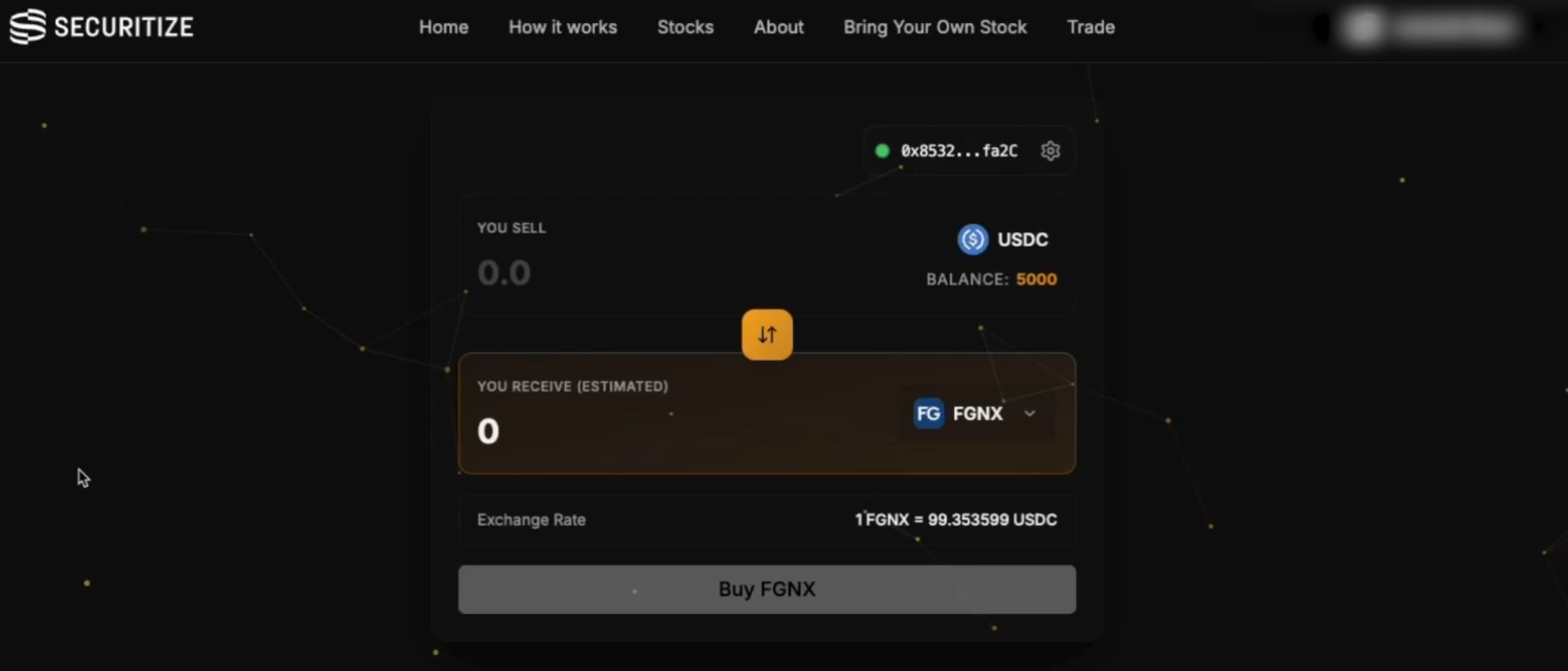
Securitize’s tokenized stock trading user interface. Source: Securitize

Related: Binance hints at stock perps in push to join global tokenized equities race

A compliant tokenized stock ecosystem

Securitize criticized the recent wave of tokenized stock products, claiming they “offer exposure, not ownership.” The company said some products rely on special-purpose vehicles or offshore structures that can add counterparty risk or create pricing mismatches.

It also criticized tokenized stock products, which it said “are not even compliant, since they are issued as permissionless assets without Know Your Customer (KYC) or Anti-Money Laundering (AML) controls.

Still, the company notes that traditional stock infrastructure is antiquated and needs disintermediation and rebuilding, with investors rarely holding “shares in their own name, settlement takes at least a day.”

“If tokenization is going to matter at public-market scale, it must deliver ownership, real securities and maintain investor protections.“

Securitize said its approach is built around regulated securities and compliance requirements, including controls that limit transfers to approved, or whitelisted, wallets.

Related: Ondo wins Liechtenstein approval to offer tokenized stocks in Europe

Regulated shares make their way to DeFi

Securitize said it will act as the transfer agent for the shares, describing itself as registered with the US Securities and Exchange Commission. Transfer agents maintain shareholder records and process changes in ownership. By pairing that role with blockchain-based issuance, the company said the tokens would be legally recognized shares rather than a proxy claim.

Securitize downplayed faster settlement as the main selling point, saying the larger opportunity is programmability, or the ability for tokenized securities to interact with smart contracts and onchain financial applications.

It further argued that this programmability allows tokenized securities to be integrated with DeFi platforms “without compromising compliance or user protections.”

“This is not about replacing traditional finance. It’s about upgrading it,“ Securitize said.
Lecturas Relacionadas

Bernstein Analysis: Can the $142 Billion Long-Term Order Hold Up the Memory Cycle?

Bernstein revisits long-term agreements (LTAs) in the memory industry, highlighting new contracts with purchase commitments, minimum prices, and financial guarantees signed by Micron and SanDisk. These aim to provide an earnings floor for the coming years. Micron has 16 strategic customer agreements, with 14 representing approximately $100 billion in minimum revenue and about $22 billion in cash deposits/commitments. SanDisk has contracts for around $42 billion in minimum revenue and over $11 billion in guarantees. Combined, these ~$33 billion in guarantees make it more costly for major clients to walk away. However, Bernstein models that the potential revenue needing protection over 3-5 years is around $5.2 trillion. The existing guarantees thus cover only about 0.6% of that scale. While LTAs provide a cushion, they cannot fully shield profits in a severe downturn, as clients may still find it cheaper to breach contracts if spot prices fall deeply below floor prices. LTAs are most suitable for large, credit-worthy customers like U.S. cloud service providers with stable, high-volume AI infrastructure needs. Consumer segments (phones, PCs) and some Chinese clients are less likely to adopt them, leaving an estimated 30-50% of the DRAM/NAND market exposed to spot price volatility. AI demand (e.g., HBM for training, storage for inference) supports higher valuations and makes LTAs more attractive for locking in high-demand customers. Yet, Bernstein stresses that LTAs soften, but do not eliminate, the memory cycle. Their true test will come in the next downturn, revealing whether clients honor contracts and whether guarantees provide sufficient pain to maintain supplier discipline.

marsbitHace 11 min(s)

Bernstein Analysis: Can the $142 Billion Long-Term Order Hold Up the Memory Cycle?

marsbitHace 11 min(s)

Dialogue with Jia Hang | Looking Back at Two Decades of Chinese Payment Going Global

**Summary: A Conversation with Jia Hang on Two Decades of China's Payment Globalization** Jia Hang, a veteran with over twenty years in payments, reflects on China's attempts to build a global payment network through three key phases: UnionPay (card networks), Alipay+ (digital wallets), and now, stablecoins. His journey began at UnionPay International, aiming to establish China's card network abroad. While successful in following Chinese tourists ("where Chinese go, UnionPay goes"), it struggled to achieve true global scale. The core lesson: card networks like Visa/Mastercard's unassailable advantage isn't just technical standards, but their deeply entrenched **governance and profit-sharing models** that create powerful network effects. Competing as the "same species" is nearly impossible. At Ant Group, he led Alipay+, a strategy to bypass card networks by interconnecting local e-wallets worldwide. While innovative, it faced a similar ceiling. Mobile QR payments and card swipes were essentially **the same species competing for the same pie**, lacking a disruptive value proposition for users or a sustainable new incentive model to replace the card networks' established flywheel. Today, at Singapore's DCS, Jia focuses on stablecoin-based payments. He argues stablecoins represent a fundamental shift. They are not competing with Visa for consumer payments but challenging the **traditional banking and account system for value movement**. Products like "U Cards" (stablecoin-linked payment cards) are transitional, leveraging existing card networks for acceptance while building new rails. The real potential lies in stablecoins enabling seamless, low-cost global value transfer, potentially reorganizing the financial infrastructure around **accounts rather than cards**. Jia believes stablecoin adoption for local retail payments, cross-border transactions, and as high-yield savings vehicles is becoming irreversible. This could gradually reduce reliance on traditional fiat channels, especially in regions with weak currencies or capital controls. The quest for the "next global payment network" continues, now centered on whether stablecoins can successfully bridge Web2 and Web3, establish new governance, and create compelling user value beyond mere cost reduction.

marsbitHace 34 min(s)

Dialogue with Jia Hang | Looking Back at Two Decades of Chinese Payment Going Global

marsbitHace 34 min(s)

Circle's Stock Price Plunges 76%, Hong Kong Dollar Stablecoin Set to Launch Within Two Weeks

Circle's stock price has plunged approximately 76% from its 2023 peak, reflecting a major market revaluation. Despite this, Circle President Heath Tarbert emphasized the company's focus on long-term execution and its dominant position with USDC's $73 billion circulation across 34 blockchains. The competitive landscape is intensifying. A new consortium-backed stablecoin, Open USD, is attempting to challenge incumbents by sharing reserve yields with partners. More significantly, Visa's new stablecoin platform, initially supporting Open USD while also being compatible with USDC, could erode Circle's network effects. In response, Circle is expanding into real-world payments through partnerships like the one with Japan's JCB. Separately, Tether (USDT) faces a two-year compliance window under new U.S. regulations, requiring it to adjust its reserve composition away from assets like Bitcoin and loans towards cash and U.S. Treasuries. Meanwhile, in Hong Kong, Standard Chartered-backed fintech firm Dian Dian is poised to launch a licensed HKD-pegged stablecoin (HKDAP), moving the industry into a phase where the real test is integrating licensed stablecoins into actual payment flows and corporate treasury systems. The sharp decline in Circle's stock underscores a broader shift: the stablecoin market is moving from a winner-takes-all dynamic to a multi-player competitive arena where execution, compliance, and real-world utility are becoming paramount.

marsbitHace 35 min(s)

Circle's Stock Price Plunges 76%, Hong Kong Dollar Stablecoin Set to Launch Within Two Weeks

marsbitHace 35 min(s)

Trading

Spot
活动图片