Second Largest Whale Cuts Losses and Liquidates, Can AAVE Still Be Bought Amid Deepening Divisions?

marsbitPublicado a 2025-12-22Actualizado a 2025-12-22

Resumen

The second-largest AAVE whale, excluding the project team, protocol contracts, and CEXs, has sold 230,000 AAVE tokens at a significant loss of $13.45 million, causing a 12% price drop. This sell-off reflects growing tensions between Aave Labs and the community over governance and fund allocation. The conflict began when Aave switched its default swap aggregator to Cow Swap, redirecting front-end transaction fees—previously sent to the Aave DAO treasury—to Aave Labs instead. Community members estimated this change could divert over $10 million annually from the DAO to the team, raising concerns about transparency and control. Aave Labs argued that front-end products are separate from the protocol and that the team has the right to monetize them. In response, a proposal was made to transfer control of Aave’s brand assets (domains, social accounts, etc.) to token holders. Founder Stani Kulechov opposed the proposal, citing its oversimplification of complex legal and operational issues, further escalating community backlash. The situation highlights deeper structural challenges in DeFi governance, where protocol value, team control, and community rights intersect. The outcome of an ongoing snapshot vote on the proposal may determine AAVE’s short-term price direction and long-term community trust. If the conflict signals fundamental misalignment between Aave Labs and the DAO, this could mark the start of continued tension rather than an isolated incident.

Author|Azuma(@azuma_eth)
The leading lending protocol Aave is embroiled in a public opinion storm. The escalating tensions between the team and the community have objectively shaken the confidence of token holders in the AAVE token itself.

In the early hours of today, the second-largest AAVE whale, excluding the project team, protocol contracts, and CEXs, cut losses and liquidated 230,000 AAVE (worth approximately $38 million), causing AAVE to drop 12% short-term. It is reported that this "number two big brother" purchased their AAVE holdings from late last year to early this year at an average price of $223.4. The average selling price today was about $165, resulting in a final loss of $13.45 million.

  • Odaily Note: The whale address is https://debank.com/profile/0xa923b13270f8622b5d5960634200dc4302b7611e.

Origin of the Incident: Dispute Over Fee Flow

To understand the current community crisis at Aave, we need to start with a recent change to the Aave frontend.

n

On December 4th, Aave announced a partnership with Cow Swap, adopting the latter as the default trading path for the swap function on the Aave frontend (Odaily Note: previously ParaSwap), utilizing its anti-MEV features for better quotes.
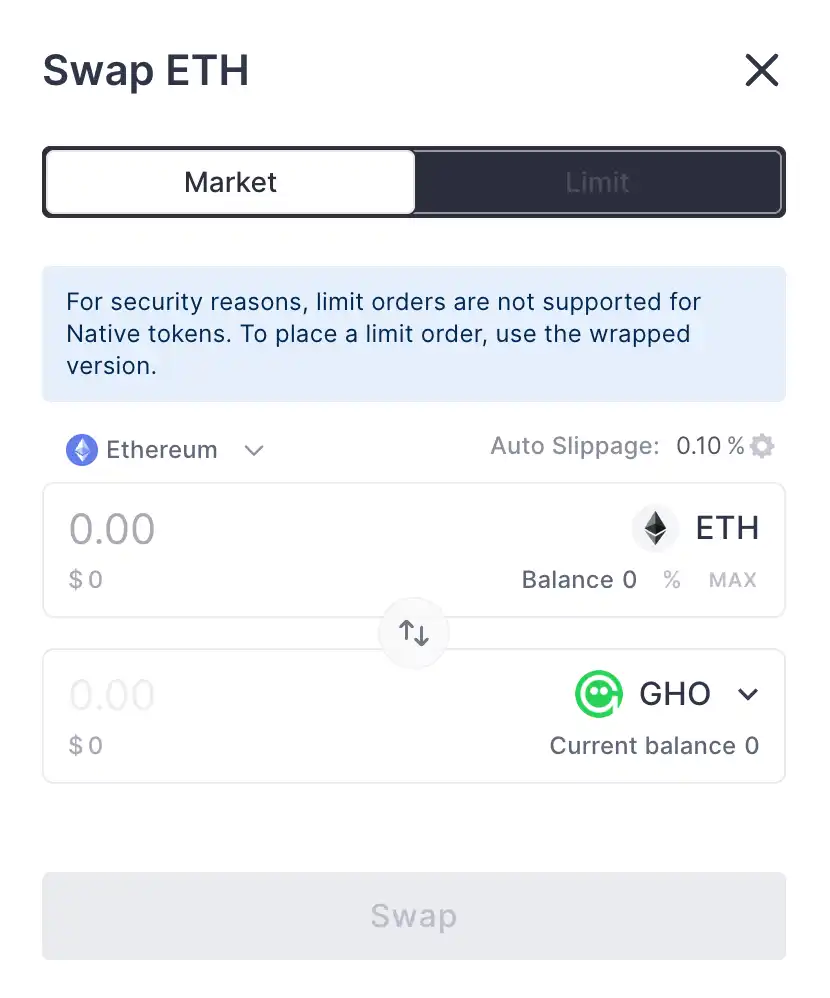
This seemed like a normal functional upgrade, but the community soon discovered that while the additional fees generated by this function (including referral fees or positive slippage surplus fees) previously flowed to the Aave DAO treasury address when using ParaSwap, after switching to Cow Swap, they were redirected to the Aave Labs address.

Community representative EzR3aL was the first to notice this unannounced change. They questioned the Aave team in the governance forum and estimated that, just tracking the income flow on Ethereum and Arbitrum, this change could generate approximately $200,000 in weekly revenue, corresponding to an annualized income of over $10 million — meaning Aave had quietly redirected at least tens of millions of dollars in revenue from the community address to the team address.

Core Controversy: Who Really Owns the Aave Brand?

As EzR3aL's post gained traction, a large number of AAVE holders felt betrayed, especially considering Aave made this change without community communication or any disclosure, seemingly intending to conceal it.

In response to community concerns, Aave Labs replied directly under EzR3aL's post, stating that there should be a clear distinction between the protocol layer and the product layer. The swap function interface on the Aave frontend is entirely operated by Aave Labs, which is responsible for the capital investment, construction, and maintenance. This function is completely independent of the DAO-managed protocol, therefore Aave Labs has the right to independently decide how to operate and profit... The revenue previously flowing to the Aave DAO address was a donation from Aave Labs, but not an obligation.

In short, Aave Labs' stance is that the frontend interface and its ancillary functions are essentially team products, and the revenue generated should be considered company property, not to be conflated with the protocol and its revenue controlled by the DAO.

This statement quickly sparked heated debate within the community regarding the ownership of the Aave protocol versus its products. A well-known DeFi analyst wrote an article titled "Who Really Owns 'Aave': Aave Labs vs Aave DAO," which Odaily Planet Daily also translated into Chinese for supplementary reading.

On December 16th, the conflict intensified further. Former Aave CTO Ernesto Boado initiated a proposal in the governance forum requesting the transfer of control over Aave brand assets (including domain names, social media accounts, naming rights, etc.) to AAVE token holders. These assets would be managed through a DAO-controlled entity (the specific form to be determined later) with strict anti-encroachment protection mechanisms.

The proposal received nearly ten thousand views and hundreds of high-quality replies within the Aave governance forum, with various participants in the Aave ecosystem weighing in. Although some voices felt the proposal's execution plan was imperfect and risked exacerbating divisions, the majority of responses expressed support.

Founder's Statement Fails to Placate Community

As community sentiment heated up, Aave founder Stani responded in the forum: "...This proposal leads us in a direction unfavorable to the Aave ecosystem. It attempts to reduce a complex legal and operational issue to a simple 'yes/no' vote without providing a clear execution path. Handling such a complex issue should involve a specially designed, structured process, achieving consensus through multiple interim checks accompanied by specific solutions. For the reasons above, I will vote against this proposal..."
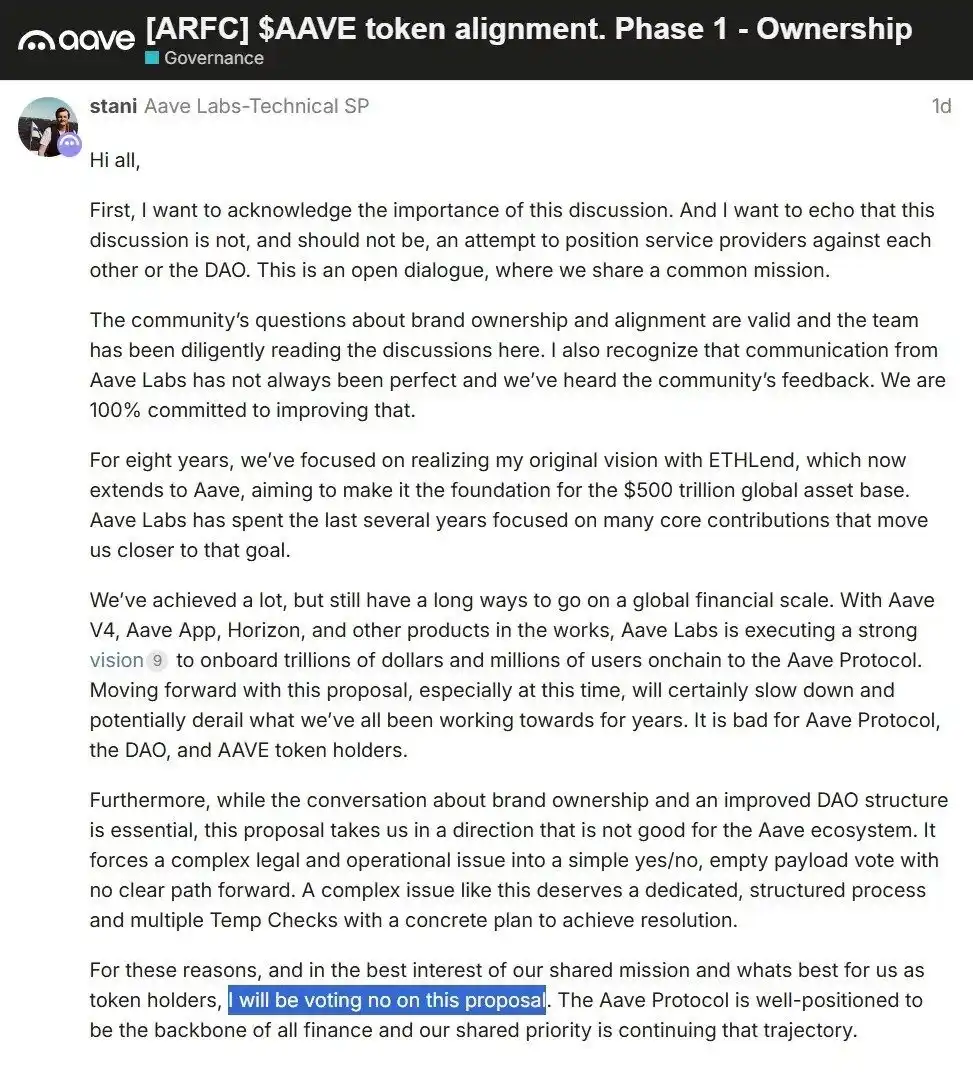
From a business operations perspective, Stani's claim that the proposal is too rash might not be wrong. However, in the current discussion atmosphere, this statement was easily interpreted as 'the Aave founder disagrees with transferring brand assets to token holders,' which obviously further intensified the对立情绪 (oppositional sentiment) between the community and the team.

After Stani's statement, even some aggressive comments targeting Stani appeared under the original post. More users expressed their discontent via the forum or social media. An OG user mentioned it was the first time they considered liquidating their AAVE, and a loyal AAVE believer stated: "AAVE holders should realize this is just another DeFi shitcoin. It's neither better nor worse than the others."

The latest community activity is the "number two big brother" cutting losses and exiting with millions in losses mentioned at the beginning of this article.

Can AAVE Still Be Bought?

Just two weeks ago, Odaily Planet Daily wrote an article titled "What Do the Smart Money Frantically Buying AAVE at Lows See?". At that time, AAVE was still a favorite of top institutions like Multicoin Capital. Its优质的信誉 (high-quality brand reputation),雄厚沉淀资金 (substantial deposited funds),清晰的扩展路径 (clear expansion path),强劲的收入与回购流水 (strong revenue and buyback flow) all proved AAVE was a 'true value token' different from other altcoins.

But in just two weeks, a舆论危机 (public opinion crisis) spanning fee ownership, brand control, and team-community relations has rapidly plunged AAVE from "value token representative" into the center of controversy, even landing it on the short-term top decliners list due to emotional impact.

As of writing, Aave Labs has stated under Ernesto's proposal that they have initiated an ARFC snapshot vote on the proposal, allowing AAVE token holders to formally express their stance and clarify the future direction. The outcome of this vote and the subsequent handling attitude of the Aave Labs team will undoubtedly significantly impact Aave's community faith and AAVE's short-term price performance.

It is important to emphasize that this incident is not merely "bad news" or a "performance change," but a集中拷问 (集中拷问 - concentrated interrogation) of Aave's existing governance structure and the boundaries of rights.

If you believe Aave Labs will still maintain高度一致 (high alignment) with Aave DAO regarding long-term interests, and the current friction is more of a communication and process失误 (mistake), then the price pullback led by emotion might be a good entry window. But if you believe this controversy exposes not an occasional problem, but a结构性矛盾 (structural contradiction) of long-term unclear rights between the team and the protocol, lacking institutional constraints, then this storm might just be the beginning.

From a broader perspective, Aave's controversy is not an isolated case. As DeFi matures, protocol revenue becomes substantial and real, and brands and frontends begin to possess commercial value, structural contradictions between protocols and products, teams and communities will surface. Aave is under the spotlight this time not because it is more wrong, but because it has gone further.

This debate over fees, brand, and control rights poses a question that needs answering not just by AAVE, but is an inevitable question the entire DeFi industry must eventually face.

Preguntas relacionadas

QWhat was the main reason behind the community crisis and whale selling AAVE tokens?

AThe crisis stemmed from a change in Aave's front-end that redirected fees from the swap function to Aave Labs instead of the Aave DAO treasury, which the community perceived as a lack of transparency and a shift of value away from token holders.

QHow much did the second-largest AAVE whale lose after selling their holdings?

AThe second-largest AAVE whale sold 230,000 AAVE tokens at a loss of approximately $13.45 million, after buying at an average price of $223.4 and selling at around $165 per token.

QWhat was Aave Labs' justification for redirecting the swap fees to their own address?

AAave Labs argued that the front-end swap function is their product, built and maintained independently from the DAO-managed protocol, and therefore they have the right to decide how to operate and profit from it, considering previous donations to the DAO as voluntary, not obligatory.

QWhat proposal did Aave's former CTO Ernesto Boado make to address the community's concerns?

AErnesto Boado proposed transferring control of Aave's brand assets, including domains, social accounts, and naming rights, to AAVE token holders through a DAO-controlled entity with anti-takeover protections.

QHow did Aave's founder Stani Kulechov respond to the proposal, and what was the community's reaction?

AStani Kulechov opposed the proposal, stating it oversimplified a complex legal and operational issue without a clear execution path. The community perceived this as resistance to decentralizing control, further escalating tensions and leading to increased criticism and selling pressure.

Lecturas Relacionadas

Only a 50% Chance of Passing This Year, Can the CLARITY Bill Succeed Before the Midterm Elections?

The CLARITY Act, which passed the House in July 2025 with strong bipartisan support (294-134), faces a critical juncture in the Senate. The Senate Banking Committee is expected to hold a markup soon, but key issues remain unresolved, including stablecoin yield provisions, DeFi regulations, and securing full Republican committee support. Other contentious points involve the Blockchain Regulatory Certainty Act (BRCA), ethics amendments for government officials, and SEC-related matters. The legislative calendar is tight, with limited time before the midterm elections. If the committee markup is delayed beyond mid-May, the chances of passage in 2026 drop significantly. Senator Cynthia Lummis has warned that failure this year could delay comprehensive crypto market structure legislation until 2030 or later. Galaxy estimates the probability of the CLARITY Act becoming law in 2026 is only about 50%. The bill provides crucial regulatory clarity by defining jurisdictional boundaries between the SEC and CFTC, establishing a path for decentralization, and bringing digital commodity intermediaries under federal regulation. Its passage is seen as vital before potential power shifts in the next Congress, which could bring less favorable leadership to key committees. The timeline is compressed, and the bill must compete for floor time with other priorities like Iran authorization and DHS appropriations. Key hurdles include finalizing the stablecoin yield compromise text, addressing law enforcement concerns about BRCA, and navigating political dynamics around SEC nominations. The outcome of the Banking Committee markup and the level of bipartisan support will be critical indicators of its future success.

marsbitHace 2 min(s)

Only a 50% Chance of Passing This Year, Can the CLARITY Bill Succeed Before the Midterm Elections?

marsbitHace 2 min(s)

Dialogue with Xinhuo Chief Economist Fu Peng: Macro Bear Market Expected to End This Year, Prioritize Allocation to Value Assets

Fu Peng, Chief Economist at New Huo Group, discusses the integration of crypto assets into traditional finance, marking a shift from a speculative phase to institutionalization. He highlights the current era as the second major fusion of finance and technology, driven by AI, data, and computing power, with crypto assets becoming part of the FICC+C (Fixed Income, Currencies, Commodities + Crypto) framework. Regulatory clarity in the U.S., such as the GENIUS and Clarity Acts, has paved the way for institutional adoption by defining digital assets as financial instruments. Fu views RWA (Real World Assets) as a tool for asset tokenization rather than a standalone asset class, noting that financial innovation differs between Eastern and Western markets due to cultural approaches to risk and regulation. He emphasizes that stablecoins are essential for future finance, but Asian markets, including Hong Kong, will adopt them cautiously. Macro liquidity now significantly influences crypto markets, as institutional participation increases correlation with traditional assets. Fu suggests the macro-driven bear market may end by year-end, reducing the relevance of Bitcoin’s four-year cycle. For asset allocation, he recommends value-oriented AI stocks for stability, Bitcoin for moderate certainty, and Ethereum for higher volatility.

marsbitHace 10 min(s)

Dialogue with Xinhuo Chief Economist Fu Peng: Macro Bear Market Expected to End This Year, Prioritize Allocation to Value Assets

marsbitHace 10 min(s)

Only a 50% Chance of Passing This Year, Can the CLARITY Bill Succeed Before the Midterm Elections?

The CLARITY Act, which passed the U.S. House in July 2025 with strong bipartisan support (294-134), faces a critical juncture in the Senate. The Senate Banking Committee is expected to hold a markup soon, but key issues remain unresolved, including stablecoin yield provisions, DeFi regulations, and securing full Republican committee support. Additional challenges involve the Blockchain Regulatory Certainty Act (BRCA), ethics amendments for government officials, and SEC-related concerns. Galaxy estimates only a 50% chance of the bill becoming law in 2026. The tight legislative calendar, competing priorities like Iran military authorization and DHS appropriations, and the impending midterm elections create significant time pressure. If the bill is not passed before the new Congress convenes in 2027, comprehensive crypto market structure legislation could be delayed until 2030 or later, especially if leadership changes result in less favorable committee chairs. The act provides crucial regulatory clarity by defining the jurisdictional boundaries between the SEC and CFTC, establishing a path for decentralized networks to be classified as non-securities, and bringing digital commodity intermediaries under federal regulation. The outcome of ongoing Senate negotiations, particularly the release of revised text on stablecoin yields, will be a key indicator of its future prospects.

Odaily星球日报Hace 12 min(s)

Only a 50% Chance of Passing This Year, Can the CLARITY Bill Succeed Before the Midterm Elections?

Odaily星球日报Hace 12 min(s)

Four-Dimensional Resonance: Hong Kong Web3 Carnival Sub-Forum Co-Creates Blueprint for Global Financial New Infrastructure

The "Four-Dimensional Resonance: 2026 Global Financial New Infrastructure" forum, a core event of the Hong Kong Web3 Festival, was successfully held at the Hong Kong Convention and Exhibition Centre. Co-hosted by Web3Labs and DeShang Singularity Tech, with joint support from Bitroot, Injective, Microsoft, and Z Oracle, the event gathered policymakers, industry leaders, and investors to explore the integration and innovation of global financial infrastructure, focusing on RWA, AI, DeFi, and compliant payments. Policy speakers, including Hong Kong Legislative Council Member Mr. Wu Jiezhuang, South Korean National Assembly Member Mr. Min Byung-duk, and ACED Chairman Mr. Yun Seok-hun, emphasized the importance of cross-border regulatory collaboration and an open policy environment for fintech innovation. Web3Labs CEO Caspar and DeShang Singularity Tech CEO Chang Shuai highlighted Hong Kong’s role as a financial innovation center and the approaching "singularity moment" for global financial infrastructure. Technical insights were shared by MagnetX, Bitroot, Microsoft, and Injective on topics including AI Agent economies, the evolution of public blockchains, and AI’s transformative role in finance. Key partnerships and initiatives were launched: - GWDC 2026 Korea collaboration between Hong Kong and South Korea. - A strategic agreement between Web3Labs and Microsoft. - The launch of a public anti-fraud alliance by Z Oracle and partners. - The "Injective Rising Star" program to support AI and Web3 projects. Panel discussions delved into AI-driven smart payments, compliant cross-border transactions, and the fusion of RWA and DeFi. Participants agreed that integrating RWA with DeFi is crucial for the next stage of financial infrastructure, enabling a shift from physical to digital finance. The forum underscored Hong Kong’s pivotal role in advancing a globalized and sustainable Asian fintech ecosystem.

marsbitHace 21 min(s)

Four-Dimensional Resonance: Hong Kong Web3 Carnival Sub-Forum Co-Creates Blueprint for Global Financial New Infrastructure

marsbitHace 21 min(s)

Trading

Spot
Futuros

Artículos destacados

Cómo comprar AAVE

¡Bienvenido a HTX.com! Hemos hecho que comprar Aave Protocol (AAVE) sea simple y conveniente. Sigue nuestra guía paso a paso para iniciar tu viaje de criptos.Paso 1: crea tu cuenta HTXUtiliza tu correo electrónico o número de teléfono para registrarte y obtener una cuenta gratuita en HTX. Experimenta un proceso de registro sin complicaciones y desbloquea todas las funciones.Obtener mi cuentaPaso 2: ve a Comprar cripto y elige tu método de pagoTarjeta de crédito/débito: usa tu Visa o Mastercard para comprar Aave Protocol (AAVE) al instante.Saldo: utiliza fondos del saldo de tu cuenta HTX para tradear sin problemas.Terceros: hemos agregado métodos de pago populares como Google Pay y Apple Pay para mejorar la comodidad.P2P: tradear directamente con otros usuarios en HTX.Over-the-Counter (OTC): ofrecemos servicios personalizados y tipos de cambio competitivos para los traders.Paso 3: guarda tu Aave Protocol (AAVE)Después de comprar tu Aave Protocol (AAVE), guárdalo en tu cuenta HTX. Alternativamente, puedes enviarlo a otro lugar mediante transferencia blockchain o utilizarlo para tradear otras criptomonedas.Paso 4: tradear Aave Protocol (AAVE)Tradear fácilmente con Aave Protocol (AAVE) en HTX's mercado spot. Simplemente accede a tu cuenta, selecciona tu par de trading, ejecuta tus trades y monitorea en tiempo real. Ofrecemos una experiencia fácil de usar tanto para principiantes como para traders experimentados.

315 Vistas totalesPublicado en 2024.12.11Actualizado en 2025.03.21

Cómo comprar AAVE

Discusiones

Bienvenido a la comunidad de HTX. Aquí puedes mantenerte informado sobre los últimos desarrollos de la plataforma y acceder a análisis profesionales del mercado. A continuación se presentan las opiniones de los usuarios sobre el precio de AAVE (AAVE).

活动图片