Second Largest Whale Cuts Losses and Liquidates, Can AAVE Still Be Bought Amid Deepening Divisions?

marsbitPublicado a 2025-12-22Actualizado a 2025-12-22

Resumen

The second-largest AAVE whale, excluding the project team, protocol contracts, and CEXs, has sold 230,000 AAVE tokens at a significant loss of $13.45 million, causing a 12% price drop. This sell-off reflects growing tensions between Aave Labs and the community over governance and fund allocation. The conflict began when Aave switched its default swap aggregator to Cow Swap, redirecting front-end transaction fees—previously sent to the Aave DAO treasury—to Aave Labs instead. Community members estimated this change could divert over $10 million annually from the DAO to the team, raising concerns about transparency and control. Aave Labs argued that front-end products are separate from the protocol and that the team has the right to monetize them. In response, a proposal was made to transfer control of Aave’s brand assets (domains, social accounts, etc.) to token holders. Founder Stani Kulechov opposed the proposal, citing its oversimplification of complex legal and operational issues, further escalating community backlash. The situation highlights deeper structural challenges in DeFi governance, where protocol value, team control, and community rights intersect. The outcome of an ongoing snapshot vote on the proposal may determine AAVE’s short-term price direction and long-term community trust. If the conflict signals fundamental misalignment between Aave Labs and the DAO, this could mark the start of continued tension rather than an isolated incident.

Author|Azuma(@azuma_eth)
The leading lending protocol Aave is embroiled in a public opinion storm. The escalating tensions between the team and the community have objectively shaken the confidence of token holders in the AAVE token itself.

In the early hours of today, the second-largest AAVE whale, excluding the project team, protocol contracts, and CEXs, cut losses and liquidated 230,000 AAVE (worth approximately $38 million), causing AAVE to drop 12% short-term. It is reported that this "number two big brother" purchased their AAVE holdings from late last year to early this year at an average price of $223.4. The average selling price today was about $165, resulting in a final loss of $13.45 million.

  • Odaily Note: The whale address is https://debank.com/profile/0xa923b13270f8622b5d5960634200dc4302b7611e.

Origin of the Incident: Dispute Over Fee Flow

To understand the current community crisis at Aave, we need to start with a recent change to the Aave frontend.

n

On December 4th, Aave announced a partnership with Cow Swap, adopting the latter as the default trading path for the swap function on the Aave frontend (Odaily Note: previously ParaSwap), utilizing its anti-MEV features for better quotes.
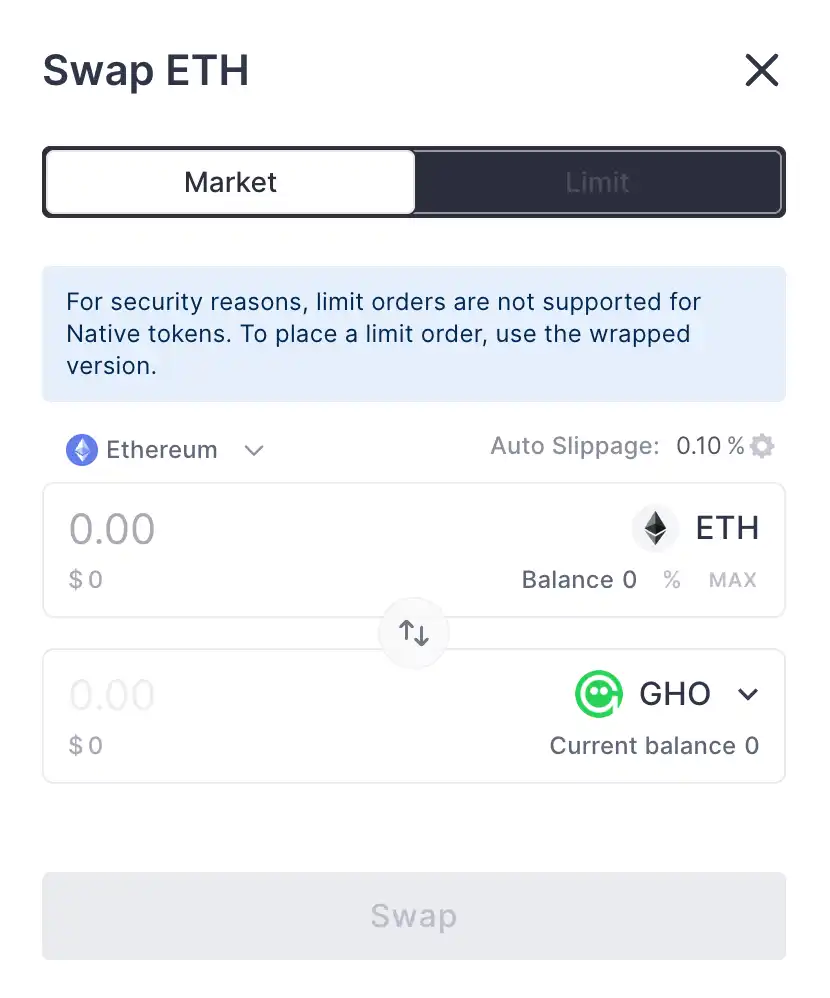
This seemed like a normal functional upgrade, but the community soon discovered that while the additional fees generated by this function (including referral fees or positive slippage surplus fees) previously flowed to the Aave DAO treasury address when using ParaSwap, after switching to Cow Swap, they were redirected to the Aave Labs address.

Community representative EzR3aL was the first to notice this unannounced change. They questioned the Aave team in the governance forum and estimated that, just tracking the income flow on Ethereum and Arbitrum, this change could generate approximately $200,000 in weekly revenue, corresponding to an annualized income of over $10 million — meaning Aave had quietly redirected at least tens of millions of dollars in revenue from the community address to the team address.

Core Controversy: Who Really Owns the Aave Brand?

As EzR3aL's post gained traction, a large number of AAVE holders felt betrayed, especially considering Aave made this change without community communication or any disclosure, seemingly intending to conceal it.

In response to community concerns, Aave Labs replied directly under EzR3aL's post, stating that there should be a clear distinction between the protocol layer and the product layer. The swap function interface on the Aave frontend is entirely operated by Aave Labs, which is responsible for the capital investment, construction, and maintenance. This function is completely independent of the DAO-managed protocol, therefore Aave Labs has the right to independently decide how to operate and profit... The revenue previously flowing to the Aave DAO address was a donation from Aave Labs, but not an obligation.

In short, Aave Labs' stance is that the frontend interface and its ancillary functions are essentially team products, and the revenue generated should be considered company property, not to be conflated with the protocol and its revenue controlled by the DAO.

This statement quickly sparked heated debate within the community regarding the ownership of the Aave protocol versus its products. A well-known DeFi analyst wrote an article titled "Who Really Owns 'Aave': Aave Labs vs Aave DAO," which Odaily Planet Daily also translated into Chinese for supplementary reading.

On December 16th, the conflict intensified further. Former Aave CTO Ernesto Boado initiated a proposal in the governance forum requesting the transfer of control over Aave brand assets (including domain names, social media accounts, naming rights, etc.) to AAVE token holders. These assets would be managed through a DAO-controlled entity (the specific form to be determined later) with strict anti-encroachment protection mechanisms.

The proposal received nearly ten thousand views and hundreds of high-quality replies within the Aave governance forum, with various participants in the Aave ecosystem weighing in. Although some voices felt the proposal's execution plan was imperfect and risked exacerbating divisions, the majority of responses expressed support.

Founder's Statement Fails to Placate Community

As community sentiment heated up, Aave founder Stani responded in the forum: "...This proposal leads us in a direction unfavorable to the Aave ecosystem. It attempts to reduce a complex legal and operational issue to a simple 'yes/no' vote without providing a clear execution path. Handling such a complex issue should involve a specially designed, structured process, achieving consensus through multiple interim checks accompanied by specific solutions. For the reasons above, I will vote against this proposal..."
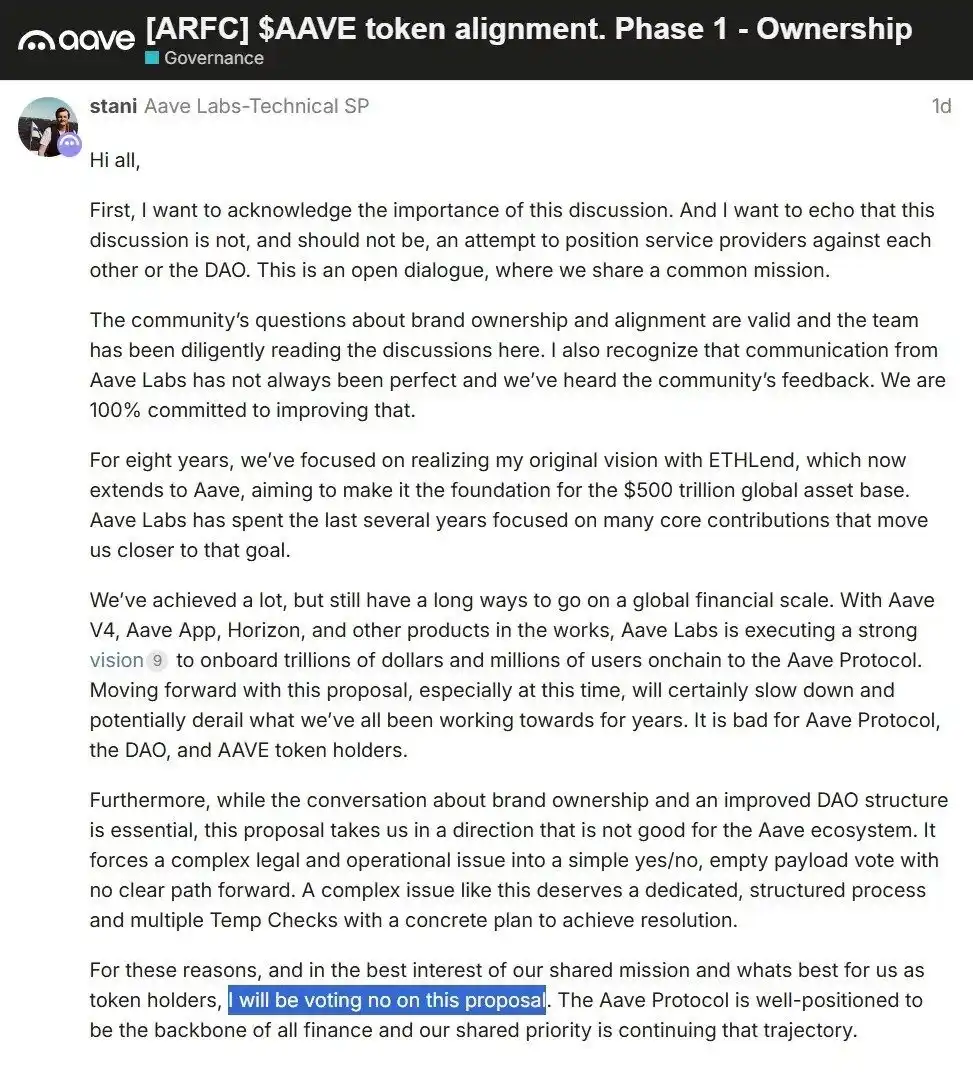
From a business operations perspective, Stani's claim that the proposal is too rash might not be wrong. However, in the current discussion atmosphere, this statement was easily interpreted as 'the Aave founder disagrees with transferring brand assets to token holders,' which obviously further intensified the对立情绪 (oppositional sentiment) between the community and the team.

After Stani's statement, even some aggressive comments targeting Stani appeared under the original post. More users expressed their discontent via the forum or social media. An OG user mentioned it was the first time they considered liquidating their AAVE, and a loyal AAVE believer stated: "AAVE holders should realize this is just another DeFi shitcoin. It's neither better nor worse than the others."

The latest community activity is the "number two big brother" cutting losses and exiting with millions in losses mentioned at the beginning of this article.

Can AAVE Still Be Bought?

Just two weeks ago, Odaily Planet Daily wrote an article titled "What Do the Smart Money Frantically Buying AAVE at Lows See?". At that time, AAVE was still a favorite of top institutions like Multicoin Capital. Its优质的信誉 (high-quality brand reputation),雄厚沉淀资金 (substantial deposited funds),清晰的扩展路径 (clear expansion path),强劲的收入与回购流水 (strong revenue and buyback flow) all proved AAVE was a 'true value token' different from other altcoins.

But in just two weeks, a舆论危机 (public opinion crisis) spanning fee ownership, brand control, and team-community relations has rapidly plunged AAVE from "value token representative" into the center of controversy, even landing it on the short-term top decliners list due to emotional impact.

As of writing, Aave Labs has stated under Ernesto's proposal that they have initiated an ARFC snapshot vote on the proposal, allowing AAVE token holders to formally express their stance and clarify the future direction. The outcome of this vote and the subsequent handling attitude of the Aave Labs team will undoubtedly significantly impact Aave's community faith and AAVE's short-term price performance.

It is important to emphasize that this incident is not merely "bad news" or a "performance change," but a集中拷问 (集中拷问 - concentrated interrogation) of Aave's existing governance structure and the boundaries of rights.

If you believe Aave Labs will still maintain高度一致 (high alignment) with Aave DAO regarding long-term interests, and the current friction is more of a communication and process失误 (mistake), then the price pullback led by emotion might be a good entry window. But if you believe this controversy exposes not an occasional problem, but a结构性矛盾 (structural contradiction) of long-term unclear rights between the team and the protocol, lacking institutional constraints, then this storm might just be the beginning.

From a broader perspective, Aave's controversy is not an isolated case. As DeFi matures, protocol revenue becomes substantial and real, and brands and frontends begin to possess commercial value, structural contradictions between protocols and products, teams and communities will surface. Aave is under the spotlight this time not because it is more wrong, but because it has gone further.

This debate over fees, brand, and control rights poses a question that needs answering not just by AAVE, but is an inevitable question the entire DeFi industry must eventually face.


Criptos en tendencia

Preguntas relacionadas

QWhat was the main reason behind the community crisis and whale selling AAVE tokens?

AThe crisis stemmed from a change in Aave's front-end that redirected fees from the swap function to Aave Labs instead of the Aave DAO treasury, which the community perceived as a lack of transparency and a shift of value away from token holders.

QHow much did the second-largest AAVE whale lose after selling their holdings?

AThe second-largest AAVE whale sold 230,000 AAVE tokens at a loss of approximately $13.45 million, after buying at an average price of $223.4 and selling at around $165 per token.

QWhat was Aave Labs' justification for redirecting the swap fees to their own address?

AAave Labs argued that the front-end swap function is their product, built and maintained independently from the DAO-managed protocol, and therefore they have the right to decide how to operate and profit from it, considering previous donations to the DAO as voluntary, not obligatory.

QWhat proposal did Aave's former CTO Ernesto Boado make to address the community's concerns?

AErnesto Boado proposed transferring control of Aave's brand assets, including domains, social accounts, and naming rights, to AAVE token holders through a DAO-controlled entity with anti-takeover protections.

QHow did Aave's founder Stani Kulechov respond to the proposal, and what was the community's reaction?

AStani Kulechov opposed the proposal, stating it oversimplified a complex legal and operational issue without a clear execution path. The community perceived this as resistance to decentralizing control, further escalating tensions and leading to increased criticism and selling pressure.

Lecturas Relacionadas

Ethereum Q1 2026 Report: Fees Decline, Users and Transaction Volume Hit New Highs

Ethereum Q1 2026 Report: Fees Down, Users & Transactions Hit New Highs Token Terminal's Q1 2026 report on Ethereum presents a pivotal development: the network achieved record highs in monthly active users (13.2M, +85.9% YoY), total transactions (200.4M, +81.5% YoY), and throughput (25.78 TPS), while transaction fees on the mainnet plummeted by 47.9% quarter-over-quarter. This shift is attributed to the network's strategic move into a "low fees for scale" phase, exemplified by the Fusaka upgrade which increased data capacity and lowered block space costs, releasing pent-up demand (a manifestation of Jevons's Paradox). The report highlights a core narrative shift for Ethereum: from a DeFi-centric blockchain to a global financial settlement layer. It maintains a dominant position in tokenized assets, holding majority market shares among top chains in stablecoins (61.8%), tokenized funds (73.0%), and tokenized commodities (84.0%). Growth in tokenized funds (+73.1% YoY) and commodities (+325.9% YoY) was particularly strong, driven by institutions like BlackRock and JPMorgan entering the space. Contrasting these usage gains, several USD-denominated value metrics declined in Q1: fully diluted market cap fell 30.3% QoQ, total value locked (TVL) dropped 11.0%, and ecosystem transaction volume decreased 24.0%. The report interprets this as Ethereum prioritizing long-term network expansion and cementing its role as the default settlement layer for finance over short-term fee capture. The commentary from Etherealize argues that, much like the early internet, Ethereum's open, permissionless model is poised to win over closed alternatives as institutional tokenization accelerates.

marsbitHace 11 min(s)

Ethereum Q1 2026 Report: Fees Decline, Users and Transaction Volume Hit New Highs

marsbitHace 11 min(s)

He Just Raised 2.7 Billion, and Li Fei-Fei Also Invested

Pete Florence, a former senior research scientist at Google DeepMind and a key contributor to the Vision-Language-Action (VLA) model architecture, is deliberately distancing his startup, Generalist AI, from the trendy "world model" label. He argues that the industry should prioritize concrete goals over buzzwords. His goal is to create robots that can perform a vast range of unseen tasks with high speed and success rates, without needing task-specific training data. Recently, his company raised $400 million (¥2.7 billion) at a $2 billion valuation. Notable investors include NVIDIA's NVentures, Bezos Expeditions, NFDG, as well as Xiaomi co-founder Lin Bin, Zoom founder Eric Yuan, and renowned AI scientist Fei-Fei Li. Florence's approach stems from his academic background at MIT under Professor Russ Tedrake, focusing on understanding the physical world. After joining DeepMind, he developed models like Transporter Network and co-created the VLA framework. He left in 2025 to found Generalist AI. The company has launched two models: GEN-0, which demonstrated that scaling laws apply to physical motion, and GEN-1. GEN-1 was trained on over 500,000 hours of physical interaction data collected via a specialized wearable device. It achieves a 99% success rate on precise mechanical tasks like folding boxes and maintains performance three times faster than its predecessor. Florence believes GEN-1 is reaching a commercial utility threshold similar to the GPT-3 inflection point. The substantial funding round, following GEN-1's release, signifies strong investor confidence in Generalist AI's practical, goal-driven path to creating versatile, useful robots, regardless of the "world model" terminology.

marsbitHace 18 min(s)

He Just Raised 2.7 Billion, and Li Fei-Fei Also Invested

marsbitHace 18 min(s)

Two Legends Lost in Three Days: Is Google's AI Talent Dam Cracking?

In three days, Google lost two AI legends. On June 18, Noam Shazeer, co-author of the seminal "Attention is All You Need" paper and Gemini co-lead, left for OpenAI. Just 48 hours later, John Jumper, 2024 Nobel laureate and AlphaFold lead, departed DeepMind for Anthropic. This follows Andrej Karpathy joining Anthropic in May. These moves highlight a structural trend: top AI talent is concentrating at mission-driven, pre-IPO firms like OpenAI and Anthropic, while Google becomes a primary source. The exodus stems from a core mission mismatch. Google's ad-centric model often subordinates AI research to product and revenue goals, creating friction for pioneers like Shazeer, who returned in 2024 only to leave again. In contrast, OpenAI and Anthropic offer singular focus on pushing AI boundaries, whether towards AGI or safety-aligned models, which deeply appeals to top researchers like Jumper. Financial incentives amplify the pull. With both OpenAI and Anthropic nearing IPO, employees stand to gain immensely from equity, an upside Google's mature stock cannot match. Furthermore, the 2023 merger of Google Brain and DeepMind, intended to consolidate strength, has instead created cultural tension and slowed the path from research to product, as evidenced by Gemini's pace. This talent redistribution is reshaping the AI landscape. While Google retains vast data and compute resources, its true crisis is the quiet, continuous loss of the people who define the field's future. The real moat in AI is not infrastructure, but the concentration of brilliant minds—a battle Google is currently losing.

marsbitHace 2 hora(s)

Two Legends Lost in Three Days: Is Google's AI Talent Dam Cracking?

marsbitHace 2 hora(s)

Behind the AI Report Card, Lies a Chinese 'Exam Setter'

Beyond the familiar performance charts like MMLU-Pro and MMMU, which major AI models strive to ace, stands a key "examiner": Chinese-Canadian researcher Wenhu Chen. An assistant professor at the University of Waterloo and founder of TIGERLab, Chen addresses the crucial need for more rigorous AI evaluation. As models like GPT-4 began scoring near-perfect results on older benchmarks like MMLU, it became difficult to distinguish their true capabilities. In response, Chen introduced MMLU-Pro in 2024, featuring harder, more reasoning-focused questions with more answer choices, successfully reintroducing meaningful performance gaps. His work extends to multi-modal evaluation with MMMU and its enhanced version, MMMU-Pro. These benchmarks test a model's ability to understand and reason with complex information from images, charts, and text across diverse academic subjects, exposing the significant challenges even top models face in genuine comprehension. Chen's background in complex QA, table reasoning, and his experience at Google DeepMind on projects like Gemini inform his approach. He understands that effective benchmarks must anticipate how models might "cheat" by memorizing data or avoiding visual analysis. His lab also actively researches video understanding and generation models (e.g., UniVideo, Vamba), ensuring his evaluation work is grounded in practical model-building challenges. Now at Meta's Super Intelligence Lab, Chen continues his focus on multi-modal data and evaluation, representing the deep yet often unseen contributions of Chinese talent in shaping the fundamental tools of the AI industry.

marsbitHace 2 hora(s)

Behind the AI Report Card, Lies a Chinese 'Exam Setter'

marsbitHace 2 hora(s)

Trading

Spot
Futuros

Artículos destacados

Cómo comprar AAVE

¡Bienvenido a HTX.com! Hemos hecho que comprar Aave Protocol (AAVE) sea simple y conveniente. Sigue nuestra guía paso a paso para iniciar tu viaje de criptos.Paso 1: crea tu cuenta HTXUtiliza tu correo electrónico o número de teléfono para registrarte y obtener una cuenta gratuita en HTX. Experimenta un proceso de registro sin complicaciones y desbloquea todas las funciones.Obtener mi cuentaPaso 2: ve a Comprar cripto y elige tu método de pagoTarjeta de crédito/débito: usa tu Visa o Mastercard para comprar Aave Protocol (AAVE) al instante.Saldo: utiliza fondos del saldo de tu cuenta HTX para tradear sin problemas.Terceros: hemos agregado métodos de pago populares como Google Pay y Apple Pay para mejorar la comodidad.P2P: tradear directamente con otros usuarios en HTX.Over-the-Counter (OTC): ofrecemos servicios personalizados y tipos de cambio competitivos para los traders.Paso 3: guarda tu Aave Protocol (AAVE)Después de comprar tu Aave Protocol (AAVE), guárdalo en tu cuenta HTX. Alternativamente, puedes enviarlo a otro lugar mediante transferencia blockchain o utilizarlo para tradear otras criptomonedas.Paso 4: tradear Aave Protocol (AAVE)Tradear fácilmente con Aave Protocol (AAVE) en HTX's mercado spot. Simplemente accede a tu cuenta, selecciona tu par de trading, ejecuta tus trades y monitorea en tiempo real. Ofrecemos una experiencia fácil de usar tanto para principiantes como para traders experimentados.

332 Vistas totalesPublicado en 2024.12.11Actualizado en 2026.06.02

Cómo comprar AAVE

Discusiones

Bienvenido a la comunidad de HTX. Aquí puedes mantenerte informado sobre los últimos desarrollos de la plataforma y acceder a análisis profesionales del mercado. A continuación se presentan las opiniones de los usuarios sobre el precio de AAVE (AAVE).

活动图片