SEC to Hold Miami Meeting With Crypto Startups and Developers

TheNewsCryptoPublicado a 2026-01-08Actualizado a 2026-01-08

Resumen

The U.S. SEC will hold a meeting in Miami on January 27 with crypto startups and developers to gather feedback before finalizing new regulations. Commissioner Hester Peirce invited small projects to share their challenges and concerns. Under new Chairman Paul Atkins, the SEC is shifting from enforcement-focused actions under former leadership toward clearer rules and direct engagement. The initiative has drawn mixed reactions—some criticize potential delays, while others see it as a constructive step. The approach has increased market confidence, particularly for U.S.-based and compliance-friendly crypto projects, and may give startups a voice in shaping future policies.

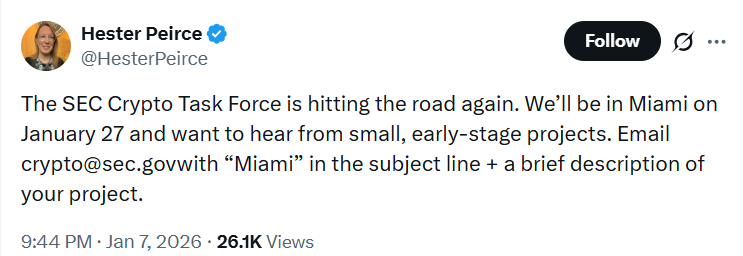
The U.S. Securities and Exchange Commission (SEC) has announced that its Crypto task force will visit Miami on January 27 to meet directly with the early-stage Crypto builders and Startups. The main goal is to listen to the Crypto community and gather feedback before finalizing new Crypto regulations.

Hester Peirce (SEC Commissioner) confirmed the visit and invited small Crypto projects to participate and share their experiences, challenges, and regulatory concerns with the SEC. Under the new SEC Chairman, Paul Atkins, the agency is moving away from “Regulations by enforcement” and focusing more on clear rules and guidance. The SEC is actively engaging in the Crypto industry instead of punishing it. This is a clear shift from the Previous approach under Gary Gensler, which relied heavily on lawsuits and enforcement actions.
SEC Listening Tour Draws Mixed Reactions, Boosts Market Confidence

During the meeting in Miami, the SEC wants to listen to the founders, developers, and startups to understand the real-world problems before writing the rules. They mainly focus on the startups instead of the big firms and discuss their policy challenges and innovations. This follows a December 2025 roundtable on financial privacy and data protection, showing a broader effort to rebuild trust with the Crypto industry.

After the announcement for this Meeting the people are in mixed reactions, like some say that listening tours slow things down and the SEC should reduce red tape faster by taking action sooner instead of talking to the startups. Some Crypto supporters say that this is the most constructive approach the SEC has taken so far and will be a great chance for the Direct conversations, which can lead to better regulations.

This approach from the SEC brings less fear and more confidence in U.S. based Crypto projects and also improved sentiment for Bitcoin and other infrastructure tokens. For the traders, it supports the bullish outlook and is especially positive for compliance-friendly and U.S. focused Crypto projects. Finally, the Startups may get the real voice in shaping future regulations.

Highlighted Crypto News:

Bybit Spot 2025 Highlights Early Listings and First-Mover Trading Gains

TagsCryptoCryptocurrencySEC

Preguntas relacionadas

QWhat is the main purpose of the SEC's upcoming meeting in Miami with crypto startups and developers?

AThe main purpose is for the SEC to listen to the crypto community and gather feedback before finalizing new crypto regulations.

QWho is the current SEC Chairman mentioned in the article, and how does his approach differ from the previous chairman?

AThe current SEC Chairman is Paul Atkins. His approach moves away from 'regulations by enforcement' and focuses more on clear rules and guidance, which is a shift from the previous approach under Gary Gensler that relied heavily on lawsuits and enforcement actions.

QWhat are the mixed reactions to the SEC's listening tour announcement?

ASome people believe listening tours slow down the regulatory process and that the SEC should reduce red tape faster by taking action sooner. Others view it as the most constructive approach the SEC has taken, providing a great chance for direct conversations that could lead to better regulations.

QHow does the SEC's new approach impact the crypto market sentiment according to the article?

AThe new approach brings less fear and more confidence in U.S.-based crypto projects, improving sentiment for Bitcoin and other infrastructure tokens. It supports a bullish outlook, especially for compliance-friendly and U.S.-focused crypto projects.

QWhat previous event does the article mention as part of the SEC's broader effort to rebuild trust with the crypto industry?

AThe article mentions a December 2025 roundtable on financial privacy and data protection as part of the broader effort to rebuild trust with the crypto industry.

Lecturas Relacionadas

STRC Major De-pegging's First Financial Report, How Will Strategy Repair Its Capital Flywheel?

Bitcoin treasury company Strategy released its Q2 2026 earnings report on July 31. Despite a 6.9% year-over-year revenue increase to $122 million, the company recorded a net loss of $8.22 billion, largely due to $8.32 billion in unrealized losses from Bitcoin price fluctuations. As of quarter-end, Strategy holds 843,775 BTC with an average cost of $75,000 per coin, and Bitcoin per share increased. The report highlights a critical shift in Strategy's capital model following the de-pegging of its key financing tool, STRC (Strategic Coin), which fell below its $100 target. Management's top priority is restoring STRC to its target value, aiming for a recovery by September 8. They rule out discounted STRC issuances and plan to maintain its dividend yield at 12%, instead focusing on bolstering its $3.75 billion cash reserve. Strategy has moved from a one-way "buy-and-hold" Bitcoin strategy to active capital management. This new approach, part of its "Digital Credit Capital Framework," involves flexibly managing its balance sheet across four elements: BTC, USD cash, common stock (MSTR), and digital credit securities like STRC. This allows for BTC monetization (having sold $218.4 million in BTC so far), strategic repurchases of discounted securities, and debt optimization, as seen with a $1.5 billion convertible bond buyback. The company's future hinges on two key tests: successfully re-pegging STRC to restore market confidence in its digital credit system, and a long-term recovery in Bitcoin's price to ultimately support its growth thesis.

marsbitHace 36 min(s)

STRC Major De-pegging's First Financial Report, How Will Strategy Repair Its Capital Flywheel?

marsbitHace 36 min(s)

STRC's First Financial Report Post-Depegging, How is Strategy Restoring the Capital Flywheel?

On July 31, 2026, Bitcoin treasury company Strategy released its Q2 financial report. Despite a 6.9% year-over-year increase in revenue to $122 million, the company recorded a substantial net loss of $8.22 billion, primarily due to $8.32 billion in unrealized losses from Bitcoin holdings. While Strategy's core Bitcoin strategy remains intact—its holdings grew 11% to 843,775 BTC—the company is undergoing a fundamental shift in its capital model. Following the de-pegging of its key financing tool, the STRCoin (STRC), from its $100 target in May, Strategy has pivoted from a one-directional "raise funds, buy Bitcoin" cycle to a more dynamic, multi-asset capital management approach. A key part of this new framework is the "Monetization Program," through which Strategy has sold approximately $218.4 million worth of BTC to bolster liquidity. The company's top priority is repairing STRC's peg, committing not to issue discounted shares until it returns to its target range. It has initiated a $1 billion buyback program for discounted digital credit securities, having repurchased $28.9 million face value of STRC so far. Management aims to restore the peg around September 8, 2026. Strategy now actively manages a matrix of assets: Bitcoin (for accumulation or strategic sales), USD cash reserves (now at $3.75 billion), common stock (MSTR), and digital credit securities like STRC. This allows for tactical moves like repurchasing discounted debt or equity to capture value. The future success of Strategy's "capital flywheel" hinges on two factors: the short-term ability to successfully re-peg STRC to restore market confidence in its digital credit system, and the long-term price trajectory of Bitcoin, upon which its entire investment thesis ultimately depends.

Odaily星球日报Hace 41 min(s)

STRC's First Financial Report Post-Depegging, How is Strategy Restoring the Capital Flywheel?

Odaily星球日报Hace 41 min(s)

With Two Consecutive Quarters of Losses, Coinbase Must Rely on Paths Beyond Trading

Coinbase posted its second consecutive quarterly net loss of $359 million on $1.22 billion in revenue for Q2, highlighting its vulnerability to crypto market cycles where weaker prices and lower volatility reduce user trading. However, the report also reveals a strategic shift in its business model. Despite a 25% quarter-over-quarter decline in global spot trading volume, Coinbase increased its market share to a company-record 10.3%. This suggests its position as a compliant U.S. on-ramp is strengthening even in a cooler market. A key development is the diversification of revenue streams. Transaction revenue fell to $599 million, nearly equaling subscription and services revenue of $555 million. Stablecoin services, generating $292 million, are becoming a crucial revenue "floor." This income, derived from interest on the $20 billion average USDC balance held on its platform, is less tied to daily trading activity. Furthermore, while spot trading volume dropped significantly, derivatives volume held steady at $1.03 trillion. Coinbase is pushing to integrate spot, stablecoin, and derivatives liquidity to create a more interconnected and sticky ecosystem for users. The GAAP net loss includes non-cash expenses like stock-based compensation and crypto asset valuation changes. Its adjusted EBITDA remained positive at $208 million for the 14th straight quarter, indicating core operations can cover ongoing costs. The company is also reducing expenses to manage the downturn. The central question moving forward is whether Coinbase's growing market share, stablecoin revenues, and expanding product integration can sufficiently offset the inherent cyclicality of its core trading business during future market contractions.

marsbitHace 56 min(s)

With Two Consecutive Quarters of Losses, Coinbase Must Rely on Paths Beyond Trading

marsbitHace 56 min(s)

Trading

Spot
活动图片