SEC Chairman Explains Why NFTs Are Not Securities: 'Like Buying Trading Cards'

marsbitPublicado a 2026-03-19Actualizado a 2026-03-19

Resumen

SEC Chairman Paul Atkins explained in a CNBC interview why NFTs are generally not considered securities, comparing them to collectibles like baseball cards. The SEC recently issued guidance identifying four categories of digital assets not classified as securities: digital commodities, digital tools, digital collectibles (including NFTs), and stablecoins. Atkins emphasized that NFTs are typically "bought and held" assets rather than investment contracts, which are central to the definition of a security. He noted that each asset is evaluated based on its specific facts and circumstances, but digital collectibles are generally viewed as immutable purchases not intended for trading like traditional securities. This reflects a broader shift in the SEC’s approach under Atkins’ leadership, moving away from enforcement-driven regulation toward clearer guidance and a more predictable framework. The change aligns with the Trump administration's crypto-friendly stance, with Atkins criticizing past regulatory missteps that he believes set the U.S. back in crypto innovation.

Author: Sam Bourgi

Compiled by: Deep Tide TechFlow

Deep Tide Introduction: SEC Chairman Paul Atkins further explained in a CNBC interview why NFTs generally do not constitute securities. The SEC recently released an interpretive document listing four categories of digital assets that are not securities: digital commodities, digital instruments, digital collectibles (including NFTs), and stablecoins.

Atkins compared NFTs to baseball cards, emphasizing that such assets are "bought and held" and do not involve investment contracts. This is the latest move by the SEC under Atkins' leadership to shift from "enforcement-driven" to "guidance-driven" regulation.

Full text as follows:

After the U.S. Securities and Exchange Commission (SEC) listed four major categories of digital assets not subject to securities laws, Chairman Paul Atkins further explained why non-fungible tokens (NFTs) generally do not meet the definition of securities.

In a CNBC interview on Wednesday, Atkins reiterated the four categories of digital assets identified in the SEC's recent interpretive document that are typically not considered securities: digital commodities, digital instruments, digital collectibles like NFTs, and stablecoins.

During the interview, host Andrew Ross Sorkin pressed the issue of digital collectibles, noting that depending on their structure, they could more easily be classified as securities.

Atkins responded, "That's true of anything." He emphasized that the SEC's analysis still depends on the specific facts and circumstances of each asset, particularly whether it involves an investment contract under long-standing legal precedent.

Atkins stated that digital collectibles are generally viewed as items to be bought and held, similar to physical collectibles, rather than investment contracts. Investment contracts are a core defining feature of securities.

He said, "These collectibles, like baseball cards, memes, memecoins, NFTs, are things someone buys. It's an immutable purchase...unlike other assets that people trade."
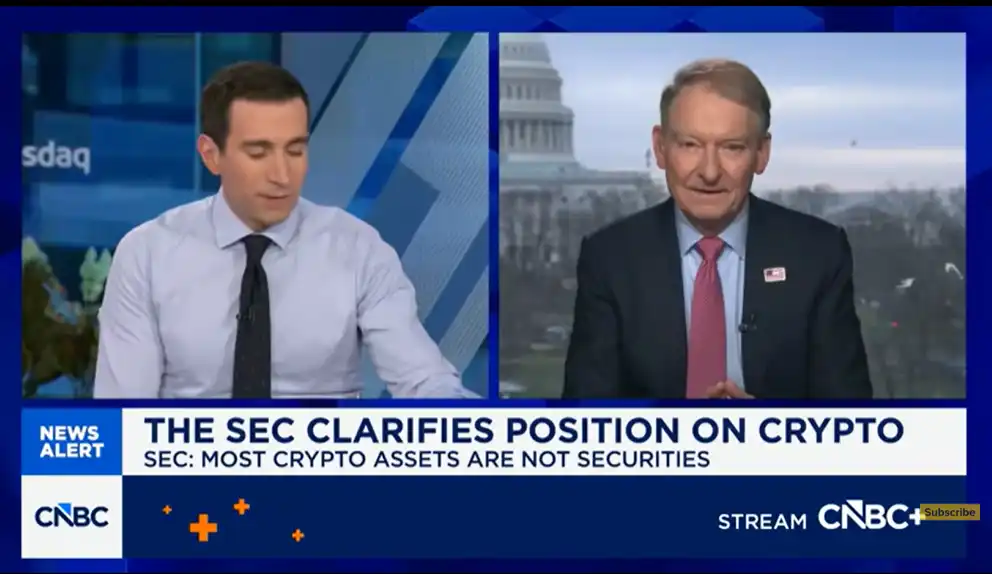
Caption: Paul Atkins interviewed on CNBC. Source: CNBC

SEC Continues to Move Away from "Enforcement-Driven" Crypto Policy

Under Atkins' leadership, the SEC's approach to regulating digital assets has undergone a noticeable adjustment. This shift coincides with the Trump administration, which is more crypto-friendly and took office in early 2025.

Atkins said in the CNBC interview, "We are breaking with the past." He described the SEC's efforts to promote clearer guidance and a more predictable regulatory framework.

Last year, Atkins criticized the SEC's previous reliance on "regulation by enforcement" and promised to move away from this approach. He also noted that tokenization is a key innovation that regulators should support rather than restrict.

Since then, he has repeatedly stated that past regulatory missteps have set the U.S. back by as much as a decade in crypto development and vowed to reverse this situation.


Preguntas relacionadas

QWhat are the four categories of digital assets that the SEC recently identified as typically not being considered securities?

AThe four categories are digital commodities, digital tools, digital collectibles (including NFTs), and stablecoins.

QHow did SEC Chairman Paul Atkins compare NFTs to explain why they are not securities?

AHe compared NFTs to baseball cards, stating they are 'bought and held' items, similar to physical collectibles, and do not involve investment contracts.

QWhat shift in regulatory approach has the SEC undergone under Chairman Paul Atkins' leadership?

AThe SEC has shifted from an 'enforcement-driven' approach to a 'guidance-driven' one, focusing on clearer guidance and a more predictable regulatory framework.

QAccording to the article, what did Paul Atkins say about the impact of past regulatory mistakes on the U.S. crypto industry?

AHe stated that past regulatory missteps set the U.S. back by as much as a decade in crypto development and vowed to reverse this situation.

QWhat key feature did Atkins emphasize as central to the definition of a security in the context of digital assets?

AHe emphasized that the key feature is whether the asset involves an investment contract under long-standing legal precedent.

Lecturas Relacionadas

Bitcoin Withdrawals Continue: 8 Years of Storage in a Coldcard Cold Wallet Ended in Zero

Coldcard Hardware Wallet Hacked: Losses Mount Due to Vulnerable Seed Generation A critical vulnerability in Coldcard hardware wallets has led to a continued wave of fund thefts. According to Galaxy Research, the total stolen has reached 1,367.05 BTC (approx. $88.6 million) from 4,585 addresses, a significant increase from the initial 594.5 BTC reported on July 30, 2026. Most of the stolen funds remain on the attackers' addresses. The issue is not with the current firmware, which Coinkite has updated, but with seed phrases generated on vulnerable devices between March 2021 and the release of fixed firmware versions. Due to a programmer error, devices switched from using a hardware random number generator to the software-based Yasmarang generator, which was initialized with publicly accessible data like the chip's serial number. This made the seed phrases predictable through offline brute-force attacks, meaning wallets remain at risk until funds are moved to a new wallet generated with the patched firmware. Affected devices include Mk2/Mk3 with firmware 4.0.1–4.1.9 (and up to 5.0.3), Mk4/Mk5 up to version 5.6.0, and Q models up to 1.5.0Q. The only exceptions are seeds created with a high-entropy method like at least 50 independent dice rolls or a strong unique BIP-39 passphrase. All other owners must generate a new seed on the fixed firmware and transfer their assets. A case highlighting the human impact involves a 39-year-old long-term investor who lost 2 BTC (approx. $130,000) in minutes. He had accumulated the Bitcoin over eight years through physical labor, viewing it as a financial lifeline and a retirement plan in a country suffering from hyperinflation. His story underscores that even conservative "buy and hold in cold storage" strategies can be compromised by such underlying technical flaws. From a technical perspective, this incident echoes historical failures where weak random number generators undermined cryptographic security, challenging the assumption that offline storage is automatically foolproof.

cryptonews.ruHace 4 hora(s)

Bitcoin Withdrawals Continue: 8 Years of Storage in a Coldcard Cold Wallet Ended in Zero

cryptonews.ruHace 4 hora(s)

Trading

Spot
活动图片



