Screwed by Polymarket, This Time the Bug Was a 'Time Warp'

marsbitPublicado a 2026-03-09Actualizado a 2026-03-09

Resumen

Polymarket, a prediction market platform, encountered a technical issue related to the transition from Eastern Standard Time (EST) to Eastern Daylight Time (EDT) on March 8. The switch, which involves moving the clock forward by one hour, caused a disruption in the platform’s hourly cryptocurrency price prediction markets for assets like BTC, ETH, SOL, and XRP. Due to the time change, the 2:00 AM hour effectively did not exist, leading Polymarket’s system to display an illogical time range of "March 8, 1-1 AM ET" for these events, instead of the expected one-hour duration. This anomaly affected both the front-end display and API data, causing confusion among users. One automated trading user reported significant losses exceeding $100,000, as their system relied on accurate end-time data to execute trades. The incident highlights a design flaw in using local time (ET) without accounting for daylight saving transitions, unlike mainstream financial systems that typically use UTC time to avoid such inconsistencies. Users have called for Polymarket to switch to UTC and compensate affected traders. The platform has not yet issued an official response.

Original | Odaily Planet Daily (@OdailyChina)

Author | Azuma (@azuma_eth)

In conventional understanding, time is linear, but the crypto world has its "exceptions".

Yesterday, Eastern Time (ET) completed the switch from standard time to daylight saving time as per convention (generally on the second Sunday of March at 2:00 AM), moving the clock forward by one hour, jumping directly from 2:00 AM on March 8 to 3:00 AM. The time didn't vanish into thin air; it's just that the Eastern Time zone switches between Eastern Standard Time (EST) and Eastern Daylight Time (EDT) based on custom, aiming to artificially adjust the time scale to make fuller use of daylight hours (and save electricity in the process).

For daily life, this switch doesn't cause much impact, but on the prediction market Polymarket, yesterday's time zone switch directly sparked an unexpected controversy.

Polymarket Runs Into Timing Controversy

The controversy occurred around the "Crypto Up or Down" prediction events on Polymarket.

Polymarket offers cryptocurrency price movement prediction events with timeframes of year, month, week, day, 4 hours, 1 hour, 15 minutes, and 5 minutes, supporting major tokens like BTC, ETH, SOL, and XRP. These events are automatically created and settled based on Eastern Time and have become a significant source of trading volume on Polymarket.

At 1:00 AM on March 8 (still Eastern Standard Time at that moment), Polymarket launched new 1-hour up/down prediction events for BTC, ETH, SOL, and XRP. Links to the relevant events are below.

  • BTC (Final Result: Up): https://polymarket.com/event/bitcoin-up-or-down-march-8-1am-et
  • ETH (Final Result: Down): https://polymarket.com/event/ethereum-up-or-down-march-8-1am-et
  • SOL (Final Result: Down): https://polymarket.com/event/solana-up-or-down-march-8-1am-et
  • XRP (Final Result: Down): https://polymarket.com/event/xrp-up-or-down-march-8-1am-et

According to the event settlement rules — comparing the opening and closing prices of the 1-hour candle on Binance's USDT trading pairs starting from the event's beginning — the above four events have all been settled.

However, because the end time of this batch of events coincided with the daylight saving time switch, the moment Eastern Time reached 2:00 AM, it immediately jumped to 3:00 AM (meaning the period from 2:00 AM to 3:00 AM was skipped), causing some timing confusion for this batch of events on the Polymarket platform itself.


As shown on Polymarket's frontend interface, perhaps because 2:00 AM did not exist in yesterday's Eastern Time reckoning, the time period currently displayed for this batch of events is "March 8, 1-1 AM ET" (i.e., March 8, 1:00 AM - 1:00 AM). Under normal timing conditions, such events should display a 1-hour time period (for example, the previous day's similar event was "March 7, 1-2 AM ET", i.e., 1:00 AM - 2:00 AM). If accounting for the daylight saving time switch, a more reasonable time period for this batch would be "March 8, 1-3 AM ET" (i.e., 1:00 AM - 3:00 AM, still effectively 1 hour).

So no matter how you look at it, the currently displayed "March 8, 1-1 AM ET" is very strange.

Chinese user "Xiao Z" (@richrichardoz) posted on X regarding this, stating that besides the frontend, Polymarket's API also returned the "1-1 AM ET" time period, causing automated programs relying on the API data to "all crash", estimating losses exceeding $100,000 as a result.
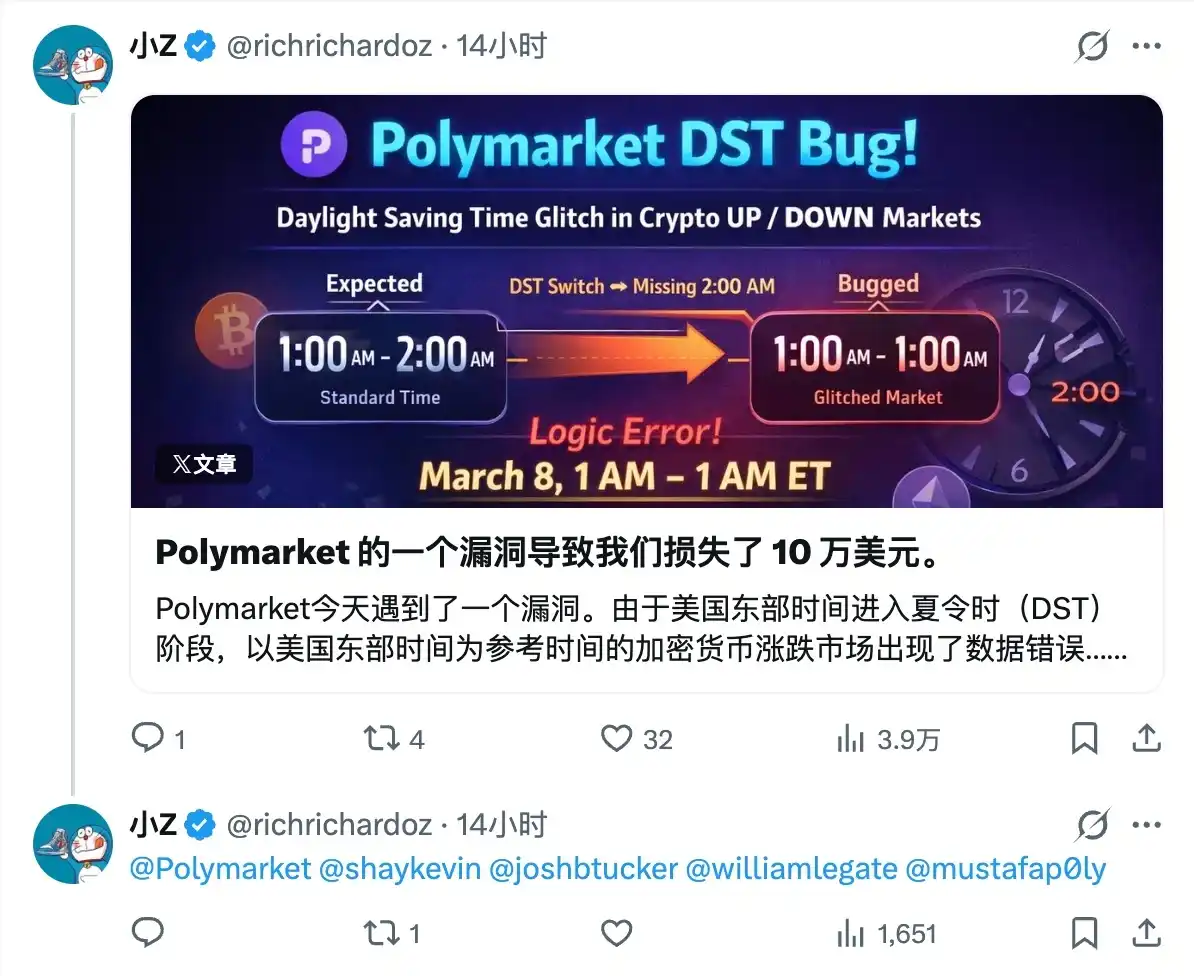
"Xiao Z" further explained that the start time and end time being exactly the same is a market state that is logically impossible. Many automated trading systems rely on the end time to determine the trading window; this error directly caused their program to lose a large sum of money. Therefore, they suggested Polymarket change the time standard for relevant events to UTC time and compensate users affected by the data issue.
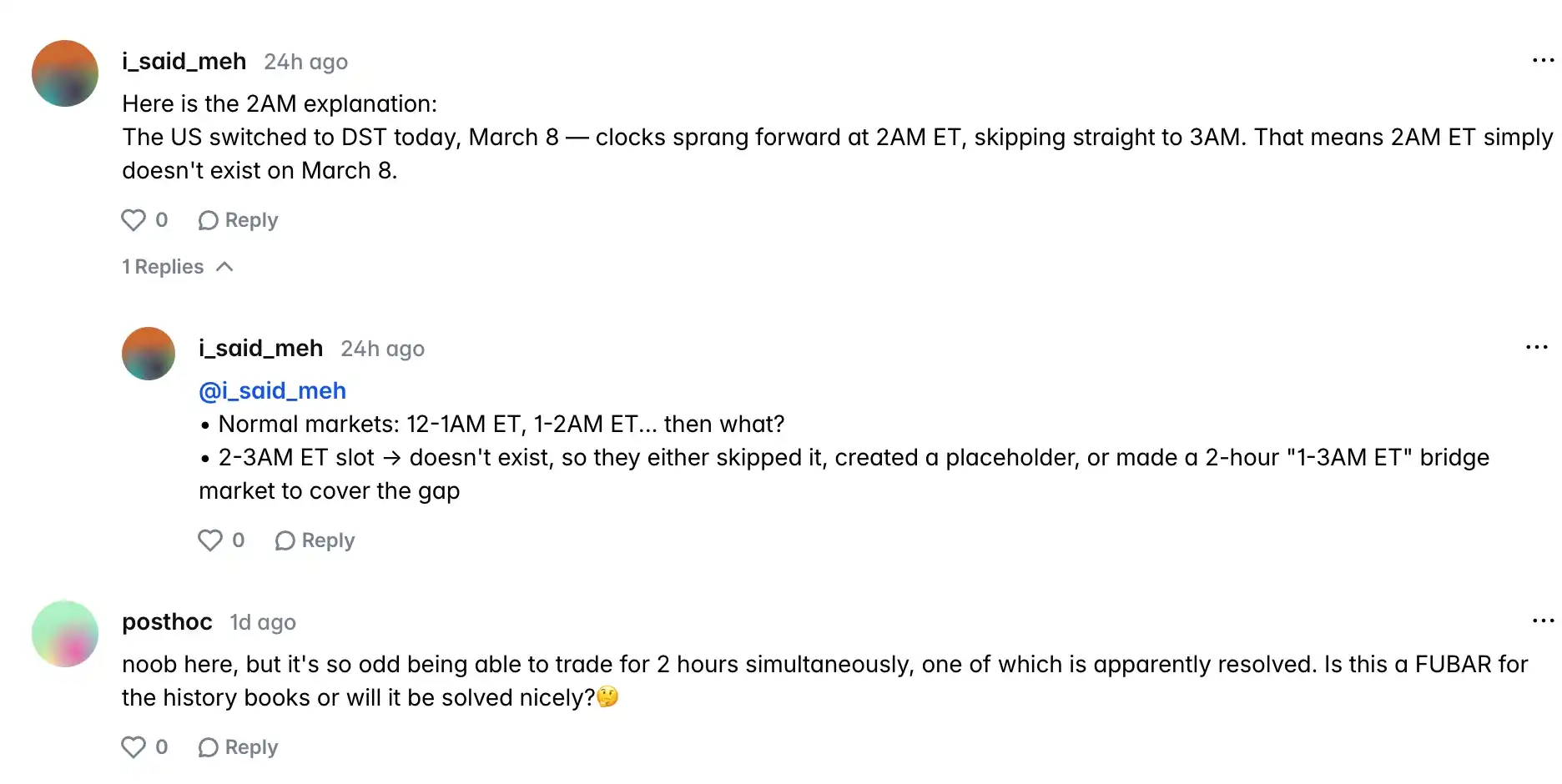
Besides this user, many other users have also commented under the relevant events expressing confusion, but as of writing, Polymarket has not responded through official channels.

Time Standards in Traditional Financial Markets

Looking back at this controversy, while the scale of impact isn't huge, it exposed a fundamental design flaw in Polymarket's "Crypto Up or Down" market events.

Influenced by historical customs, economic status, and industry practices, Eastern Time is still widely used across various industries. However, this is not particularly friendly to financial systems because Eastern Time switches between daylight saving time and standard time every year — artificially moving the clock forward or backward by one hour at specific times, creating "jumps" and "overlaps" in time respectively.

In modern financial systems, UTC time has long become the de facto universal standard. In the vast majority of financial infrastructure, internal systems typically use UTC timestamps as the sole standard time. Local times like Eastern Time are still used, but in system logic, they often only exist in the presentation layer面向用户. This design is precisely to avoid the uncertainty of time systems, ensuring that time remains monotonic, unique, and globally consistent in financial transactions, settlement, and automated systems.

The key矛盾 (contradiction) in this Polymarket controversy lies in the fact that the relevant events used Eastern Time as the timing standard but failed to fully consider the potential variable of the daylight saving time switch, ultimately causing confusion in the frontend and API data. Among the current user base of prediction markets, more and more participants are trading via APIs and automated programs. Some issues that originally only affected frontend display can easily be amplified into real financial losses in automated systems.

Judging by the outcome, this controversy might not be considered a serious incident, and theoretically it can only happen at most twice a year, but what it reveals is a more serious design problem — as prediction markets gradually move towards becoming financial infrastructure, they must also adhere to the engineering standards used by financial infrastructure.


Preguntas relacionadas

QWhat was the main issue that occurred on Polymarket due to the daylight saving time switch?

AThe main issue was a timing confusion caused by the switch from EST to EDT, where the clock jumped from 2:00 to 3:00, causing the 1-hour prediction events to display an illogical '1-1 AM ET' time period in both the frontend and API, disrupting automated trading systems.

QWhich cryptocurrencies were affected by the timing error in Polymarket's prediction events?

AThe affected prediction events were for BTC, ETH, SOL, and XRP, specifically the 1-hour up or down markets that started at 1:00 AM ET on March 8.

QHow did the timing error impact users, particularly automated trading systems?

AThe error caused automated trading programs to malfunction because the API returned an identical start and end time ('1-1 AM ET'), which is logically impossible. This led to significant losses, with one user estimating over $100,000 in losses due to the disrupted trading windows.

QWhat time standard do traditional financial markets typically use to avoid issues like daylight saving time changes?

ATraditional financial markets predominantly use UTC (Coordinated Universal Time) as the internal standard for timestamps to ensure consistency, avoid ambiguities from local time changes, and maintain global synchronization in trading and settlement systems.

QWhat suggestion did users make to Polymarket to prevent similar issues in the future?

AUsers suggested that Polymarket should change the time standard for its events to UTC instead of Eastern Time (ET) to eliminate confusion from daylight saving transitions, and also compensate users who suffered losses due to the data error.

Lecturas Relacionadas

North Korean Hackers Loot $500 Million in a Single Month, Becoming the Top Threat to Crypto Security

North Korean hackers, particularly the notorious Lazarus Group and its subgroup TraderTraitor, have stolen over $500 million from cryptocurrency DeFi platforms in less than three weeks, bringing their total theft for the year to over $700 million. Recent major attacks on Drift Protocol and KelpDAO, resulting in losses of approximately $286 million and $290 million respectively, highlight a strategic shift: instead of targeting core smart contracts, attackers are now exploiting vulnerabilities in peripheral infrastructure. For instance, the KelpDAO attack involved compromising downstream RPC infrastructure used by LayerZero's decentralized validation network (DVN), allowing manipulation without breaching core cryptography. This sophisticated approach mirrors advanced corporate cyber-espionage. Additionally, North Korea has systematically infiltrated the global crypto workforce, with an estimated 100 operatives using fake identities to gain employment at blockchain companies, enabling long-term access to sensitive systems and facilitating large-scale thefts. According to Chainalysis, North Korean-linked hackers stole a record $2 billion in 2025, accounting for 60% of all global crypto theft that year. Their total historical crypto theft has reached $6.75 billion. Post-theft, they employ specialized money laundering methods, heavily relying on Chinese OTC brokers and cross-chain mixing services rather than standard decentralized exchanges. Security experts, while acknowledging the increased sophistication, emphasize that many attacks still exploit fundamental weaknesses like poor access controls and centralized operational risks. Strengthening private key management, limiting privileged access, and enhancing coordination among exchanges, analysts, and law enforcement immediately after an attack are critical to improving defense and fund recovery chances. The industry's challenge now extends beyond secure smart contracts to safeguarding operational security at the infrastructure level.

marsbitHace 31 min(s)

North Korean Hackers Loot $500 Million in a Single Month, Becoming the Top Threat to Crypto Security

marsbitHace 31 min(s)

Circle CEO's Seoul Visit: No Korean Won Stablecoin Issuance, But Met All Major Korean Banks

Circle CEO Jeremy Allaire's recent activities in Seoul indicate a strategic shift for the company, moving away from issuing a Korean won-backed stablecoin and instead focusing on embedding itself as a key infrastructure provider within Korea’s financial and crypto ecosystem. Despite Korea accounting for nearly 30% of global crypto trading volume—with a market characterized by high retail participation and altcoin dominance—Circle has chosen not to compete for the role of stablecoin issuer. Instead, Allaire met with major Korean banks (including Shinhan, KB, and Woori), financial groups, leading exchanges (Upbit, Bithumb, Coinone), and tech firms like Kakao. This approach reflects a broader industry transition: the core of stablecoin competition is shifting from issuance rights to systemic positioning. With Korean regulators still debating whether banks or tech companies should issue stablecoins, Circle is avoiding regulatory uncertainty by strengthening its role as a service and technology partner. The company is deepening integration with trading platforms, building connections, and promoting stablecoin infrastructure. This positions Circle to benefit regardless of which entity eventually issues a won stablecoin. Allaire also noted the potential for a Chinese yuan stablecoin in the next 3–5 years, underscoring a regional trend of stablecoins becoming more regulated and integrated with traditional finance. Ultimately, Circle’s strategy highlights that future influence in the stablecoin market will belong not necessarily to the issuers, but to the foundational infrastructure layers that enable cross-system transactions.

marsbitHace 58 min(s)

Circle CEO's Seoul Visit: No Korean Won Stablecoin Issuance, But Met All Major Korean Banks

marsbitHace 58 min(s)

SpaceX Ties Up with Cursor: A High-Stakes AI Gambit of 'Lock First, Acquire Later'

SpaceX has secured an option to acquire AI programming company Cursor for $60 billion, with an alternative clause requiring a $10 billion collaboration fee if the acquisition does not proceed. This structure is not merely a potential acquisition but a strategic move to control core access points in the AI era. The deal is designed as a flexible, dual-path arrangement, allowing SpaceX to either fully acquire Cursor or maintain a binding partnership through high-cost collaboration. This "option-style" approach minimizes immediate regulatory and integration risks while ensuring long-term alignment between the two companies. At its core, the transaction exchanges critical AI-era resources: SpaceX provides its Colossus supercomputing cluster—one of the world’s most powerful AI training infrastructures—while Cursor contributes its AI-native developer environment and strong product adoption. This synergy connects compute power, models, and application layers, forming a closed-loop AI capability stack. Cursor, founded in 2022, has achieved rapid growth with over $1 billion in annual revenue and widespread enterprise adoption. Its value lies in transforming software development through AI agents capable of coding, debugging, and system design—positioning it as a gateway to future software production. For SpaceX, this move is part of a broader strategy to evolve from a aerospace company into an AI infrastructure empire, integrating xAI, supercomputing, and chip manufacturing. Controlling Cursor fills a gap in its developer tooling layer, strengthening its AI narrative ahead of a potential IPO. The deal reflects a shift in AI competition from model superiority to ecosystem and entry-point control. With programming tools as a key battleground, securing developer loyalty becomes crucial for dominating the software production landscape. Risks include questions around Cursor’s valuation, technical integration challenges, and potential regulatory scrutiny. Nevertheless, the deal underscores a strategic bet: controlling both compute and software development access may redefine power dynamics in the AI-driven future.

marsbitHace 1 hora(s)

SpaceX Ties Up with Cursor: A High-Stakes AI Gambit of 'Lock First, Acquire Later'

marsbitHace 1 hora(s)

Trading

Spot
Futuros
活动图片