SBI CEO Calls Ripple Stake A ‘Hidden Asset,’ Hints It Could Be Much Bigger

bitcoinistPublicado a 2026-02-16Actualizado a 2026-02-16

Resumen

SBI Holdings CEO Yoshitaka Kitao refuted a viral claim that the company holds $10 billion in XRP, clarifying that its true "hidden asset" is its 9% equity stake in Ripple Labs. He emphasized that Ripple's overall valuation—including its ecosystem—could be enormous, making SBI's stake significantly more valuable than its XRP holdings. Community estimates suggest Ripple's valuation could exceed $50 billion, valuing SBI's stake at over $4.5 billion with substantial future upside. SBI's long-term strategic partnership with Ripple, including investments dating back to 2016, underpins this position. At the time of reporting, XRP traded at $1.46.

SBI Holdings CEO Yoshitaka Kitao pushed back on a viral claim that the Japanese financial group holds $10 billion worth of XRP, arguing instead that SBI’s more consequential exposure sits in its equity position in Ripple Labs, a stake he suggested the market may be underappreciating.

The exchange began after an X account described SBI as “a major partner of Ripple” and “holder of $10 billion in XRP,” tying the claim to SBI’s growing footprint in Asia through the acquisition of Coinhako, a regulated crypto platform based in Singapore. Kitao replied directly, disputing the framing and pointing to SBI’s ownership in Ripple rather than a headline XRP number.

“Not $10 bil. in XRP but around 9% of Ripple Lab. So our hidden asset could be much bigger,” Kitao wrote in a Feb. 15 post.

SBI CEO Dials Up Ripple Valuation Speculation

Kitao’s response effectively reframed the conversation from balance-sheet token inventory to private-market ownership. Rather than validate a specific XRP figure, he emphasized SBI’s stake in Ripple Labs, a detail that matters because equity value is ultimately a function of Ripple’s overall valuation, not the spot price of XRP.

In a separate post the same day, Kitao went further, explicitly tying his view to Ripple’s broader footprint. “When it comes to Ripple Lab’s total valuation which obviously include its ecosystem that Ripple has created, that would be enormous,” he wrote. “SBI owns more than 9 % of that much.”

Community member “BankXRP” amplified the implications by referencing recent reports that place Ripple’s valuation at “$50B+,” arguing that such a mark would put SBI’s 9% stake at “$4.5B+,” with “massive future upside as the CEO hints.”

While Kitao did not put a dollar figure on SBI’s stake, the 9% number sets a clean valuation yardstick. If SBI’s Ripple ownership were worth more than $10 billion, Ripple’s implied valuation would need to exceed roughly $111 billion, because $10 billion divided by 0.09 equals about $111.1 billion.

Put differently, at a $90 billion Ripple valuation, a 9% stake would be about $8.1 billion; at $50 billion, it would be about $4.5 billion. The threshold for “more than $10 billion” is therefore not a subtle rounding error, it requires a triple-digit billions valuation for Ripple.

Notably, SBI’s roughly 9% position appears to be the product of a long-running strategic relationship rather than a single headline trade: SBI’s own investor materials describe the Ripple relationship as having been “established” in September 2012, with the group later investing in Ripple in March 2016 and then deepening operational ties through the SBI Ripple Asia joint venture (SBI 60%, Ripple 40%) launched in May 2016.

SBI also participated as an investor in Ripple’s $200 million Series C financing announced in December 2019, a round that included SBI alongside other backers, one of the clearer public datapoints showing continued equity exposure as Ripple raised capital.

At press time, XRP traded at $1.46.
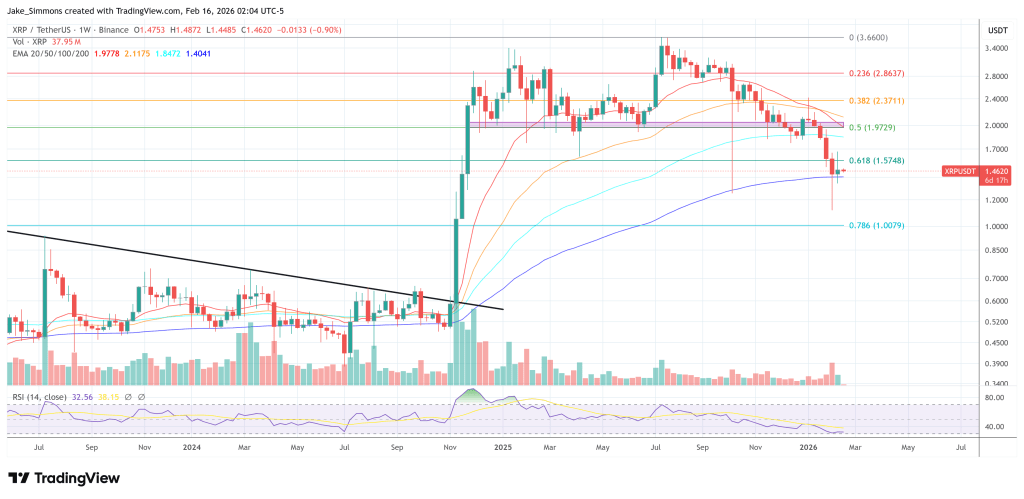
XRP remains above the 200-week EMA, 1-week chart | Source: XRPUSDT on TradingView.com

Preguntas relacionadas

QWhat did SBI Holdings CEO Yoshitaka Kitao dispute regarding SBI's holdings?

AYoshitaka Kitao disputed the viral claim that SBI Holdings holds $10 billion worth of XRP, emphasizing instead that the company's more significant exposure is its equity stake in Ripple Labs.

QWhat percentage of Ripple Labs does SBI own, according to the CEO?

ASBI owns approximately 9% of Ripple Labs, as stated by CEO Yoshitaka Kitao.

QHow did the CEO describe SBI's stake in Ripple Labs?

AThe CEO described SBI's stake in Ripple Labs as a 'hidden asset' that could be much bigger than the market appreciates.

QWhat would Ripple's valuation need to be for SBI's 9% stake to be worth over $10 billion?

AFor SBI's 9% stake to be worth over $10 billion, Ripple's implied valuation would need to exceed roughly $111 billion.

QWhen did SBI first establish its relationship with Ripple, and what key investment did it make in 2016?

ASBI established its relationship with Ripple in September 2012 and made an investment in Ripple in March 2016, later deepening ties through the SBI Ripple Asia joint venture launched in May 2016.

Lecturas Relacionadas

Dan Koe: The Counterintuitive Truth—You Don't Need to Remember Everything You Read

Dan Koe: The Counterintuitive Truth — You Don't Need to Remember Everything You Read The central idea is that deliberately trying to remember information is often misguided. True learning isn't about memorizing facts but about having important knowledge surface naturally when needed through use. Most forgetting is normal, not a failure. The article reframes learning using a control theory framework—a four-step feedback loop: having a clear Goal, accurately Sensing your current state, Comparing the gap, and Acting to close it. Most learning stalls because people only do step 2 (blind input) without a goal to create the necessary "error signal" for focused action. The most effective method is to start with output, not input. Begin a meaningful personal project first, and learn only what's necessary to complete it. This project-driven, "just-in-time" learning ensures knowledge is contextual and retained. The concept of a "Second Brain" often fails because it becomes a digital graveyard—over-collected and under-utilized. The goal should be building a "Second Subconscious"—a dynamic system that proactively surfaces relevant ideas during creation, not a static storage vault. Tools like Obsidian+Claude or Eden can help by automating organization and enabling semantic search, but their value depends on linking knowledge to active projects. Ultimately, what matters is not what you store, but what you filter and internalize. Focus on ideas that shape your worldview, use projects as filters, and transform collected material through writing and sharing. AI should be used to reduce friction in research and editing, not to formulate your core views. In conclusion, remembering is a byproduct, not the goal. Knowledge that sticks comes from pursuing personal goals, applying it in real projects, and digesting it through creation. The tools are merely aids; the crucial step is to start doing meaningful work and let the necessary knowledge find you.

marsbitHace 1 hora(s)

Dan Koe: The Counterintuitive Truth—You Don't Need to Remember Everything You Read

marsbitHace 1 hora(s)

A New Era: The Fundamental Transformation of China's Entrepreneurs

A profound generational shift is underway among Chinese entrepreneurs. The wealth and influence once dominated by real estate and internet giants is now being claimed by a new wave of founders driving breakthroughs in AI, semiconductors, and robotics. This change is vividly reflected in 2026's wealth rankings. Figures like Zhang Yiming (ByteDance), Liang Wenfeng (DeepSeek), Chen Tianshi (Cambricon), and Wang Xingxing (Unitree Robotics) are ascending. Their wealth stems not from traditional business models but from market expectations for future technological competitiveness, with AI, chips, and smart hardware becoming the primary engines of wealth creation. Their common trait is a foundational focus on technology, often starting from the laboratory rather than a business plan. Examples include Chen Tianshi's decade-long push in AI chips, Liang Wenfeng's core algorithmic innovations at DeepSeek with a compact team, and Zhu Yiming's "no salary until profitable" 9-year journey to build Changxin Memory into a global DRAM player. This transition marks a fundamental shift in China's economic imperative: from commercial expansion and learning to indigenous innovation and deep industrial capability. While the previous generation built the foundational market and infrastructure, this new cohort is tasked with achieving global leadership in core technologies, moving China from "keeping pace" to pioneering original, breakthrough innovations that are industrialized at scale. The baton is being passed to those competing on the world stage through technological originality.

marsbitHace 1 hora(s)

A New Era: The Fundamental Transformation of China's Entrepreneurs

marsbitHace 1 hora(s)

Trading

Spot
活动图片