Saylor Unveils Global Push To Make Bitcoin Quantum-Ready

bitcoinistPublicado a 2026-02-06Actualizado a 2026-02-06

Resumen

Michael Saylor, during MicroStrategy's Q4 2025 earnings call, announced a global initiative to prepare Bitcoin for the future threat of quantum computing. While acknowledging the seriousness of the quantum risk, which he estimates is at least a decade away, Saylor warned against panic and rushed protocol changes that could introduce new vulnerabilities. Instead of advocating for a specific technical solution or timeline, MicroStrategy will launch a "Bitcoin security program" to coordinate with global cybersecurity and crypto communities. The goal is to build consensus and develop solutions responsibly when the time is right. The company also reported holding 713,502 BTC after purchasing an additional 32,470 BTC in Q4 and establishing a $2.25 billion cash reserve.

Strategy used its Q4 2025 earnings call to spotlight what Michael Saylor framed as the next long-horizon security agenda for Bitcoin: coordinating a global “Bitcoin security program” aimed at quantum readiness, while warning against rushed protocol changes that could create more risk than they remove.

The remarks came as Strategy reported a quarter shaped by Bitcoin’s drawdown under fair-value accounting, even as it continued to add to its treasury. CFO Andrew Kang said the company ended 2025 with 713,502 Bitcoin—about 3.4% of all Bitcoin that will ever exist—after buying an additional 32,470 BTC in Q4 for roughly $3.1 billion.

Kang added that Strategy raised more than $25 billion of total capital during 2025 and established a $2.25 billion cash reserve designed to cover roughly 2.5 years of interest and dividend obligations.

Strategy Will Initiate A Bitcoin Security Program

Saylor addressed quantum computing directly at the end of the call, calling it the latest in a long sequence of recurring existential narratives around Bitcoin. His message was twofold: treat the risk seriously, but resist a “stampede” into premature changes.

“The concern today is quantum computers and many people ask if quantum computers represent a threat to Bitcoin,” Saylor said, before arguing the debate fits a familiar pattern. “What I would say is whenever dealing with each of these concerns we have to take them seriously... but we have to remember two things. One... ‘Don’t panic.’... The second observation, the hypocratic oath, does no harm... You don’t want an iatrogenic intervention where the cure is worse than the disease.”

In his view, the timing matters as much as the engineering. “Our position on quantum computing... we think it’s probably 10 or more years away before there’s a threat. That is the consensus,” he said. Saylor added that quantum-resistant work is happening broadly across industries that rely on conventional cryptography, and that Bitcoin-specific R&D is already underway, but emphasized that there is not yet “global consensus that existing cryptographic libraries are at risk.”

That lack of consensus, he argued, is precisely why Strategy won’t advocate a specific quantum roadmap today. “To stampede into a hypothetical fix before there is consensus would introduce new attack surfaces and new complexity and new failure modes that don’t currently exist,” Saylor said.

Pressed by Fundstrat’s Tom Lee on how Bitcoin might handle quantum-vulnerable wallet types, Saylor reiterated that Strategy would not try to steer the technical outcome. “I don’t think it’s appropriate for us to advocate a particular solution or a particular approach nor a particular time frame,” he said. “Our role is to support all of the various communities and facilitate the evolution of consensus about what should be done, how it should be done, when it should be done.”

The most concrete announcement was a commitment to formalize that support into an organized effort. “Strategy is going to initiate a Bitcoin security program that coordinates with the global cyber security community, the global crypto security community and the global Bitcoin security committee... to contribute to consensus and solutions to address the quantum computing threat as well as any other emergent security threats that evolve,” Saylor said.

He framed the initiative as a responsibility commensurate with Strategy’s scale as a holder, but also as a coordination problem: the goal is to engage “very brilliant minds,” align with the work already being done, and help solutions emerge “at the right time in a responsible fashion.”

At press time, BTC traded at $65,183.
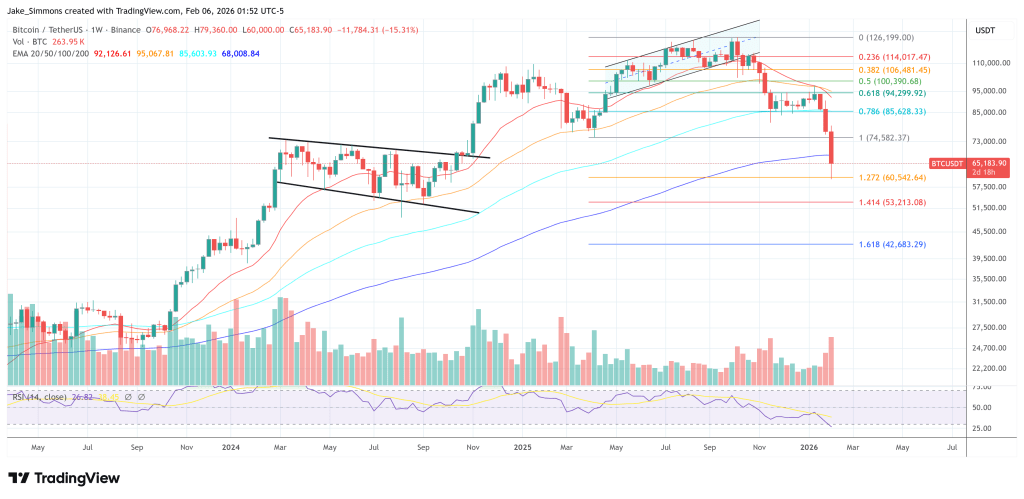
BTC needs a weekly closer above the 200-week EMA ideally, 1-week chart | Source: BTCUSDT on TradingView.com

Preguntas relacionadas

QWhat is the main focus of Michael Saylor's new Bitcoin security initiative announced during the Q4 2025 earnings call?

AThe main focus is coordinating a global 'Bitcoin security program' aimed at achieving quantum readiness and addressing emergent security threats, while cautioning against rushed protocol changes.

QHow many Bitcoin did MicroStrategy hold by the end of 2025, and what percentage of the total supply does this represent?

AMicroStrategy held 713,502 Bitcoin by the end of 2025, representing about 3.4% of all Bitcoin that will ever exist.

QWhat is Michael Saylor's estimated timeline for when quantum computing might pose a threat to Bitcoin?

AMichael Saylor estimates that a quantum computing threat to Bitcoin is probably 10 or more years away, which he states is the consensus view.

QAccording to Saylor, why is MicroStrategy not advocating for a specific quantum-resistant solution for Bitcoin at this time?

AMicroStrategy is not advocating for a specific solution because there is not yet a global consensus that existing cryptographic libraries are at risk, and rushing a fix could introduce new attack surfaces and complexity.

QWhat specific financial preparation did MicroStrategy's CFO mention regarding the company's obligations?

ACFO Andrew Kang stated that MicroStrategy established a $2.25 billion cash reserve designed to cover roughly 2.5 years of interest and dividend obligations.

Lecturas Relacionadas

From Madison Square Garden to Kalshi: Prediction Markets Break into the NBA Finals

From Madison Square Garden to Kalshi: Prediction Markets Break into the NBA Finals Prediction markets are playing a significant role in the 2026 NBA Finals, particularly around the New York Knicks' unexpected 2-0 series lead. Platforms like Kalshi and Polymarket have seen massive trading volumes, exceeding hundreds of millions of dollars on championship and related markets. Their influence extends beyond online trading. Kalshi's official partnership with Madison Square Garden has given it prominent physical branding at the arena. Furthermore, local businesses like The Jeffrey bar are using prediction market contracts to hedge the risk of game-result-based promotions, turning potential losses into manageable costs—a concept similar to the famous "Mattress Mack" strategy from traditional sports betting. These markets differentiate themselves by offering a wider, more entertainment-focused range of "event contracts" beyond typical game outcomes, such as predicting celebrity attendance. They also have broader accessibility across the U.S. compared to age- and location-restricted traditional sportsbooks. However, their rapid integration into sports raises regulatory and ethical questions. The NBA is cautiously engaging, discussing integrity frameworks with regulators like the CFTC. While the league permits minor investments like Giannis Antetokounmpo's stake in Kalshi, it advocates for strict rules to prevent insider trading. Many fans express concern on platforms like Reddit, fearing that the close ties between prediction markets, the league, and players could compromise the game's integrity. The NBA Finals has thus become a high-stakes testing ground, showcasing prediction markets' commercial potential while challenging traditional boundaries between financial trading, entertainment, and gambling.

marsbitHace 1 hora(s)

From Madison Square Garden to Kalshi: Prediction Markets Break into the NBA Finals

marsbitHace 1 hora(s)

Recursive Self-Improvement AI Gains Traction, Google Pours Cold Water, While DeepSeek and Others Approach the Fringes

The term "recursive self-improvement" (RSI), where AI improves itself autonomously, is gaining momentum in the AI industry. Startups like Recursive Superintelligence and projects such as Andrej Karpathy's Auto-Research aim to create systems where AI designs, implements, and validates its own research, moving toward superintelligence. While Google CEO Sundar Pichai cautions that such exponential acceleration is not yet a reality, progress is evident. For instance, Anthropic reported its Claude Code writes nearly 100% of the team's code, though it still lacks true self-direction. Analysts frame RSI development in stages: "adequacy" (systems functioning without humans), "parity" (matching human research quality), and "supremacy" (exceeding human-AI collaboration). Reaching parity could trigger rapid, unpredictable advancement due to AI's continuous operation. In China, companies like DeepSeek and Baidu incorporate self-optimization techniques without explicitly branding them as RSI, focusing on algorithmic efficiency and reinforcement learning. However, challenges remain, including "model collapse" from training on AI-generated data and the immense computational and open-collaboration requirements. Ultimately, RSI represents a trend of increasing automation in AI development, potentially reducing human oversight in the creation process itself.

marsbitHace 1 hora(s)

Recursive Self-Improvement AI Gains Traction, Google Pours Cold Water, While DeepSeek and Others Approach the Fringes

marsbitHace 1 hora(s)

Trading

Spot
Futuros

Artículos destacados

Cómo comprar PUSH

¡Bienvenido a HTX.com! Hemos hecho que comprar Push Protocol (PUSH) sea simple y conveniente. Sigue nuestra guía paso a paso para iniciar tu viaje de criptos.Paso 1: crea tu cuenta HTXUtiliza tu correo electrónico o número de teléfono para registrarte y obtener una cuenta gratuita en HTX. Experimenta un proceso de registro sin complicaciones y desbloquea todas las funciones.Obtener mi cuentaPaso 2: ve a Comprar cripto y elige tu método de pagoTarjeta de crédito/débito: usa tu Visa o Mastercard para comprar Push Protocol (PUSH) al instante.Saldo: utiliza fondos del saldo de tu cuenta HTX para tradear sin problemas.Terceros: hemos agregado métodos de pago populares como Google Pay y Apple Pay para mejorar la comodidad.P2P: tradear directamente con otros usuarios en HTX.Over-the-Counter (OTC): ofrecemos servicios personalizados y tipos de cambio competitivos para los traders.Paso 3: guarda tu Push Protocol (PUSH)Después de comprar tu Push Protocol (PUSH), guárdalo en tu cuenta HTX. Alternativamente, puedes enviarlo a otro lugar mediante transferencia blockchain o utilizarlo para tradear otras criptomonedas.Paso 4: tradear Push Protocol (PUSH)Tradear fácilmente con Push Protocol (PUSH) en HTX's mercado spot. Simplemente accede a tu cuenta, selecciona tu par de trading, ejecuta tus trades y monitorea en tiempo real. Ofrecemos una experiencia fácil de usar tanto para principiantes como para traders experimentados.

213 Vistas totalesPublicado en 2024.12.13Actualizado en 2026.06.02

Cómo comprar PUSH

Discusiones

Bienvenido a la comunidad de HTX. Aquí puedes mantenerte informado sobre los últimos desarrollos de la plataforma y acceder a análisis profesionales del mercado. A continuación se presentan las opiniones de los usuarios sobre el precio de PUSH (PUSH).

活动图片