Saylor Names Solana And Ethereum As Future Of Digital Credit

bitcoinistPublicado a 2026-02-27Actualizado a 2026-02-27

Resumen

In his keynote at Strategy World 2026, Michael Saylor outlined a vision where Bitcoin serves as the foundational capital base for digital credit products, with Solana and Ethereum acting as key distribution platforms. He explained that his company, MicroStrategy, is shifting from merely accumulating Bitcoin to converting it into structured credit products like its Stretch (STRC) offering. This approach aims to extract steady yield from Bitcoin’s volatility and deliver it as programmable financial instruments. Saylor emphasized that digital credit can be tokenized and distributed across various platforms—including traditional exchanges like NASDAQ and crypto networks like Solana and Ethereum. He argued that if Bitcoin appreciates significantly, it can back large volumes of investment-grade credit. Solana and Ethereum are positioned not as the reserve asset but as scalable rails for deploying tokenized credit, yield, and liquidity products to a broader market.

Michael Saylor used his Strategy World 2026 keynote on Feb. 25 to argue that Bitcoin-backed “digital credit” is moving beyond Wall Street wrappers and toward programmable distribution on crypto rails, naming Solana and Ethereum as part of that future. The pitch matters because it pushes Strategy’s Bitcoin treasury model into a broader product thesis: use Bitcoin as the capital base, then package credit, yield and liquidity for corporates, retail investors and eventually tokenized markets.

Bitcoin Capital, Credit Product

Saylor framed Bitcoin as the foundation of the stack and Strategy’s Stretch (STRC) as the credit layer built on top of it. In his telling, the company’s business is no longer just accumulating Bitcoin, but “converting capital into credit” by using long-duration capital structures to strip cash flow from a volatile asset and deliver it as a steadier yield product.

“What is Strategy doing? Our company is converting capital into credit. We’re converting economic wealth into a stream of cash flows,” Saylor said. “You need an operating company in order to take a block of economic energy and turn it into a currency, peg it to a currency, strip away the risk, damp the volatility, extract the cash flows in the form of yield and compress the duration to now.”

That framework sits at the center of his case for STRC. Saylor said Strategy arrived there only after working through what he described as increasingly durable forms of leverage, from exchange leverage and margin loans to senior debt, junior debt, convertibles and preferred structures.

The key variable, in his view, is not just headline maturity, but the “stochastic duration” of capital, how long a company can realistically rely on it before covenants, mark-to-market stress or refinancing pressure force a problem.

He argued that variable preferred credit offered the best compromise short of common equity because it maximized optionality and reduced the risk of getting squeezed out of the position during a drawdown.

Saylor also laid out a simple quantitative case for digital credit. Strategy, he said, uses three internal metrics: BTC rating, or collateral coverage; BTC risk, the probability that collateral falls below required levels by the end of the term; and the implied credit spread needed to compensate investors. He contrasted current benchmarks of 78 basis points for investment-grade bonds and 288 basis points for high-yield debt with what he said digital credit could deliver if Bitcoin compounds faster than traditional assets.

His model depends heavily on a constructive view of Bitcoin’s long-run returns. If Bitcoin appreciates at 30% annually, Saylor said, sizable volumes of investment-grade credit can be created against it. If Bitcoin goes nowhere, the same structure starts to look like distressed debt.

He used recent performance to sharpen that distinction. Since Bitcoin’s all-time high about four and a half months ago, Saylor said, Bitcoin had fallen 45%, while STRC had lost “0% of its value” and paid 4.5% in dividends through the drawdown. That, he argued, is the commercial opening: offer a less volatile yield instrument to buyers who want Bitcoin-linked economics without owning the asset outright.

Solana And Ethereum As Distribution Rails

The keynote’s most consequential turn came when Saylor described digital credit as “programmable.” He was not using the term narrowly.

“Programmable means I take the credit and I create it. I turn it into a token, a private fund, a public fund, an ETF, an ETP. I make it a bank account. I make it a crypto account,” he said. “Then I put it on a platform — the NASDAQ, the London Stock Exchange, Solana, Ethereum, Binance, Coinbase Base. There are a lot of different platforms I can put that on.”

He went further, arguing that once credit is packaged as a modular product, issuers can tune volatility, liquidity, staking periods, payout frequency and currency exposure. In that framework, Solana and Ethereum are not the capital base (Bitcoin remains that in Saylor’s model) but potential rails for distributing tokenized versions of the credit product.

That leaves Strategy with a larger ambition than simply selling preferred stock. Saylor said the company intends to deepen STRC liquidity and scale the underlying asset base, while partners build “digital money” and “digital yield” products around it.

If that thesis holds, Strategy is betting Bitcoin-backed credit can move from a public-market niche into a cross-platform product category spanning brokerages, ETFs and on-chain ecosystems.

At press time, Solana traded at $86.97.
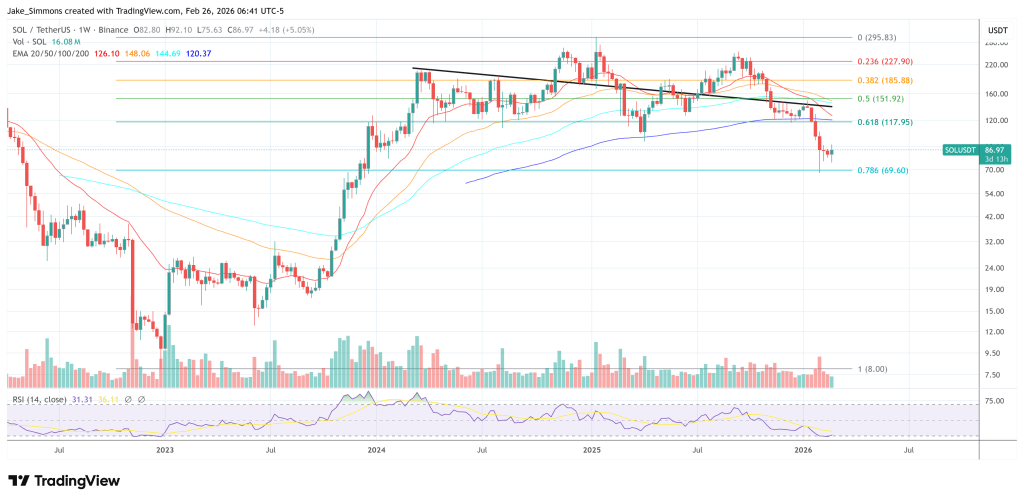
Solana must reclaim the 0.618 Fib, 1-week chart | Source: SOLUSDT on TradingView.com

Preguntas relacionadas

QWhat did Michael Sayer name as the future platforms for distributing programmable digital credit?

AMichael Saylor named Solana and Ethereum as future platforms for distributing programmable digital credit.

QAccording to Saylor, what is the role of Bitcoin in MicroStrategy's new business model?

ASaylor framed Bitcoin as the foundation of the capital stack, with MicroStrategy's Stretch (STRC) acting as the credit layer built on top of it. The company is converting capital into credit to create steadier yield products.

QWhat three internal metrics does MicroStrategy use to evaluate its digital credit model?

AThe three internal metrics are: BTC rating (collateral coverage), BTC risk (the probability collateral falls below required levels), and the implied credit spread needed to compensate investors.

QHow did Saylor contrast the performance of Bitcoin and STRC during the recent drawdown?

ASaylor stated that since Bitcoin's all-time high, it had fallen 45%, while STRC had lost '0% of its value' and paid 4.5% in dividends through the drawdown.

QWhat is the broader ambition for MicroStrategy's Bitcoin-backed credit, beyond selling preferred stock?

AThe broader ambition is to deepen STRC liquidity, scale the underlying asset base, and have partners build 'digital money' and 'digital yield' products, moving it from a public-market niche into a cross-platform product category spanning brokerages, ETFs, and on-chain ecosystems.

Lecturas Relacionadas

How Many Tokens Away Is Yang Zhilin from the 'Moon Chasing the Light'?

The article explores the intense competition between two leading Chinese AI companies, DeepSeek and Kimi (Moon Dark Side), and the mounting pressure on Yang Zhilin, the founder of Kimi. While DeepSeek re-emerged after 15 months of silence with its powerful V4 model—boasting 1.6 trillion parameters and low-cost, long-context capabilities—Kimi has been focusing on long-context processing and multi-agent systems with its K2.6 model. Yang faces a threefold challenge: technological rivalry, commercialization pressure, and investor expectations. Despite Kimi’s high valuation (reaching $18 billion), its revenue heavily relies on a single product with low paid conversion rates, while DeepSeek’s strategic silence and open-source influence have strengthened its market position and valuation prospects, now targeting over $20 billion. Both companies reflect broader trends in China’s AI ecosystem: Kimi aims for global influence through open-source contributions and agent-based advancements, while DeepSeek prioritizes foundational innovation and hardware independence, notably shifting to Huawei’s chips. Their competition is seen as vital for China’s AI progress, with the gap between top Chinese and U.S. models narrowing to just 2.7% on the Elo rating scale. Ultimately, the article argues that this rivalry, though anxiety-inducing for leaders like Zhilin, is essential for driving innovation and solidifying China’s role in the global AI landscape.

marsbitHace 3 hora(s)

How Many Tokens Away Is Yang Zhilin from the 'Moon Chasing the Light'?

marsbitHace 3 hora(s)

TechFlow Intelligence Bureau: ChatGPT Helps Amateur Mathematician Crack 60-Year-Old Problem, CFTC Sues New York Regulator Over Coinbase and Gemini

An amateur mathematician, with the assistance of ChatGPT, has solved a combinatorial mathematics puzzle originally proposed by Hungarian mathematician Paul Erdős in the 1960s. This marks another milestone in AI-aided mathematical research, demonstrating the evolving capabilities of large language models in formal reasoning. In other AI developments, OpenAI introduced a new privacy filter tool for enterprise API usage, automatically screening sensitive data. Meanwhile, the Qwen3.6-27B model achieved 100 tokens per second on a single RTX 5090 GPU using quantization, significantly lowering the cost barrier for local AI deployment. In crypto and Web3, the U.S. CFTC sued New York’s financial regulator, challenging its oversight of Coinbase and Gemini—a first-of-its-kind federal-state regulatory clash. Following a vulnerability, KelpDAO and major DeFi protocols established a recovery fund. Tether froze $344 million in assets linked to Iran’s central bank upon U.S. Treasury request, highlighting the centralized control risks in stablecoins. Separately, Litecoin underwent a 3-hour chain reorganization to undo a privacy-layer exploit. In the U.S., former President Trump invoked the Defense Production Act to address power grid bottlenecks affecting AI data centers and dismissed the entire National Science Board, raising concerns over research independence. A retail trader gained 250% on a $600k Intel options bet amid AI-related speculation. Xiaomi announced its first performance electric vehicle, targeting rivals like Tesla. Meanwhile, iPhone users reported devices automatically reinstalling a hidden app daily, suspected to be MDM-related. A Chinese securities report noted that A-share institutional crowding has reached its second-longest streak since 2007, signaling high valuations and potential style rotation. The day’s developments reflect a dual narrative: AI is enabling unprecedented individual breakthroughs, while centralized power structures—whether governmental or corporate—are becoming more assertive, underscoring that decentralization is as much a political-economic challenge as a technical one.

marsbitHace 3 hora(s)

TechFlow Intelligence Bureau: ChatGPT Helps Amateur Mathematician Crack 60-Year-Old Problem, CFTC Sues New York Regulator Over Coinbase and Gemini

marsbitHace 3 hora(s)

Trading

Spot
Futuros
活动图片