SaucerSwap Unveils Redesigned Platform and New Brand Identity for Hedera DeFi

TheNewsCryptoPublicado a 2025-12-17Actualizado a 2025-12-17

Resumen

SaucerSwap Labs, the team behind Hedera's leading decentralized exchange, has unveiled a fully redesigned platform and a refreshed brand identity. The update modernizes navigation, integrates analytics, and introduces a new visual design, while preserving the existing audited smart contracts and non-custodial architecture. CEO Peter Campbell stated the platform is rebuilt to feel "fast, trusted, and intuitive." Since its 2022 launch, SaucerSwap has grown into Hedera's dominant DeFi protocol. The redesign organizes the platform into clear, action-driven sections for trading, liquidity provisioning, staking, and governance. It also features a bridge to external networks like Base and BNB Chain. The interface is designed to serve all user types, from retail to professional traders, and scales to accommodate future upgrades. The core protocol remains unchanged; all existing user positions and rewards are intact. This marks the beginning of SaucerSwap's next chapter with a new design and capabilities, upholding its mission to be Hedera's most efficient and secure liquidity protocol.

Fernandina Beach, USA/Florida, December 15th, 2025, Chainwire

SaucerSwap Labs, the team behind Hedera’s leading decentralized exchange, today unveiled a fully redesigned platform and refreshed brand identity. The update delivers modernized navigation, integrated analytics, and a new visual design system while preserving the audited smart contracts and non-custodial architecture that users rely on.

“Whether you’re discovering Hedera DeFi for the first time or you’re a professional trader, everything has been rebuilt to feel fast, trusted, and intuitive,” said Peter Campbell, CEO and Co-founder of SaucerSwap Labs. “This is a serious workstation for capital.”

A New Era for Hedera’s Liquidity Protocol

Since launching in 2022, SaucerSwap has grown from an early-stage automated market maker into Hedera’s dominant DeFi protocol, routing the majority of on-chain liquidity and processing tens of millions of swaps. The redesigned platform brings the user experience in line with that scale, introducing clearer information architecture and analytics built directly into every workflow.

The launch also introduces a refreshed visual identity for SaucerSwap, including an updated logo, new color palette, and a modern design system that reflects the protocol’s evolution from startup to infrastructure.

Navigation Built Around Real Workflows
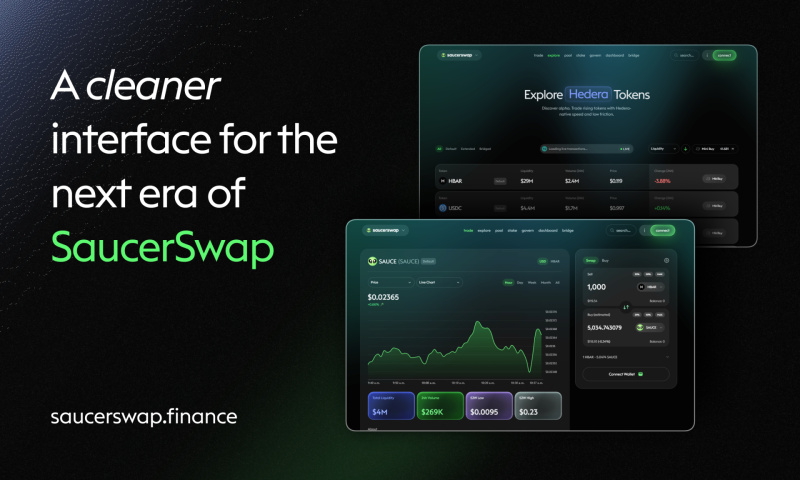
The platform is now organized into clear, action-driven sections. Trading, token discovery, liquidity provisioning, staking, governance, and portfolio monitoring each have dedicated views. Users can move from a token swap to providing liquidity, staking SAUCE, or voting on a governance proposal in seconds.

A bridge modal connects Hedera to external networks including Base and BNB Chain, making it easier to move capital in and out of the ecosystem.

The redesign standardizes how information is displayed across the platform: pair and pool charts, liquidity depth, fee APYs, LP position analytics, historical performance, and protocol health metrics all follow consistent visual patterns. These components are designed to scale with SaucerSwap’s roadmap, including the planned V3 protocol upgrade, perpetuals, limit orders, dollar cost averaging, and ETF-style products.

“The interface was designed so that complex features feel simple,” said Markus Bergvinson, Chief Strategy Officer at SaucerSwap Labs. “Whether it’s swaps today or advanced derivatives tomorrow, it all lives inside one consistent experience.”

Built for Every Type of User

The platform is tuned for different audiences. Retail users and newcomers get clear copy and guided flows that feel similar to modern banking apps. Advanced users and liquidity providers gain faster access to deeper analytics and more powerful LP tools. Builders and token projects can rely on the interface for token launches and liquidity programs. Professional partners can bridge assets from other networks and interact with a protocol that matches their expectations for security and longevity.

Protocol Unchanged, Experience Upgraded

The redesign does not change SaucerSwap’s audited smart contracts, non-custodial architecture, on-chain governance via SAUCE and xSAUCE, or any existing LP positions, stakes, or rewards. Everything users have built on SaucerSwap remains intact.

This launch marks the beginning of SaucerSwap’s next chapter: new design, new brand, and new capabilities, with the same mission of being the most efficient, accessible, and secure liquidity protocol on Hedera.

About SaucerSwap

SaucerSwap is Hedera’s leading decentralized exchange and liquidity protocol, enabling fast, low-cost token swaps with integrated analytics. Governed by the SaucerSwap DAO through SAUCE and xSAUCE, the protocol powers Hedera-native and cross-chain liquidity for retail users, builders, and institutional partners.

For more information, users can visit the SaucerSwap Docs and explore the new SaucerSwap platform.

Contact

CEO
Peter Campbell
SaucerSwap Labs LLC
[email protected]

Lecturas Relacionadas

a16z: AI's 'Amnesia', Can Continuous Learning Cure It?

The article "a16z: AI's 'Amnesia' – Can Continual Learning Cure It?" explores the limitations of current large language models (LLMs), which, like the protagonist in the film *Memento*, are trapped in a perpetual present—unable to form new memories after training. While methods like in-context learning (ICL), retrieval-augmented generation (RAG), and external scaffolding (e.g., chat history, prompts) provide temporary solutions, they fail to enable true internalization of new knowledge. The authors argue that compression—the core of learning during training—is halted at deployment, preventing models from generalizing, discovering novel solutions (e.g., mathematical proofs), or handling adversarial scenarios. The piece introduces *continual learning* as a critical research direction to address this, categorizing approaches into three paths: 1. **Context**: Scaling external memory via longer context windows, multi-agent systems, and smarter retrieval. 2. **Modules**: Using pluggable adapters or external memory layers for specialization without full retraining. 3. **Weights**: Enabling parameter updates through sparse training, test-time training, meta-learning, distillation, and reinforcement learning from feedback. Challenges include catastrophic forgetting, safety risks, and auditability, but overcoming these could unlock models that learn iteratively from experience. The conclusion emphasizes that while context-based methods are effective, true breakthroughs require models to compress new information into weights post-deployment, moving from mere retrieval to genuine learning.

marsbitHace 2 hora(s)

a16z: AI's 'Amnesia', Can Continuous Learning Cure It?

marsbitHace 2 hora(s)

Can a Hair Dryer Earn $34,000? Deciphering the Reflexivity Paradox in Prediction Markets

An individual manipulated a weather sensor at Paris Charles de Gaulle Airport with a portable heat source, causing a Polymarket weather market to settle at 22°C and earning $34,000. This incident highlights a fundamental issue in prediction markets: when a market aims to reflect reality, it also incentivizes participants to influence that reality. Prediction markets operate on two layers: platform rules (what outcome counts as a win) and data sources (what actually happened). While most focus on rules, the real vulnerability lies in the data source. If reality is recorded through a specific source, influencing that source directly affects market settlement. The article categorizes markets by their vulnerability: 1. **Single-point physical data sources** (e.g., weather stations): Easily manipulated through physical interference. 2. **Insider information markets** (e.g., MrBeast video details): Insiders like team members use non-public information to trade. Kalshi fined a剪辑师 $20,000 for insider trading. 3. **Actor-manipulated markets** (e.g., Andrew Tate’s tweet counts): The subject of the market can control the outcome. Evidence suggests Tate’sociated accounts coordinated to profit. 4. **Individual-action markets** (e.g., WNBA disruptions): A single person can execute an event to profit from their pre-placed bets. Kalshi and Polymarket handle these issues differently. Kalshi enforces strict KYC, publicly penalizes insider trading, and reports to regulators. Polymarket, with its anonymous wallet-based system, has historically been more permissive, arguing that insider information improves market accuracy. However, it cooperated with authorities in the "Van Dyke case," where a user traded on classified government information. The core paradox is reflexivity: prediction markets are designed to discover truth, but their financial incentives can distort reality. The more valuable a prediction becomes, the more likely participants are to influence the event itself. The market ceases to be a mirror of reality and instead shapes it.

marsbitHace 3 hora(s)

Can a Hair Dryer Earn $34,000? Deciphering the Reflexivity Paradox in Prediction Markets

marsbitHace 3 hora(s)

Trading

Spot
Futuros
活动图片