Satoshi Nakamoto statue lands on NYSE in sign of changing times

cointelegraphPublicado a 2025-12-11Actualizado a 2025-12-11

Resumen

The New York Stock Exchange (NYSE) has installed a statue of Satoshi Nakamoto, Bitcoin’s pseudonymous creator, marking a symbolic shift in the acceptance of cryptocurrency within traditional finance. The statue, designed by artist Valentina Picozzi, was placed by Bitcoin firm Twenty One Capital. This event coincides with the anniversary of the Bitcoin mailing list launched in 2008. The installation reflects Bitcoin’s journey from a niche concept to a mainstream asset, now held by major institutions, companies, and ETFs. Picozzi has placed six of a planned 21 statues worldwide, each representing Nakamoto’s elusive legacy and the decentralized ideals of Bitcoin.

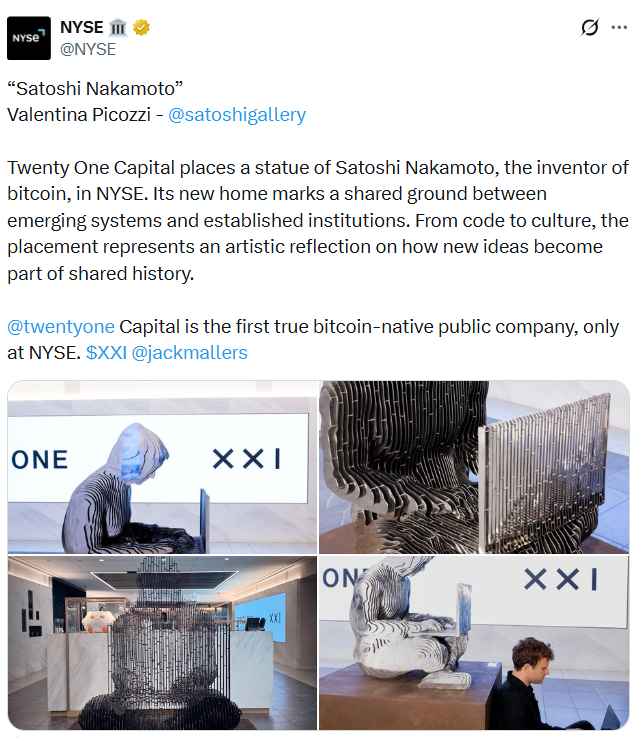
The New York Stock Exchange (NYSE) has just become the sixth home for Valentina Picozzi’s “disappearing” Satoshi Nakamoto statue — a massive contrast to just a few years ago, when crypto was seen as taboo on Wall Street.

The NYSE is considered a center of traditional financial institutions, and the inclusion of a Nakamoto statue marks it as “shared ground between emerging systems and established institutions,” the stock exchange said in an X post on Wednesday.

The statue was installed by Bitcoin company Twenty One Capital, which launched for trading this week; however, the design is the brainchild of artist Valentina Picozzi, who said on X, under her Satoshigallery handle, that her latest creation coming to such a prominent location is “Mind-blowing.”
Source: New York Stock Exchange

“This is such an achievement, even in our wildest dream we wouldn’t think about placing the statue of Satoshi Nakamoto in this location! The 6th/21 statues of Satoshi Nakamoto found its home in the NYSE,” she added.

It also happens to coincide with the anniversary of the Bitcoin mailing list, which Nakamoto launched on Dec. 10, 2008.

Bitcoin's journey from thought experiment to mainstream asset

Satoshi Nakamoto mined the genesis block on Jan. 3, 2009, minting the first 50 Bitcoin in history and planting the seeds for the crypto industry we see today.

Over a year later, on May 22, 2010, programmer Laszlo Hanyecz made the first documented purchase of goods using Bitcoin, paying 10,000 Bitcoin for two Papa John’s pizzas.

In the intervening years, Bitcoin and cryptocurrency faced many challenges, as institutions and banks shunned them, and governments allegedly attempted to suppress them through efforts such as Operation Chokepoint 2.0.

However, it has since turned a corner, as skeptics, such as BlackRock CEO Larry Fink, have changed their minds about the technology, and institutions and Wall Street have scrambled to invest through vehicles like exchange-traded funds and directly by holding Bitcoin in their treasuries.

Public and private companies, countries and ETFs now collectively hold more than 3.7 million Bitcoin, according to Bitbo, worth more than $336 billion.

More Satoshi statues incoming

Picozzi has five other Nakamoto statues around the world, located in Switzerland, El Salvador, Japan, Vietnam, and Miami, a city in the US State of Florida.

Related: Disappearing Satoshi statue in Lugano took 21 months to create, says artist

Picozzi, under her Satoshigallery handle, said she is committed to placing 21 around the world, a possible reference to the theoretical 21 million Bitcoin maximum supply.

Speaking to Cointelegraph last year, she said Nakamoto is one of the most intriguing and fascinating figures of this era, and the statues stand as a tribute to the person behind Bitcoin.

“The statue itself wants to give to the viewer this feeling of disappearance, and the sense that the inventor stays between the lines — as of today, Satoshi exists in the lines of the Bitcoin code, allowing humanity to have the first decentralized payment system,” she said.

“It represents a hacker in his stereotyped pose, sitting with the laptop on his legs, and is a tribute to all the developers and programmers around the world that helped build the Bitcoin ecosystem, fighting for transparency and freedom.”

Magazine: 6 reasons Jack Dorsey is definitely Satoshi... and 5 reasons he’s not

Criptos en tendencia

Lecturas Relacionadas

Goldman Sachs Research Report Analysis: Circle and USDC Are Moving Beyond the Crypto World, Cross-Border Payments and AI Agents Become New Battlegrounds

Goldman Sachs published a summary of its meeting with Circle Internet Group (issuer of USDC) on July 5th. The core takeaway is that stablecoins, led by USDC, are evolving from a crypto-native tool into foundational infrastructure for traditional finance and the AI economy. USDC's use cases are rapidly expanding beyond crypto trading into cross-border payments, e-commerce, capital market settlements, and notably, payments for AI agents. Circle's management emphasized that stablecoin growth is now decoupled from crypto market cycles, driven by this diversification. They outlined five key application layers and highlighted USDC's network effects, global liquidity depth, and regulatory compliance as competitive moats. Circle distinguishes USDC from bank-issued tokenized deposits, arguing the former is an open, internet-native system without bank credit risk. Strategically, Circle is building a broader fintech platform with its Arc Layer 1 blockchain, the Circle Payments Network for cross-border transfers, and an "Agentic Stack" to serve AI agent economies, where USDC already dominates. Regarding regulation, Circle views potential U.S. legislation like the CLARITY Act as a catalyst for growth rather than a constraint, expecting it to encourage broader institutional adoption and active usage. Goldman Sachs maintains a Neutral rating on Circle with a $96 price target, noting the company's shift from a pure stablecoin issuer to a financial infrastructure provider. Key risks include competition from USDT and potential earnings pressure from declining interest rates on its reserve assets.

marsbitHace 47 min(s)

Goldman Sachs Research Report Analysis: Circle and USDC Are Moving Beyond the Crypto World, Cross-Border Payments and AI Agents Become New Battlegrounds

marsbitHace 47 min(s)

The Robinhood Stock Tokens You Bought Are Just Debts from Jersey Island

The Robinhood stock tokens you buy are essentially debt securities issued by a shell company in Jersey, not real equity. These tokens merely track stock prices like NVIDIA or Apple but grant no shareholder rights like voting or dividends. If the underlying company fails, you have no claim on its assets. Instead, you hold a debt instrument from Robinhood Assets (Jersey) Limited, which promises returns based on stock performance. If this Jersey entity goes bankrupt, you become an unsecured creditor. This complex structure stems from Robinhood's past crisis during the 2021 GameStop short squeeze, where T+2 settlement caused liquidity issues. The blockchain-based tokens enable instant settlement, theoretically preventing such trading halts. The product is classified by the SEC as a "linked security" or structured note, carrying counterparty risk not borne by actual shareholders. It is available globally but excluded from the US, UK, and other major markets, while Robinhood offers a fully compliant, asset-backed token model in Europe under MiFID II. The system relies on oracles for pricing, which poses risks like manipulation and faulty liquidations seen in DeFi exploits. Robinhood profits from spreads and aims to become a full-chain settlement layer. Meanwhile, competitors like Ondo have launched SEC-registered, fully compliant equity tokens in the US with actual voting rights and dividends. Robinhood’s Jersey debt model appears as a transitional, regulatory-arbitrage product, aiming to capture market share ahead of future regulatory clarity.

Foresight NewsHace 1 hora(s)

The Robinhood Stock Tokens You Bought Are Just Debts from Jersey Island

Foresight NewsHace 1 hora(s)

Trading

Spot

Artículos destacados

Cómo comprar HOME

¡Bienvenido a HTX.com! Hemos hecho que comprar Defi.app (HOME) sea simple y conveniente. Sigue nuestra guía paso a paso para iniciar tu viaje de criptos.Paso 1: crea tu cuenta HTXUtiliza tu correo electrónico o número de teléfono para registrarte y obtener una cuenta gratuita en HTX. Experimenta un proceso de registro sin complicaciones y desbloquea todas las funciones.Obtener mi cuentaPaso 2: ve a Comprar cripto y elige tu método de pagoTarjeta de crédito/débito: usa tu Visa o Mastercard para comprar Defi.app (HOME) al instante.Saldo: utiliza fondos del saldo de tu cuenta HTX para tradear sin problemas.Terceros: hemos agregado métodos de pago populares como Google Pay y Apple Pay para mejorar la comodidad.P2P: tradear directamente con otros usuarios en HTX.Over-the-Counter (OTC): ofrecemos servicios personalizados y tipos de cambio competitivos para los traders.Paso 3: guarda tu Defi.app (HOME)Después de comprar tu Defi.app (HOME), guárdalo en tu cuenta HTX. Alternativamente, puedes enviarlo a otro lugar mediante transferencia blockchain o utilizarlo para tradear otras criptomonedas.Paso 4: tradear Defi.app (HOME)Tradear fácilmente con Defi.app (HOME) en HTX's mercado spot. Simplemente accede a tu cuenta, selecciona tu par de trading, ejecuta tus trades y monitorea en tiempo real. Ofrecemos una experiencia fácil de usar tanto para principiantes como para traders experimentados.

235 Vistas totalesPublicado en 2025.06.10Actualizado en 2026.06.10

Cómo comprar HOME

Discusiones

Bienvenido a la comunidad de HTX. Aquí puedes mantenerte informado sobre los últimos desarrollos de la plataforma y acceder a análisis profesionales del mercado. A continuación se presentan las opiniones de los usuarios sobre el precio de HOME (HOME).

活动图片