SaaS Battle Royale: The Survivors Who Win All Share One Common Trait

marsbitPublicado a 2026-06-03Actualizado a 2026-06-03

Resumen

**Summary** The AI revolution has triggered a "SaaS apocalypse," forcing a brutal market shakeout. The key dividing line is the pricing model. Companies like Snowflake and Datadog, which charge based on consumption (e.g., data processed or compute used), are thriving. AI workloads actively *generate* more demand for their services, fueling growth. Datadog's accelerating revenue is a prime example. Microsoft and Palantir, as platform/ecosystem players, also benefit by acting as essential channels for AI deployment. In contrast, traditional SaaS firms built on per-seat or per-task licensing (e.g., Intuit, Adobe) face direct pressure, as AI threatens to automate the very human tasks their software supports. Companies like Salesforce, a per-seat giant, are caught in the middle. While showing strong AI monetization (e.g., its Agentforce platform) and experimenting with consumption-based "Flex Credits," its stock remains under pressure, illustrating that the market rewards *completed* transitions, not just the intent. The recent Microsoft Build conference underscored key trends: AI is evolving from an assistant to an autonomous "agent," and platform providers like Microsoft are consolidating their control. The market's recovery is highly selective, focused on identifying which companies are "fed by AI" versus "eaten by AI." Future focus will be on the diffusion of this recovery to transforming companies and the real-world adoption data of AI agents like Microsoft Copilot.

Author: Seeking Counsel on Stock Trends, Tide Research

Today, Microsoft's annual Build developer conference kicked off at Fort Mason in San Francisco. The key message from Nadella's keynote was just one: AI is no longer an assistant that answers questions; it's now an employee that does the work for you.

The timing of this conference is interesting. Over the past five months, the US software sector has experienced a battle royale.

The market has dubbed this massacre the "SaaSpocalypse." From the beginning of the year to mid-May, Salesforce fell 33%, Intuit dropped nearly 30%, and even Workday and Adobe weren't spared. The panic logic is simple: if an AI agent can do the work of ten people, then companies don't need to buy software seats for ten people. The per-seat billing model that has underpinned the entire SaaS industry for twenty years has had its foundation pulled out.

But just last week, a group stood up amidst this slaughter.

On May 28th, Snowflake soared 36.5% in a single day, its biggest daily gain since listing. Datadog's stock price doubled year-to-date, hitting a new all-time high on May 29th. On the same day, MongoDB rose 10%, Palantir climbed 8%, with the three major indices hitting new highs.

Another group is still down. Intuit plunged 19% at one point after earnings. Although Salesforce's EPS crushed expectations by 24%, its stock still fell post-earnings and remains down about 28% year-to-date.

In the same battle royale, some have doubled while others have been halved. What's the difference?

The Spark Lit by Snowflake

Why could Snowflake light this spark? Because of its pricing model.

The core market fear over the past five months has been something very specific: per-seat pricing. The logic is simple: if an AI agent can do the work of ten people, then companies don't need software seats for ten people. Atlassian reported its first-ever decline in enterprise seat count this year, giving this fear real data support.

Snowflake happens to stand on the opposite side of this fear. It doesn't charge per seat; it charges for the computing power and data processing volume you consume. AI hasn't reduced its consumption; instead, it's furiously driving consumption: AI accounts on the platform grew from 9,100 to 13,600 in a quarter, product revenue grew 34% year-over-year, the company raised its full-year guidance, and announced a $6 billion AWS compute purchase.

Datadog tells the other side of the same story. Snowflake proved "AI is feeding volume to data platforms," Datadog proves "AI is feeding volume to monitoring platforms." Q1 revenue exceeded $1 billion for the first time, up 32% year-over-year, with growth accelerating for three consecutive quarters (from 25% to 29% to 32%). Full-year guidance was raised to $4.3-$4.34 billion. The logic is simple: the more AI workloads a business deploys, the more things need monitoring and debugging, and Datadog's consumption-based meter spins faster. Its RPO (Remaining Performance Obligations) grew 51% year-over-year to $3.48 billion, indicating customers are not only using more but also signing longer-term contracts. Its stock price doubled year-to-date, hitting a record high on May 29th.

One sentence can summarize the logic of this rebound: AI is creating more workload for certain platforms, not replacing them. Snowflake and Datadog are two of the cleanest examples.

The Market's Other Face in the Same Week

If you only look at Snowflake and shout "software stocks are saved," you'll fall into another trap.

Salesforce, which also reported Q1 earnings the same week, tells a story far more complex than just "weak guidance."

First, the good side: Q1 revenue of $11.13 billion, up 13% year-over-year, beat expectations; adjusted EPS of $3.88, 24% higher than the Wall Street consensus of $3.12; the most crucial metric, Agentforce (its AI agent platform) reached $1.2 billion in Annual Recurring Revenue (ARR), growing over 200% year-over-year. The company processed 380 million agent work units and 286 trillion AI tokens in a quarter. This is real AI monetization, not just PPT.

Salesforce is even proactively moving towards "consumption-based" billing. It launched "Flex Credits," charging not just per seat but based on the workload completed by its agents. Six of its top ten Q1 deals included Flex Credits from the start. The company is desperately trying to cross the dividing line between "per seat" and "per consumption."

Now look at the market reaction: after earnings were released, the stock still fell in after-hours trading. As of last Friday, Salesforce was still down about 28% year-to-date. The reasons were a Q2 guidance slightly below the most optimistic expectations and weaker performance in Tableau and Commerce Cloud.

What does this indicate? It shows that dividing line is real, but crossing it takes time. The market is willing to give a 36% single-day gain to a company already on the consumption side (Snowflake), but it's not willing to give credit to a company trying hard to cross over (Salesforce). Willingness to transform does not equal completion of transformation.

Intuit is another counter-example. Its stock opened down about 19% after earnings. Products like its TurboTax, which is task-based and oriented towards individuals for tax filing, are the most direct targets of the "AI replacing human labor" fear.

Build Conference: Three Signals Worth Watching

The Build conference is ongoing, and there are more noteworthy things than expected.

Signal One: Microsoft is cutting its OpenAI dependency.

Project Polaris, announced at Build, is Microsoft's in-house AI programming model. It will replace GPT-4 as GitHub Copilot's default engine in August this year. This model runs on Microsoft's own Maia AI accelerator, meaning Microsoft is bringing the entire chain—from model to chips to developer tools—back in-house. The relationship between OpenAI and Microsoft has always had commercial awkwardness, with two companies sharing overlapping user interests. Polaris is Microsoft's formal answer to this issue.

Signal Two: Agents are no longer demos; they're becoming part of the operating system.

Agent Mode has become the default for Office 365 Copilot. Open Word, Excel, PowerPoint, and the AI runs as an "agent," capable of planning and executing multi-step tasks. The Windows Agent Framework has been open-sourced (MIT license), the Windows Agent Store offers 85% revenue share to developers, with Adobe and Zoom among the first partners. Nadella's exact words: AI has gone from a "synchronous assistant" to an "asynchronous colleague capable of independently executing cross-domain, long-term tasks."

Signal Three: The $9.7 billion Pentagon contract.

Just the day before Build, the Pentagon announced a $9.7 billion, five-year software consolidation contract, bringing Microsoft 365 subscriptions scattered across various military branches, intelligence agencies, and the Coast Guard under one agreement. This money isn't new spending; it's consolidating previously disparate purchases for renegotiation. But the signal it sends is clear: at the world's largest single software buyer, Microsoft's seat-based model is not being weakened by AI; instead, it's being further locked in.

Where Exactly Is That Dividing Line?

Back to the core question. Who is this rebound rewarding, and who is it overlooking?

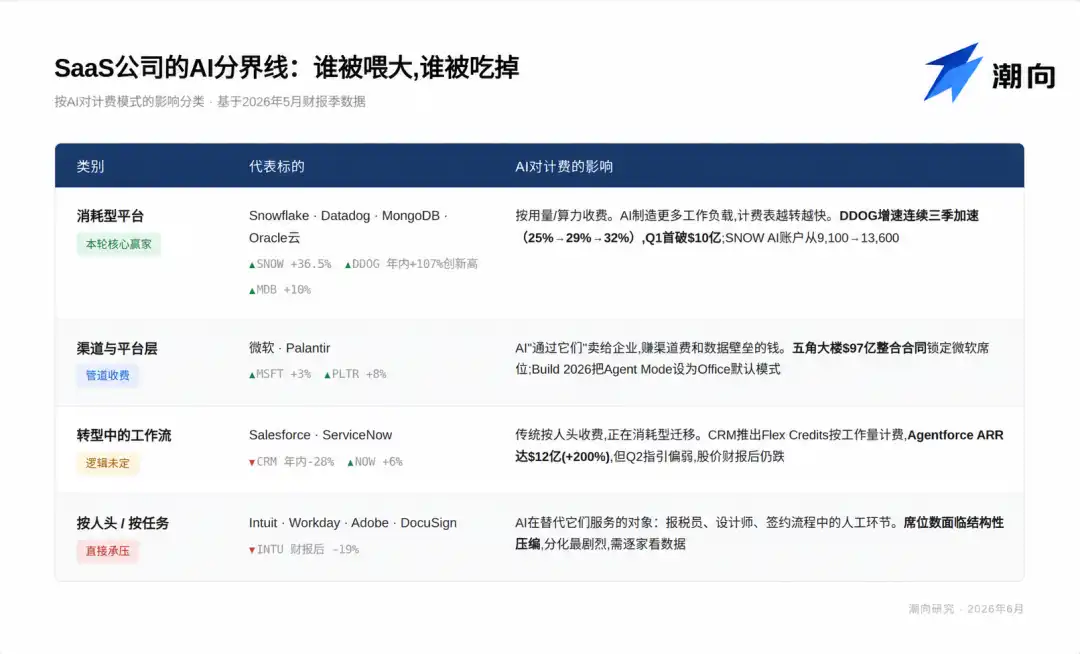
Software companies can be divided into four categories:

Category 1: Consumption-based platforms. Representatives: Snowflake, Datadog, MongoDB, Oracle Cloud business. AI creates more data processing, monitoring, and compute demands; their billing meters spin faster. Datadog is especially worth a separate look. Its growth is accelerating, from 25% to 29% to 32%, which is extremely rare among large-scale SaaS companies and makes it a core winner of this rebound.

Category 2: Channels and platform layers. Representatives: Microsoft and Palantir. AI is sold to enterprises "through them"; they earn channel fees and benefit from data barriers. Microsoft's $9.7 billion Pentagon contract, Copilot Studio, Azure AI Foundry are all reinforcing this position.

Category 3: Workflow companies in transition. Representatives: ServiceNow and Salesforce. Their traditional model is per-seat, but they are migrating towards value/consumption-based billing. Salesforce's Flex Credits is such an attempt. These companies have rebounded partly, but the market is still waiting for them to prove their transformation is fast enough.

Category 4: Directly pressured per-seat/per-task companies. Representatives: Intuit, Workday, Adobe, DocuSign. AI is replacing the objects of their services (tax preparers, designers, human steps in contracting processes). These companies face the most direct pressure, and differentiation is most intense, requiring scrutiny of seat data company by company.
What to Watch Next?

The peak of panic is over, but this isn't a signal to buy blindly. Three things are worth continuous tracking:

First, will the dividing line diffuse or narrow? Will the rebound spread from consumption-based platforms to companies that can provide hard evidence of "AI increasing per-seat value"? If it diffuses, it indicates the sector is broadly healing. If it stays only with the Snowflakes, it means the market has just adopted stricter screening criteria.

Second, can Salesforce's Flex Credits and Agentforce sustain acceleration? This is the largest single sample of "whether per-seat companies can successfully cross over." The $1.2 billion ARR proves the direction, but the drag from Tableau and Commerce Cloud shows old businesses are still consuming transformation momentum. The next earnings report (Sept 2) will reveal if Agentforce ARR can reach $1.5 billion and the proportion of Flex Credits in new contracts.

Third, enterprise adoption data for Microsoft Copilot post-Build. After Agent Mode becomes the default, changes in paid seat counts and token consumption will directly test the core hypothesis: "Are agents feeding platform revenue, or are they replacing human seats?"

The market has moved from "Will AI kill software?" into the differentiation stage of "Who is fed by AI, and who is eaten by AI?" Seeing clearly where that dividing line is matters more than chasing any single gain.

This article is an independent analysis by Tide Research based on publicly available information. The stocks and views mentioned are for research reference only and do not constitute any investment advice. The market carries risks; decision-making should be independent.

Data sources: Snowflake Q1 FY2027 Earnings · Salesforce Q1 FY2027 Earnings & SEC Filings · Microsoft Build 2026 Official Announcements · ChatForest Build 2026 Recap · CNBC · Reuters · Seeking Alpha


Criptos en tendencia

Preguntas relacionadas

QAccording to the article, what is the key characteristic of the SaaS companies that have emerged as winners from the 'SaaSpocalypse'?

AThe article states that the winning SaaS companies have a business model based on 'consumption-based' or 'usage-based' pricing. Unlike the traditional per-seat model, their revenue increases as AI generates more demand for their services (like data processing, monitoring, and computing).

QHow did Snowflake and Datadog's recent performance illustrate a positive impact from AI, and what is their primary metric for charging customers?

ASnowflake and Datadog saw their stock prices surge (Snowflake up 36.5%, Datadog doubling YTD) because AI is creating more workload for their platforms, not replacing them. Snowflake charges based on data processing/compute consumption, and Datadog charges based on monitoring consumption. Their revenue grows as AI usage increases.

QWhat is the 'line' or 'dividing line' the article repeatedly mentions that determines how the market is evaluating different SaaS companies in the age of AI?

AThe dividing line is the shift from a 'per-seat' or 'per-task' pricing model to a 'consumption-based' or 'usage-based' pricing model. The market is rewarding companies already on the consumption side and scrutinizing those whose traditional models might be replaced or disrupted by AI automation.

QDespite strong earnings, why did Salesforce's stock price not react positively, and what key initiative is it taking to address this market concern?

ASalesforce's stock did not rise despite beating EPS estimates because its forward guidance was slightly weak and its traditional per-seat business model faces market fears from AI. To address this, Salesforce is introducing 'Flex Credits,' a consumption-based pricing option for its AI Agentforce platform, aiming to shift towards usage-based revenue.

QBased on the article's classification, what are the four categories of software companies in the current AI-driven market, and can you name a representative for each?

A1. **Consumption-based Platforms:** Snowflake, Datadog, MongoDB. 2. **Channels & Platform Layers:** Microsoft, Palantir. 3. **Workflow Companies in Transition:** ServiceNow, Salesforce. 4. **Per-Seat/Per-Task Companies Under Direct Pressure:** Intuit, Workday, Adobe, DocuSign.

Lecturas Relacionadas

After Three Consecutive Quarters of Decline, Can the Crypto Market Find a Window for Stabilization in Q3?

The cryptocurrency market has just concluded its worst-performing quarter since 2022, with total capitalization dropping 12.6% to $2.1 trillion. All core metrics indicate capital is leaving the sector, not just rotating within it. Bitcoin fell 14.2% and Ethereum dropped 25.4% in Q2, breaking their previous correlation with US tech stocks. A key driver is the reversal in US spot Bitcoin ETF flows, which saw a net outflow of approximately $4.67 billion in Q2, including a record monthly outflow near $4.5 billion in June. While recent data suggests long-term holders are accumulating again, sustained ETF outflows mean continued selling pressure. Market focus is now singularly on the Federal Reserve. The upcoming July FOMC meeting is seen as the most critical event for Q3. A dovish signal could support Bitcoin reclaiming a $68,000-$84,000 range, while a hawkish stance might establish a new trading band around $50,000-$56,000. Additionally, regulatory uncertainty persists, with the progress of the crucial *CLARITY Act* stalling in the Senate, reducing its perceived 2026 passage probability to 40-45%. Despite the broad downturn, a few sectors showed growth. Prediction markets saw nominal volume surge 48.7% year-over-year to $113.8 billion, and tokenized collectibles transaction volume rose 143% quarterly to $1.4 billion. The Real-World Asset (RWA) tokenization sector also continued steady growth, now representing ~$28.1 billion in on-chain value. The market's foundation for an extreme crash appears limited, with Bitcoin price hovering near its 200-week moving average. However, the trading paradigm has shifted from narrative-driven speculation to decisions based on price action, policy developments, and interest rate expectations, making a broad sentiment-driven rally unlikely in the near term.

marsbitHace 8 hora(s)

After Three Consecutive Quarters of Decline, Can the Crypto Market Find a Window for Stabilization in Q3?

marsbitHace 8 hora(s)

BIT Trading Moment: BTC Still Suppressed by Weekly 200 EMA, Rejection May Restart Decline; Storage and Semiconductors that Surged Last Night Begin Falling in Evening Trading

**Crypto & Stock Market Wrap: Bitcoin Tests Resistance, Stocks Retreat After AI Surge** Bitcoin consolidates around $66,000, facing key resistance near $68,000—an area seen as a major psychological and technical hurdle where previous rallies have failed. Analysts note the cryptocurrency is caught between its 200-week moving average (~$63,333) and 200-week EMA (~$68,328). A clear break above $68k is needed to signal a stronger bullish trend, while a rejection could lead to a retest of $63k support. Market sentiment remains cautious, with low futures open interest pointing to a low-liquidity rebound rather than a full bull market. Bitcoin spot ETFs saw another $203 million inflow. US stock futures pointed lower after a strong Tuesday session led by a massive rebound in semiconductors and memory stocks. The rally was fueled by renewed optimism about AI-driven hardware demand, with Micron, SanDisk, and SK Hynix surging. However, those gains reversed in pre-market trading. Super Micro Computer (SMCI) soared over 20% after hours on strong guidance and a record backlog. Other standouts included Rocket Lab and nuclear energy plays Oklo and X-Energy. Rising oil prices (Brent above $91) and climbing Treasury yields (10-year near 4.64%), however, are reigniting inflation concerns and acting as a headwind for equities. In Asia, markets were mixed. South Korea's KOSPI pared early gains to close slightly higher as semiconductor stocks like SK Hynix gave back initial surges. Japan's Nikkei edged lower as the yen hit a fresh 38-year low against the dollar, raising fears of potential market intervention. Key events to watch include the Samsung Galaxy launch, AMD's AI event, and a slew of major tech earnings from Alphabet, Tesla, and IBM after the close on Wednesday, followed by the ECB meeting and Intel's earnings on Thursday.

marsbitHace 8 hora(s)

BIT Trading Moment: BTC Still Suppressed by Weekly 200 EMA, Rejection May Restart Decline; Storage and Semiconductors that Surged Last Night Begin Falling in Evening Trading

marsbitHace 8 hora(s)

Former CFTC Chairman, Circle President Tarbert: Preaching Long-Termism While Cashing Out $30 Million Himself

Former CFTC Chairman and Circle President Heath Tarbert has consistently advocated for a long-term vision in public, urging patience from investors as Circle’s stock price has fallen significantly from its peak. However, it has been revealed that since Circle’s IPO, Tarbert has continuously sold his CRCL shares through pre-arranged trading plans, cashing out approximately $30 million, without making any public market purchases. This contrast between his public messaging and personal actions has drawn criticism. Tarbert joined Circle in July 2023 as Chief Legal Officer, leveraging his regulatory experience to help guide the company through its IPO and expansion. Despite promoting stablecoins as long-term infrastructure, he established a 10b5-1 trading plan just before Circle went public, leading to substantial stock sales over the following year. In March 2026, he initiated another plan to sell more shares. His career trajectory highlights a pattern of moving between high-level regulatory roles and influential positions in the financial sector. After resigning as CFTC Chairman in early 2021, he joined Citadel Securities as Chief Legal Officer just 27 days later, during a period of intense regulatory scrutiny for the firm. He later joined Circle, aiding its efforts to navigate regulatory challenges for its public listing. While Tarbert's expertise in policy and compliance is valuable to companies like Circle, his actions—advocating long-term confidence while personally divesting—raise questions about the alignment between his public statements and his private financial decisions, leaving investors who followed his advice to bear the market risks.

marsbitHace 8 hora(s)

Former CFTC Chairman, Circle President Tarbert: Preaching Long-Termism While Cashing Out $30 Million Himself

marsbitHace 8 hora(s)

Gate Research Institute: The 'Wall Street-ization' Wave of Crypto Financial Products – Competition or Integration?

The article titled "Gate Research Institute: Are Crypto Financial Products Sparking a 'Wall Street' Wave—Competition or Convergence?" explores the evolving relationship between the crypto ecosystem and traditional finance (TradFi). The piece begins by reflecting on Bitcoin's original 2009 vision of decentralization, disintermediation, and moving away from banks. It then contrasts this with the 2024 landscape, where key crypto assets like Bitcoin are increasingly held through Wall Street products like ETFs issued by giants like BlackRock. The article questions whether this signifies that TradFi is systematically taking over the rights to issue, price, custody, and distribute crypto financial assets. The core argument is that this is not a zero-sum takeover but rather a bidirectional convergence where each side addresses the other's weaknesses. Crypto offers 24/7 global markets, programmable settlement, and open access but lacks compliant channels, institutional-grade custody, deep fiat liquidity, and mainstream distribution. TradFi possesses these but is constrained by legacy systems, limited operating hours, and slow settlement. Two primary convergence paths are highlighted: * **Path A (CEX to TradFi):** Exemplified by Gate, which has progressed from offering tokenized stocks and CFDs to providing direct, real stock trading (US, Hong Kong, South Korea) within its platform, using USDT. * **Path B (TradFi to Crypto):** Exemplified by Robinhood, which has integrated crypto trading, acquired exchanges like Bitstamp, and is moving traditional assets like stocks onto the blockchain via tokenization and its own Layer 2. Both paths are ultimately competing to become the next-generation, unified financial account—a "super account" where users can seamlessly trade cryptocurrencies, stocks, ETFs, RWA (Real World Assets), and tokenized treasury products in one interface. The growth of RWA and tokenized treasuries (e.g., BlackRock's BUIDL) is presented as the asset-layer fusion, providing stable, yield-bearing assets on-chain and acting as a bridge between the two worlds. In conclusion, the "Wall Street-ization" of crypto is framed as a mutual transformation. Decentralized ideals persist in the protocol layer, while at the application layer, a more efficient, global, and accessible unified capital market is emerging from this convergence. The future competition lies not between crypto exchanges and stockbrokers, but between platforms vying to offer the most comprehensive asset coverage, liquidity, and user experience within a single account.

marsbitHace 8 hora(s)

Gate Research Institute: The 'Wall Street-ization' Wave of Crypto Financial Products – Competition or Integration?

marsbitHace 8 hora(s)

Trading

Spot

Artículos destacados

Cómo comprar ONE

¡Bienvenido a HTX.com! Hemos hecho que comprar Harmony (ONE) sea simple y conveniente. Sigue nuestra guía paso a paso para iniciar tu viaje de criptos.Paso 1: crea tu cuenta HTXUtiliza tu correo electrónico o número de teléfono para registrarte y obtener una cuenta gratuita en HTX. Experimenta un proceso de registro sin complicaciones y desbloquea todas las funciones.Obtener mi cuentaPaso 2: ve a Comprar cripto y elige tu método de pagoTarjeta de crédito/débito: usa tu Visa o Mastercard para comprar Harmony (ONE) al instante.Saldo: utiliza fondos del saldo de tu cuenta HTX para tradear sin problemas.Terceros: hemos agregado métodos de pago populares como Google Pay y Apple Pay para mejorar la comodidad.P2P: tradear directamente con otros usuarios en HTX.Over-the-Counter (OTC): ofrecemos servicios personalizados y tipos de cambio competitivos para los traders.Paso 3: guarda tu Harmony (ONE)Después de comprar tu Harmony (ONE), guárdalo en tu cuenta HTX. Alternativamente, puedes enviarlo a otro lugar mediante transferencia blockchain o utilizarlo para tradear otras criptomonedas.Paso 4: tradear Harmony (ONE)Tradear fácilmente con Harmony (ONE) en HTX's mercado spot. Simplemente accede a tu cuenta, selecciona tu par de trading, ejecuta tus trades y monitorea en tiempo real. Ofrecemos una experiencia fácil de usar tanto para principiantes como para traders experimentados.

330 Vistas totalesPublicado en 2024.12.12Actualizado en 2026.06.02

Cómo comprar ONE

Discusiones

Bienvenido a la comunidad de HTX. Aquí puedes mantenerte informado sobre los últimos desarrollos de la plataforma y acceder a análisis profesionales del mercado. A continuación se presentan las opiniones de los usuarios sobre el precio de ONE (ONE).

活动图片












