RWA Weekly Report|On-Chain Total Value Rises Again; U.S. SEC Issues Crypto Asset Custody Guidance (12.10-12.17)

Odaily星球日报Publicado a 2025-12-17Actualizado a 2025-12-17

Resumen

RWA Weekly Report: On-Chain Value Rebounds; SEC Issues Crypto Custody Guidance (Dec 10–17) The total distributed asset value (DAV) of real-world assets (RWA) on-chain rose to $18.74 billion, up 1.63% from the previous week, ending a period of stagnation. The represented asset value (RAV) increased 4.92% to $410.38 billion, marking the largest weekly gain in two months. The number of asset holders grew by over 14,000 to 575,752. Stablecoin market cap slightly declined to $300.18 billion, but user numbers increased by 1.42% to 210.72 million. U.S. Treasuries remained the largest asset class but decreased marginally to $8.7 billion. Commodity assets grew to $3.2 billion, while private credit saw a modest rise to $2.4 billion. Public equities and non-U.S. government debt also increased, whereas private equity slightly declined. Key developments include the U.S. Congress urging the SEC to allow cryptocurrencies in 401(k) plans, the SEC releasing crypto custody guidance emphasizing wallet risks, and approving DTCC to custody tokenized stocks and RWAs on blockchain. Nasdaq proposed extending trading hours to 23 hours daily to align with crypto markets. Visa began USDC settlement via Solana for U.S. banks. Ondo Finance announced plans to launch tokenized stocks and ETFs on Solana in early 2026 after the SEC closed its investigation without charges. MSX (STONKS) reported a record $2 billion in daily trading volume and is preparing for potential official tokenized stock adoption fo...

Original | Odaily Planet Daily (@OdailyChina)

Author | Ethan (@ethanzhang_web3)
RWA Sector Market Performance

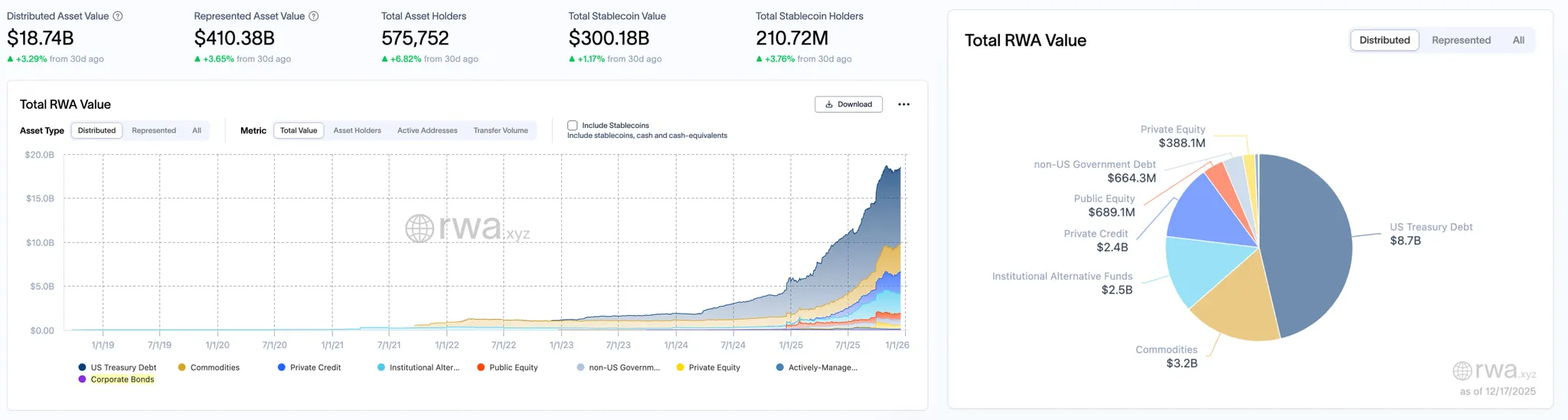
According to the rwa.xyz data panel, as of December 17, 2025, the total on-chain value of RWA (Distributed Asset Value) was $18.74 billion, an increase of $300 million from $18.44 billion on December 9, a rise of approximately 1.63%, ending a multi-day period of sideways movement and indicating a gradual recovery in on-chain asset activity. The broad Represented Asset Value increased from $391.66 billion to $410.38 billion, a weekly surge of 4.92%, the largest single-week increase in nearly two months, potentially related to the recovery of off-chain asset valuations. The total number of asset holders also continued its upward trend, rising from 561,558 to 575,752, a net increase of over 14,000 in one week, a growth rate of 2.52%. The stablecoin market was relatively stable, with the total market capitalization slightly decreasing from $3.0192 trillion to $3.0018 trillion, but still remaining high. The number of users grew from 207.75 million to 210.72 million, an increase of nearly 3 million, a growth rate of 1.42%.

In terms of asset structure, U.S. Treasury bonds remain the largest component of on-chain distributed assets, but saw a marginal decline this week, slightly decreasing from $8.8 billion to $8.7 billion, indicating a cooling off in the U.S. bond frenzy. Meanwhile, commodity assets remained stable, growing slightly from $3.1 billion to $3.2 billion, maintaining an upward trend for the third consecutive week and gradually showing potential as an emerging safe-haven asset. Private credit did not continue its previous rebound this week, with the scale only marginally increasing from $2.2 billion to $2.4 billion, maintaining a neutral stance. Institutional alternative funds remained unchanged at $2.5 billion, indicating a more cautious allocation of funds.

Among other segmented assets, public equity continued to rise, increasing from last week's $671.7 million to $689.1 million, performing relatively prominently among equity assets. Non-U.S. government debt also saw a slight synchronous increase, rising from $637.2 million to $664.3 million, but its scale is still less than 1/10th that of U.S. Treasuries. Private equity decreased from $391.6 million to $381 million this week, a slight numerical reduction.

Trend Analysis (Compared to Last Week)

The keywords for the RWA sector this week are "Valuation Repair + User Growth". The overall on-chain asset value recovered, and the scale of representative assets increased significantly, indicating that the repricing of off-chain assets may be driving the overall RWA valuation center upward. Structurally, the correction in U.S. Treasuries may be releasing some highly liquid funds, diverting them to the commodity and public equity sectors, forming new risk preference indicators. The growth in the stablecoin user base is particularly crucial, as off-market funds continue to enter the market, creating a "reservoir" for subsequent on-chain asset growth.

Market Keywords: Structural Optimization, Valuation Recovery, User Base Expansion.
Key Event Review

U.S. Congress Urges SEC to Allow Bitcoin and Other Cryptocurrencies into 401(k) Retirement Plans

The U.S. Congress is urging the U.S. Securities and Exchange Commission (SEC) to approve the inclusion of Bitcoin and other cryptocurrencies in 401(k) retirement plans. Members of the House Financial Services Committee sent a letter to SEC Chairman Paul Atkins urging him to update securities rules so that digital assets can be treated as an investment category equivalent to other alternative investments in retirement accounts. The letter stated that Americans saving for retirement deserve more investment choices, and current rules are outdated and overly restrictive, preventing millions of people from accessing new asset classes. Additionally, the letter emphasized the need to redefine the "accredited investor" standard. Current strict investor qualification rules limit participation in some private and alternative investment markets.

BNB Chain: A New Stablecoin to Be Launched

BNB Chain posted on platform X that a new stablecoin will be launched based on BNB Chain, aiming to integrate liquidity across various application scenarios and built for mass adoption.

According to community speculation, the project might be United Stables, with more details expected to be announced on December 18.

U.S. Crypto Market Structure Bill Negotiations Continue, Possibly Delayed Until Next January

Negotiations in the U.S. Senate on the crypto market structure bill may be delayed until next January for substantial progress due to several unresolved分歧点 (divergence points). The legislative text has been privately circulated among industry insiders, and industry executives briefly reviewed the current draft at a White House meeting on Thursday, chaired by U.S. President Donald Trump's crypto advisor Patrick Witt. The negotiations involve four parties: Senate Democrats, Republicans, the White House, and the crypto industry, with four major分歧点 still needing resolution. These分歧点 include ethical guidelines for government officials' involvement in digital assets, particularly the participation of U.S. President Donald Trump, whether stablecoins should be yield-bearing, and the jurisdiction of the U.S. Securities and Exchange Commission (SEC) over tokens and the handling of decentralized finance (DeFi). Patrick Witt posted on platform X that the White House and Senate Republicans are "aligned on the need to protect software developers and DeFi." Despite the分歧点, the intensity and pace of negotiations remain high. Digital Chamber CEO Cody Carbone stated that there is a genuine desire and momentum from all sides to complete the legislation, expecting practical progress early next year.

U.S. SEC Issues Crypto Asset Custody Guidance, Systematically Outlining Wallet Types and Main Risks

The U.S. Securities and Exchange Commission (SEC) issued guidance for investors on crypto wallets and asset custody on Friday local time, systematically outlining the advantages and risks of different crypto asset storage methods. The guidance compares self-custody and third-party custody models and reminds investors that when choosing third-party custody, they should focus on understanding whether the custodian engages in asset rehypothecation, whether customer assets are commingled, and other situations. The SEC also introduced the main differences between hot wallets and cold wallets: hot wallets, being connected to the internet, face higher risks of hacking and network security; cold wallets, while reducing the risk of online attacks, can lead to permanent loss of assets if the storage device is damaged, stolen, or the private key is lost. Market participants believe this guidance shows a significant shift in the SEC's regulatory attitude towards the crypto industry. The day before, SEC Chairman Paul Atkins stated that the traditional financial system is accelerating its migration on-chain, and the SEC has also approved DTCC to begin tokenization exploration for assets such as stocks, ETFs, and government bonds.

South Korea's Financial Services Commission Fails to Submit Won Stablecoin Regulatory Bill on Time

The ruling party in South Korea had previously called on ministries and the Financial Services Commission (FSC) to submit a Won stablecoin regulatory bill by December 10, but the FSC failed to meet the deadline. A spokesperson for the agency stated that the FSC needs more time to coordinate positions with relevant agencies, and rather than rushing to meet the stipulated deadline, it would announce its proposal while submitting the bill to the National Assembly.

Nasdaq Plans to Extend Stock and ETP Trading Hours to 23 Hours

Nasdaq has filed a document with the U.S. Securities and Exchange Commission (SEC) planning to extend the trading hours for stocks and exchange-traded products (ETPs) from 16 hours per day to 23 hours per day, five days a week. This move aims to meet the growing demand from global investors for extended trading hours in the U.S. stock market and to match the new investor expectations formed by the 24/7 trading cryptocurrency market. According to the proposal, Nasdaq's new trading hours will include: Day Session: 4:00 AM to 8:00 PM ET; One-hour break: 8:00 PM to 9:00 PM (for maintenance, testing, and trade settlement); Night Session: 9:00 PM to 4:00 AM the next day. The entire trading week will run from 9:00 PM Sunday to 8:00 PM Friday. The opening and closing times of the existing regular trading session (9:30 AM to 4:00 PM) remain unchanged. Nasdaq stated in the document that this move is to compete for order flow from foreign investors in different time zones like Asia and investors active in the crypto digital asset market. This will make stocks listed on Nasdaq, such as Coinbase (COIN), Robinhood (HOOD), and Strategy (MSTR), as well as many Bitcoin mining company stocks, more convenient for global traders.

U.S. SEC Allows DTCC to Custody and Recognize Tokenized Stocks and Other RWA Assets on Blockchain

The U.S. Securities and Exchange Commission (SEC) granted permission to the Depository Trust & Clearing Corporation (DTCC) in the form of a no-action letter, allowing the company to custody and recognize tokenized stocks and other real-world assets (RWA) on the blockchain. This allows DTCC to provide tokenization services on pre-approved blockchains for a three-year pilot period. SEC Commissioner Hester Peirce stated in a statement: "Although the project is still in its pilot phase and subject to various operational limitations, it marks an important step forward in the market's migration on-chain." Michael Winnike, Global Head of Strategy & Market Solutions at DTCC's Clearing & Securities Services division, said in an interview that after obtaining permission, DTCC will also extend its record-keeping work to the blockchain. DTCC, as the core clearing and settlement center of the U.S. financial system, plays a crucial role in the stock and fixed income product fields. Many liquid assets in the U.S. market are custodied at DTCC's depository unit—Depository Trust Co. The company expects to launch new tokenization services in the second half of next year.

Trump Family Crypto Project WLFI Plans to Deploy USD1 Stablecoin on Canton Network

Canton Network announced that the Trump family's crypto project, World Liberty Financial (WLFI), will deploy its USD1 stablecoin on its network, aiming to expand the coverage of USD1 in the institutional on-chain finance field and accelerate its adoption among globally regulated market participants, including collateral for derivatives and institutional loans, instant cross-border payments and 24/7 settlement, on-chain asset issuance, financing, and redemption.

U.S. SEC Chairman: DTC Participants Can Transfer Tokenized Securities to Other Participants' Registered Wallets

U.S. Securities and Exchange Commission (SEC) Chairman Paul Atkins posted on platform X, stating that the U.S. financial market is about to transition on-chain and will prioritize innovation and actively adopt new technologies. The SEC has issued a no-action letter to the Depository Trust & Clearing Corporation (DTC). The on-chain market will bring higher predictability, transparency, and efficiency to investors. Now DTC participants can directly transfer tokenized securities to other participants' registered wallets, and these transactions will be tracked by DTC's official records.

Trump Family Crypto Project WLFI Plans to Deploy USD1 Stablecoin on Canton Network

Canton Network announced that the Trump family's crypto project, World Liberty Financial (WLFI), will deploy its USD1 stablecoin on its network, aiming to expand the coverage of USD1 in the institutional on-chain finance field and accelerate its adoption among globally regulated market participants, including collateral for derivatives and institutional loans, instant cross-border payments and 24/7 settlement, on-chain asset issuance, financing, and redemption.

Visa Opens USDC Settlement Services to U.S. Banks via Solana

Visa has begun allowing U.S. banks and payment partners to use the USD-backed stablecoin USDC for transaction settlement within the United States.

Cross River Bank and Lead Bank are the first institutions to use Visa's USDC settlement service via the Solana blockchain. Visa plans to promote the service more widely in 2026.

Visa stated that this move aims to provide participating banks with faster fund transfers and a seven-day settlement window, without changing the consumer card experience. As of November 2025, the company's annualized stablecoin settlement volume run rate has exceeded $3.5 billion.

Hot Project Dynamics

Ondo Finance (ONDO)

One-Sentence Introduction:

Ondo Finance is a decentralized finance protocol focused on structured financial products and the tokenization of real-world assets. Its goal is to provide users with fixed-income products, such as tokenized U.S. Treasury bonds or other financial instruments, through blockchain technology. Ondo Finance allows users to invest in low-risk, highly liquid assets while maintaining decentralized transparency and security. Its token, ONDO, is used for protocol governance and incentive mechanisms. The platform also supports cross-chain operations to expand its application scope in the DeFi ecosystem.

Latest Developments:

On December 15, Ondo Finance announced on platform X that its tokenized stock and ETF platform will launch on the Solana blockchain in early 2026, aiming to bring Wall Street liquidity to the internet capital market.

Previously, it was reported that the U.S. Securities and Exchange Commission (SEC) has ended its investigation into tokenized asset company Ondo Finance without recommending any charges.

This investigation began in October 2023, initiated by former SEC Chairman Gary Gensler, primarily reviewing whether Ondo complied with U.S. securities laws when tokenizing U.S. Treasury products and whether the ONDO token should be classified as a security. An Ondo spokesperson stated that the company received formal notice in late November that this two-year SEC investigation had concluded. Since the pro-crypto SEC Chairman Paul Atkins took office, the agency has ended most crypto-related investigations. Ondo stated that the resolution of the investigation clears obstacles for its expansion in the U.S. The company had previously registered as an investment adviser and acquired Oasis Pro Markets, an SEC-registered broker-dealer, ATS operator, and transfer agent. Ondo is scheduled to host its annual Ondo Summit in New York on February 3, where new tools and products for tokenizing real-world assets are expected to be announced.

MSX (STONKS)
One-Sentence Introduction:

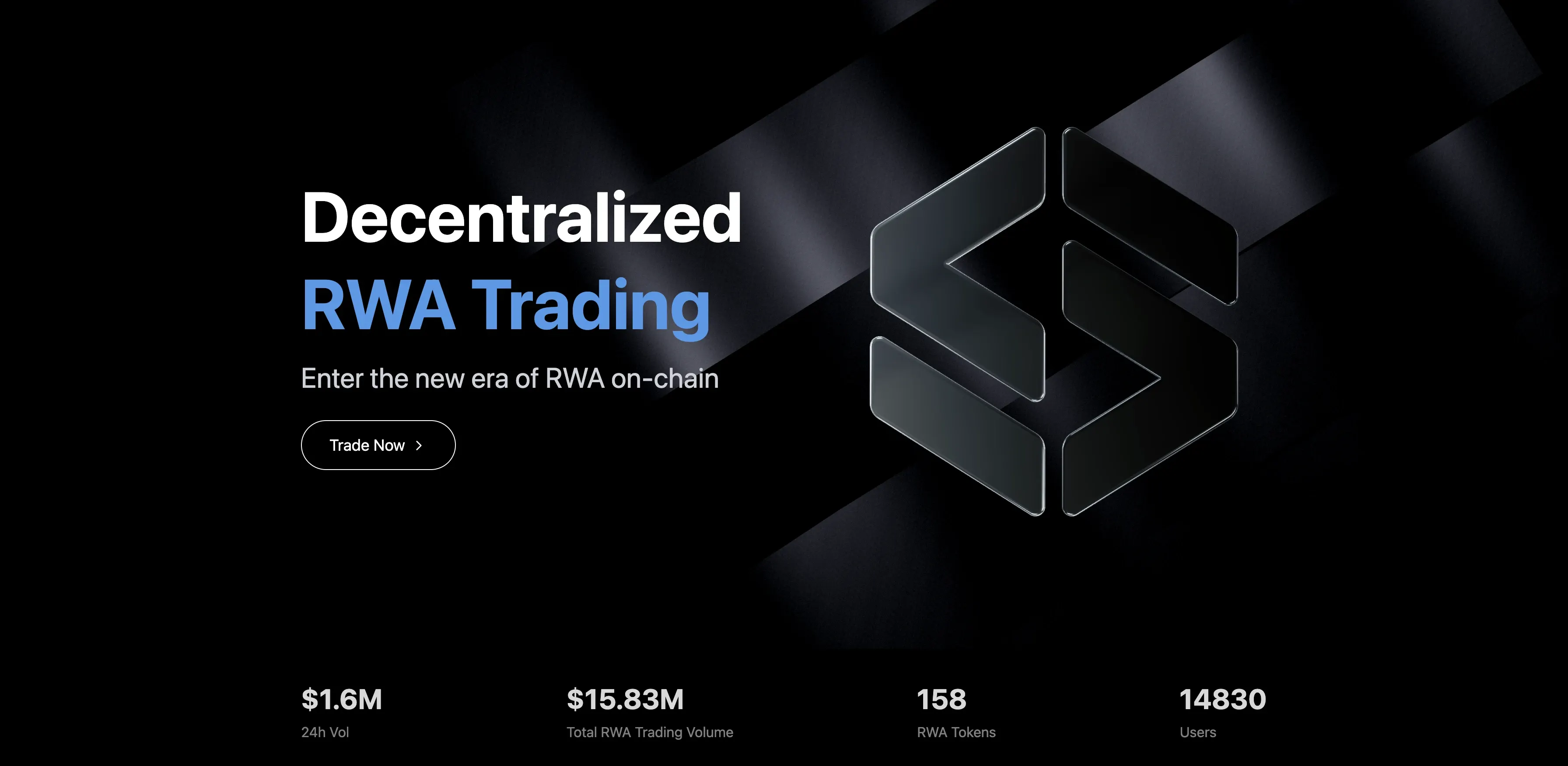
MSX is a community-driven DeFi platform focused on tokenizing U.S. stocks and other RWAs for on-chain trading. Through a partnership with Fidelity, the platform achieves 1:1 physical custody and token issuance. Users can use stablecoins like USDC, USDT, and USD1 to mint stock tokens such as AAPL.M and MSFT.M, and trade 24/7 on the Base blockchain. All trading, minting, and redemption processes are executed by smart contracts, ensuring transparency, security, and auditability. MyStonks is committed to bridging the gap between TradFi and DeFi, providing users with a high-liquidity, low-barrier entry to U.S. stock investment on-chain, building the "Nasdaq of the Crypto World".

Latest Developments:

On December 3, data from the MSX official website (msx.com) showed that the platform's trading volume reached $2 billion in the past 24 hours, setting a new all-time high for a single day. As of the time of writing, the total platform trading volume has exceeded $20.6 billion, surging by over $7.5 billion in the past 5 days, a cumulative increase of over 57%. Additionally, MSX ended its points season S1 on December 2. The M Credits (M Beans) earned by users will be directly used for future MSX token distribution.

On December 5, MSX founder Bruce posted on X that Nasdaq has submitted a stock token application, and MSX is prepared to convert to "official" tokens. He said: "Nasdaq submitted its stock token application to the SEC as early as September this year. If progress is fast, it will officially launch in Q1 next year. The launch of Nasdaq's stock tokens will impact all 'non-official stock tokens.' MSX is prepared to convert to 'official' tokens at any time."

Related Links

《RWA Weekly Report Series》

Curates the latest insights and market data on the RWA sector.

《5 Major L1 Public Chains Most Worth Watching in 2026: The Mainline Evolution from DeFi to RWA》

For investors, developers, and traders, helping to see which public chains are continuously gathering real activity, users, and long-term value.


Preguntas relacionadas

QWhat was the total Distributed Asset Value (DAV) of RWA on-chain as of December 17, 2025, and what was the weekly increase?

AThe total Distributed Asset Value (DAV) of RWA on-chain was $18.74 billion as of December 17, 2025, representing a weekly increase of approximately 1.63% from $18.44 billion on December 9.

QWhat significant action did the U.S. SEC take regarding crypto asset custody, and what key risks did it highlight for investors?

AThe U.S. SEC issued an investor guidance on crypto asset custody, systematically outlining the advantages and risks of different storage methods. It compared self-custody with third-party custody and warned investors to understand if a custodian engages in asset rehypothecation or commingles customer assets. It also highlighted that hot wallets face higher cybersecurity risks, while cold wallets risk permanent loss from device damage, theft, or lost private keys.

QWhich company received a no-action letter from the SEC to custody tokenized stocks and other RWA assets on a blockchain, and what is the significance of this move?

AThe Depository Trust & Clearing Corporation (DTCC) received a no-action letter from the SEC, permitting it to custody and recognize tokenized stocks and other real-world assets (RWA) on a pre-approved blockchain. This is a significant step marking the migration of traditional markets onto the blockchain, as DTCC is a core clearing and settlement hub for the U.S. financial system.

QWhat major announcement did Ondo Finance make regarding its platform, and what regulatory hurdle was recently cleared for the company?

AOndo Finance announced that its tokenized stock and ETF platform will launch on the Solana blockchain in early 2026. Additionally, the SEC recently concluded its investigation into the company without recommending any charges, which began in October 2023 to examine compliance with U.S. securities laws regarding its tokenized U.S. Treasury products and the classification of its ONDO token.

QWhat change did Nasdaq propose to the SEC regarding trading hours, and what was the stated reason for this proposal?

ANasdaq proposed to the SEC to extend the trading hours for stocks and exchange-traded products (ETPs) from 16 hours per day to 23 hours per day, five days a week. The stated reason was to meet the growing global demand for extended U.S. equity trading and to align with the new investor expectations set by the 24/7 cryptocurrency market, aiming to attract orders from foreign investors in different time zones and active crypto market participants.

Lecturas Relacionadas

Polymarket's "2028 Presidential Election" Volume King Is... LeBron James???

An article from Odaily Planet Daily, authored by Azuma, discusses a peculiar phenomenon observed on the prediction market platform Polymarket regarding the "2028 US Presidential Election" event. Despite having a real-time probability of less than 1%, unlikely candidates such as NBA star LeBron James (with $48.41 million in trading volume), celebrity Kim Kardashian ($33.84 million), and even ineligible figures like Elon Musk ($23.14 million) and New York City Mayor Zohran Mamdani ($18.39 million) account for approximately 70% of the total trading volume. In contrast, high-probability candidates like Vice President JD Vance ($10.58 million), California Governor Gavin Newsom ($15.71 million), and Secretary of State Marco Rubio ($9.32 million) have significantly lower trading activity. The article explains that this counterintuitive trend is not driven by irrational speculation but by rational strategies. Polymarket offers a 4% annualized holding reward for certain markets, including the 2028 election, to maintain long-term pricing accuracy. This yield exceeds the current 5-year US Treasury rate (3.98%), attracting large investors ("whales") to hold "NO" shares on low-probability candidates for risk-free returns. Additionally, some users utilize a platform feature that allows converting a set of "NO" shares into corresponding "YES" shares for better liquidity or pricing efficiency, rather than directly buying "YES" shares for their preferred candidates. Thus, the seemingly absurd trading activity is strategically motivated.

marsbitHace 1 hora(s)

Polymarket's "2028 Presidential Election" Volume King Is... LeBron James???

marsbitHace 1 hora(s)

Trading

Spot
Futuros

Artículos destacados

Qué es $S$

Entendiendo SPERO: Una Visión General Completa Introducción a SPERO A medida que el panorama de la innovación continúa evolucionando, la aparición de tecnologías web3 y proyectos de criptomonedas juega un papel fundamental en la configuración del futuro digital. Un proyecto que ha atraído la atención en este campo dinámico es SPERO, denotado como SPERO,$$s$. Este artículo tiene como objetivo reunir y presentar información detallada sobre SPERO, para ayudar a entusiastas e inversores a comprender sus fundamentos, objetivos e innovaciones dentro de los dominios web3 y cripto. ¿Qué es SPERO,$$s$? SPERO,$$s$ es un proyecto único dentro del espacio cripto que busca aprovechar los principios de descentralización y tecnología blockchain para crear un ecosistema que promueva la participación, la utilidad y la inclusión financiera. El proyecto está diseñado para facilitar interacciones de igual a igual de nuevas maneras, proporcionando a los usuarios soluciones y servicios financieros innovadores. En su esencia, SPERO,$$s$ tiene como objetivo empoderar a los individuos al proporcionar herramientas y plataformas que mejoren la experiencia del usuario en el espacio de las criptomonedas. Esto incluye habilitar métodos de transacción más flexibles, fomentar iniciativas impulsadas por la comunidad y crear caminos para oportunidades financieras a través de aplicaciones descentralizadas (dApps). La visión subyacente de SPERO,$$s$ gira en torno a la inclusividad, buscando cerrar brechas dentro de las finanzas tradicionales mientras aprovecha los beneficios de la tecnología blockchain. ¿Quién es el Creador de SPERO,$$s$? La identidad del creador de SPERO,$$s$ sigue siendo algo oscura, ya que hay recursos públicos limitados que proporcionan información de fondo detallada sobre su(s) fundador(es). Esta falta de transparencia puede derivarse del compromiso del proyecto con la descentralización, una ética que muchos proyectos web3 comparten, priorizando las contribuciones colectivas sobre el reconocimiento individual. Al centrar las discusiones en torno a la comunidad y sus objetivos colectivos, SPERO,$$s$ encarna la esencia del empoderamiento sin señalar a individuos específicos. Como tal, comprender la ética y la misión de SPERO sigue siendo más importante que identificar a un creador singular. ¿Quiénes son los Inversores de SPERO,$$s$? SPERO,$$s$ cuenta con el apoyo de una diversa gama de inversores que van desde capitalistas de riesgo hasta inversores ángeles dedicados a fomentar la innovación en el sector cripto. El enfoque de estos inversores generalmente se alinea con la misión de SPERO, priorizando proyectos que prometen avances tecnológicos sociales, inclusión financiera y gobernanza descentralizada. Estas fundaciones de inversores suelen estar interesadas en proyectos que no solo ofrecen productos innovadores, sino que también contribuyen positivamente a la comunidad blockchain y sus ecosistemas. El respaldo de estos inversores refuerza a SPERO,$$s$ como un contendiente notable en el dominio de proyectos cripto que evoluciona rápidamente. ¿Cómo Funciona SPERO,$$s$? SPERO,$$s$ emplea un marco multifacético que lo distingue de los proyectos de criptomonedas convencionales. Aquí hay algunas de las características clave que subrayan su singularidad e innovación: Gobernanza Descentralizada: SPERO,$$s$ integra modelos de gobernanza descentralizada, empoderando a los usuarios para participar activamente en los procesos de toma de decisiones sobre el futuro del proyecto. Este enfoque fomenta un sentido de propiedad y responsabilidad entre los miembros de la comunidad. Utilidad del Token: SPERO,$$s$ utiliza su propio token de criptomoneda, diseñado para servir diversas funciones dentro del ecosistema. Estos tokens permiten transacciones, recompensas y la facilitación de servicios ofrecidos en la plataforma, mejorando la participación y la utilidad general. Arquitectura en Capas: La arquitectura técnica de SPERO,$$s$ apoya la modularidad y escalabilidad, permitiendo la integración fluida de características y aplicaciones adicionales a medida que el proyecto evoluciona. Esta adaptabilidad es fundamental para mantener la relevancia en el cambiante paisaje cripto. Participación de la Comunidad: El proyecto enfatiza iniciativas impulsadas por la comunidad, empleando mecanismos que incentivan la colaboración y la retroalimentación. Al nutrir una comunidad sólida, SPERO,$$s$ puede abordar mejor las necesidades de los usuarios y adaptarse a las tendencias del mercado. Enfoque en la Inclusión: Al ofrecer tarifas de transacción bajas e interfaces amigables para el usuario, SPERO,$$s$ busca atraer a una base de usuarios diversa, incluyendo a individuos que anteriormente pueden no haber participado en el espacio cripto. Este compromiso con la inclusión se alinea con su misión general de empoderamiento a través de la accesibilidad. Cronología de SPERO,$$s$ Entender la historia de un proyecto proporciona información crucial sobre su trayectoria de desarrollo y hitos. A continuación se presenta una cronología sugerida que mapea eventos significativos en la evolución de SPERO,$$s$: Fase de Conceptualización e Ideación: Las ideas iniciales que forman la base de SPERO,$$s$ fueron concebidas, alineándose estrechamente con los principios de descentralización y enfoque comunitario dentro de la industria blockchain. Lanzamiento del Whitepaper del Proyecto: Tras la fase conceptual, se lanzó un whitepaper completo que detalla la visión, los objetivos y la infraestructura tecnológica de SPERO,$$s$ para generar interés y retroalimentación de la comunidad. Construcción de Comunidad y Primeras Interacciones: Se realizaron esfuerzos de divulgación activa para construir una comunidad de primeros adoptantes y posibles inversores, facilitando discusiones en torno a los objetivos del proyecto y obteniendo apoyo. Evento de Generación de Tokens: SPERO,$$s$ llevó a cabo un evento de generación de tokens (TGE) para distribuir sus tokens nativos a los primeros seguidores y establecer liquidez inicial dentro del ecosistema. Lanzamiento de la dApp Inicial: La primera aplicación descentralizada (dApp) asociada con SPERO,$$s$ se puso en marcha, permitiendo a los usuarios interactuar con las funcionalidades centrales de la plataforma. Desarrollo Continuo y Alianzas: Actualizaciones y mejoras continuas a las ofertas del proyecto, incluyendo alianzas estratégicas con otros actores en el espacio blockchain, han moldeado a SPERO,$$s$ en un jugador competitivo y en evolución en el mercado cripto. Conclusión SPERO,$$s$ se erige como un testimonio del potencial de web3 y las criptomonedas para revolucionar los sistemas financieros y empoderar a los individuos. Con un compromiso con la gobernanza descentralizada, la participación comunitaria y funcionalidades diseñadas de manera innovadora, allana el camino hacia un paisaje financiero más inclusivo. Como con cualquier inversión en el espacio cripto que evoluciona rápidamente, se anima a los posibles inversores y usuarios a investigar a fondo y participar de manera reflexiva con los desarrollos en curso dentro de SPERO,$$s$. El proyecto muestra el espíritu innovador de la industria cripto, invitando a una mayor exploración de sus innumerables posibilidades. Mientras el viaje de SPERO,$$s$ aún se desarrolla, sus principios fundamentales pueden, de hecho, influir en el futuro de cómo interactuamos con la tecnología, las finanzas y entre nosotros en ecosistemas digitales interconectados.

72 Vistas totalesPublicado en 2024.12.17Actualizado en 2024.12.17

Qué es $S$

Qué es AGENT S

Agent S: El Futuro de la Interacción Autónoma en Web3 Introducción En el paisaje en constante evolución de Web3 y las criptomonedas, las innovaciones están redefiniendo constantemente cómo los individuos interactúan con las plataformas digitales. Uno de estos proyectos pioneros, Agent S, promete revolucionar la interacción humano-computadora a través de su marco agente abierto. Al allanar el camino para interacciones autónomas, Agent S busca simplificar tareas complejas, ofreciendo aplicaciones transformadoras en inteligencia artificial (IA). Esta exploración detallada profundizará en las complejidades del proyecto, sus características únicas y las implicaciones para el dominio de las criptomonedas. ¿Qué es Agent S? Agent S se presenta como un marco agente abierto innovador, diseñado específicamente para abordar tres desafíos fundamentales en la automatización de tareas informáticas: Adquisición de Conocimiento Específico del Dominio: El marco aprende inteligentemente de diversas fuentes de conocimiento externas y experiencias internas. Este enfoque dual le permite construir un rico repositorio de conocimiento específico del dominio, mejorando su rendimiento en la ejecución de tareas. Planificación a Largo Plazo de Tareas: Agent S emplea planificación jerárquica aumentada por la experiencia, un enfoque estratégico que facilita la descomposición y ejecución eficiente de tareas complejas. Esta característica mejora significativamente su capacidad para gestionar múltiples subtareas de manera eficiente y efectiva. Manejo de Interfaces Dinámicas y No Uniformes: El proyecto introduce la Interfaz Agente-Computadora (ACI), una solución innovadora que mejora la interacción entre agentes y usuarios. Utilizando Modelos de Lenguaje Multimodal de Gran Escala (MLLMs), Agent S puede navegar y manipular diversas interfaces gráficas de usuario sin problemas. A través de estas características pioneras, Agent S proporciona un marco robusto que aborda las complejidades involucradas en la automatización de la interacción humana con las máquinas, preparando el terreno para una multitud de aplicaciones en IA y más allá. ¿Quién es el Creador de Agent S? Si bien el concepto de Agent S es fundamentalmente innovador, la información específica sobre su creador sigue siendo elusiva. El creador es actualmente desconocido, lo que resalta ya sea la etapa incipiente del proyecto o la elección estratégica de mantener a los miembros fundadores en el anonimato. Independientemente de la anonimidad, el enfoque sigue siendo en las capacidades y el potencial del marco. ¿Quiénes son los Inversores de Agent S? Dado que Agent S es relativamente nuevo en el ecosistema criptográfico, la información detallada sobre sus inversores y patrocinadores financieros no está documentada explícitamente. La falta de información disponible públicamente sobre las bases de inversión u organizaciones que apoyan el proyecto plantea preguntas sobre su estructura de financiamiento y hoja de ruta de desarrollo. Comprender el respaldo es crucial para evaluar la sostenibilidad del proyecto y su posible impacto en el mercado. ¿Cómo Funciona Agent S? En el núcleo de Agent S se encuentra una tecnología de vanguardia que le permite funcionar de manera efectiva en diversos entornos. Su modelo operativo se basa en varias características clave: Interacción Humano-Computadora Similar a la Humana: El marco ofrece planificación avanzada de IA, esforzándose por hacer que las interacciones con las computadoras sean más intuitivas. Al imitar el comportamiento humano en la ejecución de tareas, promete elevar las experiencias de los usuarios. Memoria Narrativa: Empleada para aprovechar experiencias de alto nivel, Agent S utiliza memoria narrativa para hacer un seguimiento de las historias de tareas, mejorando así sus procesos de toma de decisiones. Memoria Episódica: Esta característica proporciona a los usuarios una guía paso a paso, permitiendo que el marco ofrezca apoyo contextual a medida que se desarrollan las tareas. Soporte para OpenACI: Con la capacidad de ejecutarse localmente, Agent S permite a los usuarios mantener el control sobre sus interacciones y flujos de trabajo, alineándose con la ética descentralizada de Web3. Fácil Integración con APIs Externas: Su versatilidad y compatibilidad con varias plataformas de IA aseguran que Agent S pueda encajar sin problemas en ecosistemas tecnológicos existentes, convirtiéndolo en una opción atractiva para desarrolladores y organizaciones. Estas funcionalidades contribuyen colectivamente a la posición única de Agent S dentro del espacio cripto, ya que automatiza tareas complejas y de múltiples pasos con una intervención humana mínima. A medida que el proyecto evoluciona, sus posibles aplicaciones en Web3 podrían redefinir cómo se desarrollan las interacciones digitales. Cronología de Agent S El desarrollo y los hitos de Agent S pueden encapsularse en una cronología que resalta sus eventos significativos: 27 de septiembre de 2024: El concepto de Agent S fue lanzado en un documento de investigación integral titulado “Un Marco Agente Abierto que Usa Computadoras Como un Humano”, mostrando las bases del proyecto. 10 de octubre de 2024: El documento de investigación fue puesto a disposición del público en arXiv, ofreciendo una exploración profunda del marco y su evaluación de rendimiento basada en el benchmark OSWorld. 12 de octubre de 2024: Se lanzó una presentación en video, proporcionando una visión visual de las capacidades y características de Agent S, involucrando aún más a posibles usuarios e inversores. Estos marcadores en la cronología no solo ilustran el progreso de Agent S, sino que también indican su compromiso con la transparencia y la participación comunitaria. Puntos Clave Sobre Agent S A medida que el marco Agent S continúa evolucionando, varios atributos clave destacan, subrayando su naturaleza innovadora y potencial: Marco Innovador: Diseñado para proporcionar un uso intuitivo de las computadoras similar a la interacción humana, Agent S aporta un enfoque novedoso a la automatización de tareas. Interacción Autónoma: La capacidad de interactuar de manera autónoma con las computadoras a través de GUI significa un salto hacia soluciones informáticas más inteligentes y eficientes. Automatización de Tareas Complejas: Con su metodología robusta, puede automatizar tareas complejas y de múltiples pasos, haciendo que los procesos sean más rápidos y menos propensos a errores. Mejora Continua: Los mecanismos de aprendizaje permiten a Agent S mejorar a partir de experiencias pasadas, mejorando continuamente su rendimiento y eficacia. Versatilidad: Su adaptabilidad en diferentes entornos operativos como OSWorld y WindowsAgentArena asegura que pueda servir a una amplia gama de aplicaciones. A medida que Agent S se posiciona en el paisaje de Web3 y criptomonedas, su potencial para mejorar las capacidades de interacción y automatizar procesos significa un avance significativo en las tecnologías de IA. A través de su marco innovador, Agent S ejemplifica el futuro de las interacciones digitales, prometiendo una experiencia más fluida y eficiente para los usuarios en diversas industrias. Conclusión Agent S representa un audaz avance en la unión de la IA y Web3, con la capacidad de redefinir cómo interactuamos con la tecnología. Aunque aún se encuentra en sus primeras etapas, las posibilidades para su aplicación son vastas y atractivas. A través de su marco integral que aborda desafíos críticos, Agent S busca llevar las interacciones autónomas al primer plano de la experiencia digital. A medida que nos adentramos más en los reinos de las criptomonedas y la descentralización, proyectos como Agent S sin duda desempeñarán un papel crucial en la configuración del futuro de la tecnología y la colaboración humano-computadora.

337 Vistas totalesPublicado en 2025.01.14Actualizado en 2025.01.14

Qué es AGENT S

Cómo comprar S

¡Bienvenido a HTX.com! Hemos hecho que comprar Sonic (S) sea simple y conveniente. Sigue nuestra guía paso a paso para iniciar tu viaje de criptos.Paso 1: crea tu cuenta HTXUtiliza tu correo electrónico o número de teléfono para registrarte y obtener una cuenta gratuita en HTX. Experimenta un proceso de registro sin complicaciones y desbloquea todas las funciones.Obtener mi cuentaPaso 2: ve a Comprar cripto y elige tu método de pagoTarjeta de crédito/débito: usa tu Visa o Mastercard para comprar Sonic (S) al instante.Saldo: utiliza fondos del saldo de tu cuenta HTX para tradear sin problemas.Terceros: hemos agregado métodos de pago populares como Google Pay y Apple Pay para mejorar la comodidad.P2P: tradear directamente con otros usuarios en HTX.Over-the-Counter (OTC): ofrecemos servicios personalizados y tipos de cambio competitivos para los traders.Paso 3: guarda tu Sonic (S)Después de comprar tu Sonic (S), guárdalo en tu cuenta HTX. Alternativamente, puedes enviarlo a otro lugar mediante transferencia blockchain o utilizarlo para tradear otras criptomonedas.Paso 4: tradear Sonic (S)Tradear fácilmente con Sonic (S) en HTX's mercado spot. Simplemente accede a tu cuenta, selecciona tu par de trading, ejecuta tus trades y monitorea en tiempo real. Ofrecemos una experiencia fácil de usar tanto para principiantes como para traders experimentados.

712 Vistas totalesPublicado en 2025.01.15Actualizado en 2025.03.21

Cómo comprar S

Discusiones

Bienvenido a la comunidad de HTX. Aquí puedes mantenerte informado sobre los últimos desarrollos de la plataforma y acceder a análisis profesionales del mercado. A continuación se presentan las opiniones de los usuarios sobre el precio de S (S).

活动图片