RWA Weekly Report|Data: Approximately 50% of Euro Stablecoins Deployed on Ethereum; Potential Policy Adjustments as Trump Prepares for Next November's Midterm Elections May Again Impact Digital Assets (12.18-12.23)

Odaily星球日报Publicado a 2025-12-23Actualizado a 2025-12-23

Resumen

RWA Weekly Report: Data shows approximately 50% of euro-denominated stablecoins are deployed on Ethereum; potential policy shifts as Trump prepares for midterm elections may impact digital asset markets (Dec 18–23, 2025). The on-chain value of Real World Assets (RWA) grew 1.65% to $19.05 billion, while the broader RWA market contracted slightly to $402.57 billion. User adoption continued to rise, with RWA holders increasing to 582,639 and stablecoin holders reaching 212.54 million. U.S. Treasury bonds remained the core asset at $8.7 billion, while commodities and private equity saw notable growth. Key developments include the SEC issuing new guidance for crypto asset custody and ATS operations, Hong Kong proposing new rules for insurer investments in crypto assets, and U.S. lawmakers discussing tax exemptions for small stablecoin transactions. Data from Token Terminal indicates about half of all euro stablecoins are on Ethereum. Political focus remains on potential policy adjustments by Trump ahead of the 2026 midterm elections, which could affect digital asset markets. Projects like Ondo Finance and MSX (STONKS) are advancing tokenized traditional assets, with Ondo expanding to Solana and MSX preparing for Nasdaq’s potential entry into tokenized stocks. Ghana legalized cryptocurrency trading and is exploring gold-backed stablecoins, reflecting global regulatory evolution. Stablecoin supply reached $300 billion in 2025, with significant transaction volume driving growth i...

Original | Odaily Planet Daily (@OdailyChina)

Author | Ethan(@ethanzhang_web3)
RWA Sector Market Performance

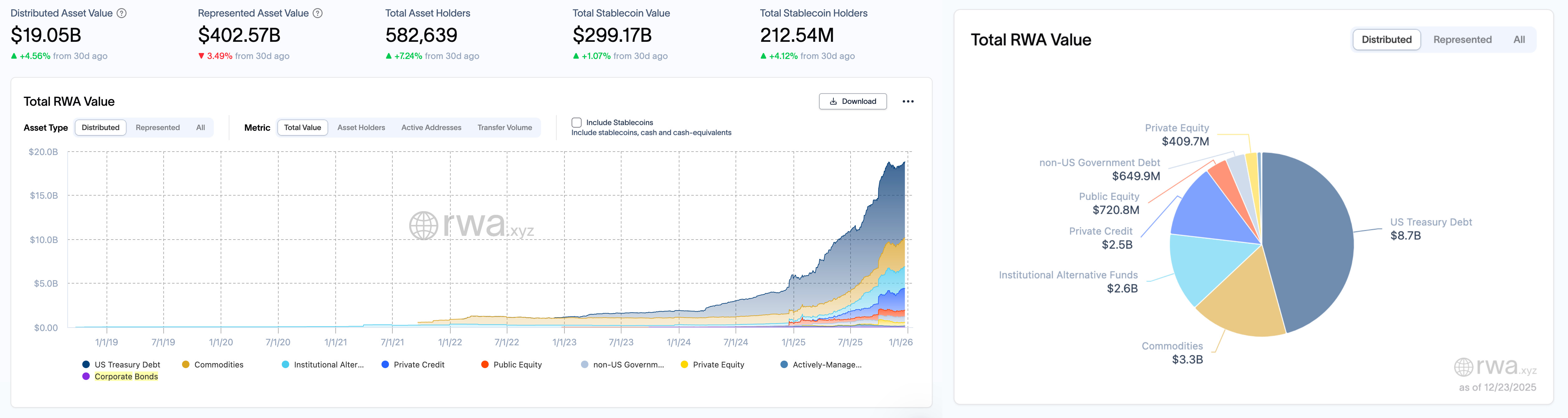
According to the rwa.xyz data dashboard, as of December 23, 2025, the total on-chain value (Distributed Asset Value) of RWA continued its moderate growth trend this week, increasing from $187.4 billion on December 17 to $190.5 billion, a rise of approximately $3.1 billion, representing a weekly gain of 1.65%. The broader RWA market size contracted slightly, falling from $410.38 billion to $402.57 billion, a decrease of $7.81 billion, or 1.9%. The total number of asset holders on the user side increased from 575,752 to 582,639, adding 6,887 new users in a single week, a sequential growth of 1.2%. Meanwhile, the stablecoin user base continued to expand, with the number of holders climbing from 210.72 million to 212.54 million, an increase of about 1.82 million people, or 0.86%. The total market capitalization of stablecoins saw a slight pullback, decreasing from $300.18 billion to $299.17 billion. Although it declined slightly (by about $101 million), the drop was minimal, and the market remained relatively steady overall.

In terms of asset structure, US Treasury bonds remain the core anchor of the RWA sector, with their on-chain scale holding steady at $8.7 billion. Commodity assets saw an uptick, rising from $3.22 billion to $3.33 billion, a gain of $110 million, contributing the most incremental growth this week. The institutional alternative fund sector also experienced a slight increase, moving from $2.5 billion to $2.6 billion, indicating a trend of capital reallocation into stable, non-traditional assets. Private equity recorded significant growth, jumping from $381 million to $410 million, an increase of $29 million. Non-US government debt saw a slight correction, decreasing modestly from $664.3 million to $649.9 million, a drop of 2.2%. However, public equity quietly grew, increasing from $689.1 million to $720.8 million. Private credit remained stable, edging up by $10 million to $2.5 billion, continuing its sideways trend after stabilizing previously.

Trend Analysis (Compared to Last Week)

Overall, the total volume of on-chain RWA assets showed steady growth this week, while the broader traditional representative assets experienced some fluctuations. User numbers continued to grow, indicating a gradual strengthening of real activity in the on-chain RWA market. Assets with medium risk appetites, such as commodities, private equity, and institutional alternative funds, began to attract more capital allocation, suggesting that some market participants are releasing liquidity from low-risk instruments like US Treasuries and转而 seeking higher marginal returns. Furthermore, the continued climb in stablecoin holders remains a key variable driving potential capital inflows in the future.

Market Keywords: Stable with upward momentum, structural shift, user activity.
Key Event Recap

Potential Policy Adjustments as Trump Prepares for Next November's Midterm Elections May Again Impact Digital Assets

Caixin published its "2026 New Year Special Review and Outlook," which pointed out that the "Trump Trade" took effect in 2025, with gold and virtual currencies shining. In March, an executive order was signed to include approximately 210,000 Bitcoin held by the federal government into the national strategic reserve. Various transactions based on stablecoins and digital currencies saw significant implementation in 2025, and listed companies transforming into treasury companies专门囤积 digital currencies sparked speculation. However, the seizure of $15 billion in Bitcoin from the Chen Zhi telecom fraud group by the US brought transaction security issues into sharp focus, and Bitcoin fell from its historical highs by year-end. Moving into 2026, as Trump begins preparing for the November midterm elections, which areas his policies will adjust in response to feedback, and how this will impact the performance of various major asset classes, becomes a theme requiring持续关注 in 2026.

US SEC Issues Guidance on Broker Crypto Asset Custody and Crypto ATS Operations

The U.S. Securities and Exchange Commission (SEC) this week issued a new staff statement through its Division of Trading and Markets, providing operational guidance for regulated broker-dealers custodying client crypto assets, and simultaneously released a FAQ document regarding crypto alternative trading systems (ATS).

Regarding custody, the SEC stated that as long as broker-dealers follow the informal standards proposed in the statement, including properly safeguarding client private keys and预先 considering scenarios like blockchain failures, 51% attacks, hard forks, or airdrops, the regulatory层面 will not take enforcement action. This guidance applies to crypto securities including tokenized stocks and debt securities, but related definitions仍需进一步明确.

Additionally, the SEC highlighted key regulatory focuses for the trading and settlement activities of crypto ATSs. SEC Crypto Assets and Cyber Unit Chief, Commissioner Hester Peirce, stated that trading platforms and market participants need to operate under clear market structure rules to promote a fair and orderly market environment without adding unnecessary burdens.

Bloomberg: Hong Kong Plans to Introduce New Rules for Insurer Investments in Crypto Assets and Infrastructure

The Hong Kong Insurance Authority (IA) has proposed new rules aimed at guiding insurance funds into crypto assets and infrastructure sectors. According to a presentation document dated December 4, the regulator plans to impose a 100% risk capital requirement on crypto assets, while the risk capital requirement for stablecoin investments will be determined based on the fiat currency to which the Hong Kong-regulated stablecoin is pegged.

The Hong Kong IA stated that it initiated a review of the risk-based capital制度 this year, with the primary goal of supporting the insurance industry and broader economic development. The proposal is expected to undergo public consultation from February to April next year, before being submitted to the legislature. Furthermore, the new rules involve incentives for infrastructure investment, proposing capital benefits for investments in infrastructure projects in Hong Kong, mainland China, or Hong Kong-linked projects (such as the development of new towns like the Northern Metropolis), to support the SAR government's local infrastructure construction plans. As of 2024, the total premium income of Hong Kong's insurance industry was approximately HK$635 billion.

US Lawmakers Propose Tax Breaks for Small Stablecoin Payments and Staking Rewards

US lawmakers have introduced a discussion draft that would ease the tax burden on ordinary cryptocurrency users by exempting small stablecoin transactions from capital gains tax, including a $200 tax exemption for stablecoin payments, and providing new deferral options for staking and mining rewards. According to the draft, if a stablecoin is issued by an issuer permitted under the GENIUS Act, is pegged to the US dollar, and its trading price remains within a narrow range around $1, users would not need to recognize gains or losses on transactions not exceeding $200.

Data: Approximately 50% of Euro Stablecoins Deployed on Ethereum

According to Token Terminal data, approximately 50% of the market capitalization of Tokenized Euro (Euro stablecoins) is deployed on the Ethereum chain, with the remainder distributed across multiple chains including Arbitrum, Polygon, Base, and Solana.

Grayscale: 2025 Stablecoin Supply Reached $300 Billion, Monthly Average Trading Volume $1.1 Trillion, Multiple Token Projects to Benefit

Grayscale posted on X platform, stating that stablecoins experienced explosive growth in 2025, with supply reaching $300 billion and monthly average trading volume reaching $1.1 trillion. With the passage of the GENIUS Act (Stablecoin Genius Act) and increased stablecoin adoption, blockchain projects like ETH, TRX, BNB, and SOL will benefit from the growing transaction flow. Infrastructure like Chainlink (LINK) and emerging networks like XPL will also benefit.

Gemini: Urges US Congress to Maintain the Genius Act As Is

Gemini posted on X platform, stating that Gemini, along with over 125 companies and organizations, has co-signed a letter urging the US Congress to maintain the Genius Act as is. Gemini stated that legitimate stablecoin rewards benefit consumers and competition, and are already legally permitted. Amending the Genius Act at this time would harm certainty and innovation.

Stablecoin U Officially Launches: Live on BNB Chain and Ethereum, Integrated with Mainstream DeFi Protocols like PancakeSwap, ListaDAO, and Listed on Centralized Exchange HTX

United Stables announced the official launch of the USD stablecoin U, currently deployed on both BNB Smart Chain (BSC) and Ethereum (ETH), with multiple ecosystem integrations completed. It is reported that the U stablecoin is backed 1:1 by full reserves (USD + major stablecoins), features real-time on-chain proof-of-reserve (PoR), monthly audits, and will support enterprise-grade privacy protection and AI-native payments (EIP-3009/x402) in the future. U is the first "unified stablecoin" on BNB Chain, integrating mainstream stablecoins as usable collateral assets to form a unified liquidity base layer.

Ecosystem Integration: U has been integrated into mainstream DeFi protocols including PancakeSwap, Aster, Four.meme, and ListaDAO, allowing users to directly trade, stake, lend, and provide liquidity on-chain. Wallet Support: Binance Wallet, Trust Wallet, and SafePal have simultaneously listed U. Beyond the on-chain world, U is also listed on the centralized exchange HTX.

United Stables stated that U will focus on empowering scenarios such as trading, DeFi, institutional settlement, cross-border payments, and the AI autonomous economy, and plans to expand to more public chains, DeFi protocols, and trading platforms in the future.

WLFI Releases Governance Proposal: Proposes Using Part of Unlocked Treasury Funds to Incentivize USD1 Adoption

WLFI released a governance update announcement stating that a new community governance proposal is open for voting, proposing the use of part of the unlocked WLFI treasury funds as incentives to drive the adoption and growth of the stablecoin USD1.

The announcement showed that in the past three weeks, WLFI has used USD1 to repurchase approximately $10 million worth of WLFI tokens and successfully obtained multiple spot trading pair supports on Binance. Meanwhile, the usage scale of USD1 in CeFi and DeFi scenarios has grown significantly, and the WLFI token unlock schedule is also steadily progressing and nearing finalization.

The proposal aims to延续 the current growth momentum, further expanding the integration, use cases, and number of partners for USD1 through incentive mechanisms, thereby enhancing the overall level of economic activity within the WLFI ecosystem. The announcement pointed out that the growth of USD1 will directly drive the expansion of the WLFI ecosystem and benefit the entire community.

Ghana Passes New Bill Legalizing Cryptocurrency Trading, Plans to Explore Gold-Backed Stablecoins

The Ghanaian parliament has voted to pass the Virtual Asset Service Provider Bill, formally legalizing cryptocurrency trading and related digital asset activities. The bill stipulates that individuals and entities engaged in digital asset activities must register with the Bank of Ghana or the Securities and Exchange Commission based on the nature of their business.

Bank of Ghana Governor Johnson Asiama stated in a speech that the bill lays the foundation for the licensing and supervision of industry participants, ensuring that emerging activities are brought into a transparent and regulated framework. Johnson Asiama explicitly stated that after the bill is passed, no one will be arrested for trading cryptocurrencies. Additionally, Ghana plans to conduct specialized explorations in 2026 focusing on payments, trade finance, and market infrastructure, including researching asset-backed digital settlement instruments like gold-backed stablecoins. According to estimates by Web3 Africa Group, Ghana processed approximately $3 billion in cryptocurrency transactions between July 2023 and June 2024.

Bankless Founder's 2026 Predictions: Focus on Tokenization, ICO Return, and Quantum Challenges

Bankless founder David Hoffman released his market predictions for 2026, stating: He believes 2026 will be the first year of asset tokenization, with traditional financial giants like BlackRock fully embracing blockchain technology; as the environment improves, ICOs will return to the market in a more mature form; the DeFi ecosystem will accelerate its expansion, with stablecoin neo-banks有望 developing into financial super-apps; robot-related tokens may see speculative price frenzies; meanwhile, the potential threat of quantum computing to cryptocurrency security will gradually attract industry attention.

Hot Project Dynamics

Ondo Finance (ONDO)

One-Sentence Introduction:

Ondo Finance is a decentralized finance protocol focused on structured financial products and the tokenization of real-world assets. Its goal is to provide users with fixed-income products, such as tokenized US Treasury bonds or other financial instruments, through blockchain technology. Ondo Finance allows users to invest in low-risk, highly liquid assets while maintaining decentralized transparency and security. Its token, ONDO, is used for protocol governance and incentive mechanisms, and the platform also supports cross-chain operations to expand its application within the DeFi ecosystem.

Latest Developments:

On December 15, Ondo Finance announced on the X platform that its tokenized stocks and ETF platform will launch on the Solana blockchain in early 2026, aiming to bring Wall Street liquidity to the internet capital market.

Previously, it was reported that the U.S. Securities and Exchange Commission (SEC) has concluded its investigation into tokenized asset company Ondo Finance without recommending any charges.

This investigation began in October 2023, initiated by former SEC Chairman Gary Gensler, primarily examining whether Ondo complied with US securities laws when tokenizing US Treasury products and whether the ONDO token should be classified as a security. An Ondo spokesperson stated that the company received formal notice in late November that this two-year SEC investigation had concluded. Since the pro-cryptocurrency SEC Chairman Paul Atkins took office, the agency has closed most cryptocurrency-related investigations. Ondo stated that the resolution of the investigation clears obstacles for its expansion in the US. The company had previously registered as an investment adviser and acquired Oasis Pro Markets, an SEC-registered broker-dealer, ATS operator, and transfer agent. Ondo is scheduled to host its annual Ondo Summit in New York on February 3, where new tools and products for tokenizing real-world assets are expected to be announced.

MSX(STONKS)
One-Sentence Introduction:

MSX is a community-driven DeFi platform focused on tokenizing US stocks and other RWAs for on-chain trading. Through a partnership with Fidelity, the platform achieves 1:1 physical custody and token issuance. Users can use stablecoins like USDC, USDT, and USD1 to mint stock tokens such as AAPL.M and MSFT.M, and trade them 24/7 on the Base blockchain. All trading, minting, and redemption processes are executed by smart contracts, ensuring transparency, security, and auditability. MyStonks is committed to bridging the gap between TradFi and DeFi, providing users with a high-liquidity, low-barrier entry to on-chain US stock investment, building the "Nasdaq of the crypto world".

Latest Developments:

On December 22, MSX founder Bruce posted, stating that recent BTC selling pressure has encountered resistance, marginal selling has dried up, and there is actual capital absorbing筹码 below, not emotional buying, and he holds a bullish view on this.

Previously, Bruce posted on X that Nasdaq has submitted a stock token application, and MSX is prepared to convert into "official" tokens. He said: "Nasdaq submitted a stock token application to the SEC as early as September this year. If progress is fast, it will officially launch in Q1 next year. The launch of Nasdaq's stock tokens will impact all 'non-official stock tokens.' MSX is prepared to convert into 'official' tokens at any time."

Related Links

《RWA Weekly Report Series》

Curates the latest insights and market data on the RWA sector.

《5 Major L1 Public Chains Most Worth Watching in 2026: The Main Evolution from DeFi to RWA》

For investors, developers, and traders, helping to see which public chains are continuously gathering real activity, users, and long-term value.

《After 13 Ministries and 7 Associations Issued a Document to Prevent Virtual Currency Risks, Where is the Path for RWA?》

Article: Our advice is: If you want to engage in RWA, please first sever all ties with domestic RMB, ordinary retail investors, and promotional channels. In front of the red line, living long is more important than running fast. The red line of the law is never meant for jumping rope.

Preguntas relacionadas

QWhat percentage of Euro stablecoins are deployed on the Ethereum blockchain according to the article?

AApproximately 50% of Euro stablecoins are deployed on the Ethereum blockchain.

QHow did the RWA sector's on-chain total value (Distributed Asset Value) change during the week of December 18-23, 2025?

AThe RWA on-chain total value increased from $187.4 billion to $190.5 billion, a weekly gain of $3.1 billion or 1.65%.

QWhat potential impact could former President Trump's policy adjustments have on digital assets, as mentioned in the article?

AAs Trump prepares for the midterm elections in November 2026, his policy adjustments could once again influence the performance of various major asset classes, including digital currencies.

QWhat new regulations did the Hong Kong Insurance Authority propose regarding crypto assets?

AThe Hong Kong Insurance Authority proposed new rules to guide insurance funds into crypto assets and infrastructure, including a 100% risk capital requirement for crypto assets and a risk-based capital requirement for stablecoins tied to the fiat currency they are pegged to.

QWhat is the core focus of the asset tokenization platform Ondo Finance?

AOndo Finance is a decentralized finance protocol focused on structured financial products and the tokenization of real-world assets (RWA), aiming to provide users with fixed-income products like tokenized U.S. Treasuries through blockchain technology.

Lecturas Relacionadas

The AI Agent Era Accelerates Its Arrival: Questflow Defines a New Paradigm of Financial Intelligence with On-Chain AI Brokerage

The AI Agent era is accelerating, with the CB Insights AI 100 list highlighting global investment confidence. The focus has shifted from whether AI works to its speed of deployment and ability to manage complex workflows, with autonomous AI Agents driving this transformation. At the forefront is Questflow, a Singapore-based startup redefining financial intelligence through its on-chain AI brokerage. Unlike tools that merely provide data dashboards, Questflow deploys AI Agents that proactively scan markets, form judgments, and execute trades via a conversational interface—operating 24/7 without requiring manual confirmation for each decision. This embodies the new AI paradigm of agents capable of executing multi-step workflows autonomously. Questflow's mission is to democratize institutional-grade trading intelligence. Historically reserved for the ultra-wealthy, this capability is now accessible starting from just $1 through Questflow's "AI Clone + Copy Trade" model. The platform charges only a 1% execution fee, aligning its incentives directly with users and eliminating traditional management or performance fees. The timing is opportune, aligning with key trends identified by CB Insights: the scalable deployment of AI Agents, accelerated AI adoption in financial services, and the maturation of on-chain infrastructure. With robust liquidity on platforms like Hyperliquid and Polymarket, alongside advancements in AI reasoning and non-custodial wallet security, Questflow is positioned to merge the roles of broker, fund, and exchange into a single, accessible platform for millions.

链捕手Hace 16 min(s)

The AI Agent Era Accelerates Its Arrival: Questflow Defines a New Paradigm of Financial Intelligence with On-Chain AI Brokerage

链捕手Hace 16 min(s)

Why Pricing Social Interactions is Doomed to Fail?

Titled "Why Putting a Price on Social Interaction Is Doomed to Fail," this article critiques attempts to monetize social networks directly through SocialFi models, arguing their inevitable failure stems from a fundamental misunderstanding of media dynamics. Using Marshall McLuhan's theory of "hot" and "cold" media, the author posits that social networks are inherently "cold" media. Their value isn't contained in individual posts but is co-created through user participation, interpretation, and fragmented, ongoing interaction (e.g., replies, shares). This ambiguity and need for user involvement are core to their function. The article asserts that SocialFi projects like Friend.tech failed because introducing real-time, tradable financial pricing (a definitive "hot" signal) into this "cold" environment doesn't add a layer—it replaces the medium's essence. The unambiguous price signal overshadows and nullifies the nuanced, participatory social signal. Users become traders, not participants, and when speculative profits vanish, the underlying social ecosystem—never genuinely cultivated—collapses entirely. This principle extends beyond crypto. The author argues platforms like Twitter have gradually "heated up" through metrics (likes, retweets counts, algorithmically defined value), shifting users from participants to performers and eroding organic engagement. The solution isn't to abandon capital but to manage its entry point. Successful models like Substack, Patreon, or Bandcamp allow capital to "condense" at specific, isolated nodes (e.g., subscriptions, one-time payments) without permeating and "heating" every social interaction. They preserve the core "cold," participatory medium while enabling monetization at designated boundaries. The NFT boom and bust serves as a stark parallel: the ancient "cold" medium of collecting (valued for story, community, gradual accumulation) was rapidly destroyed by platforms that introduced real-time floor prices, rarity scores, and trading dashboards, transforming collectors into speculators and vaporizing cultural value when prices fell. The core lesson: "Liquidity equals heat." Injecting high liquidity and definitive pricing into a "cold" participatory medium doesn't optimize it; it fundamentally alters and destroys its value-creating mechanism. The future lies not in pricing every social gesture but in finding precise, non-invasive points for capital to condense without overheating the entire ecosystem.

marsbitHace 24 min(s)

Why Pricing Social Interactions is Doomed to Fail?

marsbitHace 24 min(s)

Jensen Huang's CMU Speech: In the AI Era, Don't Just Watch, Build

Jensen Huang, CEO of NVIDIA and a first-generation immigrant, delivered the commencement address to Carnegie Mellon University's class of 2026. He shared his personal journey from a humble background to founding NVIDIA, emphasizing resilience, learning from failure, and the responsibility that comes with leadership. Huang framed the present moment as the dawn of the AI revolution, a shift he believes is more profound than previous computing waves. He described AI as fundamentally resetting computing—moving from human-written software to machines that understand, reason, and use tools. This will create a new industry for generating intelligence and transform every sector. While acknowledging AI's potential to automate tasks and displace some jobs, Huang distinguished between the *tasks* of a job and its core *purpose*. He argued AI will augment human capability, not replace humans. The real risk, he stated, is not AI itself, but people being left behind by those who effectively use AI. He presented AI as a generational opportunity for massive infrastructure investment—in chip factories, data centers, energy grids, and advanced manufacturing—that could re-industrialize nations like the U.S. and bridge the digital divide by making computing and intelligent tools accessible to all. Huang called for a balanced approach: advancing AI safely and responsibly, establishing prudent policies, ensuring broad access, and encouraging universal participation. He urged the graduates not to fear the future but to engage with optimism and ambition, reminding them of CMU's motto, "My heart is in the work." His core message was clear: this is their moment to actively build and shape the AI-powered future, not merely observe it.

marsbitHace 1 hora(s)

Jensen Huang's CMU Speech: In the AI Era, Don't Just Watch, Build

marsbitHace 1 hora(s)

Trading

Spot
Futuros

Artículos destacados

Qué es $S$

Entendiendo SPERO: Una Visión General Completa Introducción a SPERO A medida que el panorama de la innovación continúa evolucionando, la aparición de tecnologías web3 y proyectos de criptomonedas juega un papel fundamental en la configuración del futuro digital. Un proyecto que ha atraído la atención en este campo dinámico es SPERO, denotado como SPERO,$$s$. Este artículo tiene como objetivo reunir y presentar información detallada sobre SPERO, para ayudar a entusiastas e inversores a comprender sus fundamentos, objetivos e innovaciones dentro de los dominios web3 y cripto. ¿Qué es SPERO,$$s$? SPERO,$$s$ es un proyecto único dentro del espacio cripto que busca aprovechar los principios de descentralización y tecnología blockchain para crear un ecosistema que promueva la participación, la utilidad y la inclusión financiera. El proyecto está diseñado para facilitar interacciones de igual a igual de nuevas maneras, proporcionando a los usuarios soluciones y servicios financieros innovadores. En su esencia, SPERO,$$s$ tiene como objetivo empoderar a los individuos al proporcionar herramientas y plataformas que mejoren la experiencia del usuario en el espacio de las criptomonedas. Esto incluye habilitar métodos de transacción más flexibles, fomentar iniciativas impulsadas por la comunidad y crear caminos para oportunidades financieras a través de aplicaciones descentralizadas (dApps). La visión subyacente de SPERO,$$s$ gira en torno a la inclusividad, buscando cerrar brechas dentro de las finanzas tradicionales mientras aprovecha los beneficios de la tecnología blockchain. ¿Quién es el Creador de SPERO,$$s$? La identidad del creador de SPERO,$$s$ sigue siendo algo oscura, ya que hay recursos públicos limitados que proporcionan información de fondo detallada sobre su(s) fundador(es). Esta falta de transparencia puede derivarse del compromiso del proyecto con la descentralización, una ética que muchos proyectos web3 comparten, priorizando las contribuciones colectivas sobre el reconocimiento individual. Al centrar las discusiones en torno a la comunidad y sus objetivos colectivos, SPERO,$$s$ encarna la esencia del empoderamiento sin señalar a individuos específicos. Como tal, comprender la ética y la misión de SPERO sigue siendo más importante que identificar a un creador singular. ¿Quiénes son los Inversores de SPERO,$$s$? SPERO,$$s$ cuenta con el apoyo de una diversa gama de inversores que van desde capitalistas de riesgo hasta inversores ángeles dedicados a fomentar la innovación en el sector cripto. El enfoque de estos inversores generalmente se alinea con la misión de SPERO, priorizando proyectos que prometen avances tecnológicos sociales, inclusión financiera y gobernanza descentralizada. Estas fundaciones de inversores suelen estar interesadas en proyectos que no solo ofrecen productos innovadores, sino que también contribuyen positivamente a la comunidad blockchain y sus ecosistemas. El respaldo de estos inversores refuerza a SPERO,$$s$ como un contendiente notable en el dominio de proyectos cripto que evoluciona rápidamente. ¿Cómo Funciona SPERO,$$s$? SPERO,$$s$ emplea un marco multifacético que lo distingue de los proyectos de criptomonedas convencionales. Aquí hay algunas de las características clave que subrayan su singularidad e innovación: Gobernanza Descentralizada: SPERO,$$s$ integra modelos de gobernanza descentralizada, empoderando a los usuarios para participar activamente en los procesos de toma de decisiones sobre el futuro del proyecto. Este enfoque fomenta un sentido de propiedad y responsabilidad entre los miembros de la comunidad. Utilidad del Token: SPERO,$$s$ utiliza su propio token de criptomoneda, diseñado para servir diversas funciones dentro del ecosistema. Estos tokens permiten transacciones, recompensas y la facilitación de servicios ofrecidos en la plataforma, mejorando la participación y la utilidad general. Arquitectura en Capas: La arquitectura técnica de SPERO,$$s$ apoya la modularidad y escalabilidad, permitiendo la integración fluida de características y aplicaciones adicionales a medida que el proyecto evoluciona. Esta adaptabilidad es fundamental para mantener la relevancia en el cambiante paisaje cripto. Participación de la Comunidad: El proyecto enfatiza iniciativas impulsadas por la comunidad, empleando mecanismos que incentivan la colaboración y la retroalimentación. Al nutrir una comunidad sólida, SPERO,$$s$ puede abordar mejor las necesidades de los usuarios y adaptarse a las tendencias del mercado. Enfoque en la Inclusión: Al ofrecer tarifas de transacción bajas e interfaces amigables para el usuario, SPERO,$$s$ busca atraer a una base de usuarios diversa, incluyendo a individuos que anteriormente pueden no haber participado en el espacio cripto. Este compromiso con la inclusión se alinea con su misión general de empoderamiento a través de la accesibilidad. Cronología de SPERO,$$s$ Entender la historia de un proyecto proporciona información crucial sobre su trayectoria de desarrollo y hitos. A continuación se presenta una cronología sugerida que mapea eventos significativos en la evolución de SPERO,$$s$: Fase de Conceptualización e Ideación: Las ideas iniciales que forman la base de SPERO,$$s$ fueron concebidas, alineándose estrechamente con los principios de descentralización y enfoque comunitario dentro de la industria blockchain. Lanzamiento del Whitepaper del Proyecto: Tras la fase conceptual, se lanzó un whitepaper completo que detalla la visión, los objetivos y la infraestructura tecnológica de SPERO,$$s$ para generar interés y retroalimentación de la comunidad. Construcción de Comunidad y Primeras Interacciones: Se realizaron esfuerzos de divulgación activa para construir una comunidad de primeros adoptantes y posibles inversores, facilitando discusiones en torno a los objetivos del proyecto y obteniendo apoyo. Evento de Generación de Tokens: SPERO,$$s$ llevó a cabo un evento de generación de tokens (TGE) para distribuir sus tokens nativos a los primeros seguidores y establecer liquidez inicial dentro del ecosistema. Lanzamiento de la dApp Inicial: La primera aplicación descentralizada (dApp) asociada con SPERO,$$s$ se puso en marcha, permitiendo a los usuarios interactuar con las funcionalidades centrales de la plataforma. Desarrollo Continuo y Alianzas: Actualizaciones y mejoras continuas a las ofertas del proyecto, incluyendo alianzas estratégicas con otros actores en el espacio blockchain, han moldeado a SPERO,$$s$ en un jugador competitivo y en evolución en el mercado cripto. Conclusión SPERO,$$s$ se erige como un testimonio del potencial de web3 y las criptomonedas para revolucionar los sistemas financieros y empoderar a los individuos. Con un compromiso con la gobernanza descentralizada, la participación comunitaria y funcionalidades diseñadas de manera innovadora, allana el camino hacia un paisaje financiero más inclusivo. Como con cualquier inversión en el espacio cripto que evoluciona rápidamente, se anima a los posibles inversores y usuarios a investigar a fondo y participar de manera reflexiva con los desarrollos en curso dentro de SPERO,$$s$. El proyecto muestra el espíritu innovador de la industria cripto, invitando a una mayor exploración de sus innumerables posibilidades. Mientras el viaje de SPERO,$$s$ aún se desarrolla, sus principios fundamentales pueden, de hecho, influir en el futuro de cómo interactuamos con la tecnología, las finanzas y entre nosotros en ecosistemas digitales interconectados.

72 Vistas totalesPublicado en 2024.12.17Actualizado en 2024.12.17

Qué es $S$

Qué es AGENT S

Agent S: El Futuro de la Interacción Autónoma en Web3 Introducción En el paisaje en constante evolución de Web3 y las criptomonedas, las innovaciones están redefiniendo constantemente cómo los individuos interactúan con las plataformas digitales. Uno de estos proyectos pioneros, Agent S, promete revolucionar la interacción humano-computadora a través de su marco agente abierto. Al allanar el camino para interacciones autónomas, Agent S busca simplificar tareas complejas, ofreciendo aplicaciones transformadoras en inteligencia artificial (IA). Esta exploración detallada profundizará en las complejidades del proyecto, sus características únicas y las implicaciones para el dominio de las criptomonedas. ¿Qué es Agent S? Agent S se presenta como un marco agente abierto innovador, diseñado específicamente para abordar tres desafíos fundamentales en la automatización de tareas informáticas: Adquisición de Conocimiento Específico del Dominio: El marco aprende inteligentemente de diversas fuentes de conocimiento externas y experiencias internas. Este enfoque dual le permite construir un rico repositorio de conocimiento específico del dominio, mejorando su rendimiento en la ejecución de tareas. Planificación a Largo Plazo de Tareas: Agent S emplea planificación jerárquica aumentada por la experiencia, un enfoque estratégico que facilita la descomposición y ejecución eficiente de tareas complejas. Esta característica mejora significativamente su capacidad para gestionar múltiples subtareas de manera eficiente y efectiva. Manejo de Interfaces Dinámicas y No Uniformes: El proyecto introduce la Interfaz Agente-Computadora (ACI), una solución innovadora que mejora la interacción entre agentes y usuarios. Utilizando Modelos de Lenguaje Multimodal de Gran Escala (MLLMs), Agent S puede navegar y manipular diversas interfaces gráficas de usuario sin problemas. A través de estas características pioneras, Agent S proporciona un marco robusto que aborda las complejidades involucradas en la automatización de la interacción humana con las máquinas, preparando el terreno para una multitud de aplicaciones en IA y más allá. ¿Quién es el Creador de Agent S? Si bien el concepto de Agent S es fundamentalmente innovador, la información específica sobre su creador sigue siendo elusiva. El creador es actualmente desconocido, lo que resalta ya sea la etapa incipiente del proyecto o la elección estratégica de mantener a los miembros fundadores en el anonimato. Independientemente de la anonimidad, el enfoque sigue siendo en las capacidades y el potencial del marco. ¿Quiénes son los Inversores de Agent S? Dado que Agent S es relativamente nuevo en el ecosistema criptográfico, la información detallada sobre sus inversores y patrocinadores financieros no está documentada explícitamente. La falta de información disponible públicamente sobre las bases de inversión u organizaciones que apoyan el proyecto plantea preguntas sobre su estructura de financiamiento y hoja de ruta de desarrollo. Comprender el respaldo es crucial para evaluar la sostenibilidad del proyecto y su posible impacto en el mercado. ¿Cómo Funciona Agent S? En el núcleo de Agent S se encuentra una tecnología de vanguardia que le permite funcionar de manera efectiva en diversos entornos. Su modelo operativo se basa en varias características clave: Interacción Humano-Computadora Similar a la Humana: El marco ofrece planificación avanzada de IA, esforzándose por hacer que las interacciones con las computadoras sean más intuitivas. Al imitar el comportamiento humano en la ejecución de tareas, promete elevar las experiencias de los usuarios. Memoria Narrativa: Empleada para aprovechar experiencias de alto nivel, Agent S utiliza memoria narrativa para hacer un seguimiento de las historias de tareas, mejorando así sus procesos de toma de decisiones. Memoria Episódica: Esta característica proporciona a los usuarios una guía paso a paso, permitiendo que el marco ofrezca apoyo contextual a medida que se desarrollan las tareas. Soporte para OpenACI: Con la capacidad de ejecutarse localmente, Agent S permite a los usuarios mantener el control sobre sus interacciones y flujos de trabajo, alineándose con la ética descentralizada de Web3. Fácil Integración con APIs Externas: Su versatilidad y compatibilidad con varias plataformas de IA aseguran que Agent S pueda encajar sin problemas en ecosistemas tecnológicos existentes, convirtiéndolo en una opción atractiva para desarrolladores y organizaciones. Estas funcionalidades contribuyen colectivamente a la posición única de Agent S dentro del espacio cripto, ya que automatiza tareas complejas y de múltiples pasos con una intervención humana mínima. A medida que el proyecto evoluciona, sus posibles aplicaciones en Web3 podrían redefinir cómo se desarrollan las interacciones digitales. Cronología de Agent S El desarrollo y los hitos de Agent S pueden encapsularse en una cronología que resalta sus eventos significativos: 27 de septiembre de 2024: El concepto de Agent S fue lanzado en un documento de investigación integral titulado “Un Marco Agente Abierto que Usa Computadoras Como un Humano”, mostrando las bases del proyecto. 10 de octubre de 2024: El documento de investigación fue puesto a disposición del público en arXiv, ofreciendo una exploración profunda del marco y su evaluación de rendimiento basada en el benchmark OSWorld. 12 de octubre de 2024: Se lanzó una presentación en video, proporcionando una visión visual de las capacidades y características de Agent S, involucrando aún más a posibles usuarios e inversores. Estos marcadores en la cronología no solo ilustran el progreso de Agent S, sino que también indican su compromiso con la transparencia y la participación comunitaria. Puntos Clave Sobre Agent S A medida que el marco Agent S continúa evolucionando, varios atributos clave destacan, subrayando su naturaleza innovadora y potencial: Marco Innovador: Diseñado para proporcionar un uso intuitivo de las computadoras similar a la interacción humana, Agent S aporta un enfoque novedoso a la automatización de tareas. Interacción Autónoma: La capacidad de interactuar de manera autónoma con las computadoras a través de GUI significa un salto hacia soluciones informáticas más inteligentes y eficientes. Automatización de Tareas Complejas: Con su metodología robusta, puede automatizar tareas complejas y de múltiples pasos, haciendo que los procesos sean más rápidos y menos propensos a errores. Mejora Continua: Los mecanismos de aprendizaje permiten a Agent S mejorar a partir de experiencias pasadas, mejorando continuamente su rendimiento y eficacia. Versatilidad: Su adaptabilidad en diferentes entornos operativos como OSWorld y WindowsAgentArena asegura que pueda servir a una amplia gama de aplicaciones. A medida que Agent S se posiciona en el paisaje de Web3 y criptomonedas, su potencial para mejorar las capacidades de interacción y automatizar procesos significa un avance significativo en las tecnologías de IA. A través de su marco innovador, Agent S ejemplifica el futuro de las interacciones digitales, prometiendo una experiencia más fluida y eficiente para los usuarios en diversas industrias. Conclusión Agent S representa un audaz avance en la unión de la IA y Web3, con la capacidad de redefinir cómo interactuamos con la tecnología. Aunque aún se encuentra en sus primeras etapas, las posibilidades para su aplicación son vastas y atractivas. A través de su marco integral que aborda desafíos críticos, Agent S busca llevar las interacciones autónomas al primer plano de la experiencia digital. A medida que nos adentramos más en los reinos de las criptomonedas y la descentralización, proyectos como Agent S sin duda desempeñarán un papel crucial en la configuración del futuro de la tecnología y la colaboración humano-computadora.

429 Vistas totalesPublicado en 2025.01.14Actualizado en 2025.01.14

Qué es AGENT S

Cómo comprar S

¡Bienvenido a HTX.com! Hemos hecho que comprar Sonic (S) sea simple y conveniente. Sigue nuestra guía paso a paso para iniciar tu viaje de criptos.Paso 1: crea tu cuenta HTXUtiliza tu correo electrónico o número de teléfono para registrarte y obtener una cuenta gratuita en HTX. Experimenta un proceso de registro sin complicaciones y desbloquea todas las funciones.Obtener mi cuentaPaso 2: ve a Comprar cripto y elige tu método de pagoTarjeta de crédito/débito: usa tu Visa o Mastercard para comprar Sonic (S) al instante.Saldo: utiliza fondos del saldo de tu cuenta HTX para tradear sin problemas.Terceros: hemos agregado métodos de pago populares como Google Pay y Apple Pay para mejorar la comodidad.P2P: tradear directamente con otros usuarios en HTX.Over-the-Counter (OTC): ofrecemos servicios personalizados y tipos de cambio competitivos para los traders.Paso 3: guarda tu Sonic (S)Después de comprar tu Sonic (S), guárdalo en tu cuenta HTX. Alternativamente, puedes enviarlo a otro lugar mediante transferencia blockchain o utilizarlo para tradear otras criptomonedas.Paso 4: tradear Sonic (S)Tradear fácilmente con Sonic (S) en HTX's mercado spot. Simplemente accede a tu cuenta, selecciona tu par de trading, ejecuta tus trades y monitorea en tiempo real. Ofrecemos una experiencia fácil de usar tanto para principiantes como para traders experimentados.

847 Vistas totalesPublicado en 2025.01.15Actualizado en 2025.03.21

Cómo comprar S

Discusiones

Bienvenido a la comunidad de HTX. Aquí puedes mantenerte informado sobre los últimos desarrollos de la plataforma y acceder a análisis profesionales del mercado. A continuación se presentan las opiniones de los usuarios sobre el precio de S (S).

活动图片