Data: DeFi Stablecoin Interest Rates Hit Lowest Level Since June 2023
Blockworks posted on X platform, stating that stablecoin interest rates in DeFi have dropped to their lowest level since June 2023.
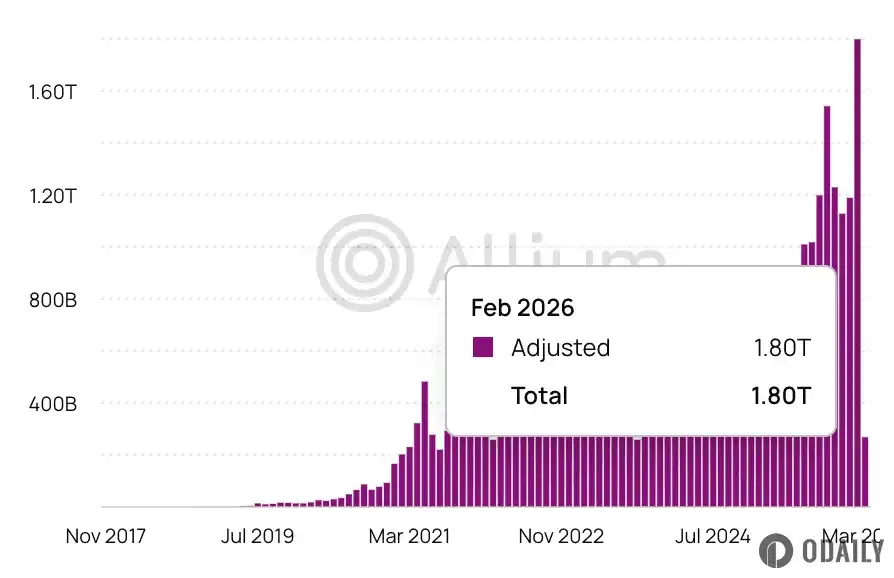
Data: Stablecoin Transaction Count Reached 1.8 Trillion in February, Hitting a New All-Time High; USDC Accounts for ~70% of Transactions, ~2x USDT's Volume
According to data from the Allium website, the number of stablecoin transactions reached 1.8 trillion in February, setting a new monthly record; among them, USDC transactions accounted for approximately 70% of the total data, about 1.26 trillion transactions, which is roughly twice the number of USDT transactions, the latter being about 514 billion.
Florida State Senate Unanimously Passes Stablecoin Regulatory Bill, Establishes State-Level Framework for Payment Stablecoins
The Florida State Senate passed Senate Bill 314 on Thursday with 37 votes in favor and 0 against, paving the way for establishing a regulatory framework for issuing payment stablecoins in the state. The bill, along with its companion House Bill 175, will be submitted to Governor Ron DeSantis for signature within the next 30 days. It is reported that the bill prohibits payment stablecoin issuers from paying any form of interest to holders, provided that "federal law prohibits such payments." A companion bill, CS/CS/SB 1440, was passed on the same day, expanding confidentiality protections for information from virtual currency businesses, qualified payment stablecoin issuers, and other institutions to protect trade secrets and non-public information.
Hong Kong SFC Chief Executive: Market Infrastructure Must Be Thoroughly Upgraded, Integrating Tokenization-Related Innovation Projects
Julia Leung, Chief Executive of the Hong Kong Securities and Futures Commission (SFC), delivered a keynote speech at the 2026 ASIFMA EU-Asia Financial Services Dialogue event. She stated that Hong Kong must thoroughly upgrade its market infrastructure, particularly in the fractionalization, clearing, and settlement of financial products. Distributed Ledger Technology (DLT) and tokenization developments offer a way forward. The true value of tokenization lies in its programmable nature, which supports a wide range of investment products, including bonds, funds, and even gold. As the tokenization ecosystem continues to grow, it is essential to effectively integrate related innovation projects, seamlessly combining market confidence in traditional finance with the efficiency of decentralized finance to further unlock liquidity. Leung revealed that the SFC has co-led a working group under the Asia-Pacific Regional Committee with the Australian Securities and Investments Commission (ASIC) to combat online scams and is participating in standard-setting and coordination work with global peers in areas such as digital assets.
South Korean Financial Authorities Plan to Prohibit Corporate Investment in Stablecoins
The South Korean Financial Services Commission is drafting "Corporate Virtual Currency Transaction Guidelines," and the permitted investment scope will not include stablecoins. These guidelines aim to allow listed corporations and registered professional investment corporations to trade digital assets for investment or financial purposes. To prevent disorderly investment in the early market stages, the authorities have decided to exclude dollar stablecoins like USDT and USDC from the permitted scope.
One reason for excluding stablecoins is that current South Korean foreign exchange laws do not recognize stablecoins as a means of external payment. Including stablecoins in the permitted investment scope would conflict with the existing legal system, effectively allowing companies to use stablecoins for trade and other commercial purposes. The South Korean National Assembly is currently reviewing an amendment to the Foreign Exchange Transactions Act, proposed last October, which aims to recognize stablecoins as a payment means.
It is reported that some listed companies with a high proportion of trade had requested the inclusion of stablecoins in the permitted scope to use them for foreign exchange hedging. Even if excluded from the guidelines, companies can still trade stablecoins through personal wallets or overseas exchanges. Industry insiders revealed that the relevant working group has completed its tasks, but the release of the guidelines is tied to the legislative process of the Digital Asset Basic Act.
Russian Ministry of Finance Plans to Introduce Stablecoin Bill, Citing "Huge Potential"
Russian Ministry of Finance officials stated they are considering introducing a separate stablecoin bill, rather than including stablecoins in the upcoming crypto exchange regulations. Alexey Yakovlev, Head of the Financial Policy Department at the Ministry, stated that stablecoins have "huge, even extremely huge potential."
Russia has already viewed stablecoins as a potential tool to circumvent sanctions. Yakovlev said that after the State Duma passes a bill prohibiting citizens from trading crypto assets on platforms without operating licenses, they will proceed with stablecoin regulation. This crypto bill is expected to be submitted to the State Duma during the spring session and could take effect as early as July.
Currently, stablecoins have no legal status in Russian law, and the Ministry of Finance expressed a desire to resolve this issue quickly. Yakovlev stated that the government wants to ensure stablecoins "serve economic interests, especially domestic ones." Previously, the Russian Central Bank established a category for "foreign digital rights," with the first approved stablecoin being the ruble-pegged A7A5 stablecoin, permitted for overseas trade last October. According to DefiLlama data, the total value of issued stablecoins has increased by over 51% since early 2025, reaching $311 billion.
BlackRock's $26 Billion Private Credit Fund Restricts Redemptions, Market Worries About Spillover to Bitcoin and DeFi
BlackRock, the asset management giant, has begun restricting withdrawals from one of its private credit funds, valued at approximately $26 billion, due to rising redemption requests. This has sparked concerns about spillover effects from stress in the global private credit market. Analysts warn that risks could also be transmitted directly on-chain. Data shows the current on-chain private credit scale is nearly $5 billion, primarily entering DeFi in the form of RWA tokenization. If the underlying credit assets face impairment or default, net value fluctuations of related tokens could trigger liquidations or liquidity tightening, thereby transmitting traditional credit stress to the DeFi ecosystem. Furthermore, tensions in this sector could affect the crypto market through two channels: macro deleveraging and tokenized credit products. If private credit funds are forced to deleverage or liquidate assets, it could trigger a chain reaction in broader risk assets and impact crypto assets, including Bitcoin.
Stablecoin Payment Company KAST Raises $80 Million, Valuation ~$600 Million
Stablecoin payment company KAST has completed an $80 million funding round co-led by QED Investors and Left Lane Capital. The funds will be used for expansion in North America, Latin America, and the Middle East, as well as for hiring, license applications, and product development. The new round values the company at approximately $600 million. Insiders said the terms of this round were finalized in October, and the company's annualized revenue is expected to rise to $100 million this year.
Bloomberg Analyst: Equity Tokenization Will Not Replace ETFs, But Will Democratize Access for Investors
Eric Balchunas, Senior ETF Analyst at Bloomberg, posted on the X platform, stating that Nasdaq's launch of an equity tokenization framework aims to allow stocks like Nvidia and Tesla to trade as traditional stocks while also supporting blockchain token forms. This initiative will build a bridge between traditional stock markets and blockchain investors, diversifying stock trading methods. Equity tokenization will not replace ETFs but will distribute them on-chain, providing participation opportunities for global investors, especially in less developed countries and regions. Bringing the world's most popular ETFs and stocks on-chain is a positive development for the market.
Hot Project Dynamics
Ondo Finance (ONDO)

One-Sentence Introduction:
Ondo Finance is a decentralized finance protocol focused on structured financial products and the tokenization of real-world assets. Its goal is to provide users with fixed-income products, such as tokenized U.S. Treasuries or other financial instruments, through blockchain technology. Ondo Finance allows users to invest in low-risk, highly liquid assets while maintaining decentralized transparency and security. Its token, ONDO, is used for protocol governance and incentive mechanisms. The platform also supports cross-chain operations to expand its application within the DeFi ecosystem.
Latest Developments:
On March 9, according to an official announcement, Binance Wallet launched an Ondo tokenized securities trading competition on Binance Alpha. Event period: March 9, 2026, 18:00 to March 23, 2026, 18:00 (UTC+8). During the event, the top 20,000 users by trading volume of Ondo tokenized securities on Binance Alpha will share equally in rewards equivalent to $500,000 worth of IAUon.
Previously, Ondo Finance posted on the X platform, stating that Ondo's tokenized stock DeFi application, supported by Chainlink as the official data oracle, is now live. Institutional-grade priced assets like QQQon and TSLAon have unlocked on-chain stocks as high-quality collateral. With TradFi liquidity and oracle data, Ondo's tokenized U.S. stocks can now support on-chain lending and structured products. The first projects launched are Euler Finance vaults, with risk management by Sentora and security provided by Chainlink. This marks the first time tokenized stocks are used as collateral in Ethereum DeFi.
MSX (STONKS)
One-Sentence Introduction:
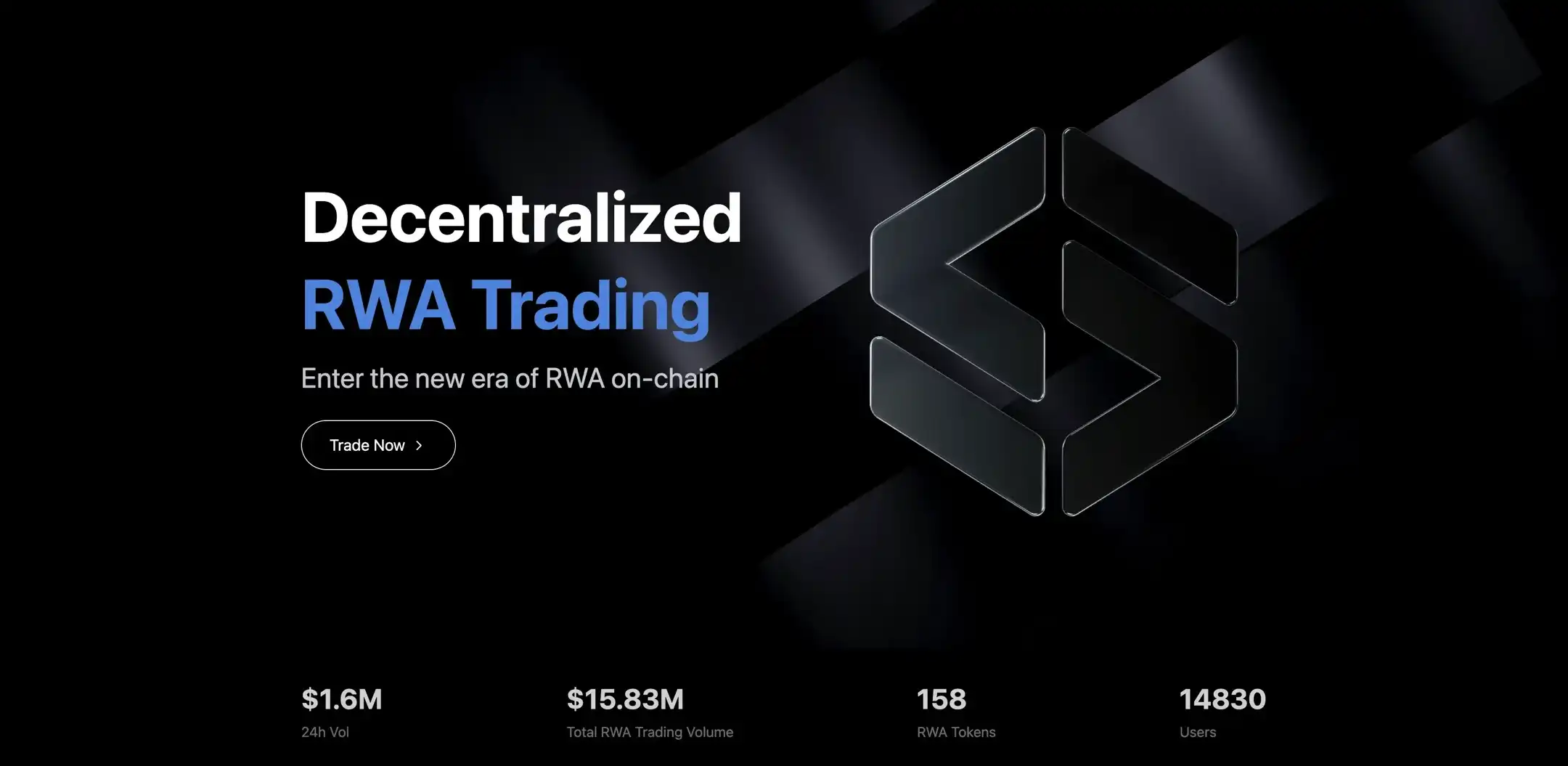
MSX is a community-driven DeFi platform focused on tokenizing U.S. stocks and other RWAs for on-chain trading. Through a partnership with Fidelity, the platform achieves 1:1 physical custody and token issuance. Users can use stablecoins like USDC, USDT, and USD1 to mint stock tokens such as AAPL.M and MSFT.M and trade them 24/7 on the Base blockchain. All trading, minting, and redemption processes are executed by smart contracts, ensuring transparency, security, and auditability. MyStonks is committed to bridging the gap between TradFi and DeFi, providing users with a high-liquidity, low-barrier entry for on-chain U.S. stock investment, building the "Nasdaq of the crypto world."
Past Developments:
On March 2, MSX officially announced the launch of its Pre-IPO section and initiated its first offering. The first batch of open targets includes equity quotas from four unlisted companies: SpaceX ($3 million), ByteDance ($2 million), Lambda Labs ($1 million), and Cerebras Systems ($500,000). Eligible users can participate in the subscription through the MSX platform, with a minimum subscription amount of $10 per transaction. This Pre-IPO section is built based on a cooperation structure between MSX and Republic, with related assets connected through compliant channels and held by regulated third-party custodians. MSX stated that it will expand the scope of Pre-IPO targets in phases in the future and explore technical paths to enhance asset liquidity.
Previously, MSX announced that its official website, msx.com, underwent a comprehensive design upgrade on February 11, 2026. This revision focused on three directions: "visual redesign, interaction optimization, and brand communication," including adopting a dark financial color scheme, introducing neumorphic style and character elements, and reorganizing the layout of market data and functional modules. In terms of interaction, the website increased page whitespace based on a grid system, weakened interference from non-critical information, and centralized and streamlined entrances and buttons in high-frequency areas like market data, positions, and order placement to shorten operation paths. Simultaneously, the website uniformly uses brand green to mark key operations and status feedback, improving readability for critical steps like order placement and confirmation, and reducing the risk of misclicks and misjudgments.
Related Links
《RWA Weekly Report Series》
《After the Elevated Status of Stablecoins, Old Partners Circle and Stripe Compete for Territory》
《NYSE's $25 Billion Valuation Stake in OKX, Stock Tokenization Officially Lands》