RWA Deposits Triple as Traditional Finance Embraces Blockchain

cryptonews.ruPublicado a 2026-08-24Actualizado a 2026-08-24

Resumen

The DeFi sector is undergoing a structural transformation, with tokenized real-world assets (RWA) taking center stage. According to a joint report from CoinShares and Token Terminal, deposits in RWA on decentralized lending and trading platforms surged to $7.4 billion in Q2 2026, a more than threefold increase from $2.3 billion a year earlier. This growth starkly contrasts with a 15% decline in overall DeFi deposits and a nearly 70% drop in DEX trading volume over the same period. Analysts see this as a fundamental shift driven by the real financial utility of blockchain for traditional capital, not speculation. Primary drivers include tokenized U.S. Treasury bonds and multi-strategy funds, with products like BlackRock's BUIDL being used as collateral to access liquidity while earning yields of 3.2% to 5.5%. Ethereum remains the dominant network, holding about 70% of all RWA collateral. Beyond bonds, tokenized equities and commodity derivatives are also gaining traction, with the tokenized stock market now valued at roughly $2.2 billion. Decentralized platforms like TradeXYZ have seen explosive growth in RWA-based perpetual futures for assets like oil and the S&P 500. Looking ahead, Standard Chartered projects the total market capitalization of tokenized assets could reach $4 trillion by the end of 2028. The RWA sector's growth demonstrates that tokenization has moved beyond crypto market cycles, offering tangible value, deep liquidity, and 24/7 access to global capital as ...

The decentralized finance (DeFi) sector is undergoing a structural transformation, with tokenized real-world assets (RWA) rapidly moving to the forefront.

According to a report by analytics firm CoinShares and platform Token Terminal dated August 6, 2026, the volume of deposits in RWA on decentralized lending and trading platforms reached $7.4 billion in the second quarter of the current year. A year earlier, this figure was just $2.3 billion, indicating a more than threefold growth. Such a massive influx of capital looks particularly impressive against the backdrop of general stagnation in classical cryptocurrency instruments.
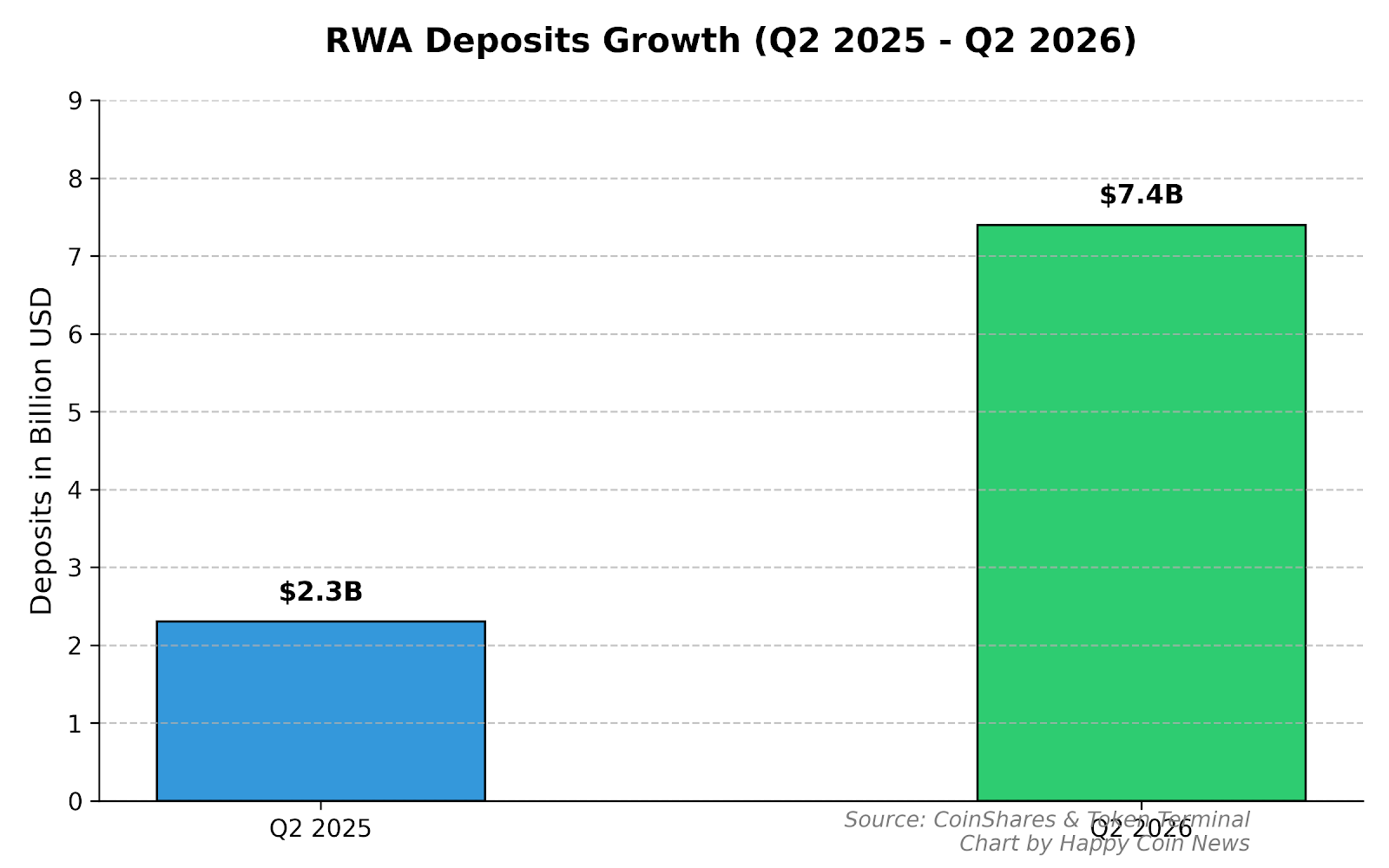
Interest in traditional financial instruments on the blockchain is growing contrary to the market cycles of digital assets. At the same time, from the second quarter of 2025 to 2026, total deposits in DeFi decreased by approximately 15%, while the volume of spot trading of tokenized assets soared by 220%. For comparison, the aggregate trading volume on decentralized exchanges (DEX) over the same period fell by almost 70%.

Experts at CoinShares emphasize that this gap confirms a fundamental shift: demand is being driven not by speculation but by the real financial utility of the blockchain as infrastructure for traditional capital.

The main drivers of this unprecedented growth are tokenized U.S. Treasury bonds and multi-strategy funds. Investors are actively using products such as BlackRock's BUIDL and Sky's sUSDS as reliable collateral. This allows them to attract liquidity in stablecoins while continuing to earn yields from the underlying asset, which range from 3.2% to 5.5% per annum. Meanwhile, the Ethereum network remains the undisputed leader in liquidity concentration, accounting for about 70% of all RWA collateral. This is facilitated by stablecoin pools and proven lending platforms like Aave and Morpho.

Beyond government bonds, tokenized stocks and commodity derivatives are seeing significant development. The market volume of tokenized stocks is currently estimated at approximately $2.2 billion. Although this figure may still seem small compared to the global stock market, the long-term trend is quite clear. Concurrently, a boom is observed in the sector of perpetual futures based on RWA. In particular, the decentralized platform TradeXYZ recorded a twentyfold increase in trading volumes for contracts on oil, precious metals, and the S&P 500 index, offering investors 24/7 access to price movements, which is impossible on traditional exchanges.

The prospects for further scaling of the tokenization segment look promising for the entire financial industry. According to forecasts by analysts at banking giant Standard Chartered, by the end of 2028, the total capitalization of tokenized assets could reach $4 trillion. It is expected that this colossal volume of liquidity will be distributed between stablecoins and various classes of real-world assets integrated into global blockchain ecosystems.

The integration of traditional finance and cryptocurrency technologies has moved from the experimental stage to a phase of active institutional scaling. The growth of the RWA sector proves that tokenization is no longer dependent on bullish market sentiment, as it offers tangible value, deep liquidity, and uninterrupted access to global capital.

end-content

Preguntas relacionadas

QAccording to the article, what happened to the volume of deposits in RWA on decentralized lending and trading platforms from Q2 of the previous year to Q2 of the current year?

AThe volume of deposits in tokenized real-world assets (RWA) on decentralized lending and trading platforms more than tripled, growing from $2.3 billion in Q2 of the previous year to $7.4 billion in Q2 of the current year.

QWhat are the main drivers of the unprecedented growth in the RWA sector, as mentioned in the article?

AThe main drivers are tokenized U.S. Treasury bonds and multi-strategy funds. Investors actively use products like BlackRock's BUIDL and Sky's sUSDS as reliable collateral to secure liquidity in stablecoins while earning returns from the underlying assets.

QHow did the performance of spot trading in tokenized assets differ from the trading volume on decentralized exchanges (DEX) from Q2 2025 to 2026?

AWhile the total trading volume on decentralized exchanges (DEX) fell by nearly 70% in that period, the volume of spot trading in tokenized assets skyrocketed by 220%.

QWhat is the estimated potential total capitalization of tokenized assets by the end of 2028, according to the forecasts mentioned in the article?

AAccording to forecasts by Standard Chartered, the total capitalization of tokenized assets could reach $4 trillion by the end of 2028.

QWhich blockchain network is the leader in terms of concentration of RWA collateral liquidity, and what percentage does it hold?

AThe Ethereum network is the leader, concentrating about 70% of all RWA collateral liquidity. This is attributed to its stablecoin pools and established lending platforms like Aave and Morpho.

Lecturas Relacionadas

PeaqOS and World ID Integrate ZK Proofs into Autonomous Robots

The integration of PeaqOS and World ID now allows autonomous machines to verify they are interacting with real, unique individuals without collecting names, photos, or other personal data. This update, available via robotic.sh, enables connected devices to directly request and verify World ID proofs. The system leverages zero-knowledge technology, letting a person prove they are human while maintaining the privacy of their identity. This addresses a key challenge for operators of delivery robots, shared machines, and autonomous systems: how to authenticate a user as genuine without relying on insecure PINs, pickup codes, or traditional identity checks that require personal data collection. Instead of obtaining identifying information, a device receives a cryptographic proof that the user is a real person. PeaqOS acts as a coordination layer, allowing devices to utilize World ID via decentralized identifiers and a device marketplace. A robot can request verification, receive a zero-knowledge proof, and register an auditable record of the interaction—all without exposing underlying personal data. The system also supports uniqueness verification, enabling machines to enforce rules like "one item per person" without maintaining user identity databases. A demonstrated use case involves autonomous medicine delivery: a patient verifies via the World App when placing an order, a pharmacist verifies before loading the medication, and the patient verifies again upon delivery so the robot can confirm the recipient is linked to the order before unlocking the compartment. Similarly, promotional robots could ensure one item per person, and shared vending machines could grant access to verified individuals without requiring accounts or personal data. This integration for PeaqOS-powered robots and devices minimizes the identity information collected or stored while allowing autonomous systems to confirm they are interacting with real humans.

cryptonews.ruHace 51 min(s)

PeaqOS and World ID Integrate ZK Proofs into Autonomous Robots

cryptonews.ruHace 51 min(s)

Trading

Spot
活动图片