Russian Borrowed Mining Equipment from Miners and Secretly Sold It Off

cryptonews.ruPublicado a 2026-09-14Actualizado a 2026-09-14

Resumen

A Russian man from the Orenburg region is accused of defrauding several partners in cryptocurrency mining schemes. According to investigators, from February 2024 to December 2025, he borrowed 51 mining devices and funds for new equipment from three individuals under the pretense of upgrading operations, but instead sold all the hardware, causing over 3 million rubles in damages. Separately, between April and August 2024, he allegedly convinced another partner to provide 1.3 million rubles to purchase mining equipment, took the money, but never delivered the devices. In a related case in Russia's Irkutsk region, a 44-year-old man is on trial for allegedly organizing a clandestine mining farm in an industrial warehouse rented by his wife. The farm operated using electricity paid for by the unsuspecting landlord, with energy companies estimating the damages at 8 million rubles. In a separate international matter, the American investment firm Mintvest Capital has sued the mining company Energy & Compute (formerly Coinmint) in a Puerto Rico court. The lawsuit alleges that Coinmint's CEO, Ashton Soniat, misappropriated 448.7193 bitcoins. Mintvest claims Soniat provided investors with later start dates for bitcoin mining on new equipment than the actual commencement.

According to the investigation, from February 2024 to December 2025, the man took 51 mining devices "for temporary use" from three residents of Orenburg, along with money to purchase new computing equipment "for modernizing the mining operation." Instead of using the hardware and funds as agreed, he sold all the equipment, causing his partners losses exceeding 3 million rubles, as stated in the case materials.

Simultaneously, the 33-year-old man deceived another partner, investigators believe — from April to August 2024, he convinced this partner to buy mining equipment worth 1.3 million rubles, took the money, but never delivered the equipment.

The court in the city of Bodaybo, Irkutsk Region, Russia, received a case against a 44-year-old man whom the investigation considers the organizer of an underground mining operation. The farm was set up in an industrial workshop rented by the accused's wife. Moreover, the landlord paid for the electricity, unaware of the hidden crypto farm on his premises. Power engineers estimated the damage at 8 million rubles.

The American investment company Mintvest Capital filed a lawsuit in the District Court of Puerto Rico against the mining company Energy & Compute, formerly known as Coinmint. The plaintiff alleges that Coinmint's CEO Ashton Soniat misappropriated 448.7193 bitcoins. When commissioning new equipment, Soniat provided investors with later start dates for bitcoin mining than actually occurred, Mintvest Capital insists.

end-content

Preguntas relacionadas

QWhat is the main accusation against the man who borrowed mining equipment from three Orenburg residents?

AThe man is accused of taking 51 mining devices and money for new equipment 'for temporary use' but instead sold all the equipment, causing over 3 million rubles in damage.

QHow did the 33-year-old man defraud another partner, according to the investigation?

AHe convinced the partner to buy mining equipment for 1.3 million rubles, took the money, but never delivered the equipment.

QWhat charges does the 44-year-old man in the court case in Bodaibo, Irkutsk region, face?

AHe is considered by the investigation to be the organizer of an illegal underground mining farm set up in an industrial premises rented by his wife.

QWhat was the estimated damage caused by the underground mining farm to the power company?

AThe energy company estimated the damage caused by the illegal mining operation at 8 million rubles.

QWhat is the American investment firm Mintvest Capital accusing the CEO of Coinmint (Energy & Compute) of in its lawsuit?

AMintvest Capital accuses Coinmint CEO Ashton Soniat of misappropriating 448.7193 bitcoins and providing investors with later dates for the start of bitcoin mining than when it actually began.

Lecturas Relacionadas

Meme Coins Peak in 17.2 Days on Average: Ephemeral Fervor and the Great Capital Migration

Meme Coins' Average Peak: 17.2 Days - A Fleeting Frenzy and a Capital Exodus A Bloomberg analysis reveals the stark reality behind meme coin mania: extreme short-term speculation. On average, a new meme coin reaches its all-time high (ATH) a mere 17.2 days after its first trade. Alarmingly, 25% of projects peak within just 38.4 hours. The subsequent decline is brutal, with the median time to drop 95% from the peak and enter dormancy being 370 days. Only about 3% ever break their previous ATH again. This drastic compression of the speculative lifecycle is driven by zero-barrier token creation on platforms like Pump.fun and automated trading tools like sniper bots, which enable instant deployment and rapid pump-and-dump schemes. The market is saturated, diluting liquidity and forcing a predatory, player-versus-player environment where early holders quickly exit with minimal gains. As the odds of success in traditional meme coins diminish, speculative capital is migrating. Decentralized prediction markets like Polymarket, offering transparent, event-driven betting, are attracting significant liquidity. Concurrently, AI agent tokens are drawing funds with their combination of high volatility and long-term narrative tied to artificial intelligence. This capital shift marks a move away from simplistic "greater fool" assets toward platforms with clearer mechanisms or dynamic technological themes.

marsbitHace 3 min(s)

Meme Coins Peak in 17.2 Days on Average: Ephemeral Fervor and the Great Capital Migration

marsbitHace 3 min(s)

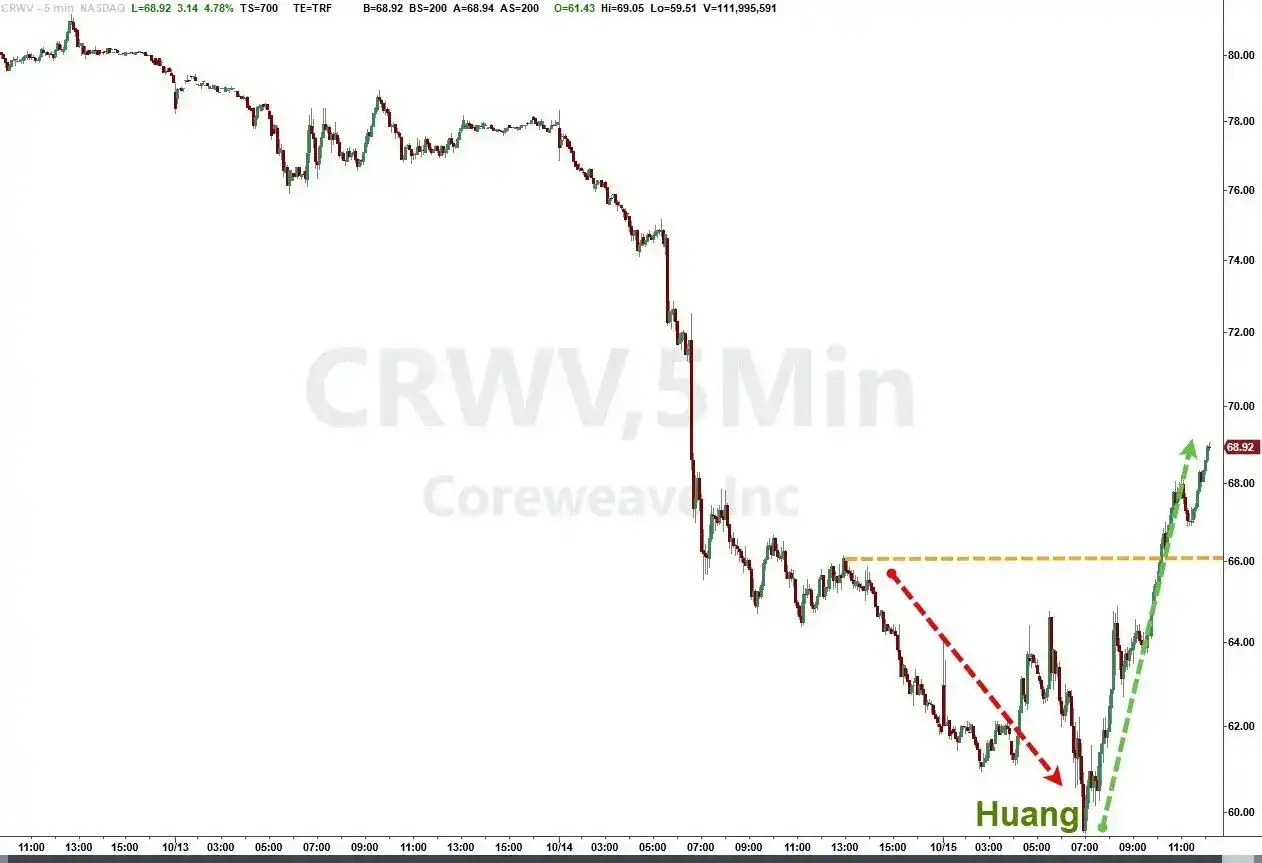
CoreWeave Default Probability Exceeds 60%! Huang Renxun 'Puts Out Fire': Financing Costs Declining, No Need for NVIDIA to Provide Backstop

CoreWeave, a major AI cloud service provider and key NVIDIA customer, is facing heightened credit market concerns. Its five-year credit default swap (CDS) spreads soared to a record high of over 1190 basis points, implying a perceived default probability exceeding 60%. Concurrently, its bond prices plummeted, with yields surging above 15-16%, reflecting intense investor worries about its ability to service nearly $50 billion in debt while remaining unprofitable. This stress is spreading within the AI infrastructure sector. CDS spreads for companies like Oracle, SoftBank, NVIDIA, and others also widened significantly, indicating a broader market reassessment of the debt risks behind massive AI capital expenditures. In response, NVIDIA CEO Jensen Huang publicly expressed confidence in CoreWeave, stating its "financial strength is growing daily" and its cost of capital is declining. He explicitly stated NVIDIA sees no need to provide a financial backstop for CoreWeave, in which it holds a roughly 10% stake. His comments helped CoreWeave's stock recover from early losses. The core issue under scrutiny is whether the future cash flows from AI investments can cover the enormous upfront costs and interest burdens, especially as financing becomes more expensive. The situation highlights a critical shift in market focus: from purely evaluating AI compute demand to questioning the sustainability of the debt-fueled expansion models used to build that capacity.

marsbitHace 22 min(s)

CoreWeave Default Probability Exceeds 60%! Huang Renxun 'Puts Out Fire': Financing Costs Declining, No Need for NVIDIA to Provide Backstop

marsbitHace 22 min(s)

Farcaster Changes Hands Again: The Hottest Potato in the Decentralized World

The decentralized social protocol Farcaster has changed ownership for the third time in nine months, being described as a "hot potato" in the decentralized world. On October 15, 2026, Rish, co-founder of Neynar, announced that Network School, founded by Balaji Srinivasan, would take over Farcaster, including its application, protocol codebase, and related products. This followed Neynar's acquisition of Farcaster from its original creator, Merkle Manufactory, in January 2026. Farcaster, which achieved a $1 billion valuation after a $150 million Series A round in 2024, saw its user activity and revenue decline sharply post-2025. Daily active users (DAU) dropped 40% from its peak of nearly 100,000, and monthly revenue fell to around $10,000. After taking over, Neynar pivoted Farcaster toward developers, but protocol revenue (including from Clanker) plummeted by 99% from Q1 to Q3 2026, leading to the search for a new owner. Network School, Balaji Srinivasan's venture practicing his "network state" theory and recently valued at $2 billion, plans to rebrand Farcaster as the "Network State Protocol." Significant rule changes include requiring users to accept a "social smart contract" to mint an NFT for full access, implementing content moderation based on Singaporean public conduct codes, and introducing AI-assisted review with potential human verification. These changes, particularly the centralized control over content and access via the dominant official app (formerly Warpcast), have sparked community debate. The repeated ownership transfers highlight a core tension in decentralized social networking: while the protocol layer is technically decentralized, control over the primary user application grants centralized power over the entire network's experience and direction. Each new owner brings a different vision, but all face the fundamental challenge of reviving a platform with declining users and revenue.

marsbitHace 23 min(s)

Farcaster Changes Hands Again: The Hottest Potato in the Decentralized World

marsbitHace 23 min(s)

US Stock Market Trends (October 16): Dow Surges Over 550 Points, TSMC's Net Profit Rises Nearly 70% but Stock Closes Lower

**U.S. Market Trends (October 16): Dow Jumps Over 550 Points, TSMC Falls Despite 69% Net Profit Surge** U.S. stocks reversed early losses on Thursday. The Dow Jones surged over 550 points (1.08%), while the Nasdaq Composite edged up 0.08%. The Philadelphia Semiconductor Index fell for a seventh consecutive session, closing down 0.88%. The S&P 500 rose 0.33%, with healthcare, materials, and financials leading gains. Energy and tech sectors declined. Major tech stocks were mixed. Microsoft and Alphabet gained, while Nvidia and Tesla fell. Server stocks like Dell and Hewlett Packard Enterprise dropped sharply. Despite reporting strong Q3 results—a 69% year-on-year jump in net profit and raising its full-year revenue growth forecast to ~44%—TSMC's U.S.-listed shares fell 1.80%. Investor concerns persist about funding for massive AI/data center expansions and their eventual returns. CoreWeave's stock rebounded to close nearly 6% higher after Nvidia CEO Jensen Huang stated the AI cloud provider was strengthening and did not need rescue, easing equity investor worries. However, its bonds remained under pressure due to high leverage and funding needs. Economic data showed mixed signals. September PPI surged 1.3% month-on-month (the highest since March 2022), driven by energy prices. Retail sales grew 0.8%, largely fueled by gasoline spending. Excluding autos and gas, growth was minimal. Despite hot inflation prints, Treasury yields retreated, with the 10-year near 5.09%. Oil (WTI) rose over 3%, while gold gained 2%. Bitcoin traded around $82,300. Focus turns to upcoming remarks from Fed officials ahead of the quiet period and key data like industrial production, as investors weigh inflation against growth concerns and tech sector volatility.

marsbitHace 39 min(s)

US Stock Market Trends (October 16): Dow Surges Over 550 Points, TSMC's Net Profit Rises Nearly 70% but Stock Closes Lower

marsbitHace 39 min(s)

Trading

Spot
活动图片