Russia May Block Global Crypto Exchanges Ahead Of New Regulatory Framework – Report

bitcoinistPublicado a 2026-02-19Actualizado a 2026-02-19

Resumen

Russia is preparing to restrict access to global cryptocurrency exchanges by summer 2026 as part of a new domestic regulatory framework, according to industry experts. The move aims to shift trading activity from foreign platforms to Russian-based services. Analysts suggest that authorities may block overseas exchanges using methods similar to previous restrictions on platforms like Telegram and YouTube. However, experts warn that such measures could drive part of the market underground, increasing fraud and complicating regulation. Meanwhile, the European Union is considering broader sanctions on all Russia-related crypto transactions to prevent sanctions evasion, including a potential ban on digital ruble transactions.

Russia is preparing to restrict access to global crypto exchanges this summer, experts said, suggesting that authorities are planning to shift trading from foreign platforms to domestic ones under the upcoming regulatory framework.

Russia To Restrict Foreign Crypto Exchanges

On Tuesday, experts said Russia will likely block foreign crypto exchanges by summer 2026 as lawmakers advance the highly anticipated domestic framework, expected by July 1, to bring the industry out of the shadows.

According to a report by local news outlet RBC Crypto, industry participants believe authorities will soon begin restricting access to overseas exchanges, similar to the Telegram and YouTube block.

Nikita Zuborev, senior analyst at crypto exchange aggregator Bestchange.ru, told the news media outlet that this scenario is likely, asserting that as soon as the domestic market enters the new regulatory regime, “there is an almost 100% chance that the fight against major competitors will begin.”

“We expect that Roskomnadzor may begin mass blocking of websites of crypto exchanges and large exchangers not registered in Russia as early as this summer. Most likely, they will act according to the YouTube blocking model — they will delete DNS records in the Russian segment of the Internet and continue to fight against means of circumventing the blocks,” the analyst stated.

However, Zuborev cautioned that if global exchanges are not allowed to obtain licenses or to operate as agents of domestic exchanges or brokers, a part of the market will move underground, increasing fraud, complicating regulation, and resulting in higher commission fees.

Meanwhile, Dmitry Machikhin, lawyer and founder of BitOK, considers a “Belarusian scenario” highly possible. Notably, only companies operating under Belarus’ special regime can conduct cryptocurrency transactions, while individuals are prohibited from buying and selling digital assets on foreign platforms.

Machikhin noted that completely restricting operations is impossible, citing Binance as an example. The global exchange still has over 1 million Russian customers despite its departure from the country’s market. Therefore, the chances of a direct ban on transactions using foreign exchanges are low, the lawmakers added.

EU Explores Broader Sanctions

Ignat Likhunov, founder of Cartesius law agency, agreed with the other two experts, affirming, “It seems that blocking measures are being prepared in parallel with the creation of a ‘white’ zone, and conditions for ‘illegal’ exchangers and unfriendly foreign exchanges will deteriorate.”

He pointed out that the lack of “real levers of influence” over foreign exchanges, noting that the platforms don’t need to hurry to comply with any requirements of Russian legislation.

As a result, authorities will likely hold them accountable in absentia and block access to the foreign exchanges that enforce sanctions against Russia for various reasons, including economic or non-compliance with the law on data landing.

It’s worth noting that the European Union has been exploring implementing strict sanctions on all crypto transactions linked to Russia to limit sanctions evasion. As reported by Bitcoinist, the European Commission is strengthening its crackdown on the country’s use of digital assets to evade sanctions by considering measures to ban all Russia-related crypto transactions.

Legal documents show that the Commission has proposed a broader prohibition “instead of attempting to ban copycat Russian crypto entities spun out of already sanctioned platforms.” The proposal focuses on stopping the growth of successors to Russia-linked crypto exchange Garantex, while aiming at payment platforms such as A7 and its related ruble-pegged stablecoin A7A5.

The Commission also suggested adding 20 banks to the list of sanctioned entities and a ban on any digital ruble-related transactions.
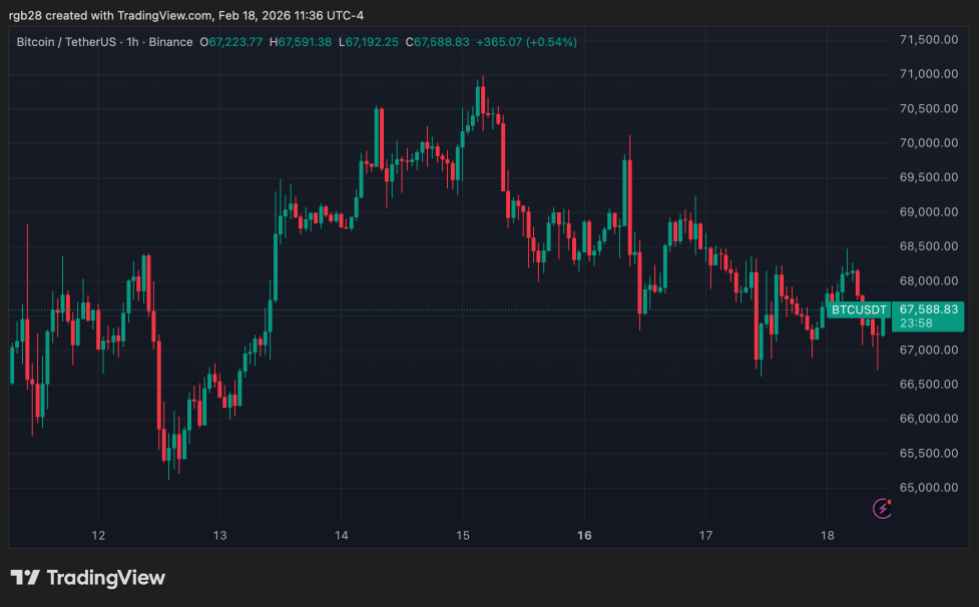
Bitcoin (BTC) trades at $67,588 in the one-week chart. Source: BTCUSDT on TradingView


Preguntas relacionadas

QWhat is Russia planning to do with global crypto exchanges according to the report?

ARussia is preparing to restrict access to global crypto exchanges, likely by blocking their websites, to shift trading activity to domestic platforms under a new regulatory framework expected by summer 2026.

QWhich Russian agency is expected to carry out the mass blocking of foreign crypto exchange websites?

ARoskomnadzor, Russia's federal executive body responsible for monitoring and controlling media and communications, is expected to begin mass blocking of these websites.

QWhat potential negative consequence did Nikita Zuborev warn about if global exchanges are not allowed to operate in Russia?

ANikita Zuborev warned that if global exchanges are not allowed to obtain licenses or operate as agents, a part of the market will move underground, leading to increased fraud, more difficult regulation, and higher commission fees.

QWhat alternative scenario, similar to another country's model, was suggested as a possibility for Russia's crypto regulation?

ADmitry Machikhin suggested a 'Belarusian scenario' is highly possible, where only companies operating under a special regime can conduct crypto transactions, while individuals are prohibited from using foreign platforms.

QWhat broader action is the European Union exploring regarding crypto transactions and Russia?

AThe European Union is exploring implementing strict sanctions to ban all crypto transactions linked to Russia to limit sanctions evasion, including a broader prohibition and a ban on any digital ruble-related transactions.

Lecturas Relacionadas

Within Strategy's Framework, STRC's Dividend Yield Remains at 12% as Share Price Stays Below Par Value

Michael Saylor, Executive Chairman of Strategy (MSTR), confirmed that the dividend rate for its STRC perpetual preferred shares will remain at 12.00% through August 2026. The rate has increased from 9% at its July 2025 launch to the current high via a "ratchet" mechanism, which permanently raises the rate by 0.5% whenever the share price falls below $95. This mechanism is intended to push the price back toward its $100 par value and support Strategy's "at-the-market" (ATM) program for issuing new shares to fund Bitcoin purchases. However, the mechanism has not worked as intended. STRC shares closed at $89.46 on July 31, remaining about 10-11% below par value despite the record-high dividend. Competition from rival Strive's higher-yielding SATA securities has pressured demand. The persistent discount has forced Strategy to suspend new STRC issuances via its ATM program, limiting this funding channel for Bitcoin acquisitions. STRC's struggles reflect Bitcoin's own volatility, as the preferred shares historically move in tandem. Analysts have warned the ratchet structure carries long-term, one-way risk. A law firm is investigating Strategy's ability to maintain dividend payments if Bitcoin's price stays low. Retail investors own roughly 83% of outstanding STRC shares, a group seen as prone to panic selling during downturns. In response, Strategy has established financial reserves, including a liquidity cushion covering about 26 months of dividend/interest obligations, and a $2 billion share buyback program alongside a Bitcoin monetization framework, though the company emphasized it is not obligated to sell any Bitcoin.

cryptonews.ruHace 3 min(s)

Within Strategy's Framework, STRC's Dividend Yield Remains at 12% as Share Price Stays Below Par Value

cryptonews.ruHace 3 min(s)

Analyst: Bitcoin's Price Will Drop to $60k in August, Then Rebound to $70k

Financial analyst Andrey Poroshin has provided a new forecast for Bitcoin's price dynamics in August. Poroshin, an analyst at the Bitbanker exchange, expects the cryptocurrency market to experience a downturn this month, with prices retesting the $60,000 level due to a lack of supportive macroeconomic catalysts. He noted that the recent US Federal Reserve decision to hold interest rates did not significantly impact the market, while inflation remains above the 2% target. Poroshin stated that Bitcoin is ending July under pressure from moderate volatility and a lack of new macroeconomic stimuli, leading to continued market caution. According to his base scenario, Bitcoin will drop to a range of $60,000 to $62,000 before recovering to $70,000. He pointed out that even $70,000 remains below the cost of mining in the US, which has prompted some miners to shift towards AI data center operations. Poroshin cited the winding down of BitMEX's operations as a potential catalyst for a price rebound, suggesting the exit of weaker players often coincides with market reversals and reduced short-term selling pressure. He believes Bitcoin is currently less susceptible to geopolitical shocks, such as the Iran-US conflict, and does not expect significant market changes in August related to the pending CLARITY Act. Looking ahead, Poroshin forecasts that September will bring more active price fluctuations driven by potential Fed rate decisions and possible discussions or approval of the CLARITY Act.

cryptonews.ruHace 4 min(s)

Analyst: Bitcoin's Price Will Drop to $60k in August, Then Rebound to $70k

cryptonews.ruHace 4 min(s)

In Jinjiang, Fujian, a Storage Super Unicorn Lies Quiet

In Fujian's Jinjiang, a city known for sportswear, lies a quiet semiconductor giant: Fujian Jinhua Integrated Circuit Co. (JHICC). Once a promising domestic DRAM manufacturer alongside Yangtze Memory and ChangXin Memory Technologies (CXMT), its journey was derailed in 2018 when the U.S. placed it on an Entity List and filed criminal charges for alleged trade secret theft. This halted production for years. A turning point came in February 2024 when a U.S. federal court found JHICC not guilty. However, it had lost crucial time. While CXMT soared to become a top-valued A-share company in 2024, JHICC, with an estimated valuation of 80 billion RMB, was just restarting. Its current output is primarily customized DDR4 chips, not the advanced DDR5/HBM demanded for AI, but it still benefits from the broader memory chip upcycle. JHICC's story is tied to Chen Zhengkun, a veteran engineer who left Micron to lead the venture. Founded in 2016 with state-backed funding, JHICC partnered with Taiwan's UMC to develop DRAM technology. Rapid progress was cut short by the U.S. actions, which Micron initiated, partly due to its heavy reliance on the Chinese market. Post-sanctions, Chen's team worked to rebuild the production line with reduced reliance on U.S. technology. According to its records, JHICC achieved small-scale production and revenue growth under immense pressure. It now focuses on the stable "niche" DRAM market (e.g., TVs, routers) with a monthly capacity of ~40,000 wafers, aiming for 60,000 by 2026. It holds over 1,000 patents but remains on the Entity List. For Jinjiang, investing in JHICC was a bold industrial leap. The local government provided unwavering financial and logistical support during the crisis, helping the company survive. JHICC has become the anchor for a growing local semiconductor cluster. Though its scale lags behind domestic peers, JHICC's persistence symbolizes a hard-won foothold in a global market long dominated by Samsung, SK Hynix, and Micron. Having missed one boom, it seeks a place in the new AI-driven memory supercycle.

marsbitHace 2 hora(s)

In Jinjiang, Fujian, a Storage Super Unicorn Lies Quiet

marsbitHace 2 hora(s)

Trading

Spot
活动图片




