Russia May Block Global Crypto Exchanges Ahead Of New Regulatory Framework – Report

bitcoinistPublicado a 2026-02-19Actualizado a 2026-02-19

Resumen

Russia is preparing to restrict access to global cryptocurrency exchanges by summer 2026 as part of a new domestic regulatory framework, according to industry experts. The move aims to shift trading activity from foreign platforms to Russian-based services. Analysts suggest that authorities may block overseas exchanges using methods similar to previous restrictions on platforms like Telegram and YouTube. However, experts warn that such measures could drive part of the market underground, increasing fraud and complicating regulation. Meanwhile, the European Union is considering broader sanctions on all Russia-related crypto transactions to prevent sanctions evasion, including a potential ban on digital ruble transactions.

Russia is preparing to restrict access to global crypto exchanges this summer, experts said, suggesting that authorities are planning to shift trading from foreign platforms to domestic ones under the upcoming regulatory framework.

Russia To Restrict Foreign Crypto Exchanges

On Tuesday, experts said Russia will likely block foreign crypto exchanges by summer 2026 as lawmakers advance the highly anticipated domestic framework, expected by July 1, to bring the industry out of the shadows.

According to a report by local news outlet RBC Crypto, industry participants believe authorities will soon begin restricting access to overseas exchanges, similar to the Telegram and YouTube block.

Nikita Zuborev, senior analyst at crypto exchange aggregator Bestchange.ru, told the news media outlet that this scenario is likely, asserting that as soon as the domestic market enters the new regulatory regime, “there is an almost 100% chance that the fight against major competitors will begin.”

“We expect that Roskomnadzor may begin mass blocking of websites of crypto exchanges and large exchangers not registered in Russia as early as this summer. Most likely, they will act according to the YouTube blocking model — they will delete DNS records in the Russian segment of the Internet and continue to fight against means of circumventing the blocks,” the analyst stated.

However, Zuborev cautioned that if global exchanges are not allowed to obtain licenses or to operate as agents of domestic exchanges or brokers, a part of the market will move underground, increasing fraud, complicating regulation, and resulting in higher commission fees.

Meanwhile, Dmitry Machikhin, lawyer and founder of BitOK, considers a “Belarusian scenario” highly possible. Notably, only companies operating under Belarus’ special regime can conduct cryptocurrency transactions, while individuals are prohibited from buying and selling digital assets on foreign platforms.

Machikhin noted that completely restricting operations is impossible, citing Binance as an example. The global exchange still has over 1 million Russian customers despite its departure from the country’s market. Therefore, the chances of a direct ban on transactions using foreign exchanges are low, the lawmakers added.

EU Explores Broader Sanctions

Ignat Likhunov, founder of Cartesius law agency, agreed with the other two experts, affirming, “It seems that blocking measures are being prepared in parallel with the creation of a ‘white’ zone, and conditions for ‘illegal’ exchangers and unfriendly foreign exchanges will deteriorate.”

He pointed out that the lack of “real levers of influence” over foreign exchanges, noting that the platforms don’t need to hurry to comply with any requirements of Russian legislation.

As a result, authorities will likely hold them accountable in absentia and block access to the foreign exchanges that enforce sanctions against Russia for various reasons, including economic or non-compliance with the law on data landing.

It’s worth noting that the European Union has been exploring implementing strict sanctions on all crypto transactions linked to Russia to limit sanctions evasion. As reported by Bitcoinist, the European Commission is strengthening its crackdown on the country’s use of digital assets to evade sanctions by considering measures to ban all Russia-related crypto transactions.

Legal documents show that the Commission has proposed a broader prohibition “instead of attempting to ban copycat Russian crypto entities spun out of already sanctioned platforms.” The proposal focuses on stopping the growth of successors to Russia-linked crypto exchange Garantex, while aiming at payment platforms such as A7 and its related ruble-pegged stablecoin A7A5.

The Commission also suggested adding 20 banks to the list of sanctioned entities and a ban on any digital ruble-related transactions.
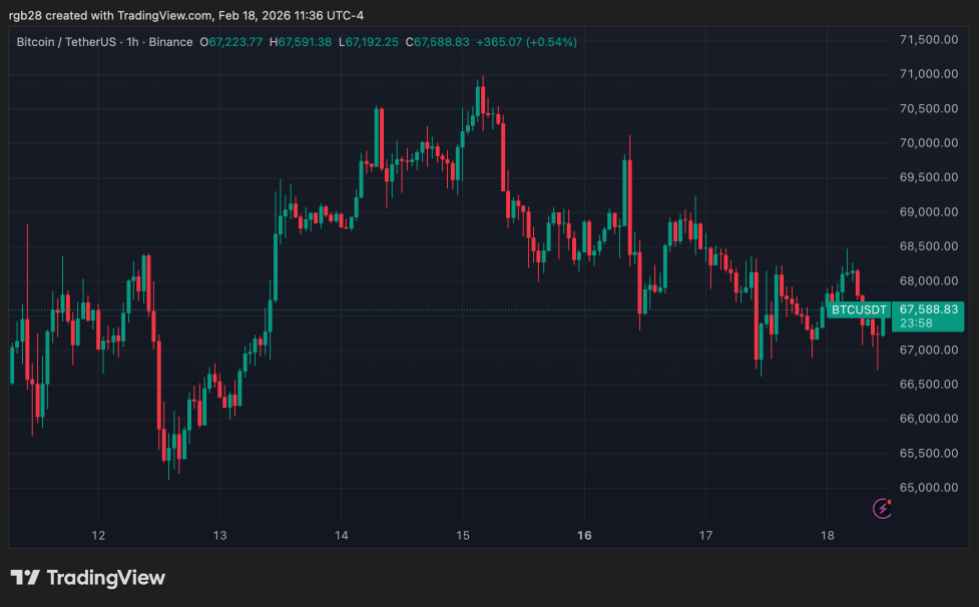
Bitcoin (BTC) trades at $67,588 in the one-week chart. Source: BTCUSDT on TradingView


Preguntas relacionadas

QWhat is Russia planning to do with global crypto exchanges according to the report?

ARussia is preparing to restrict access to global crypto exchanges, likely by blocking their websites, to shift trading activity to domestic platforms under a new regulatory framework expected by summer 2026.

QWhich Russian agency is expected to carry out the mass blocking of foreign crypto exchange websites?

ARoskomnadzor, Russia's federal executive body responsible for monitoring and controlling media and communications, is expected to begin mass blocking of these websites.

QWhat potential negative consequence did Nikita Zuborev warn about if global exchanges are not allowed to operate in Russia?

ANikita Zuborev warned that if global exchanges are not allowed to obtain licenses or operate as agents, a part of the market will move underground, leading to increased fraud, more difficult regulation, and higher commission fees.

QWhat alternative scenario, similar to another country's model, was suggested as a possibility for Russia's crypto regulation?

ADmitry Machikhin suggested a 'Belarusian scenario' is highly possible, where only companies operating under a special regime can conduct crypto transactions, while individuals are prohibited from using foreign platforms.

QWhat broader action is the European Union exploring regarding crypto transactions and Russia?

AThe European Union is exploring implementing strict sanctions to ban all crypto transactions linked to Russia to limit sanctions evasion, including a broader prohibition and a ban on any digital ruble-related transactions.

Lecturas Relacionadas

Must-Watch Events Next Week|CLARITY Act Could Face Senate Vote; SpaceX, Circle to Report Earnings (8.3-8.9)

**Summary: Key Events and Developments to Watch (August 3-9)** The upcoming week is marked by significant financial disclosures, key legislative deadlines, and notable product updates. **Major Financial Events:** Several companies are scheduled to release their Q2 2026 earnings. American Bitcoin (ABTC) will report on August 3, followed by SpaceX and Hut 8 Mining Corp. on August 4, and Circle on August 5. Notably, a significant portion of SpaceX shares (up to 12% of total shares) will be unlocked on August 6 following their earnings release. **Key Legislative Deadline:** The U.S. Senate faces an August 7 deadline to secure 60 votes for the CLARITY Act, a bipartisan bill aiming to establish a federal regulatory framework for cryptocurrencies. The Senate may hold a full vote on the bill during the week. **Economic Data:** The U.S. July Non-Farm Payrolls report will be released on August 7, providing crucial labor market data. **Technology & Product Updates:** * **Shutdowns:** DeFi portfolio tracker Zapper and wallet app Ctrl Wallet will cease operations on August 3. * **Upgrades:** LayerZero will deprecate its v1 relayers on August 3. XRP Ledger's new version 3.3.0, featuring five new functions, is expected next week. * **AI:** Elon Musk announced that the advanced Grok 4.6 AI model is set for release around August 7. * **Bitcoin:** The BIP-110 forced signaling for a potential Bitcoin network change is scheduled to begin around August 8. **Other Notable Events:** Chinese robotics firm Unitree Tech has set its preliminary price inquiry for its IPO for August 5. South Korean exchange Upbit will delist AQT and AERGO tokens on August 3.

marsbitHace 16 min(s)

Must-Watch Events Next Week|CLARITY Act Could Face Senate Vote; SpaceX, Circle to Report Earnings (8.3-8.9)

marsbitHace 16 min(s)

Stocks Are Plummeting More Sharply Than Cryptocurrencies. Where Has the Money Gone?

Stock Markets Plunge Deeper Than Cryptocurrencies: Where Did the Money Go? In late July, Seoul's Kospi index triggered circuit breakers for two consecutive days, plummeting over 40% from its June high. The collapse was led by heavyweight stocks like SK Hynix, whose record profits still disappointed investors, and devastating leveraged ETFs, with one major product losing over 83% of its value. This signaled a global, forced deleveraging targeting the most crowded trades. Interestingly, while stocks exhibited extreme volatility akin to crypto markets, Bitcoin rose nearly 15% in July after a prior steep drop. Analysis shows the money fleeing equities did not flow into Bitcoin. Instead, Bitcoin had already absorbed its sell-off in May-June, when U.S. spot Bitcoin ETFs saw historic outflows. The true safe-haven beneficiary was gold, whose price rose over 20% year-on-year, highlighting a decoupling between Bitcoin and gold as "digital gold." The sell-off was a targeted unwinding of leveraged positions in tech and semiconductors, accelerated by broker-dealer risk management and shifts in the AI narrative, including new competition from Chinese memory chipmakers. The retreat path was clear: from high-valuation tech stocks to cash and U.S. Treasuries, then to gold. For Bitcoin to attract sustained institutional inflows, conditions like eased global liquidity pressure, a "soft-landing" Fed rate cut, and U.S. regulatory clarity via legislation like the stalled CLARITY Act are needed. Currently, Bitcoin is not a safe haven but an already-cleared asset. Its low correlation with tech stocks, however, makes it a potential diversification play for institutional portfolios once the storm passes. The money isn't here yet, but the positioning is underway.

marsbitHace 16 min(s)

Stocks Are Plummeting More Sharply Than Cryptocurrencies. Where Has the Money Gone?

marsbitHace 16 min(s)

In Conversation with Ray Dalio: We Are Currently in an AI Bubble, with 1% of My Portfolio in Bitcoin

Ray Dalio, founder of Bridgewater Associates, warns in an interview that the current AI boom shows classic bubble characteristics, which could lead to significant economic downturns as seen in past cycles like 1929 or 2000. He explains that speculative enthusiasm, fueled by debt and overvaluation, often precedes a crash when rising rates or taxation force asset sales, causing widespread losses and recession. Dalio also outlines his "Big Cycle" theory, describing an approximate 80-year pattern where widening wealth gaps, massive government deficits, and shifting geopolitical power (like China's rise) create internal conflict and global instability. He emphasizes that we are in a late-cycle, transitional phase where traditional powers like the US and UK face decline. For personal wealth protection, Dalio advises diversification beyond cash into assets like stocks, bonds, real estate, and particularly gold, which he prefers over Bitcoin. While he holds about 1% of his portfolio in Bitcoin as a non-printable hard asset, he views gold as more secure from technological or governmental threats. Regarding AI's impact, Dalio believes it will disproportionately benefit capital owners, worsening inequality by replacing both physical and cognitive labor. He suggests that human intuition and emotional intelligence, combined with AI, will be key for future workers. On taxation, Dalio argues that wealth taxes are impractical and risk triggering asset sell-offs, reducing productive investment. He points to the UK as a cautionary example of debt, low productivity, and political strife. Geopolitically, Dalio foresees a more regionalized world, with the US showing weakness in prolonged conflicts like with Iran, akin to past imperial declines. The ideal outcome, he suggests, is coexisting powerful blocs (e.g., Americas, China-Asia Pacific) without major war.

marsbitHace 4 hora(s)

In Conversation with Ray Dalio: We Are Currently in an AI Bubble, with 1% of My Portfolio in Bitcoin

marsbitHace 4 hora(s)

Daily 7.2 Trillion KRW: Foreign Capital's Record Net Buying on Friday! Wall Street Says Headwinds for Korean Stock Fund Flows Have Subsided

South Korean stock market sees a dramatic shift in fund flows. On July 31, foreign investors made a record net purchase of approximately KRW 7.2 trillion in KOSPI stocks, marking a fundamental reversal from the persistent large-scale net outflows seen in previous months. This contributed to a significant narrowing of foreign net selling in July to KRW 9.8 trillion, down sharply from KRW 48.4 trillion in June and KRW 44.5 trillion in May. Simultaneously, domestic institutional pressure eased. South Korean pension funds and asset managers turned to a net buying position in July, purchasing KRW 1.0 trillion worth of KOSPI shares, contrasting with net sales in May and June. Market volatility is expected to be dampened by new financial regulations. Effective July 31, the Financial Services Commission tightened access for retail investors to single-stock leveraged ETFs by raising the minimum cash deposit requirement. Trading volumes for these products subsequently dropped to about 50% of their monthly average. Citigroup Research maintains its year-end KOSPI target of 10,000 points. The firm cites several supportive factors: the substantial easing of headwinds from capital outflows, a robust fundamental outlook for the semiconductor sector, historically low market valuations, strong economic fundamentals, and the potential for policy support from financial authorities if needed.

marsbitHace 4 hora(s)

Daily 7.2 Trillion KRW: Foreign Capital's Record Net Buying on Friday! Wall Street Says Headwinds for Korean Stock Fund Flows Have Subsided

marsbitHace 4 hora(s)

Trading

Spot
活动图片




