Russia, Iran-Linked Groups Turn To Crypto For Crowdfunded Drone Purchases – Report

bitcoinistPublicado a 2026-03-31Actualizado a 2026-03-31

Resumen

A recent Chainalysis report reveals that pro-Russia and Iran-affiliated groups are increasingly using cryptocurrency to fund purchases of commercially available drones and components, which have become central to modern conflict. These groups utilize crypto for both direct purchases from manufacturers and indirect acquisitions via third-party e-commerce platforms like Alibaba. Iran-linked entities, including the IRGC, have used crypto to buy drone parts, while pro-Russia militias have raised over $8.3 million in crypto donations since 2022 to purchase drones, often from Chinese manufacturers. The blockchain provides transparency into these transactions, highlighting how crypto is transforming conflict economics by enabling groups to crowdfund military equipment despite limited access to traditional finance.

A recent report has shared that Pro-Russia and Iran groups are turning to crypto to fund purchases of commercially available drones and related components, as the products become central to modern conflict.

Crypto-Funded Drone Purchases Linked To Russia, Iran

On Monday, blockchain analytics firm Chainalysis revealed that groups affiliated with Russia and Iran are utilizing crypto to fund the acquisition of low-cost military drones and their components.

The firm traced crypto flows from individual wallets linked to various paramilitary groups to the purchase of affordable drones and related components from vendors on e-commerce platforms.

According to the report, low-cost, commercially available drones have become central to modern conflict, enabling both state and non-state actors, including pro-Russia militias and Iran-backed terrorist organizations.

Most purchases use traditional financial channels, but Chainalysis noted that drone procurement networks are ⁠increasingly intersecting with the blockchain. As the firm explained, crypto can enter the drone procurement picture directly or indirectly. In the first scenario, a drone manufacturer openly accepts digital assets as payment on its website.

In the second scenario, electronics and dual-use component vendors that sell through third-party e-commerce platforms like Alibaba accept digital assets to sell drones and their parts to buyers whose identities and intended use are unclear.

The report found that Iran-linked groups have been using crypto to acquire drone components and sell military equipment, highlighting a wallet associated with Iran’s Islamic Revolutionary Guard Corps (IRGC) that purchased drone parts from a Hong Kong-based supplier.

As reported by Bitcoinist in January, Iran’s Ministry of Defence Export Center (Mindex), the state arms export arm, openly offered to accept crypto as payment for military hardware, including drones, air defense systems, warships, and ballistic missiles.

Paramilitary Groups ‘Crowdfund The Frontline’

Chainalysis also emphasized that the “most publicly visible crypto-drone nexus operates at the militia level, through open crowdfunding campaigns on social media platforms.”

The blockchain analytics firm has identified dozens of pro-Russia volunteer and paramilitary organizations asking for crypto donations for military equipment since Russia invaded Ukraine in ​2022.

Over the past four years, the pro-Russia groups have raised more than $8.3 million in these donations across various blockchains to purchase drones and associated components from global e-commerce platforms.

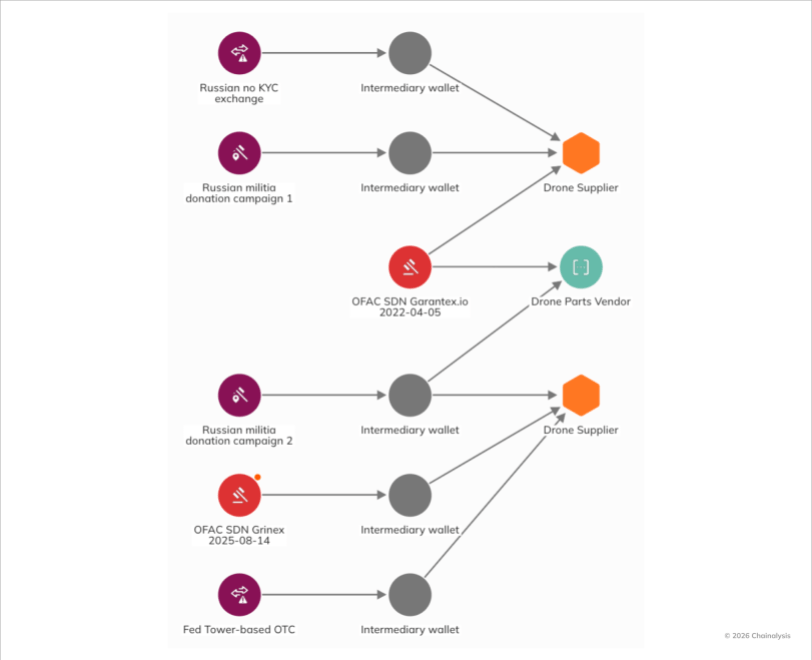
On-chain evidence shows Russian militia fundraising groups purchasing from a Hong Kong-based drone manufacturer and drone purchasers acquiring liquidity from Russian-language no-Know Your Client (KYC) exchanges, the sanctioned Russian exchanges Garantex and Grinex, and a Federation Tower-based OTC service.

To the firm, this strongly suggests that Russia-linked actors may have acquired drones from Chinese manufacturers for deployment in Ukraine. Chainalysis also matched crypto transactions between $2,200-$3,500 to the exact prices of drones and their components on ​e-commerce platforms.

Russian militia donation campaign wallets purchase drones via intermediaries. Source: Chainalysis

“The striking point is not the dollar figure, but the logic. At the militia level, low-cost commercial drones are among the most tactically significant items crowdfunded crypto can buy,” the report affirmed.

“At $2,200–$3,500 per unit, a single successful fundraising campaign translates directly into battlefield capability for groups that cannot access conventional finance,” it continued.

The firm underscored that the blockchain offers new opportunities to trace these flows and obtain a better understanding of how emerging technologies are “transforming the economics of conflict.”

“On the blockchain, there’s this incredible opportunity, once you have ‌identified the ⁠vendor to see the counterparty activity and make assessments that help clarify that utilization and the intent behind the purchase,” Andrew Fierman, Chainalysis’s head of national security intelligence, told Reuters
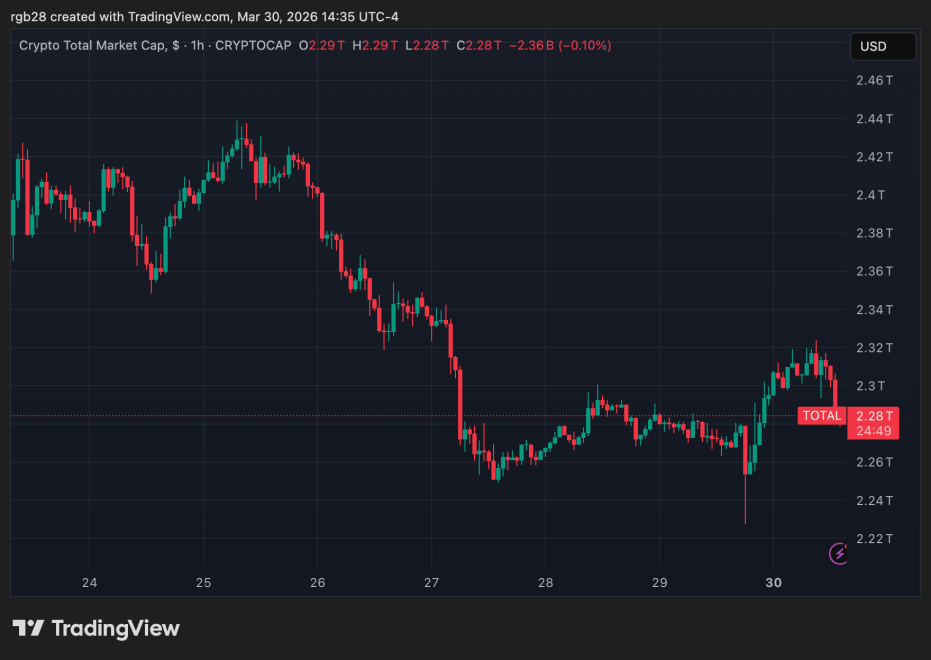
Total crypto market capitalization is at $2.28 trillion on the one-week chart. Source: TOTAL on TradingView


Preguntas relacionadas

QAccording to the report, how are pro-Russia and Iran-linked groups using cryptocurrency in relation to drone procurement?

AThey are using cryptocurrency to fund the acquisition of low-cost military drones and related components, often through crowdfunding campaigns on social media and purchases from vendors on e-commerce platforms.

QWhat are the two main scenarios described in which cryptocurrency enters the drone procurement process?

AThe first scenario is when a drone manufacturer openly accepts digital assets as payment on its website. The second is when electronics and dual-use component vendors on third-party e-commerce platforms accept crypto from buyers whose identities and intended use are unclear.

QWhich specific Iran-linked group was identified as using a crypto wallet to purchase drone parts, and from where?

AA wallet associated with Iran’s Islamic Revolutionary Guard Corps (IRGC) was used to purchase drone parts from a Hong Kong-based supplier.

QHow much money have pro-Russia groups raised through crypto donations for military equipment since the invasion of Ukraine, and what is its primary use?

APro-Russia groups have raised more than $8.3 million in crypto donations, which is primarily used to purchase drones and associated components from global e-commerce platforms.

QWhat does the report identify as the 'most striking point' about these crypto-funded drone purchases, and why?

AThe most striking point is not the dollar figure, but the logic. For militia-level groups that cannot access conventional finance, a single successful campaign raising $2,200–$3,500 can directly translate into significant battlefield capability by funding a low-cost commercial drone.

Lecturas Relacionadas

Goldman Sachs: July Smashes Through Crowded Trades, U.S. Stock Bull Market Not Broken but Harder to Navigate

Goldman Sachs: July Sees Crowded Trades Unwound, U.S. Bull Market Intact but Getting Tougher. The U.S. stock market in July did not see an index-level crash, but rather a significant unwinding of speculative positions. While the S&P 500 remained stable—trading within a narrow 3.5% range and staying within 2% of its high—underlying market dynamics were volatile. Heavily crowded trades, particularly in high-momentum tech, AI-linked stocks, and Asian strategies, faced severe pressure and forced deleveraging. Data indicates this was a meaningful cleanse, not a minor adjustment. Global tech exposure saw its largest sell-off in over five years, leverage in Korean equity ETFs plummeted, and Goldman's prime brokerage recorded the largest gross exposure reduction since late 2022. Leverage on momentum factors among fundamental long/short clients fell to the 28th percentile of its one-year range. The AI trade narrative shifted from pure potential to a focus on tangible returns. While Meta failed to show clear AI monetization, Microsoft and Amazon provided evidence that massive capital expenditure is translating into scalable revenue and product growth, preventing a blanket sell-off of the AI sector. The Federal Reserve's more opaque communication style and volatility in long-end Treasury yields have introduced new friction, particularly for rate-sensitive growth and tech stocks. The broader outlook for U.S. equities remains favorable, supported by a strong economy, robust earnings, and substantial AI capital expenditure. However, risk/reward is no longer cheap, and the market's upward elasticity has weakened. The Nasdaq 100's trajectory—up 12% year-to-date despite significant pullbacks—illustrates that the bull trend persists but the path is becoming more difficult. The key lesson from July is that the market no longer rewards crowded, highly leveraged trades, requiring more disciplined and liquid portfolio approaches.

marsbitHace 4 hora(s)

Goldman Sachs: July Smashes Through Crowded Trades, U.S. Stock Bull Market Not Broken but Harder to Navigate

marsbitHace 4 hora(s)

Trading

Spot
活动图片