Running MoE on Mobile Phones? Meta Proposes MobileMoE, Speeding Up iPhone 16 Pro by 3.8x

marsbitPublicado a 2026-06-01Actualizado a 2026-06-01

Resumen

Meta's MobileMoE, a mobile-optimized Mixture-of-Experts (MoE) language model architecture, enables efficient on-device large language model (LLM) inference for the first time on commercial smartphones. Designed for decoder-only Transformers, it replaces dense feed-forward layers with MoE layers. Key design choices include 8 experts with granularity g=8, top-4 routing, and a shared expert. The model undergoes a four-stage training process: pre-training, intermediate training, supervised fine-tuning, and quantization-aware training. Results show MobileMoE models, with similar memory footprint, achieve equal or higher average accuracy across 14 foundational benchmarks while using only 1/2 to 1/4 of the FLOPs compared to dense baselines. After INT4 quantization, they remain competitive. Notably, on an iPhone 16 Pro, MobileMoE-S demonstrates significant speedups: up to 3.8x faster in the prompt phase and 2.2-3.4x faster in per-token generation compared to a dense counterpart, with lower peak memory usage. While MobileMoE establishes a new Pareto frontier for on-device LLMs in accuracy-compute trade-offs, particularly excelling in code and math tasks, it currently lags behind models like Qwen3.5 2B in advanced instruction following and knowledge reasoning. Future work includes improving post-training techniques, exploring NPU deployment, and managing the runtime memory sensitivity of MoE models to varying inputs.

In recent years, the Mixture of Experts (MoE) model has been widely used in large cloud-based models. However, on the mobile side, Large Language Models (LLMs) are still predominantly based on dense architectures. In the past, mobile devices imposed stricter constraints on memory, computing power, and latency, and there was a lack of systematic research on on-device MoE within the sub-billion active parameter range. Now, with the increase in DRAM capacity of mobile devices, MoE also has the opportunity to be deployed on smartphones.

The MobileMoE proposed by Meta's team achieves efficient MoE inference on commercial smartphones for the first time. The results show that across 14 foundational tests, MobileMoE-S/M, with similar memory usage, achieved comparable or even higher average accuracy using only 1/2 to 1/4 of the inference compute of dense baselines. In real-world tests, MobileMoE-S showed the most significant speedup on the iPhone 16 Pro's GPU/MLX backend, with a maximum speedup of 3.8x during the input phase.

Paper Link: https://arxiv.org/abs/2605.27358

The research team also proposed a set of on-device MoE scaling laws to determine model structures more suitable for mobile deployment. MobileMoE establishes a new Pareto frontier for on-device large language models, achieving better results in the trade-off between accuracy and inference computational overhead.
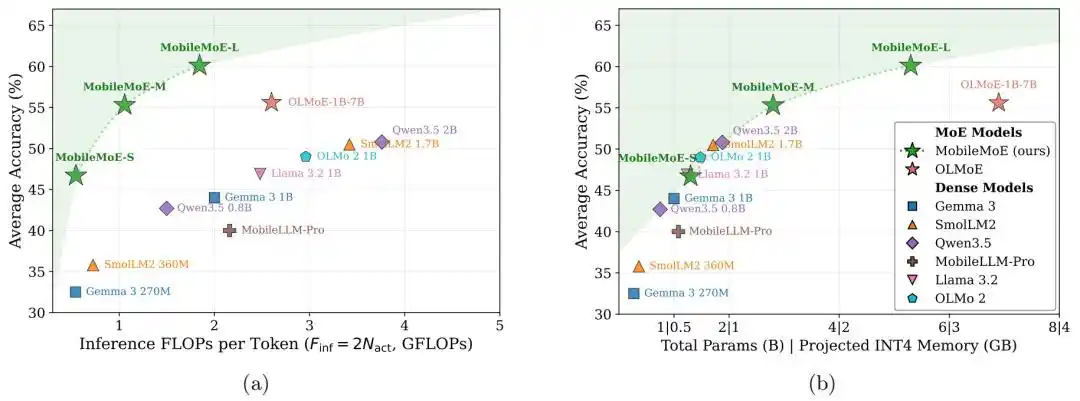
Figure | MobileMoE establishes a new Pareto frontier for on-device large language models.

How is MobileMoE Designed?

MobileMoE can be understood as follows: it is a class of MoE language models designed for on-device deployment. The overall architecture remains a decoder-only Transformer, but the original dense feed-forward layers are replaced with MoE layers. The router selects the top-scoring few experts for each token to participate in computation, while a shared expert always participates. The entire training process is divided into four steps: pretraining, intermediate training, supervised fine-tuning, and quantization-aware training.

Pretraining: The research team pretrained the model using approximately 6T tokens of open-licensed data with a context length of 2048. The data primarily consisted of web content, while also covering domains such as mathematics, code, knowledge, and science.

Intermediate Training: The research team extended the context length to 8192 and further increased the proportion of high-quality data in areas like knowledge, code, mathematics, and science, with a total scale of about 500B tokens.

Supervised Fine-Tuning (SFT): The research team fine-tuned MobileMoE-Base on open-licensed instruction-tuning data comprising over 80 million samples.

Quantization-Aware Training: The research team quantized linear layers and embeddings to INT4, activations to INT8 with dynamic quantization, while the router retained FP32 precision.

Figure | The four-stage training of MobileMoE.

Experimental Results

Ablation Study Results

The research team first compared three architectural variables: the number of experts E, expert granularity g, and the inclusion of a shared expert.
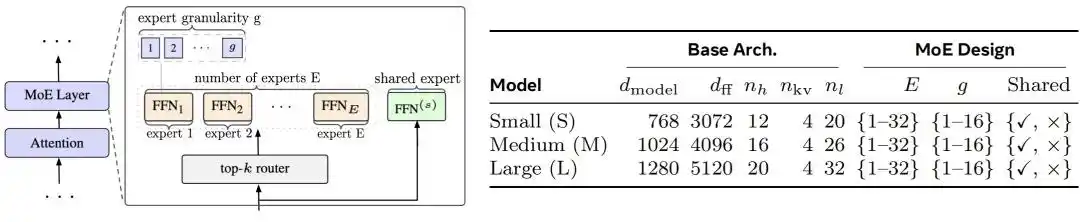
Figure | Scaling the number of experts E.

Under a fixed memory budget, when memory is above approximately 0.25GB, the loss of MoE begins to be lower than that of the corresponding dense model. Continuing to increase the number of experts E further reduces the loss, but the marginal gain significantly diminishes after E increases to 8. Experiments on expert granularity g indicate that finer-grained expert configurations are generally better, with g=8 achieving a good balance between effectiveness and training cost; when g increases from 8 to 16, the loss improvement is less than 0.01, but training time increases by about 50%. Under the same computational budget, the model loss further decreases after adding a shared expert.

Based on the ablation study results, the research team ultimately adopted the configuration with E=8, g=8, and a shared expert, i.e., 60 fine-grained routing experts, Top-4 routing, and 1 shared expert, and used this architecture for the three versions: MobileMoE-S, M, and L.
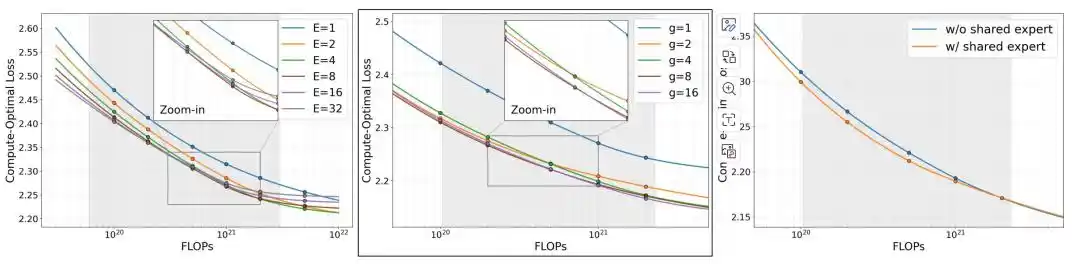
Figure | Scaling MoE models under compute-optimal conditions.
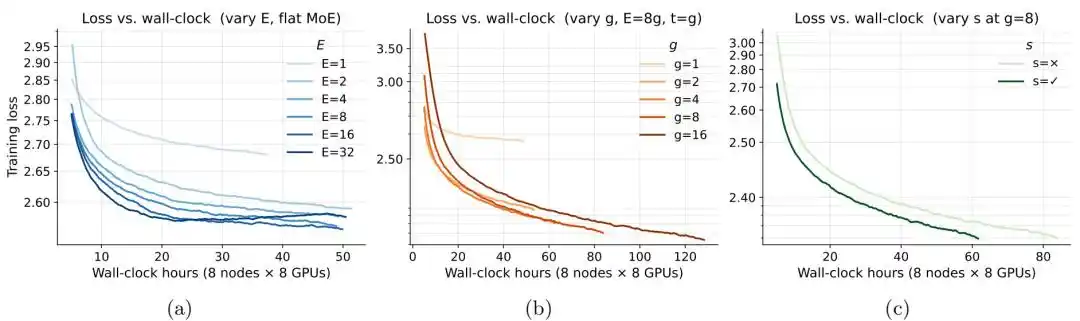
Figure | Training efficiency of the MoE architecture.

14 Foundational Evaluations: Establishing a New On-Device Pareto Frontier

The research team compared MobileMoE with models such as Gemma 3, SmolLM2, Qwen3.5, OLMo 2, and OLMoE-1B-7B under a unified setup across 14 foundational evaluations in five categories: commonsense reasoning, knowledge, science, reading, and reasoning.
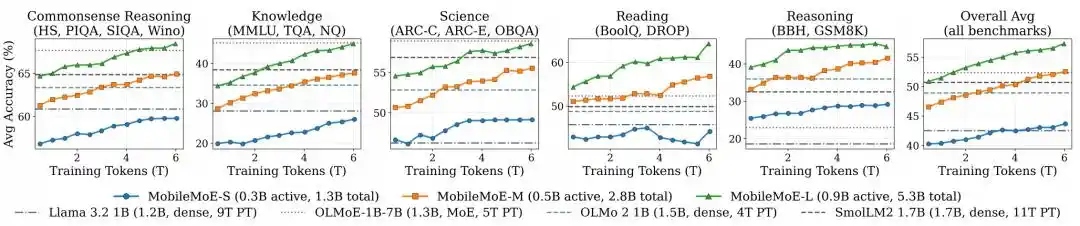
Figure | Pretraining trajectory of MobileMoE.

Comparison results for Base models show that the average score of MobileMoE-M is higher than that of Qwen3.5 2B, and the average score of MobileMoE-L is higher than that of OLMoE-1B-7B, while also requiring a smaller model size. The team also noted that the average score of the Base version of MobileMoE-L is already higher than that of the Instruct version of OLMoE-1B-7B. In terms of training scale, MobileMoE uses about 6T pretraining tokens, which is less than Llama 3.2 1B's 9T and SmolLM2 1.7B's 11T. In the overall comparison of instruction-tuned models, the average accuracy of MobileMoE-M is already close to that of OLMoE-1B-7B, but with both active and total parameters reduced by about 60%.

Figure | Comparison of MobileMoE-Base models.

Advanced Evaluations: More Prominent Advantages in Code and Math Tasks

In advanced evaluations after instruction tuning, MobileMoE performs more prominently on code and math tasks. Taking MobileMoE-L as an example, its average scores in both code and math categories are higher than those of Qwen3.5 2B and OLMoE-1B-7B. However, the research team also notes that in terms of instruction-following and knowledge reasoning capabilities, Qwen3.5 2B remains stronger.
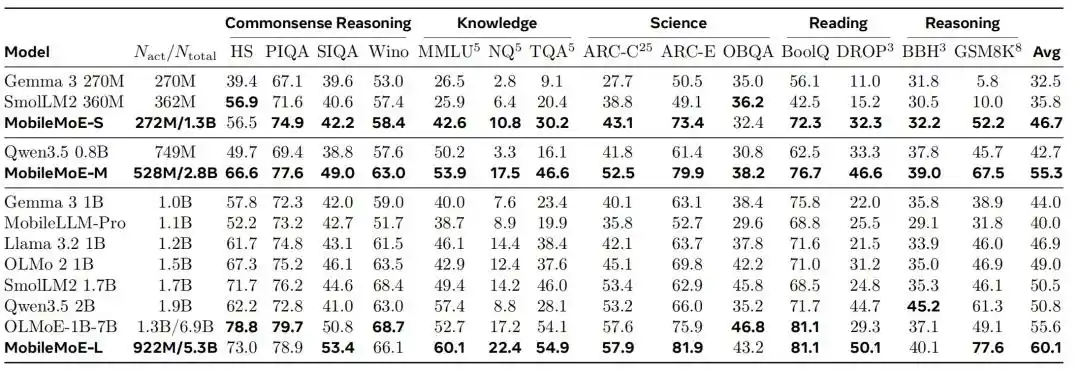
Figure | Comparison of Instruct models on advanced benchmarks.

Quantization and On-Device Deployment: Remains Competitive After INT4, Significant Speedup on Mobile

After quantization, the overall average scores of MobileMoE-S/M/L decreased compared to their respective BF16 versions, but the drops were roughly within 2 to 3 points. Even so, the performance of the INT4 version of MobileMoE-L remained higher than the BF16 version of OLMoE-1B-7B Instruct.

The research team also deployed MobileMoE on Samsung Galaxy S25 and iPhone 16 Pro for testing. The results show that under comparable INT4 weight memory conditions, MobileMoE-S, compared to MobileLLM-Pro, achieved speedups of 1.8-3.8x during the input phase and speedups of 2.2-3.4x during token-by-token generation.

In terms of memory usage, under conditions of Samsung Galaxy S25, 8K context length, and real prompts, the peak RSS of MobileMoE-S was 1.49GB, lower than MobileLLM-Pro's 1.91GB.

Figure | On-device runtime latency.

Limitations and Future Directions

Currently, in terms of higher-order instruction following, knowledge, and reasoning capabilities, the instruction-tuned MobileMoE still lags behind Qwen3.5 2B. The research team believes this gap may be related to more comprehensive post-training. In the future, to narrow this gap, training-side efforts should focus on strengthening distillation, inference-oriented post-training, and multimodal extension.

Furthermore, the research team points out that the memory footprint of MoE on mobile phones varies with input content. Compared to templated inputs, real inputs typically lead to higher memory usage. Testing solely based on templated inputs might underestimate the actual memory pressure in real deployment scenarios. In the future, to more accurately evaluate the real memory performance of on-device MoE, more real-world measurement data is needed.

At the same time, the research team has already completed systematic real-device testing on CPU and GPU backends, but the NPU path remains to be explored. Additionally, the runtime memory footprint of MoE is relatively sensitive to input content. In the future, dynamic routing, expert pruning, mixed-precision quantization, and mobile NPU deployment are all directions for further improving on-device efficiency.

For more technical details, please refer to the original paper.

This article is from the WeChat public account "Academic Headlines" (ID: SciTouTiao), Author: Xia Qiansi


Preguntas relacionadas

QWhat is MobileMoE and what problem does it address?

AMobileMoE is an efficient Mixture of Experts (MoE) language model designed by Meta for on-device deployment on smartphones. It addresses the challenge of deploying large language models (LLMs) with MoE architecture on mobile devices, which traditionally have stringent constraints on memory, compute power, and latency, making them predominantly use dense architectures. MobileMoE aims to provide competitive accuracy with significantly less computational cost than dense baselines.

QWhat key speed improvement did MobileMoE achieve on the iPhone 16 Pro?

AIn real-world testing, MobileMoE-S showed the most significant speed improvement on the iPhone 16 Pro's GPU/MLX backend, achieving up to a 3.8x speedup during the input processing phase.

QWhat are the main stages in the training process of MobileMoE?

AThe training process for MobileMoE consists of four main stages: 1) Pre-training on ~6T tokens with a 2048 context length, 2) Mid-training which extends the context to 8192 and uses ~500B higher-quality tokens, 3) Supervised Fine-Tuning (SFT) on over 80 million open-licensed instruction-following samples, and 4) Quantization-Aware Training (QAT), quantizing most layers to INT4/INT8 while keeping the router at FP32.

QWhat are the primary limitations or future directions mentioned for MobileMoE?

AThe main limitations are that MobileMoE still lags behind models like Qwen3.5 2B in higher-order instruction following and knowledge/reasoning capabilities. Future directions to address this include enhanced distillation, inference-oriented post-training, and multimodal extension. Additionally, MoE's runtime memory usage is sensitive to input content, and deploying on mobile NPUs remains an unexplored avenue for further efficiency gains.

QHow does MobileMoE's performance on code and mathematical tasks compare to other models in advanced evaluations?

AIn advanced evaluations after instruction fine-tuning, MobileMoE showed more pronounced advantages on code and mathematical tasks. For example, the MobileMoE-L model achieved higher average scores on code and math benchmarks compared to both Qwen3.5 2B and OLMoE-1B-7B.

Lecturas Relacionadas

"Water Scarcity": The Hidden Fatal Flaw of AI Infrastructure

“Water Scarcity: The Hidden Vulnerability of AI Infrastructure” In June 2026, SpaceX revised its IPO prospectus to highlight a core resource constraint alongside power and processors: water. This move signals a pivotal shift where water scarcity has transformed from an operational cost to a major, uncontrollable investment risk, directly threatening AI data center expansion. The scale of the problem is immense. U.S. data centers consumed an estimated 17 billion gallons of water for direct cooling in 2023, with indirect water use for power generation exceeding 211 billion gallons. Giants like Google alone use billions of gallons annually, with single sites consuming volumes equivalent to a medium-sized city. This water is largely “consumptive,” evaporated into the atmosphere and lost. This massive demand is colliding with scarcity. Tech companies are building “water tigers” in arid regions, sparking community protests in places like Mexico and Arizona, where data centers can legally use millions of gallons daily—enough for tens of thousands of residents. These conflicts are not about illegality, but about a mismatch between historic water allocation frameworks and new, colossal demand. The consequences are real. Community opposition, largely centered on water, has reportedly stalled or canceled $64 billion in U.S. data center projects over two years. Simultaneously, investors are pressuring companies for greater water footprint transparency, viewing it as a financial risk, not just an ESG metric. Technological solutions like air or liquid cooling involve trade-offs between water and electricity use, with final choices dictated by local constraints. The irony is stark: while industry leaders envision AI as a utility “like water,” its physical infrastructure is straining real-world water supplies. The race for AI supremacy may ultimately be governed not by the fastest chip, but by the slowest water meter.

marsbitHace 3 min(s)

"Water Scarcity": The Hidden Fatal Flaw of AI Infrastructure

marsbitHace 3 min(s)

Global Card Issuance Enters a Compliance-Driven Era: WasabiCard is Building the Next-Generation Payment Infrastructure

Global card issuance is entering a compliance-driven era, with WasabiCard building next-generation payment infrastructure. The platform asserts that as stablecoins increasingly enter cross-border payments, corporate settlements, and global commerce, the industry is shifting focus from "availability" and "growth-driven" models to long-term, compliant operation under global frameworks. Competition will center on sustainable compliance and global infrastructure capabilities. Stablecoins are evolving from on-chain assets into key payment tools in global business, with card issuance acting as critical infrastructure connecting digital assets to traditional payment networks like Visa and Mastercard. This expansion has revealed structural issues, including cross-regional issuance, BIN resource management, and insufficient AML and risk controls. In response, the industry is moving away from reliance on "grey efficiency" towards prioritizing compliance, risk management, and long-term operational stability. WasabiCard outlines its strategy: collaborating with licensed principals and local partners for localized operations, building robust KYC/AML systems, strictly separating commercial and consumer BIN usage, and enhancing global issuance, payment, and cross-border fund flow infrastructure. The goal is to build stable, scalable payment infrastructure amid evolving global regulations, shifting industry competition from scale to infrastructure capability. As stablecoins integrate further with global commerce, payment infrastructure will become a fundamental, embedded component of internet business. WasabiCard will continue to develop capabilities in global card issuance, stablecoin payments, cross-border fund flows, and API-driven financial workflows.

marsbitHace 14 min(s)

Global Card Issuance Enters a Compliance-Driven Era: WasabiCard is Building the Next-Generation Payment Infrastructure

marsbitHace 14 min(s)

Zhou Hang: How Much Is SpaceX Really Worth?

**Zhou Hang: How Much is SpaceX Really Worth?** SpaceX, arguably one of the greatest industrial companies of the past 50 years, is reportedly targeting a staggering $1.75 trillion valuation in its potential IPO. However, the author argues this figure is inflated by approximately $1.25 trillion when assessed through standard financial metrics. The analysis begins by acknowledging SpaceX's undeniable success: drastically reducing launch costs, achieving near-monopoly in commercial launches, and building the strategic Starlink network. Its achievement surpasses even Tesla's, given it disrupted a state-monopolized industry. Despite this greatness, a $1.75 trillion valuation places SpaceX above the combined market cap of Boeing, Lockheed Martin, Northrop Grumman, RTX, and General Dynamics. Projecting optimistic 2030 revenues of $50-80 billion and applying generous tech-sector multiples yields a "reasonable" valuation range of $500 billion to $1.2 trillion. The $1.25 trillion gap is attributed to three non-financial premiums: 1. **Long-term vision premium** for future Starship-enabled markets (e.g., space-based computing). 2. **Sovereign asset/strategic premium**, as SpaceX is deeply integrated into U.S. national security. 3. **Retail narrative/Musk cult premium**, driven by a heroic story and personal following. Post-IPO, three scenarios are outlined: valuation solidifying (25% probability), sideways volatility as narrative outpaces reality (50%), or a re-rating down to $800B-$1.2T if execution falters or Musk-related risks emerge (25%). The probability-weighted expected value is $1.3-1.5 trillion, suggesting negative expected returns for those buying at the IPO price. The conclusion advises investors to separate the company's excellence from its stock price. Buying at the IPO likely prices in excessive optimism. A more prudent strategy would be to wait for key milestones (e.g., Starship V3 stability) or a significant price correction before investing, or to treat an early purchase as a long-term, high-conviction hold with limited position size, not a short-term bet.

链捕手Hace 18 min(s)

Zhou Hang: How Much Is SpaceX Really Worth?

链捕手Hace 18 min(s)

Trading

Spot
Futuros
活动图片




