Rules Change Mid-Game, Polymarket’s Billion-Dollar Bitcoin Prediction Market Mired in Settlement Controversy

foresightnews_apiPublicado a 2026-06-05Actualizado a 2026-06-05

Resumen

A nearly $150 million prediction market contract on Polymarket is in turmoil after the platform refused to settle in favor of traders who correctly predicted that MicroStrategy (now Strategy) would sell Bitcoin. The core dispute revolves around a sale of 32 BTC, which occurred between May 26-31 but was officially disclosed in an SEC 8-K filing on June 1. The original contract stated it would resolve to "Yes" if Strategy sold any Bitcoin before May 31, 11:59 PM ET, using public disclosures and on-chain data as proof. After the filing on June 1, traders who saw the disclosure rushed to buy "Yes" contracts, believing it was conclusive evidence. However, Polymarket's operators later added a rule that the disclosure itself must occur by the deadline, not just the transaction, invalidating the filing as proof. This retroactive rule change has sparked accusations of market manipulation, leaving traders like "willo2," who invested $527,000, facing total losses. The controversy highlights a deeper structural flaw in Polymarket's decentralized settlement system, which relies on UMA's optimistic oracle. Disputed resolutions are ultimately decided by a vote among UMA token holders, a mechanism critics say is vulnerable to manipulation by large holders ("whales") who can vote in their own financial interest rather than on objective facts. Data suggests a high concentration of voting power and significant overlap between voters and Polymarket traders. The dispute emerges as prediction m...


By: Oluwapelumi Adejumo

Compiled by: Saoirse, Foresight News


A nearly $150 million prediction market contract is in chaos: the Polymarket platform is refusing to pay out winnings to traders who accurately predicted that Strategy would sell a portion of its Bitcoin. The core dispute centers on a mismatch between the actual transaction time and the official disclosure time, exposing fundamental systemic flaws in how decentralized prediction markets handle the settlement of large-scale contracts. Traders are now locked in a tug-of-war over a fine-print rule, facing the risk of having their expected millions in profits wiped out.


Strategy (formerly MicroStrategy), an asset management firm holding nearly $60 billion in Bitcoin, filed a regulatory 8-K form on June 1, confirming it sold 32 Bitcoins between May 26 and May 31, with a market value of approximately $2.5 million. For participants in Polymarket's "Will Strategy sell Bitcoin before May 31?" contract, this regulatory disclosure was supposed to be irrefutable proof for the "Yes" bet. However, the current disputed ruling heavily favors the "No" camp.


After the contract deadline, Polymarket's operators added a new rule: since the official disclosure of this sale landed on June 1, exceeding the deadline, the transaction would not be considered valid evidence for the contract. This last-minute rule change has sparked numerous accusations of market manipulation. At a critical juncture where the prediction market sector is striving for compliance with traditional finance, its decentralized, lottery-like settlement mechanisms are facing intense industry scrutiny.


Complete Timeline of the Disputed Contract


The controversy stems from the contract's original terms: the contract would be settled as "Yes" if Strategy sold any amount of Bitcoin before 11:59 PM ET on May 31. The rules explicitly stated that official company disclosure documents and on-chain data were the two primary sources for adjudication.
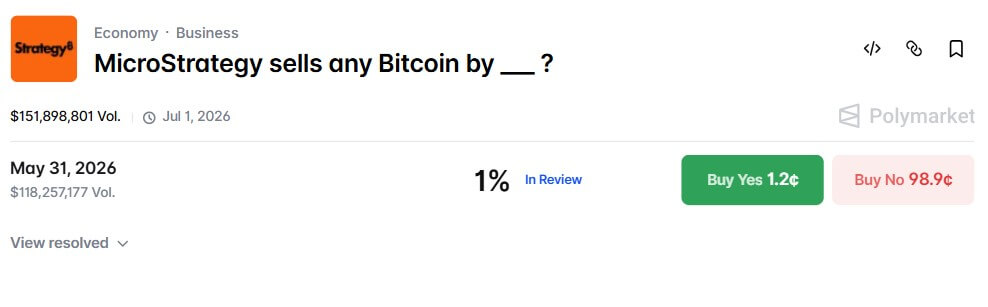

Polymarket contract regarding the disputed Bitcoin sale by Strategy (Source: Polymarket)


When Strategy submitted the mandatory disclosure document on June 1, trading for this contract remained open. Several traders, spotting the disclosure and perceiving an arbitrage opportunity, rushed to enter the market: user 'willo2' invested $527,000 to go all-in on "Yes," while the market odds still implied an 80% probability of a "No" outcome. This trader initially expected to secure a 20% arbitrage profit. However, as large buy orders flooded in, Polymarket retroactively added the rule, deeming the disclosure date invalid because it was past the deadline. As a result, this user lost their entire principal.


Willo posted on X platform in protest: "This limit was never written in the contract rules, it makes no logical sense, and Polymarket itself hasn't followed this standard before. If the disclosure had to be made by May 31, trading should have been halted directly at that time, but the market continued to operate normally afterward."


Industry analysts collectively criticized the platform's contradictory operations. Jeff Dorman, Chief Investment Officer of Arca, pointed out a fatal flaw: if the contract strictly required May 31 midnight as the final cutoff, the platform should have closed trading at that exact time. Allowing users to open positions on June 1 while later retroactively demanding the disclosure date align with the deadline is tantamount to setting a trap for traders who followed the contract's written rules. Jonatan Pallesen, a data researcher specializing in decentralized projects, stated bluntly:


The platform's failure to explicitly state hidden conventions upfront and its post-hoc addition of rules constitutes implicit fraud; institutional players familiar with the platform's unwritten rules can exploit these gaps to harvest ordinary retail traders, who default to expecting payouts based on factual transactions but end up suffering losses.


UMA Oracle Reveals Underlying Structural Flaws


The Strategy wager dispute has evolved from a single contract conflict into a collective interrogation of Polymarket's entire settlement system. Unlike traditional exchanges that rely on centralized clearinghouses and legal departments to execute derivatives settlements, Polymarket outsources the fact-finding entirely to the UMA (Universal Market Access) optimistic oracle. UMA's operating logic is: token holders determine disputed outcomes through on-chain voting; a trader can initiate a dispute by posting a $750 bond. If the disagreement persists unresolved, the final verdict is determined by a vote among UMA token holders weighted by their token holdings, based on stake proportion rather than objective fact-checking.


Many industry insiders warn that this system is highly susceptible to manipulation by whales. Prominent crypto analyst Eric Conner noted that token voting mechanisms inherently suffer from design flaws: large holders (whales) can exploit ambiguous rules to protect their own positions, disregarding objective facts to overturn settlement results and avoid significant losses.


Data from a Wall Street Journal investigation corroborates these concerns: in the vast majority of disputed orders on Polymarket, the top ten wallets hold over half the voting power; approximately 60% of active UMA voting accounts are linked to Polymarket trading addresses, and in one-fifth of dispute cases, voters themselves have a direct financial stake in the outcome. In the first five months of 2026, disputed orders on Polymarket exceeded 1,150, surpassing the platform's total for the entire previous year; constrained by its decentralized architecture, the platform's official team has no authority to overturn the final rulings issued by UMA's token vote.


Rapid Industry Expansion vs. The Reality of Decentralized Mechanisms


This billion-dollar dispute coincides with a critical window for the large-scale adoption of prediction markets. Over the past two years, Polymarket and Kalshi have worked vigorously to shed the "unregulated crypto casino" label and deeply integrate with the traditional financial ecosystem. DeFiLlama data shows that in May 2026, the combined trading volume of the two platforms exceeded $10 billion, a tenfold year-on-year surge; the platforms have successively secured data and content partnerships with the New York Stock Exchange, Dow Jones, Associated Press, and Fox News.


The regulatory landscape for the industry has fluctuated: in 2022, the U.S. Commodity Futures Trading Commission (CFTC) ordered Polymarket to cease U.S. operations and relocate overseas; Kalshi also engaged in prolonged litigation with the CFTC over the compliance of event contracts until winning a federal court case in late 2024. Following the 2024 U.S. election, regulatory winds shifted. Polymarket secured a U.S. federal derivatives license, with the CFTC explicitly stating that event contracts fall under commodity derivatives and are within its regulatory purview. CFTC Chairman Michael S. Selig stated: "Event contracts can help entities and individuals hedge against event risks and optimize portfolio exposure, while also conveying market expectations about events. The product attributes fall within the CFTC's regulatory responsibilities."


Even with compliance licenses, the settlement logic of decentralized prediction markets remains experimental. Traditional secondary markets rely on strong regulation and ample liquidity to anchor prices to real fundamentals; whereas in token-vote-based prediction markets, the definition of "factual truth" is always determined by voting games. Until adjudication mechanisms are perfected, traders in the rapidly expanding prediction market sector will remain subject to unwritten rules and on-chain voting juries that exist beyond the black-and-white text of contracts.

Preguntas relacionadas

QWhat was the core issue that led to the settlement dispute on Polymarket's $150 million Bitcoin prediction contract?

AThe core issue was a mismatch between the actual transaction time and the official disclosure time, coupled with a rule change by Polymarket after the contract deadline. The platform ruled that MicroStrategy's sale of 32 BTC did not count for settlement because the official SEC 8-K filing disclosing the sale occurred on June 1st, after the contract's cutoff of May 31st at 23:59 ET, even though the sales themselves happened between May 26-31.

QHow did the user 'willo2' allegedly lose their investment in the disputed Polymarket contract?

AUser 'willo2' invested $527,000 to buy 'Yes' shares after MicroStrategy's 8-K filing was published on June 1st, believing the confirmed sale guaranteed a payout. However, Polymarket later applied a new rule stating the disclosure had to occur by the May 31st deadline to be valid. Since the filing was on June 1st, the 'No' outcome was favored, causing 'willo2' to lose their entire principal.

QWhat is the role of UMA's optimistic oracle in Polymarket's dispute resolution process, and what criticism has it faced?

AUMA's optimistic oracle is used to settle disputes on Polymarket. Its process involves token holders voting on-chain to determine the outcome. It has been criticized for a structural defect where large token holders (whales) can manipulate votes to favor their own positions, ignoring objective facts. Data shows the top 10 wallets hold over half the voting power, and many voters have direct ties to Polymarket addresses.

QWhat recent regulatory developments were mentioned regarding prediction markets like Polymarket and Kalshi?

AThe article mentions that after a 2024 court victory for Kalshi and a shifting regulatory landscape post-2024 elections, Polymarket secured a federal derivatives license in the U.S. The CFTC chairman stated that event contracts fall under the agency's jurisdiction as commodity derivatives, helping entities hedge risk and convey market expectations.

QAccording to the article, what fundamental tension exists in decentralized prediction markets as they scale?

AThe fundamental tension is between the industry's rapid growth and the experimental nature of its decentralized settlement logic. While traditional markets rely on strong regulation and liquidity to anchor prices to fundamentals, in token-voting prediction markets, the 'truth' or settlement outcome is ultimately determined by voting博弈 (game theory and博弈), leaving traders subject to unwritten rules and on-chain voting juries.

Lecturas Relacionadas

Near Returns to the AI Stage: Transformation into a Public Chain Due to 'Payroll Difficulties,' Agent and Privacy Emerge as New Growth Narratives

NEAR Returns to AI Origins: From Payroll Struggles to Blockchain, Now Focusing on AI Agents and Privacy NEAR Protocol's journey began not with grand blockchain ambitions, but from a practical hurdle: its AI startup founders, including Transformer paper co-author Illia Polosukhin, couldn't efficiently pay international developers in 2017. This led them to pivot and build a high-performance, scalable blockchain. After years navigating various crypto narratives like sharding and cross-chain interoperability, NEAR is now leveraging its AI roots to re-enter the AI arena. A key driver is its "NEAR Intents" layer, which abstracts complex cross-chain transactions. Users simply state their goal (e.g., swap BTC for ETH), and a solver network finds the optimal route. This system has processed over $20B in cross-chain volume, generating significant fee revenue. A major growth area is private transactions via "Confidential Intents/Swaps," which hide trade details until settlement to protect against MEV and front-running. Remarkably, private swaps recently accounted for over 40% of NEAR's transaction volume, highlighting strong demand but also potential regulatory scrutiny. With its AI-founder pedigree, NEAR is positioning itself at the intersection of blockchain, AI agents, and privacy, aiming to become infrastructure for the emerging agent economy while navigating the challenges of its rapid adoption.

marsbitHace 2 hora(s)

Near Returns to the AI Stage: Transformation into a Public Chain Due to 'Payroll Difficulties,' Agent and Privacy Emerge as New Growth Narratives

marsbitHace 2 hora(s)

From Ethereum to AI's 'CROPS': What Exactly is This Set of 'Slow Variables' That Vitalik Repeatedly Emphasizes?

In recent discussions, Vitalik Buterin has frequently emphasized the concept of "CROPS," a framework defining core values for Ethereum's development. CROPS stands for Censorship Resistance, Capture Resistance, Open Source, Privacy, and Security. Initially outlined in the Ethereum Foundation's "EF Mandate," it represents a commitment to user sovereignty, ensuring that the network resists external control, remains open, protects privacy, and prioritizes security. The relevance of CROPS extends beyond Ethereum's foundational principles, becoming crucial in the context of AI integration. As AI agents begin handling wallet operations and automated transactions, the risk increases that users may cede control over their digital assets, privacy, and intentions to centralized AI service providers. A "CROPS AI" would therefore emphasize local execution where possible, privacy-preserving remote model calls (e.g., using zero-knowledge proofs), and transparent, verifiable processes to maintain user agency. Vitalik highlights a significant convergence between "CROPS Ethereum access layer" and "CROPS AI." Both address the same fundamental challenge: how users can access powerful services—be it blockchain data via RPCs or AI models—without exposing sensitive information or relinquishing ultimate control. This intersection points toward a future digital entry point that is more private, secure, and user-controlled. Ultimately, CROPS is not merely an abstract ideal but a practical guidepost. It steers development—from protocol resilience and wallet design to AI agent safety—towards a future where users retain self-sovereignty even as digital systems grow more complex and powerful. In an era of accelerating AI adoption, these "slow variables" of censorship resistance, openness, privacy, and security may define Ethereum's enduring value.

marsbitHace 2 hora(s)

From Ethereum to AI's 'CROPS': What Exactly is This Set of 'Slow Variables' That Vitalik Repeatedly Emphasizes?

marsbitHace 2 hora(s)

Silicon Valley 'Startup Guru' Steve Hoffman: Web3 + AI Could Be a Trap

Silicon Valley investor and "Godfather of Startups" Steve Hoffman warns that combining Web3 with AI is likely a trap, not a promising venture. In an interview, Hoffman argues that while AI is a foundational technology touching all industries, Web3 adds complexity, friction, and regulatory risk without solving mainstream consumer or business needs. He advises founders to focus on deep, specialized applications where startups can out-iterate giants, rather than on generic features easily replicated by large tech companies. Hoffman observes that Silicon Valley will lead foundational AI research, while China excels at rapid, large-scale application and commercialization, particularly in robotics. He stresses that AI-driven autonomous agents capable of collaborative, multi-step tasks are 2-4 years away, which will cause significant job displacement. The solution is not to slow AI but to redesign business models around human-AI collaboration and reform social systems like education and retraining. For startups, Hoffman recommends focusing on vertical, expertise-heavy domains to build defensibility. He sees major opportunities in AI fraud detection and cybersecurity. Key founder mindsets include systemic thinking over feature-focus, relentless customer centricity, building adaptive teams, and deeply understanding AI's capabilities and limits. Hoffman is also leading a non-profit initiative to establish university centers aimed at training future leaders in responsible, human-value-aligned AI innovation.

marsbitHace 3 hora(s)

Silicon Valley 'Startup Guru' Steve Hoffman: Web3 + AI Could Be a Trap

marsbitHace 3 hora(s)

Token Inefficient, Economy Tokenless

The article "Tokens Aren't Economical, Economics Aren't Tokenized" analyzes a pivotal shift in the AI industry from a technology-driven narrative to one dominated by capital efficiency. It highlights two concurrent trends: a severe capital shortage due to the exorbitant and recurring costs of compute (e.g., OpenAI's high burn rate) and a wave of corporate spin-offs where major tech companies are separating their AI units (like Kuaishou's Kling and Baidu's Kunlunxin). The core argument is that AI's "anti-internet" business model, where user growth increases costs rather than profits, has created a disconnect between high valuations and actual cash flow. Spin-offs address this by allowing AI assets to be valued independently. Within a parent company, they are seen as cost centers, but as standalone entities, they are priced based on their growth potential and scarcity in the primary market, leading to massive valuation premiums (e.g., Kling's estimated value tripling post-spin-off). The industry is at an inflection point, moving from "model worship" to "value realization." The competition is evolving from a pure compute (GPU) race to a broader focus on systemic efficiency and full-stack engineering (involving CPUs and orchestration) to achieve viable commercialization. The year 2026 is framed as a critical moment where the industry must definitively answer how to economically translate AI capability into tangible business value, reshaping the sector's future power structure.

marsbitHace 4 hora(s)

Token Inefficient, Economy Tokenless

marsbitHace 4 hora(s)

Trading

Spot
Futuros

Artículos destacados

Qué es BITCOIN

Entendiendo HarryPotterObamaSonic10Inu (ERC-20) y Su Posición en el Espacio Cripto En los últimos años, el mercado de criptomonedas ha sido testigo de un aumento en la popularidad de las monedas meme, capturando el interés no solo de los comerciantes, sino también de aquellos que buscan compromiso comunitario y valor de entretenimiento. Entre estos tokens únicos se encuentra HarryPotterObamaSonic10Inu (ERC-20), un proyecto intrigante que mezcla referencias culturales en el tejido de las criptomonedas. Este artículo profundiza en los aspectos clave de HarryPotterObamaSonic10Inu, explorando sus mecanismos, ethos impulsado por la comunidad y su relación con el paisaje cripto más amplio. ¿Qué es HarryPotterObamaSonic10Inu (ERC-20)? Como su nombre sugiere, HarryPotterObamaSonic10Inu es una moneda meme construida sobre la blockchain de Ethereum, clasificada bajo el estándar ERC-20. A diferencia de las criptomonedas tradicionales que pueden enfatizar la utilidad práctica o el potencial de inversión, este token prospera en el valor de entretenimiento y la fuerza de su comunidad. El proyecto tiene como objetivo fomentar un entorno donde los usuarios comprometidos puedan reunirse, compartir ideas y participar en actividades inspiradas por diversos fenómenos culturales. Una característica notable de HarryPotterObamaSonic10Inu es su cero impuestos en las transacciones. Este atractivo elemento tiene como objetivo incentivar el comercio y la participación comunitaria, sin cargos adicionales que puedan disuadir a los comerciantes de pequeña escala. El suministro total de la moneda está establecido en mil millones de tokens, una cifra que marca su intención de mantener una circulación sustancial dentro de la comunidad. Creador de HarryPotterObamaSonic10Inu (ERC-20) Los orígenes de HarryPotterObamaSonic10Inu están algo envueltos en misterio; los detalles sobre el creador siguen siendo desconocidos. El desarrollo de este token carece de un equipo identificable o de un plan explícito, lo cual no es inusual dentro del sector de monedas meme. En cambio, el proyecto ha surgido de manera orgánica, con su progreso muy dependiente del entusiasmo y la participación de su comunidad. Inversores de HarryPotterObamaSonic10Inu (ERC-20) En cuanto a inversiones externas y respaldo, HarryPotterObamaSonic10Inu también sigue siendo ambiguo. El token no lista ninguna fundación de inversión conocida o apoyo organizacional significativo. En cambio, la savia del proyecto es su comunidad de base, que informa su crecimiento y sostenibilidad a través de la acción colectiva y el compromiso en el espacio cripto. ¿Cómo Funciona HarryPotterObamaSonic10Inu (ERC-20)? Como una moneda meme, HarryPotterObamaSonic10Inu opera principalmente fuera de los marcos tradicionales que a menudo rigen el valor de los activos. Hay varios aspectos distintivos que definen cómo funciona el proyecto: Transacciones Sin Impuestos: Sin tarifas impositivas en las transacciones, los usuarios pueden comprar y vender el token libremente sin preocuparse por costos ocultos. Compromiso Comunitario: El proyecto prospera en la interacción comunitaria, aprovechando plataformas de redes sociales para crear entusiasmo y facilitar la participación. Las discusiones, el intercambio de contenido y el compromiso son elementos cruciales que ayudan a expandir su alcance y fomentar la lealtad entre los seguidores. Sin Utilidad Práctica: Cabe señalar que HarryPotterObamaSonic10Inu no ofrece utilidad concreta dentro del ecosistema financiero. Más bien, se clasifica como un token principalmente para actividades de entretenimiento y comunitarias. Referencia Cultural: El token incorpora astutamente elementos de la cultura popular para atraer interés, conectando con entusiastas de los memes y seguidores de las criptomonedas por igual. HarryPotterObamaSonic10Inu ejemplifica cómo las monedas meme operan de manera diferente a los proyectos de criptomonedas más tradicionales, ingresando al mercado como construcciones sociales innovadoras en lugar de activos utilitarios. Cronología de HarryPotterObamaSonic10Inu (ERC-20) La historia de HarryPotterObamaSonic10Inu está marcada por varios hitos notables: Creación: El token surgió de un meme viral, capturando la imaginación de muchos entusiastas de las criptomonedas. Las fechas específicas de creación no están disponibles, subrayando su ascenso orgánico. Listado en Exchanges: HarryPotterObamaSonic10Inu ha llegado a varios exchanges, permitiendo un acceso y comercio más fácil por parte de la comunidad. Iniciativas de Compromiso Comunitario: Actividades continuas destinadas a mejorar la interacción comunitaria, incluyendo concursos, campañas en redes sociales y generación de contenido por parte de fanáticos y defensores. Planes de Expansión Futuros: La hoja de ruta del proyecto incluye el lanzamiento de una colección de NFT, mercancía y un sitio de comercio electrónico relacionado con sus temas culturales, involucrando aún más a la comunidad e intentando añadir más dimensiones a su ecosistema. Puntos Clave Sobre HarryPotterObamaSonic10Inu (ERC-20) Naturaleza Impulsada por la Comunidad: El proyecto prioriza la participación colectiva y la creatividad, asegurando que la involucración de los usuarios esté a la vanguardia de su desarrollo. Clasificación como Moneda Meme: Representa la epítome de las criptomonedas basadas en el entretenimiento, diferenciándose de los vehículos de inversión tradicionales. Sin Afiliación Directa con Bitcoin: A pesar de la similitud en el nombre del ticker, HarryPotterObamaSonic10Inu es distinto y no tiene relación con Bitcoin u otras criptomonedas establecidas. Enfoque en la Colaboración: HarryPotterObamaSonic10Inu está diseñado para crear un espacio para la colaboración y el intercambio de historias entre sus poseedores, proporcionando una vía para la creatividad y el vínculo comunitario. Perspectivas Futuras: La ambición de expandirse más allá de su premisa inicial hacia NFTs y mercancías describe un camino para que el proyecto potencialmente ingrese a avenidas más tradicionales dentro de la cultura digital. A medida que las monedas meme continúan capturando la imaginación de la comunidad de criptomonedas, HarryPotterObamaSonic10Inu (ERC-20) se destaca debido a sus lazos culturales y su enfoque centrado en la comunidad. Si bien puede no encajar en el molde típico de un token impulsado por la utilidad, su esencia radica en la alegría y la camaradería fomentadas entre sus seguidores, destacando la naturaleza en evolución de las criptomonedas en una era cada vez más digital. A medida que el proyecto continúa desarrollándose, será importante observar cómo las dinámicas comunitarias influyen en su trayectoria en el cambiante paisaje de la tecnología blockchain.

1.7k Vistas totalesPublicado en 2024.04.01Actualizado en 2024.12.03

Qué es BITCOIN

Cómo comprar BTC

¡Bienvenido a HTX.com! Hemos hecho que comprar Bitcoin (BTC) sea simple y conveniente. Sigue nuestra guía paso a paso para iniciar tu viaje de criptos.Paso 1: crea tu cuenta HTXUtiliza tu correo electrónico o número de teléfono para registrarte y obtener una cuenta gratuita en HTX. Experimenta un proceso de registro sin complicaciones y desbloquea todas las funciones.Obtener mi cuentaPaso 2: ve a Comprar cripto y elige tu método de pagoTarjeta de crédito/débito: usa tu Visa o Mastercard para comprar Bitcoin (BTC) al instante.Saldo: utiliza fondos del saldo de tu cuenta HTX para tradear sin problemas.Terceros: hemos agregado métodos de pago populares como Google Pay y Apple Pay para mejorar la comodidad.P2P: tradear directamente con otros usuarios en HTX.Over-the-Counter (OTC): ofrecemos servicios personalizados y tipos de cambio competitivos para los traders.Paso 3: guarda tu Bitcoin (BTC)Después de comprar tu Bitcoin (BTC), guárdalo en tu cuenta HTX. Alternativamente, puedes enviarlo a otro lugar mediante transferencia blockchain o utilizarlo para tradear otras criptomonedas.Paso 4: tradear Bitcoin (BTC)Tradear fácilmente con Bitcoin (BTC) en HTX's mercado spot. Simplemente accede a tu cuenta, selecciona tu par de trading, ejecuta tus trades y monitorea en tiempo real. Ofrecemos una experiencia fácil de usar tanto para principiantes como para traders experimentados.

5.1k Vistas totalesPublicado en 2024.12.12Actualizado en 2026.06.02

Cómo comprar BTC

Qué es $BITCOIN

ORO DIGITAL ($BITCOIN): Un Análisis Integral Introducción al ORO DIGITAL ($BITCOIN) ORO DIGITAL ($BITCOIN) es un proyecto basado en blockchain que opera en la red Solana, cuyo objetivo es combinar las características de los metales preciosos tradicionales con la innovación de las tecnologías descentralizadas. Aunque comparte un nombre con Bitcoin, a menudo referido como “oro digital” debido a su percepción como un refugio de valor, ORO DIGITAL es un token separado diseñado para crear un ecosistema único dentro del paisaje Web3. Su meta es posicionarse como un activo digital alternativo viable, aunque los detalles sobre sus aplicaciones y funcionalidades aún están en desarrollo. ¿Qué es ORO DIGITAL ($BITCOIN)? ORO DIGITAL ($BITCOIN) es un token de criptomoneda diseñado explícitamente para su uso en la blockchain de Solana. A diferencia de Bitcoin, que proporciona un papel de almacenamiento de valor ampliamente reconocido, este token parece centrarse en aplicaciones y características más amplias. Aspectos notables incluyen: Infraestructura Blockchain: El token está construido sobre la blockchain de Solana, conocida por su capacidad para manejar transacciones de alta velocidad y bajo costo. Dinámicas de Suministro: ORO DIGITAL tiene un suministro máximo limitado a 100 cuatrillones de tokens (100P $BITCOIN), aunque los detalles sobre su suministro circulante no se han divulgado actualmente. Utilidad: Si bien las funcionalidades precisas no están delineadas explícitamente, hay indicios de que el token podría ser utilizado para diversas aplicaciones, potencialmente involucrando aplicaciones descentralizadas (dApps) o estrategias de tokenización de activos. ¿Quién es el Creador de ORO DIGITAL ($BITCOIN)? En la actualidad, la identidad de los creadores y el equipo de desarrollo detrás de ORO DIGITAL ($BITCOIN) sigue siendo desconocida. Esta situación es típica entre muchos proyectos innovadores dentro del espacio blockchain, particularmente aquellos alineados con las finanzas descentralizadas y fenómenos de monedas meme. Si bien tal anonimato puede fomentar una cultura impulsada por la comunidad, intensifica las preocupaciones sobre la gobernanza y la responsabilidad. ¿Quiénes son los Inversores de ORO DIGITAL ($BITCOIN)? La información disponible indica que ORO DIGITAL ($BITCOIN) no tiene patrocinadores institucionales conocidos ni inversiones destacadas de capital de riesgo. El proyecto parece operar en un modelo de peer-to-peer centrado en el apoyo y la adopción de la comunidad en lugar de rutas de financiamiento tradicionales. Su actividad y liquidez se sitúan principalmente en intercambios descentralizados (DEX), como PumpSwap, en lugar de plataformas de trading centralizadas establecidas, lo que resalta aún más su enfoque de base. Cómo Funciona ORO DIGITAL ($BITCOIN) Los mecanismos operativos de ORO DIGITAL ($BITCOIN) pueden elaborarse en función de su diseño blockchain y atributos de red: Mecanismo de Consenso: Al aprovechar el único proof-of-history (PoH) de Solana combinado con un modelo de proof-of-stake (PoS), el proyecto asegura una validación de transacciones eficiente que contribuye al alto rendimiento de la red. Tokenómica: Si bien los mecanismos deflacionarios específicos no se han detallado extensamente, el vasto suministro máximo de tokens implica que podría atender microtransacciones o casos de uso nicho que aún están por definirse. Interoperabilidad: Existe el potencial de integración con el ecosistema más amplio de Solana, incluyendo varias plataformas de finanzas descentralizadas (DeFi). Sin embargo, los detalles sobre integraciones específicas permanecen no especificados. Cronología de Eventos Clave Aquí hay una cronología que destaca hitos significativos relacionados con ORO DIGITAL ($BITCOIN): 2023: El despliegue inicial del token ocurre en la blockchain de Solana, marcado por su dirección de contrato. 2024: ORO DIGITAL gana visibilidad al estar disponible para trading en intercambios descentralizados como PumpSwap, permitiendo a los usuarios comerciar contra SOL. 2025: El proyecto presencia actividad de trading esporádica y potencial interés en compromisos liderados por la comunidad, aunque no se han documentado asociaciones notables o avances técnicos hasta el momento. Análisis Crítico Fortalezas Escalabilidad: La infraestructura subyacente de Solana soporta altos volúmenes de transacciones, lo que podría mejorar la utilidad de $BITCOIN en varios escenarios de transacción. Accesibilidad: El potencial bajo precio de trading por token podría atraer a inversores minoristas, facilitando una participación más amplia debido a oportunidades de propiedad fraccionada. Riesgos Falta de Transparencia: La ausencia de patrocinadores, desarrolladores o un proceso de auditoría conocidos públicamente puede generar escepticismo sobre la sostenibilidad y confiabilidad del proyecto. Volatilidad del Mercado: La actividad de trading depende en gran medida del comportamiento especulativo, lo que puede resultar en una volatilidad de precios significativa y en incertidumbre para los inversores. Conclusión ORO DIGITAL ($BITCOIN) surge como un proyecto intrigante pero ambiguo dentro del ecosistema de Solana en rápida evolución. Si bien intenta aprovechar la narrativa del “oro digital”, su alejamiento del papel establecido de Bitcoin como refugio de valor subraya la necesidad de una diferenciación más clara de su utilidad y estructura de gobernanza previstas. La aceptación y adopción futura dependerán probablemente de abordar la actual opacidad y de definir sus estrategias operativas y económicas de manera más explícita. Nota: Este informe abarca información sintetizada disponible hasta octubre de 2023, y pueden haber ocurrido desarrollos más allá del período de investigación.

83 Vistas totalesPublicado en 2025.05.13Actualizado en 2025.05.13

Qué es $BITCOIN

Discusiones

Bienvenido a la comunidad de HTX. Aquí puedes mantenerte informado sobre los últimos desarrollos de la plataforma y acceder a análisis profesionales del mercado. A continuación se presentan las opiniones de los usuarios sobre el precio de BTC (BTC).

活动图片