Robinhood Gains a New Batch of Stock Investors, the Oldest is 1 Year Old, the Youngest is -3 Years Old

marsbitPublicado a 2026-04-08Actualizado a 2026-04-08

Resumen

On April 6, the U.S. Treasury announced that Robinhood, in collaboration with BNY Mellon, has been selected as the broker and initial custodian for the "Trump Accounts" (also known as 530A accounts). Established under the "Big and Beautiful" Act authorized by former President Trump in June 2025, the program aims to create tax-advantaged investment accounts for children born between January 1, 2025, and January 1, 2029. Each account will receive an initial $1,000 from the federal government. Private donations, such as Michael Dell’s $6.25 billion contribution, will add $250 for eligible lower-income families. Families can also deposit up to $5,000 annually per child. Funds are restricted to low-cost index funds or ETFs tracking broad market indices like the S&P 500 and cannot be withdrawn until the child turns 18. With an estimated 14.4 million children eligible, the program could inject over $14.4 billion in government funds alone, growing significantly with private and family contributions. This creates a long-term, passively managed pool of capital potentially worth hundreds of billions of dollars. Robinhood stands to benefit significantly by gaining millions of young users who will be tied to the platform from birth, with their accounts converting to IRA-like structures upon adulthood. This provides Robinhood with a long-term client base, stable custodial assets, and entry into government-backed financial infrastructure, diversifying its business beyond its traditional ...

Author: Azuma, The Block

On April 6 local time, the U.S. Department of the Treasury officially announced the latest developments regarding 'Trump Accounts' — The Bank of New York Mellon (BNY) has been selected as the designated financial agent of the U.S. government, responsible for managing the initial accounts; Robinhood will cooperate with BNY, serving as the broker and initial custodian for the 'Trump Accounts'.

All parties will work together to support the Treasury's goal of ensuring that every eligible newborn American citizen can quickly and conveniently obtain a 'Trump Account'.

What is a 'Trump Account'?

The so-called 'Trump Account', also known as a 530A account, is a tax-advantaged investment account plan established on June 9, 2025, under the authorization of the 'Big and Beautiful' Act by then-President Donald Trump. It aims to set up government-funded savings accounts for children of U.S. citizens born between January 1, 2025, and January 1, 2029.

The initial funding for 'Trump Accounts' primarily comes from government appropriations, private donations, and family deposits. The federal government will provide $1,000 in initial funding for each account; Dell founder Michael Dell and his wife announced a donation of $6.25 billion in December last year, which will open accounts for 25 million children from families with a regional median income below $150,000, injecting $250 into each account; parents, friends, and other designated individuals can also deposit funds into specified accounts, but a maximum of $5,000 can be deposited per child per year.
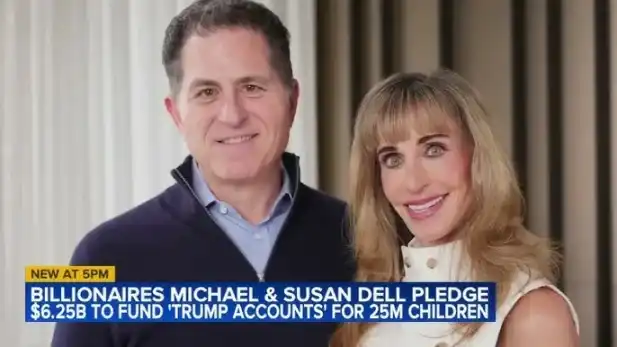
Odaily Note: Michael Dell couple, who donated $6.25 billion. Trump called this 'one of the most generous acts in American history'.

In terms of investment, 'Trump Accounts' will be limited to investing in low-cost investment funds or exchange-traded funds (ETFs) that track broad stock indices such as the 'S&P 500' index, and cannot be used to invest in specific industry or sector indices. The usage of funds is also restricted. Before the child turns 18 and becomes a legal adult on January 1 of that year, funds in the account cannot be withdrawn for any reason (unless the child passes away or the funds are transferred to another similar restricted account). After the child turns 18, the account will receive the same treatment as a traditional Individual Retirement Account (IRA).

According to the current plan, 'Trump Accounts' are tentatively scheduled to begin accepting initial deposits on July 4, 2026 (the 250th anniversary of the signing of the U.S. Declaration of Independence). This timing coincides with the run-up to the 2026 midterm elections and is expected to be a major policy 'trump card' for the Republican Party to win voters.

What is the Potential Scale?

According to statistics from Statista, since 2020, the annual number of births in the United States has fluctuated around 3.6 million.

Using this data as a benchmark, the planned coverage period from January 1, 2025, to January 1, 2029, is expected to include approximately 14.4 million newborn American children. If the federal government opens a $1,000 'Trump Account' for each child, this implies a massive fund of $14.4 billion; with potential private donations and family deposits, this number will continue to grow to hundreds of billions of dollars; if the plan continues to be promoted as a long-term initiative after 2029, its potential scale will be even more staggering.

Due to its operational characteristics of long-term lock-up, passive investment, and continuous new inflows, the 'Trump Account' will essentially become a long-term passive fund pool with a potential scale of hundreds of billions of dollars. Compared to a simple child welfare attribute, this更像是 establishing a long-term capital transmission channel between fiscal policy and the capital market, directly integrating the future generation into the stock market system.

The Biggest Beneficiary: Robinhood?

After the 'Trump Account' plan was announced, financial institutions such as JPMorgan Chase, Charles Schwab, and Robinhood began fierce competition for related services. With the U.S. Treasury Department officially designating Robinhood as the broker and initial custodian yesterday, Robinhood, which has obtained the 'entry ticket', is poised to become one of the most direct beneficiaries of this plan.

The most直观 benefit lies on the user side. According to the current policy coverage calculation, 'Trump Accounts' will correspond to tens of millions of newborn accounts, and the interaction portal for these accounts will be completed through a unified application — in other words, Robinhood will acquire a batch of potential users bound to the platform from birth. The oldest of these users is only 1 year old, and the youngest hasn't even been born yet... More importantly, these users are not one-time traffic but potential clients with an extremely long lifecycle. After the children turn 18, the accounts will convert into long-term investment accounts similar to IRAs, which means Robinhood has the opportunity to directly承接 these users into their adult investment behaviors and further extend into more business scenarios such as ETFs, options, and even crypto assets. From a lifecycle perspective, this is almost the longest possible user path a broker can obtain.

The benefits on the asset side are equally significant. The funds in 'Trump Accounts' have obvious long-term lock-up characteristics, hardly flowing out before the child reaches adulthood, while the investment scope is limited to index funds. This type of fund is extremely high-quality custody asset for brokers — low volatility, long retention, predictable scale. Furthermore, Robinhood's core label in the past has been a 'retail trading platform', with growth highly dependent on market conditions and trading activity. The 'Trump Account' introduces low-frequency, long-term, passive investment funds, which are closer to the capital attributes of traditional wealth management businesses. As the proportion of such funds increases, it will also enrich Robinhood's business diversity to a certain extent,补齐相对短板.

At the same time, the endorsement at the policy level also has symbolic significance. Participating in an account plan led by the Treasury Department brings Robinhood into the U.S. government's financial infrastructure system for the first time. This not only enhances its institutional credibility but also provides new narrative space for its future expansion into retirement accounts, long-term investment, and wealth management businesses.

From a political perspective, the 'Trump Account' is an important policy chip for the Republican Party facing the midterm elections; from a capital market perspective, this plan introduces an institutionalized long-term source of funds into the U.S. stock market. Robinhood happens to be at the intersection of both — as millions of newborns who have not yet entered society are 'automatically opening accounts', this policy design围绕选票 has also quietly laid a growth curve for Robinhood that could last for more than a decade.


Preguntas relacionadas

QWhat is the 'Trump Account' and what is its purpose?

AThe 'Trump Account', also known as a 530A account, is a tax-advantaged investment account plan established under the 'Big and Beautiful' Act. Its purpose is to provide government-funded savings accounts for children born between January 1, 2025, and January 1, 2029, who are U.S. citizens.

QWhich financial institutions were selected to manage the 'Trump Accounts' and what are their roles?

ABNY Mellon was selected as the designated financial agent to manage the initial accounts. Robinhood will partner with BNY Mellon, serving as the broker and initial custodian for the accounts.

QWhat are the sources of initial funding for a 'Trump Account' and what are the contribution limits?

AInitial funding comes from a $1000 federal grant, private donations (e.g., a $250 donation from the Michael Dell family for eligible children), and deposits from parents/friends, who can contribute up to $5000 per child per year.

QWhat is the potential scale of the 'Trump Account' program in terms of the number of children and total assets?

AThe program is expected to cover approximately 14.4 million children born during the eligibility period. With the $1000 federal grant alone, this represents $14.4 billion in assets, with the total potential size growing to hundreds of billions when including private and family contributions.

QWhy is Robinhood considered a major potential beneficiary of the 'Trump Account' program?

ARobinhood gains a long-term user base locked in from birth, with accounts converting to IRA-like accounts at age 18. It also acquires high-quality, long-term, passive assets that diversify its business beyond its traditional reliance on active retail trading, and receives a significant credibility boost from the government partnership.

Lecturas Relacionadas

The Shutdown of Claude Mythos Revealed the True Cost of Renting AI to Me

The sudden shutdown of Claude Mythos this week starkly highlights a critical, often overlooked risk for founders: when your core capability relies entirely on someone else's platform, your fate is not in your own hands. The key question becomes: who truly owns the intelligence your product depends on? For years, the debate around open-source models focused on cost. Now, the evidence is clear: fine-tuned open-source models can achieve frontier-level quality for specific, mission-critical tasks at a fraction of the cost. However, the deeper issue is control. Relying on a third-party API is like renting; it works until the landlord changes the rules, raises the rent, or asks you to leave—as Mythos experienced. The lesson is not to stop using frontier models—they are incredible infrastructure. The goal is ownership. Ownership means starting with a powerful open-source model and shaping it around what makes your company unique: your data, workflows, domain expertise, and definition of "good." Over time, the model becomes less generic and more reflective of your business, creating durable value. The optimistic conclusion is that AI's future doesn't hinge on one superior model. There is no single frontier. The frontier includes proprietary models, models fine-tuned on company-specific knowledge, specialized models for narrow problems, and intelligent routers orchestrating model ensembles. The most interesting development is not models getting smarter, but intelligence becoming increasingly customizable. The winning companies will be those that transform intelligence into a unique, owned asset. Looking ahead, the vision is not one model dominating all, but many teams owning the part of the frontier that matters most to them.

marsbitHace 32 min(s)

The Shutdown of Claude Mythos Revealed the True Cost of Renting AI to Me

marsbitHace 32 min(s)

Tiger Research: U.S. Strategic Bitcoin Reserve - Should the Market Be Happy or Disappointed?

Tiger Research analyzes the evolution of U.S. legislative efforts regarding a strategic Bitcoin reserve, concluding the market impact is limited in the short term but potentially positive long-term. The core event was a March 2025 executive order by former President Trump, which designated confiscated Bitcoin as a strategic reserve and promised not to sell existing holdings (approx. 190k BTC). As it contained no mandate to purchase new Bitcoin, the market reacted negatively, with prices dropping 5.7%. Legislative history shows a significant retreat from initial ambitions. The 2024 "BITCOIN Act" proposed mandatory purchases of 1 million BTC over five years. Reintroduced in 2025, it stalled due to high fiscal costs, concerns over dollar hegemony, and opposition from the Treasury Secretary. The current frontrunner, the 2026 "American Retirement and Monetary Advancement (ARMA) Act," is a compromise. It lacks any purchase requirement, instead focusing on consolidating existing government-held Bitcoin and legally prohibiting its sale for at least 20 years. While ARMA has higher passage odds due to bipartisan support and no purchase mandate, its immediate market effect is neutral. It eliminates potential government selling pressure but creates no new demand. The long-term significance is that formally establishing Bitcoin as a national reserve asset in law could later reignite debates on mandatory purchases. Therefore, the path to a government buyer is longer than initially priced by the market, but the directional narrative remains intact.

marsbitHace 35 min(s)

Tiger Research: U.S. Strategic Bitcoin Reserve - Should the Market Be Happy or Disappointed?

marsbitHace 35 min(s)

US Stock Market Trend (June 16): SpaceX Rises 42% in Two Days, New Fed Chairman Takes Office Today

**U.S. Stocks Trend (June 16): SpaceX Soars 42% in Two Days, New Fed Chair Takes Office Today** Markets surged on Monday following former President Trump's social media announcement of a completed U.S.-Iran deal to reopen the Strait of Hormuz, pending a June 19 signing. The news triggered a broad risk-on rally: oil prices crashed, tech stocks soared, bond yields fell, and defensive sectors lagged. **Market Performance:** The Nasdaq jumped 3.07%, led by semiconductor stocks like Micron (+9.2%). The S&P 500 gained 1.65%, and the Dow rose 0.92% to a record high. However, the Russell 2000 small-cap index underperformed (+0.72%). SpaceX continued its hot streak, rising another 5% pre-market after disclosures of large buys by an Australian billionaire and Cathie Wood's ARK. Boeing also rallied on the transportation optimism. Conversely, energy stocks like Chevron fell over 3% on the oil price plunge, with other defensive sectors also selling off. The day's action showed a clear rotation of funds from energy/defensive plays into AI and tech narratives. **Macro & Outlook:** The VIX fear index fell 8.37%. Treasury yields declined, and WTI crude dropped over 5%. Attention now shifts to a packed schedule: the Bank of Japan is widely expected to hike rates to 1.0% on Tuesday. The Fed's June meeting concludes Wednesday, marking new Chair Wash's debut. While rates are expected to hold, his tone on stubborn inflation and the "dot plot" will be crucial for gauging the 2024 rate path. The formal Iran deal signing is set for Friday. **Trend Perspective:** While the peace deal is a genuine positive, Monday's explosive rally may have gotten ahead of itself, pricing in a swift resolution to inflation concerns. The shortened trading week faces a triple test: BoJ tightening, the Fed's policy stance, and deal implementation details. Tech and semiconductors, which led the surge, remain vulnerable to any disappointment from these key events. The real price discovery begins with the central banks' communications this week.

marsbitHace 56 min(s)

US Stock Market Trend (June 16): SpaceX Rises 42% in Two Days, New Fed Chairman Takes Office Today

marsbitHace 56 min(s)

Trading

Spot
Futuros
活动图片