Robinhood Chain Goes Viral in One Week: Memes Drive Traffic, Stablecoins Support TVL

Foresight NewsPublicado a 2026-07-09Actualizado a 2026-07-09

Resumen

Robinhood Chain, an Arbitrum-based Layer 2 network launched on July 1st, experienced explosive growth in its first week. While meme coin hype drove user activity, stablecoin deposits fueled its surge in Total Value Locked (TVL). The chain's rapid adoption was driven by multiple factors. CEO Vlad Tenev reversed his initial stance, endorsing the chain for meme coins despite its original focus on Real-World Assets (RWA). The integration of the popular Solana-based launchpad Pump.fun significantly lowered the barrier for meme trading. Furthermore, the prediction market application World announced a migration from Solana to Robinhood Chain. Meme coin mania, led by tokens like CASHCAT, generated massive trading volume, with daily active addresses skyrocketing from near zero to hundreds of thousands. However, the primary driver of the chain's TVL, which soared past $234 million, was a major institutional deposit. Ethena injected approximately $50 million in stablecoins into the Morpho lending protocol, which underpins Robinhood's Earn product, accounting for the bulk of locked value. This highlights two concurrent narratives: retail-driven meme speculation boosting transactions, and institutional stablecoin deposits building foundational liquidity. In contrast, the chain's flagship RWA offerings, like tokenized stocks, remain a minor part of the ecosystem at around $12.8 million. The first week demonstrates a path where speculative trading and yield-seeking capital provide initia...


Written by: The Defiant Team

Compiled by: Saoirse, Foresight News


This week, a combination of the meme coin hype, the integration of the Pump.fun platform, and the announcement of an application migrating from Solana to this new blockchain just one week after its launch have collectively driven a surge in activity on Robinhood Chain. Notably, however, the single largest inflow of funds on-chain came from stablecoin staking, not meme coin trading.


According to data from a network dashboard published by Entropy Advisors on Dune Analytics: this layer-2 network built on Arbitrum has seen its cumulative address count approach 200,000, with a total protocol value locked (TVL) of approximately $234 million.


The public chain officially opened mainnet access on July 1st, meaning almost all of this growth has occurred within the week following its launch, and on-chain activity has continued to accelerate in recent days.
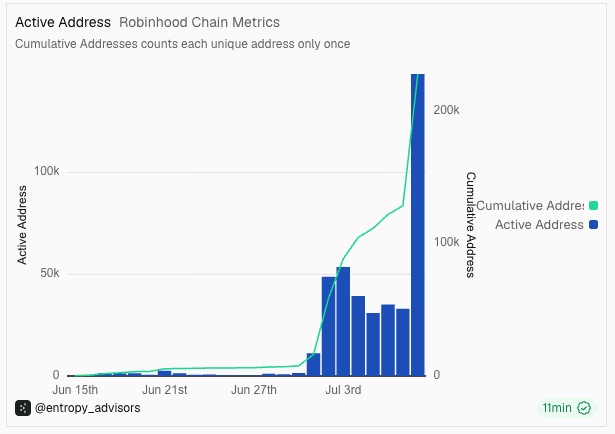

Robinhood Active Address Count. Source: Dune Analytics


CEO's Official Stance Completely Reverses


The shift in strategic direction began at the top. On the evening of July 7th, CEO Vlad Tenev posted on platform X: "We built Robinhood Chain to be the best public chain for real world assets (RWA)... but the chain is also really great for memes."


This statement overturned his position from just days before. On the day of the mainnet launch, July 2nd, he stated in a CNBC interview that meme coins were essentially dead. In his view, tokens without practical utility were unsustainable in the long run, and tokenized real-world assets were a more viable path for the crypto industry.


When Robinhood officially launched the mainnet at its London keynote presentation "Robinhood Presents: The World is Flat," it consistently positioned the chain as infrastructure for tokenized stocks and various real-world assets; integrations with Uniswap, Chainlink, Alchemy, and BitGo were completed on launch day.


Pump.fun Diverts a Large Number of Traders


On July 8th, the token launch platform Pump.fun, born in the Solana ecosystem, announced support for trading Robinhood Chain tokens, significantly lowering the barrier for traders to participate in the chain's meme coins.


The platform's official account posted on platform X: "You can now trade Robinhood Chain tokens on the Pump.fun app! No bridge needed, trade seamlessly with SOL, all popular Robinhood chain tokens are supported."


Pump.fun co-founder Alon Cohen stated that this update is merely an extension of the platform's existing multi-chain trading tool features, not a separate new business. He posted: "Pump.fun is not just for launching platform-native tokens, it supports all cross-chain trading. You can trade Robinhood tokens now, fee-free via Solana rails."


World Project Migrates Out of Solana Ecosystem


Robinhood Chain successfully poached project resources from the Solana ecosystem. The on-chain prediction market World launched on Solana on July 1st, accessible directly within the Phantom wallet. Now, the project's officials have announced a complete migration to this new public chain.


The project team announced on platform X on July 8th: "World has decided to migrate from Solana to Robinhood Chain." The team stated that the strategic adjustment was made after careful evaluation over the past 24 hours and expressed gratitude to the Solana Foundation and community.


CASHCAT Ignites Meme Coin Frenzy


The most popular token currently is CASHCAT, named after Robinhood's early stock-trading era mascot "Cash Cat," traded on the Uniswap V3 exchange deployed on Robinhood Chain.


CoinGecko data shows that on July 8th, CASHCAT traded around $0.1373, a 24-hour increase of 1320%, with a market cap nearing $137 million and a 24-hour trading volume of approximately $194 million; its price fluctuated between $0.0089 and $0.1475 that day.


User Base Expands Rapidly From Zero


Setting aside the meme coin frenzy, on-chain monitoring data shows growth across all aspects of the ecosystem. Active addresses during the testnet phase in June were nearly zero, but daily active addresses surged to tens of thousands in early July, with cumulative unique addresses approaching 200,000.


Decentralized exchange volume performed remarkably, peaking at nearly $400 million on July 7th, with the vast majority of trades completed via Uniswap V3, V4, and PancakeSwap V3. Meanwhile, on-chain fees remained low, with Gas prices around 0.021 Gwei and an average transaction fee of just $0.005.
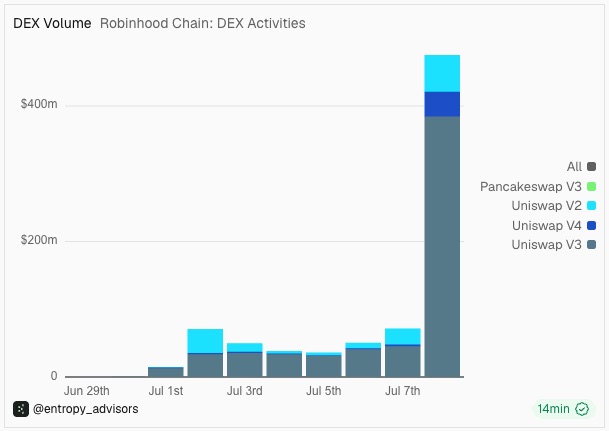

Robinhood Chain DEX Trading Volume. Source: Dune Analytics


Core Driver of TVL Surge is Ethena Stablecoin, Not Meme Coins


While market attention is focused on meme coin speculation, the most critical factor driving the surge in Robinhood Chain's total value locked (TVL) is a deposit of stablecoin funds. Ethena injected approximately $50 million into the USDG pool managed by Steakhouse Financial within the lending protocol Morpho. Morpho is the underlying protocol for Robinhood's Earn product on the chain, which can offer an annualized yield of about 7% for USDG.


DefiLlama data shows this capital inflow directly propelled the protocol's TVL to a single-day increase of over 160%. Morpho hosts the vast majority of statistically trackable DeFi liquidity on the chain, with stablecoins (primarily USDG) constituting the bulk of on-chain asset value.
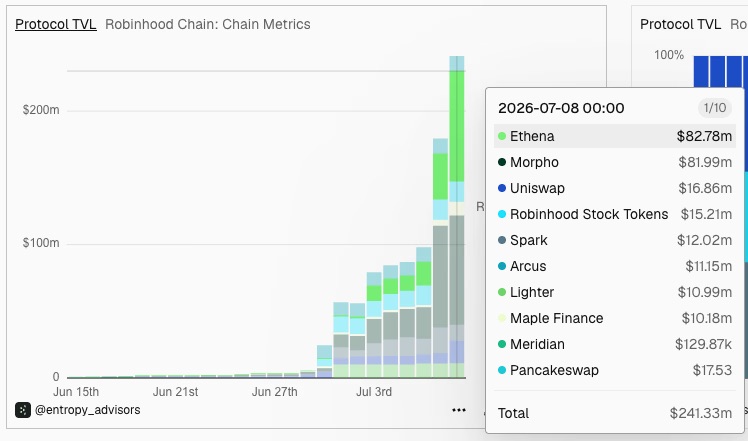

Robinhood Chain Total Value Locked. Source: Dune Analytics


The data reflects two parallel development paths for the public chain: institutional stablecoin capital and lending business solidify the underlying capital base; the retail-driven meme coin frenzy boosted by Pump.fun continuously drives up transaction counts and active users. Confusing the relationship between the two would severely overstate the contribution of meme trading to the total value locked metric.


RWA Business Still Accounts for a Tiny Fraction


Despite Robinhood Chain's focus on the RWA narrative, tokenized real-world asset business currently constitutes an extremely low proportion. The total value of tokenized assets like U.S. Treasuries, stocks, ETFs, and commodities is only about $12.8 million, far less than the TVL supported by stablecoins and lending funds.


The stock tokens launched by Robinhood are tokenized debt certificates that track the prices of U.S. stocks and ETFs but do not grant holders shareholder voting rights. The product is open to users in over 120 countries globally and is not offered to users within the United States.


This gap summarizes the state of Robinhood Chain in its first week: speculative trading and stablecoin deposits seeking yield bring initial liquidity and on-chain activity, while the chain's originally planned core focus — tokenized securities business — remains in its slow early stages.


Criptos en tendencia

Preguntas relacionadas

QAccording to the article, what is the primary driver behind the recent surge in Robinhood Chain's Total Value Locked (TVL)?

AThe primary driver behind the recent surge in Robinhood Chain's TVL is stablecoin deposits, specifically a roughly $50 million injection of Ethena's USDG stablecoin into a Morpho pool, which powers the Robinhood Earn product.

QHow did Pump.fun contribute to the activity on the Robinhood Chain after its mainnet launch?

APump.fun contributed by announcing support for trading Robinhood Chain tokens on its platform, significantly lowering the barrier for traders to participate in the chain's Meme coin activity and attracting a large number of users.

QWhat significant shift in stance did Robinhood CEO Vlad Tenev make regarding Meme coins on the Robinhood Chain?

AVlad Tenev reversed his previous stance, initially stating on July 2nd that Meme coins were 'mostly dead ends,' but later declaring on July 7th that the Robinhood Chain was also 'really well-suited for Meme coins' while still aiming to be the best chain for RWAs.

QWhat specific Meme coin experienced a massive price surge on Robinhood Chain, and what was its reported 24-hour gain?

AThe specific Meme coin is CASHCAT. It reportedly experienced a 1320% 24-hour gain, with its price reaching around $0.1373 and a market cap nearing $137 million.

QHow does the current scale of Real World Asset (RWA) activity on Robinhood Chain compare to its other activities like stablecoin deposits and Meme trading?

AThe current scale of RWA activity is very small compared to other activities. Tokenized real-world assets like U.S. Treasuries and stocks have a total value of only about $12.8 million, which is far less than the TVL driven by stablecoin deposits and Meme coin trading volume.

Lecturas Relacionadas

Beyond Private Keys: From Wallets and L2 to Supply Chains, How to Guard the Security Perimeter of Web3?

Beyond Private Keys: Securing Web3's Expanding Attack Surface from Wallets to L2s and Supply Chains The crypto space faced a wave of security incidents in June, with over $75 million lost across 40 major attacks. These breaches highlighted risks beyond private key theft, exposing vulnerabilities across the entire user interaction chain. Wallet security was compromised not through stolen seed phrases, but via a critical flaw in the Cardano wallet SecondFi's signing implementation. This bug allowed attackers to potentially derive private keys from publicly visible signature data, emphasizing that wallet security depends on correct cryptographic implementation, ideally in open-source, auditable code. Layer-2 networks also revealed complex trust chain risks. Attacks on legacy Aztec deployments exploited inconsistencies in proof systems, showing that a valid zero-knowledge proof is only as secure as its underlying rules. Another attack on Taiko's SGX-based prover stemmed from a leaked signing key and inadequate verification checks. Furthermore, a technical glitch halted Base's block production, underscoring that L2 security encompasses network availability and reliable user exit paths as much as asset safety. Finally, the Polymarket incident demonstrated that even audited smart contracts are not immune. A compromised third-party supplier led to a malicious script being injected into the platform's frontend, resulting in user fund losses. This "supply chain attack" shows that the security of the entire interaction path—from the webpage to the wallet signature—is critical. The conclusion is clear: Web3 security now involves safeguarding the entire journey from transaction intent to on-chain settlement. Users must adopt layered security habits: isolating long-term holdings, using dedicated wallets for daily interactions, scrutinizing transaction details before signing, and managing authorizations cautiously. Defense must evolve from protecting a single point (the private key) to securing a complete chain of interactions.

marsbitHace 35 min(s)

Beyond Private Keys: From Wallets and L2 to Supply Chains, How to Guard the Security Perimeter of Web3?

marsbitHace 35 min(s)

The Illusion of a Prodigy

The Illusion of the "Genius Youth" The article discusses the recent interview incident involving Li Bojie, a former "Huawei Genius Youth," and AI company DeepSeek. It highlights the core conflict not as a simple case of suspected cheating during a coding test, but as a profound mismatch in expectations. Li, with an impressive background including entrepreneurship, a role at Huawei, and a position as a chief scientist, was deeply affected by a standard remote interview where the interviewer questioned his actions. The key point is his stated view of DeepSeek as the "pinnacle of the Chinese tech world." For him, the interview was a quest for identity validation—proof he belonged at the center of the new AI era. For DeepSeek, it was a routine skills assessment. The article argues that Li, while publicly rejecting the "genius" label, subconsciously expected to be treated as a peer for discussion, a courtesy extended by other companies like MiniMax and Xiaomi. DeepSeek, however, adhered strictly to its standardized process, prioritizing consistent, merit-based evaluation over individual prestige. This clash symbolizes a larger shift in the tech industry. The core thesis is that the AI era is dismantling the old system where past titles, companies, and accumulated experience guaranteed status. Now, with rapid knowledge obsolescence, "excellence is calculated in real-time." Li's anxiety—waiting weeks for the DeepSeek interview despite other offers—stems from the fear that rejection means being left behind by technological progress. The article concludes that this incident is a harbinger; soon, everyone will face a constant, implicit "interview" with the AI age itself, asking: "You were excellent yesterday. What about today?"

marsbitHace 1 hora(s)

The Illusion of a Prodigy

marsbitHace 1 hora(s)

Vanguard Group Enters the Arena, Opening a New Crypto Portal for 50 Million Traditional Investors

Vanguard Group, the world's second-largest asset manager with $12 trillion in assets under management and over 50 million investors, has signaled a significant strategic shift by posting a job opening for a "Head of Digital Assets, Personal Wealth." The role entails developing a comprehensive digital asset strategy, establishing long-term plans, and overseeing the full integration of digital assets into Vanguard's wealth management platform, covering areas like custody, settlement, asset tokenization, and stablecoins. This move marks a notable reversal from the firm's previous stance. In 2024, Vanguard refused to list spot Bitcoin ETFs and removed Bitcoin futures products. By late 2025, it allowed some third-party crypto ETF trading but reiterated it would not create its own crypto funds. The new hire represents a third step: building an internal team to integrate digital assets into its core infrastructure, moving beyond merely listing products. The initiative focuses on foundational financial infrastructure—how tokenized assets and digital settlement systems can connect to Vanguard's existing platform, which primarily serves long-term, conservative investors. While Vanguard maintains it will not launch proprietary crypto ETFs, it is proactively preparing its systems for a future involving tokenized assets and stablecoins, which Citigroup projects could reach a $5.5 trillion market by 2030. Vanguard's scale means its chosen standards for custody, settlement, and compliance could set de facto rules for the broader wealth management industry. The firm is acting despite regulatory uncertainty and cautious market sentiment (e.g., Citi recently lowered crypto price targets). Analysts suggest even a minimal 0.01% allocation from Vanguard's asset base would bring ~$12 billion into digital assets, forcing the development of robust risk and operational frameworks. Ultimately, Vanguard's focus is on building the plumbing for digital assets to potentially serve its vast client base, an effort whose impact may extend far beyond any single market cycle.

Foresight NewsHace 1 hora(s)

Vanguard Group Enters the Arena, Opening a New Crypto Portal for 50 Million Traditional Investors

Foresight NewsHace 1 hora(s)

Paradigm's New Playbook: Crypto in One Hand, AI and Robotics in the Other

Title: Paradigm's New Strategy: Crypto in One Hand, AI and Robotics in the Other On July 8, 2026, top-tier venture capital firm Paradigm announced the successful $12 billion close of its fourth fund, marking a strategic evolution beyond its pure-play crypto roots. While remaining committed to cryptocurrency, the firm is now formally extending its investment focus to include artificial intelligence, robotics, and other frontier technologies. This shift was foreshadowed by a subtle but significant change to its official social media description earlier in March, from "A research-driven crypto investment firm" to a broader "We build and invest in the companies and ideas shaping the frontier." The move is driven by the firm's recognition of transformative technological waves beyond crypto, particularly in AI and robotics, and a response to the shifting capital allocation landscape. Despite significant AI sector fundraising, Paradigm emphasizes its commitment remains grounded in deep technical rigor. A key intersection for Paradigm lies in AI Agents, where decentralized blockchain networks and stablecoins are seen as a natural financial infrastructure for autonomous digital operations. The firm is active in promoting open-source, decentralized AI (e.g., investing in Nous Research) and building agent-friendly blockchains (e.g., incubating Tempo). It is also developing tools like EVMbench (with OpenAI) and the Centaur AI Agent platform. Within its crypto stronghold, Paradigm will continue focusing on core infrastructure areas. These include derivatives and new liquidity layers (e.g., Hyperliquid), prediction markets (with plans for a proprietary trading terminal), and developer tools (continuing development of Reth and Foundry). In summary, Paradigm's expansion reflects a broader realignment in venture capital, where the intense capital concentration in AI and the search for exponential growth compel even crypto-native funds to broaden their narratives. However, this does not signify an abandonment of crypto; instead, the focus is sharpening on real-world financial applications like stablecoins, RWA, on-chain derivatives, prediction markets, and the convergence of Crypto and AI Agents.

Foresight NewsHace 2 hora(s)

Paradigm's New Playbook: Crypto in One Hand, AI and Robotics in the Other

Foresight NewsHace 2 hora(s)

Trading

Spot

Artículos destacados

Cómo comprar ONE

¡Bienvenido a HTX.com! Hemos hecho que comprar Harmony (ONE) sea simple y conveniente. Sigue nuestra guía paso a paso para iniciar tu viaje de criptos.Paso 1: crea tu cuenta HTXUtiliza tu correo electrónico o número de teléfono para registrarte y obtener una cuenta gratuita en HTX. Experimenta un proceso de registro sin complicaciones y desbloquea todas las funciones.Obtener mi cuentaPaso 2: ve a Comprar cripto y elige tu método de pagoTarjeta de crédito/débito: usa tu Visa o Mastercard para comprar Harmony (ONE) al instante.Saldo: utiliza fondos del saldo de tu cuenta HTX para tradear sin problemas.Terceros: hemos agregado métodos de pago populares como Google Pay y Apple Pay para mejorar la comodidad.P2P: tradear directamente con otros usuarios en HTX.Over-the-Counter (OTC): ofrecemos servicios personalizados y tipos de cambio competitivos para los traders.Paso 3: guarda tu Harmony (ONE)Después de comprar tu Harmony (ONE), guárdalo en tu cuenta HTX. Alternativamente, puedes enviarlo a otro lugar mediante transferencia blockchain o utilizarlo para tradear otras criptomonedas.Paso 4: tradear Harmony (ONE)Tradear fácilmente con Harmony (ONE) en HTX's mercado spot. Simplemente accede a tu cuenta, selecciona tu par de trading, ejecuta tus trades y monitorea en tiempo real. Ofrecemos una experiencia fácil de usar tanto para principiantes como para traders experimentados.

315 Vistas totalesPublicado en 2024.12.12Actualizado en 2026.06.02

Cómo comprar ONE

Discusiones

Bienvenido a la comunidad de HTX. Aquí puedes mantenerte informado sobre los últimos desarrollos de la plataforma y acceder a análisis profesionales del mercado. A continuación se presentan las opiniones de los usuarios sobre el precio de ONE (ONE).

活动图片