RIVER drops 30%, yet a rebound could still be coming: Here’s why

ambcryptoPublicado a 2026-03-24Actualizado a 2026-03-24

Resumen

RIVER has experienced a significant 30% decline over 48 hours, erasing gains and returning to price levels last seen in early February. Despite this sharp pullback, it remains one of the top-performing altcoins with 369% gains over 90 days, second only to SIREN. However, the token faces a critical test of momentum sustainability. Market data reveals growing bearish pressure: funding rates turned negative, indicating dominance of short positions, while approximately $27.7 million exited perpetual futures contracts. Spot market activity also weakened, with $1.35 million in net selling over three days. Despite short-term outflows, longer-term net inflows remain positive, suggesting underlying demand hasn't fully reversed. Liquidation heatmaps show clusters above current prices, hinting at potential upward movement if market sentiment stabilizes. While the decline aligns with a corrective phase rather than a confirmed long-term downtrend, continued short dominance may extend losses. A rebound remains possible if long positions re-enter or broader market momentum improves.

River [RIVER] has entered a phase of losses not seen in several weeks. Over the past 48 hours, amid a wider market shake-up, the asset has declined by 30%, revisiting levels last observed around the 4th of February. The move marks a notable shift in short-term sentiment after an extended period of upside performance.

Despite the correction, RIVER still ranks among the top-performing altcoins. Data from the 90-day Altcoin Season Index shows the asset remains the second-best performer, with gains of roughly 369%, trailing only SIREN.

However, history suggests caution. Numerous tokens have previously occupied similar positions but failed to sustain their momentum. This context places RIVER at a critical juncture, where the current decline could either evolve into a broader trend reversal or remain a temporary correction within a larger uptrend.

Capital outflows and funding rates signal pressure

An analysis of capital flows in the perpetual futures market, a key driver of volatility, points to sustained pressure on RIVER.

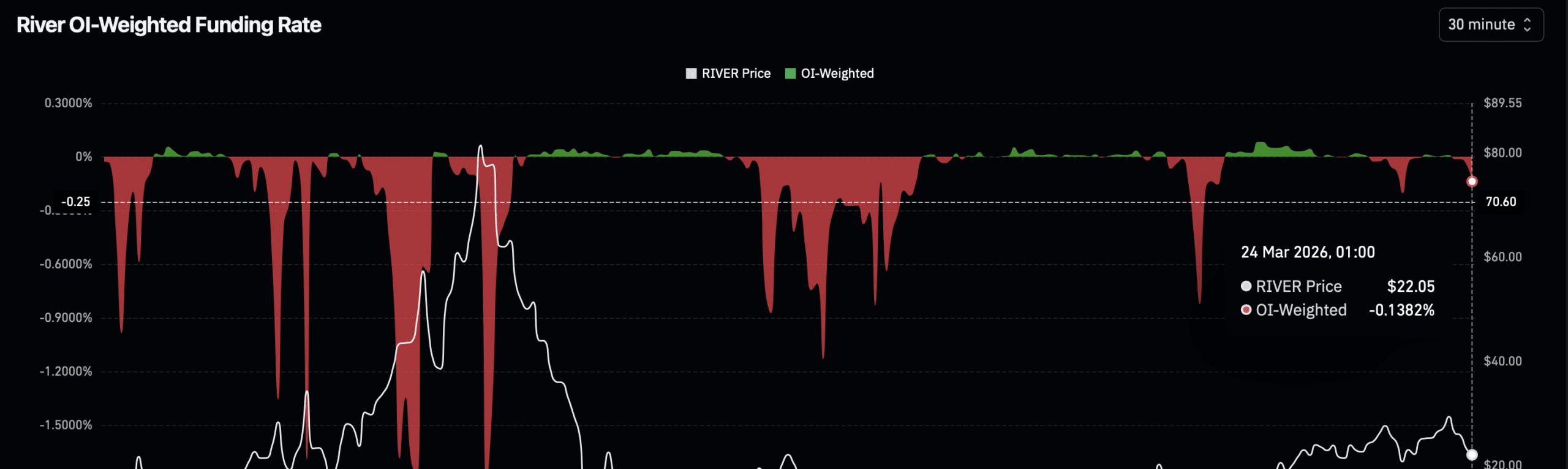
The Funding Rate, which reflects whether long or short positions dominate the market, has turned negative as of writing. A reading of -0.1382% indicated that short positions now outweighed longs, highlighting a growing bearish bias among derivatives traders.

This shift typically reflects expectations that the asset is overvalued, encouraging traders to position for further downside while amplifying selling pressure.
Source: CoinGlass

At the same time, not all participants are actively shorting. A segment of investors has exited positions entirely, reinforcing the narrative of declining conviction. This behavior often emerges when market participants anticipate heightened volatility or lack clarity on near-term direction.

Approximately $27.7 million has flowed out of RIVER’s perpetual contracts within this period. This level of capital movement is significant. If long positions re-enter, it could support a rebound. However, continued dominance of short positions may extend the decline.

Spot market activity supports a bearish narrative

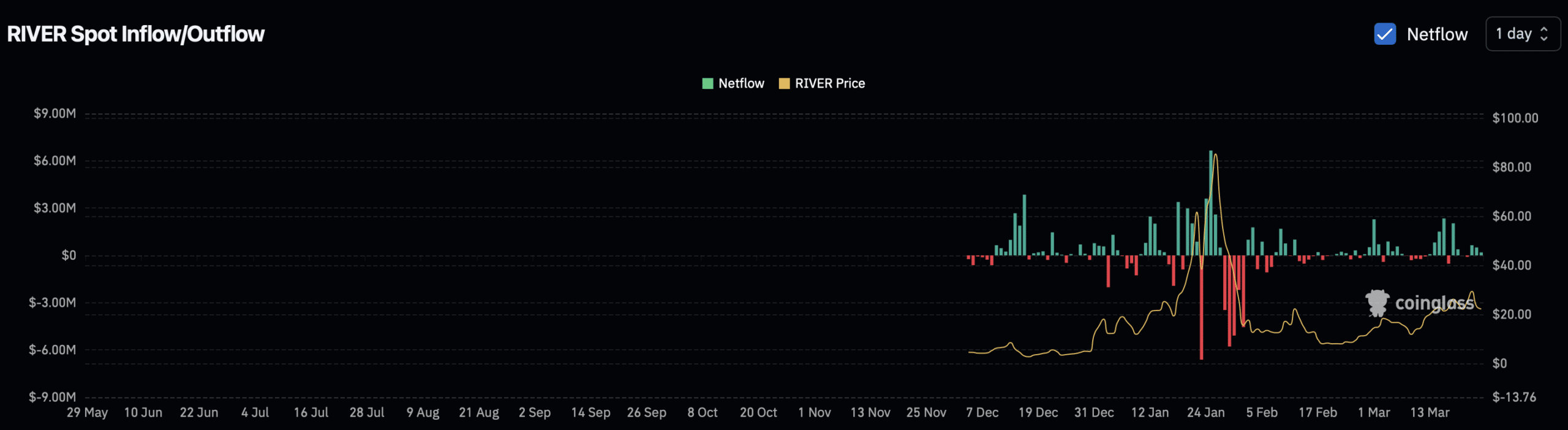
Developments in the spot market further align with the weakening sentiment. Over the past three days, selling activity has outpaced buying, reinforcing downward pressure.

During this window, roughly $1.35 million worth of RIVER has been sold. This trend suggests that investors are reducing exposure in the short term, likely rotating into stablecoins or lower-risk assets while uncertainty persists.
Source: CoinGlass

Nevertheless, a broader perspective provides a more balanced picture. Net inflows for the 10-day, 15-day, and 30-day periods remain positive at $8.74 million, $9.13 million, and $16.71 million, respectively. This suggests that, while short-term sentiment has declined, underlying demand has not completely reversed.

Additionally, daily selling volume has declined over the past three days. This gradual drop indicates that bearish conviction may be losing strength.

In a sustained downtrend, selling pressure would typically intensify as more participants position for further losses. That pattern has yet to fully materialize.

Liquidation clusters hint at upside potential

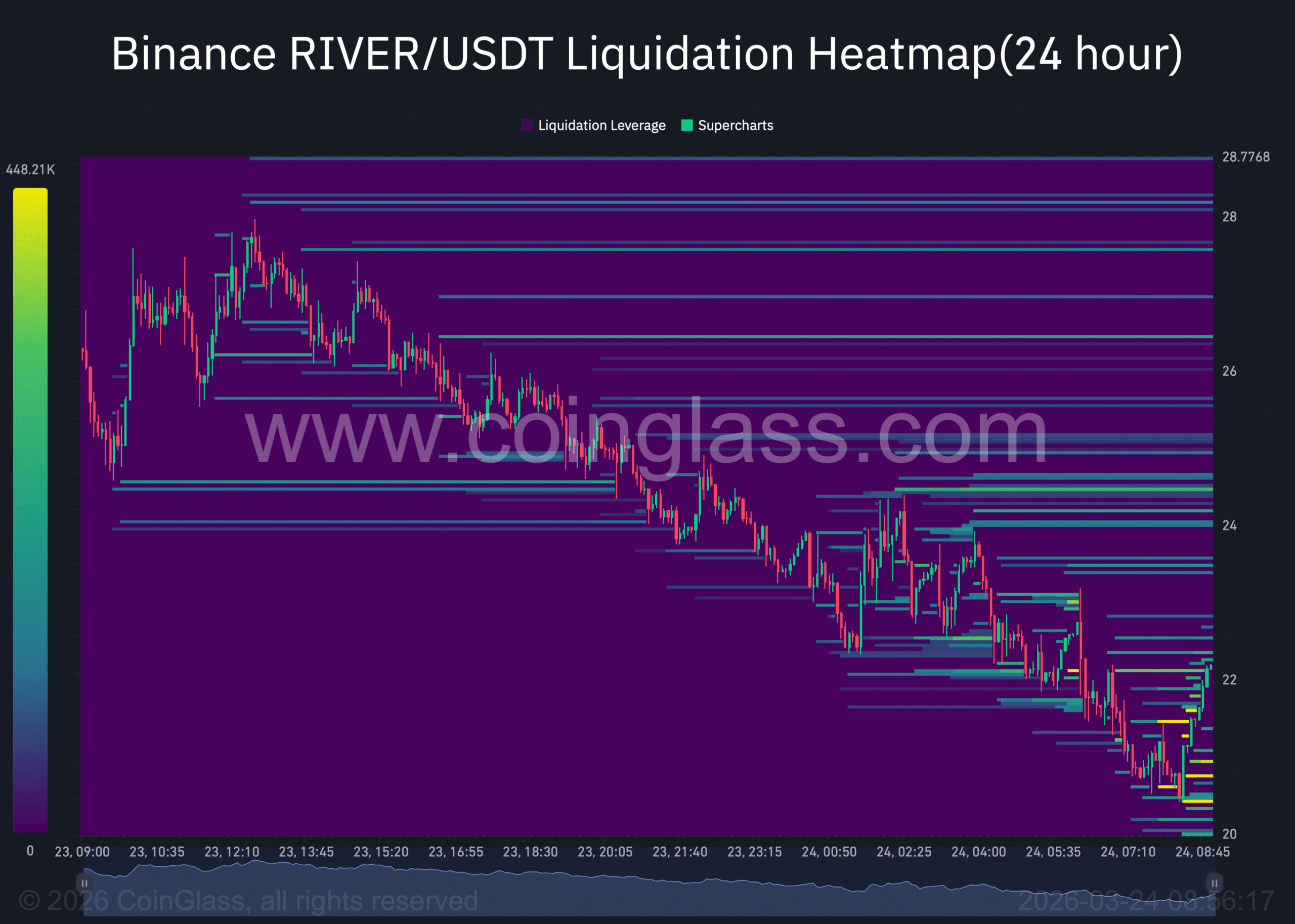
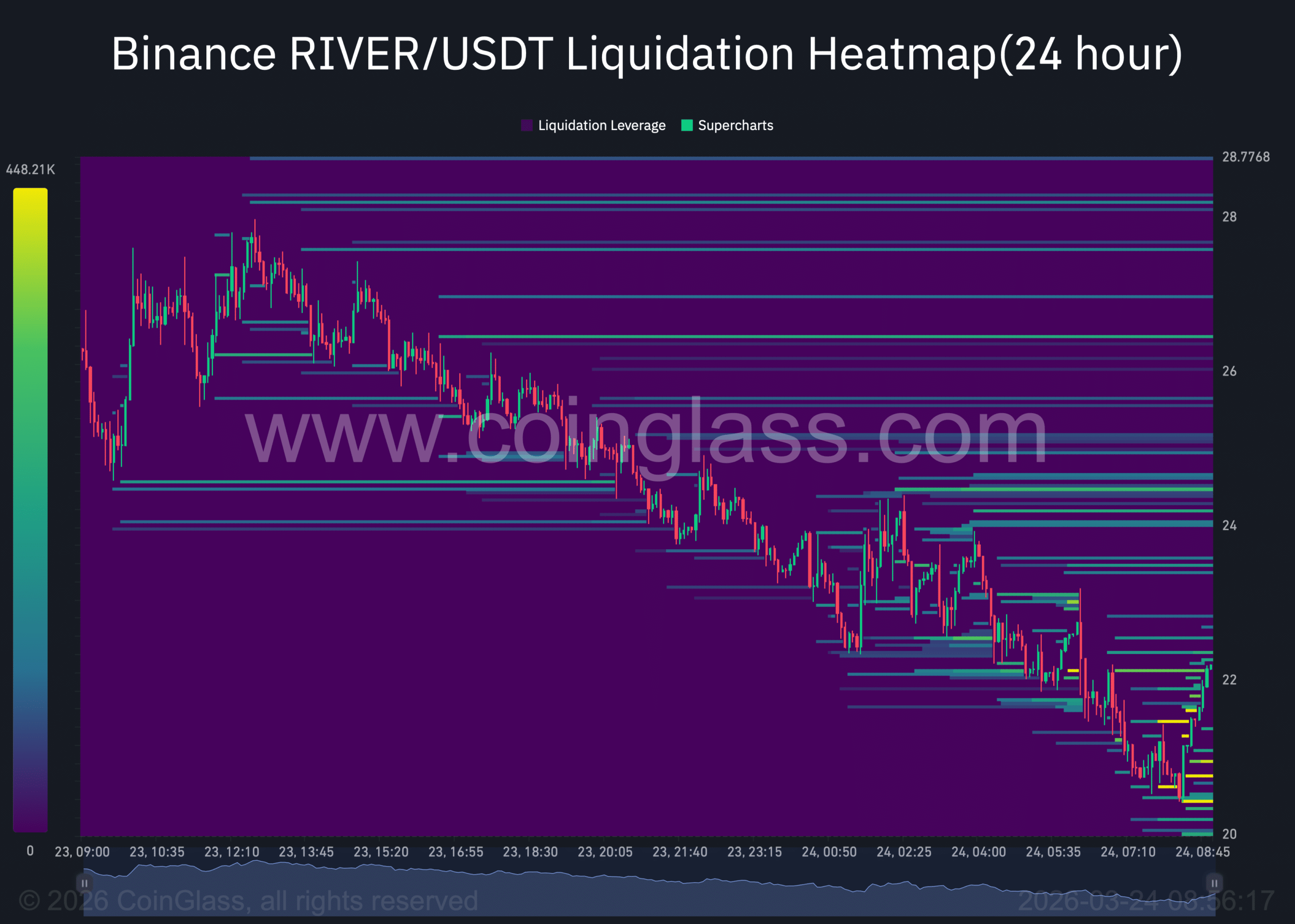
Liquidation heatmaps provide further insight into possible price direction. These maps identify clusters of liquidation orders, which often act as magnets for price movement. Clusters below the current price represent potential buy-side liquidity, while those above indicate sell-side pressure.

In RIVER’s case, a larger share of clusters sits above the current price. Although these clusters are relatively shallow, meaning they may not exert strong influence individually, their presence still points to a possible upward bias in price movement.
Source: CoinGlass

Such positioning suggests that the market could attempt to move higher to trigger these liquidity zones, particularly if broader sentiment stabilizes.

While bullish momentum across the wider market could still drive a recovery, current data indicates that RIVER’s movement aligns more with a corrective phase than a confirmed long-term downtrend.


Final Summary

  • RIVER records a sharp pullback as capital exits and trader conviction weakens.
  • Spot market momentum favors bears, though the asset’s broader performance remains strong.

Lecturas Relacionadas

SpaceX, OpenAI, Anthropic: The Three AI Giants Racing for IPO, Which One Is Worth Betting On?

SpaceX, OpenAI, and Anthropic are poised for historic IPOs within weeks, potentially raising a combined $180 billion—a sum exceeding the entire internet bubble's fundraising. The hosts of the Limitless Podcast argue this isn't just individual company financing but an unprecedented capital concentration for AI infrastructure, driven by an insatiable need for compute, data centers, power, and chips. SpaceX's IPO is notable for reportedly changing market index rules to allow faster inclusion, potentially funneling trillions in passive retirement funds into its stock, despite its unproven space-based data center business model. In contrast, Anthropic demonstrates explosive growth, with ARR reportedly hitting $45 billion and approaching profitability, fueled by strong enterprise adoption of products like Claude Code. Google's separate $80 billion raise highlights the immense capital pressure, even for giants. The discussion acknowledges bubble risks but leans optimistic. The hosts contend the massive spending is building essential physical infrastructure for the next technological era. A key bottleneck isn't capital but the real-world limits of chip manufacturing and construction speed. As long as demand for AI compute outstrips supply, this investment cycle represents a foundational build-out rather than a purely financial bubble. All three companies are seen as foundational bets on the future, with Anthropic often cited as the most immediately compelling due to its proven revenue trajectory.

marsbitHace 1 hora(s)

SpaceX, OpenAI, Anthropic: The Three AI Giants Racing for IPO, Which One Is Worth Betting On?

marsbitHace 1 hora(s)

From 'Old Guys' to 'New Favorites': How AI Is Revaluing Old Infrastructure from Dell to Nokia?

From "Vintage Tech" to "New AI Darlings": How AI Revalues Old Infrastructure One year ago, tech giants like Dell, Nokia, Cisco, and Western Data were seen as slow-growth, low-valuation stories, far from the AI spotlight dominated by players like Nvidia. Now, these legacy tech stocks are gaining market attention, sparking debate on whether this is genuine industry revaluation or a temporary narrative. As AI moves from model parameters to real-world data centers, the market is recognizing companies with proven delivery and infrastructure capabilities. This shift marks a change in the AI investment thesis: from pure model and GPU focus to the complex systems engineering required for deployment. Companies like Dell, HPE, and Corning are being revalued not for being "sexy" AI innovators, but for their decades of accumulated expertise in supply chains, enterprise delivery, and infrastructure—assets that have become critical in the AI buildout phase. The revaluation is unfolding across three key infrastructure lines: 1. **Servers & System Integration:** Dell and HPE are emerging as crucial system integrators or "general contractors" for AI data centers, translating GPU orders into complete, deployable server racks integrated with power, cooling, and networking. 2. **Networking & Connectivity:** AI's scale demands robust high-speed connections. Corning (fiber optics), Nokia (AI-RAN, 6G), and Cisco (data center switches) are gaining importance for enabling efficient data transfer within and between AI clusters. 3. **Storage:** Beyond high-speed memory (HBM/DRAM), the AI data explosion is driving demand for high-capacity hard drives (HDDs) from companies like Western Digital and Seagate to handle training data, logs, and cold storage cost-effectively. For this revaluation to be substantive and not just a narrative, three criteria are key: 1) Concrete AI-related order and revenue growth (e.g., Dell's AI server sales), 2) Upward revisions to company financial guidance, and 3) Sustainable improvements in profit quality, not just top-line revenue spikes. In essence, AI's transition to a real construction phase is re-pricing "old assets" against "new demand." The opportunity, however, is selective. Only those legacy firms that are demonstrably integrated into the capital expenditure chains of data center and enterprise AI deployment are likely to experience a true "logic re-rating" rather than just a temporary valuation bounce.

marsbitHace 2 hora(s)

From 'Old Guys' to 'New Favorites': How AI Is Revaluing Old Infrastructure from Dell to Nokia?

marsbitHace 2 hora(s)

The Merger of Codex and ChatGPT Marks the Beginning of a Major Reshuffle in Programming Tools

OpenAI is shifting its strategic focus from ChatGPT to Codex, merging them along with the browser tool Atlas into a unified desktop super-app. This move signals an internal belief that Codex, originally a programming tool, represents the next evolution of AI more than conversational models like ChatGPT. Over the past year, Codex's weekly active users have surged past 5 million. The key distinction is that while ChatGPT answers questions, Codex executes tasks. Enterprises increasingly value this ability to get work done over simply receiving advice. Consequently, Codex is attracting professionals beyond developers, including analysts, bankers, marketers, and product managers. OpenAI's reorganization and increased investment in Codex stem from recognizing that the future of AI competition lies in execution capabilities, not just conversation. The company is launching role-specific plugins (e.g., for data analysis, sales, design) to transform Codex into a broad knowledge work platform that automates and redefines white-collar workflows. Beyond being a tool, Codex reflects OpenAI's ambition to redefine software. New features like "Sites"—which generates interactive websites from documents—and collaborative "Annotations" aim to create a paradigm where the AI understands the goal and handles the tools and steps, functioning more like a digital colleague than traditional software. The ultimate goal is a unified experience where the user cares only about the completed task.

marsbitHace 2 hora(s)

The Merger of Codex and ChatGPT Marks the Beginning of a Major Reshuffle in Programming Tools

marsbitHace 2 hora(s)

Trading

Spot
Futuros

Artículos destacados

Cómo comprar RIVER

¡Bienvenido a HTX.com! Hemos hecho que comprar River (RIVER) sea simple y conveniente. Sigue nuestra guía paso a paso para iniciar tu viaje de criptos.Paso 1: crea tu cuenta HTXUtiliza tu correo electrónico o número de teléfono para registrarte y obtener una cuenta gratuita en HTX. Experimenta un proceso de registro sin complicaciones y desbloquea todas las funciones.Obtener mi cuentaPaso 2: ve a Comprar cripto y elige tu método de pagoTarjeta de crédito/débito: usa tu Visa o Mastercard para comprar River (RIVER) al instante.Saldo: utiliza fondos del saldo de tu cuenta HTX para tradear sin problemas.Terceros: hemos agregado métodos de pago populares como Google Pay y Apple Pay para mejorar la comodidad.P2P: tradear directamente con otros usuarios en HTX.Over-the-Counter (OTC): ofrecemos servicios personalizados y tipos de cambio competitivos para los traders.Paso 3: guarda tu River (RIVER)Después de comprar tu River (RIVER), guárdalo en tu cuenta HTX. Alternativamente, puedes enviarlo a otro lugar mediante transferencia blockchain o utilizarlo para tradear otras criptomonedas.Paso 4: tradear River (RIVER)Tradear fácilmente con River (RIVER) en HTX's mercado spot. Simplemente accede a tu cuenta, selecciona tu par de trading, ejecuta tus trades y monitorea en tiempo real. Ofrecemos una experiencia fácil de usar tanto para principiantes como para traders experimentados.

752 Vistas totalesPublicado en 2026.01.16Actualizado en 2026.06.02

Cómo comprar RIVER

Discusiones

Bienvenido a la comunidad de HTX. Aquí puedes mantenerte informado sobre los últimos desarrollos de la plataforma y acceder a análisis profesionales del mercado. A continuación se presentan las opiniones de los usuarios sobre el precio de RIVER (RIVER).

活动图片













