Ripple Study Reveals How Financial World Leaders Are Looking At The Market

bitcoinistPublicado a 2026-03-21Actualizado a 2026-03-21

Resumen

Ripple's survey of over 1,000 financial leaders reveals a strong consensus that adopting crypto is essential for competitiveness, with 72% stating companies must offer crypto solutions. Key findings include high optimism for stablecoins, with 74% viewing them as tools for improving cash flow and treasury management. Fintechs lead in crypto adoption, while corporates and banks are increasingly seeking partners for solutions like tokenization, where 89% of banks prioritize crypto and custody services. The report underscores a demand for comprehensive crypto tech stacks and trusted providers. This comes as the SEC's recent taxonomy classified XRP as a digital commodity, not a security, supporting Ripple's position in its legal battle.

Ripple has released a crypto survey that sought the opinions of over 1,000 financial world leaders on their crypto market outlook. Notably, most of these leaders suggested that institutions must look to embrace crypto or risk losing their competitiveness in the market.

Ripple Study Shows Finance Leaders View Crypto as Now Important

Ripple noted that in its survey report, that 72% of respondents believe that companies must offer a crypto solution to remain competitive. Furthermore, these finance leaders revealed similar industry consensus on stablecoins, tokenization, and partner considerations. The crypto firm stated that stablecoins are among the use cases financial leaders are most bullish on.

74% of these financial leaders said that stablecoins can boost cash-flow efficiency and unlock trapped working capital. Additionally, these respondents view stablecoins as tools for treasury management. Meanwhile, the Ripple survey revealed that fintechs have demonstrated crypto leadership among the companies that were surveyed.

More fintechs, 47% of them, than corporates, 14% of them, are also working towards building their own solutions. However, a positive is that 74% of corporates plan to work with partners that offer desired solutions. Meanwhile, banks are also showing interest in tokenizing financial assets as they seek partners to help execute their strategies.

89% of these banks evaluating tokenization partners say crypto and custody are top priorities. Ripple said the key takeaway from the survey is that finance leaders want more from crypto firms offering the solutions they desire. Basically, they want a tech stack that can meet all crypto needs and a “trusted provider to partner with now and in the future as strategies evolve.”

This survey comes as Ripple looks to be the go-to infrastructure for these institutions. The firm currently offers a range of crypto services, including payments, custody, and trading, to institutional investors. The firm has also notably partnered with several TradFi giants to tokenize their real-world assets on the XRP Ledger (XRPL).

Another Major Development For Ripple

Ripple’s survey comes just as the SEC released a token taxonomy that confirmed XRP is a digital commodity, not a security. This vindicates Ripple in its legal fight against the SEC under Gary Gensler, when they claimed that XRP was a security. Meanwhile, crypto pundit SMQKE highlighted arguments from legal experts about why the SEC was wrong to have ever labeled XRP a security.

The argument was that investors do not receive any contract when they buy XRP, especially from exchanges. A contract is considered a key factor under the Howey test in determining what constitutes a security. However, the SEC has noted that a non-security like XRP could become a security if it is used as the basis of an investment contract in which investors expect to make gains from the efforts of others.

XRP trading at $1.44 on the 1D chart | Source: XRPUSDT on Tradingview.com

Preguntas relacionadas

QWhat percentage of financial leaders believe companies must offer a crypto solution to remain competitive, according to Ripple's survey?

A72% of financial leaders believe companies must offer a crypto solution to remain competitive.

QWhat are the two main benefits that 74% of financial leaders associate with stablecoins?

A74% of financial leaders said stablecoins can boost cash-flow efficiency and unlock trapped working capital.

QAccording to the survey, what do banks evaluating tokenization partners consider as top priorities?

A89% of banks evaluating tokenization partners say crypto and custody are top priorities.

QWhat key development from the SEC is mentioned in relation to XRP's status?

AThe SEC released a token taxonomy that confirmed XRP is a digital commodity, not a security.

QWhat is the main argument presented by legal experts against the SEC's initial labeling of XRP as a security?

AThe argument was that investors do not receive any contract when they buy XRP, especially from exchanges, and a contract is a key factor under the Howey test.

Lecturas Relacionadas

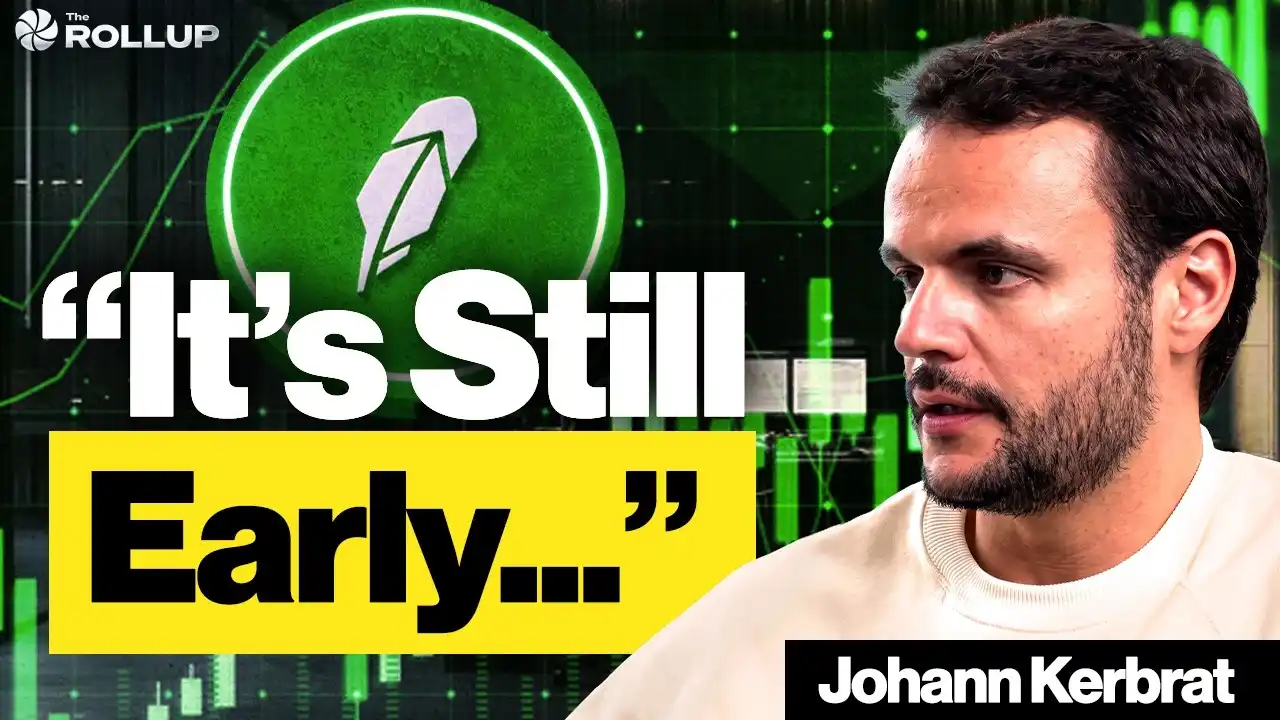
Interview with Robinhood Executive: Meme + Tokenized US Stocks as "Barbell" Customer Acquisition Strategy, All Business Lines Achieve Hundreds of Millions in Revenue

Interview with Robinhood executive Johann Kerbrat reveals the company's "barbell" customer acquisition strategy for its new Robinhood Chain, combining meme tokens with tokenized stocks. Three weeks after mainnet launch, the chain has seen over $3B in weekly DEX volume and 105M transactions. Kerbrat explains the logic behind the permissionless chain: meme tokens attract DeFi users, while tokenized real-world assets (RWA), currently over 90 US stocks and ETFs accessible in 120+ countries, serve global users. The goal is to bring Robinhood's 27 million funded accounts on-chain by simplifying DeFi with a user-friendly interface, exemplified by features like Robinhood Earn which offers yield without requiring wallet management. Built on Arbitrum's technology stack for its speed, low cost, and Ethereum's security, the chain focuses on financial products like Earn, spot trading, and perpetuals. Kerbrat downplays direct competition with platforms like Base, emphasizing the goal of expanding the overall market for on-chain assets. He details selective partnerships (e.g., Morpho, Lighter) based on compliance, unique UX, and differentiation. While regulatory clarity is pending for US perpetuals, the expansion continues via Bitstamp in Europe. Finally, Kerbrat positions Robinhood as a "super app" integrating stocks, options, crypto, banking, and AI trading, with all major business lines generating hundreds of millions in revenue. For the chain, current priority is driving adoption over maximizing gas fee revenue.

marsbitHace 2 hora(s)

Interview with Robinhood Executive: Meme + Tokenized US Stocks as "Barbell" Customer Acquisition Strategy, All Business Lines Achieve Hundreds of Millions in Revenue

marsbitHace 2 hora(s)

Fidelity Q3 Report: BTC, ETH, and SOL Continue to Build Bottoms; How Much Further Will This Crypto Bear Market Go?

Fidelity's Q3 Crypto Signal Report analyzes the current bear market, noting Bitcoin (BTC), Ethereum (ETH), and Solana (SOL) are in a prolonged bottoming phase. Key indicators like the weighted Net Unrealized Profit/Loss (NUPL) have turned negative (-0.01), signaling the market is slightly below its aggregate cost basis, with BTC acting as the primary stabilizing asset. BTC's dominance has risen to 68%, indicating a lack of capital rotation to other digital assets. Performance has been weak across the board, with BTC, ETH, and SOL down significantly year-to-date. Market sentiment is depressed, exacerbated by substantial outflows from spot ETPs and a challenging macro environment. The report compares the current ~203-day downtrend to historical ~300-day bottoming cycles, suggesting the process may be two-thirds complete, with late 2026 as a potential timeframe to monitor. For Bitcoin, NUPL at 0.09 indicates cautious sentiment, while momentum signals remain negative. The Yardstick metric points to potential undervaluation relative to network security (hashrate). Ethereum's NUPL is deep in the "capitulation" zone at -0.43, a historically positive signal for future returns, though its momentum and network fee revenue are negative. Solana shows the deepest NUPL at -0.72 but demonstrates relative resilience in on-chain activity and stablecoin transfer volume. The report concludes that while several metrics are near historical capitulation levels, a definitive market bottom has not yet been established. The path forward likely involves continued consolidation, with BTC's relative strength and fundamental on-chain usage for ETH and SOL providing key areas for investor observation.

marsbitHace 2 hora(s)

Fidelity Q3 Report: BTC, ETH, and SOL Continue to Build Bottoms; How Much Further Will This Crypto Bear Market Go?

marsbitHace 2 hora(s)

Trading

Spot
活动图片