Ripple Lands Major Korea Deal With Top Insurance Giant Kyobo

bitcoinistPublicado a 2026-04-16Actualizado a 2026-04-16

Resumen

Ripple has partnered with Kyobo Life Insurance, one of Korea's largest insurers, to develop the country's first tokenized government bond settlement workflow on blockchain. The collaboration will utilize Ripple Custody to hold, transfer, and settle transactions within a regulated framework, aiming to replace manual process with on-chain execution that could compress the standard two-day settlement cycle to near real-time. This initiative is positioned as infrastructure for a broader institutional stack. Both companies aim to assess the technical and regulatory feasibility, reduce counterparty risk, and explore stablecoin-based payment rails for 24/7 transactions. Ripple described this as a strategic entry into Korea's institutional financial market and a signal that proven digital asset infrastructure is ready for deployment.

Ripple has struck a new partnership with Kyobo Life Insurance to explore what it says would be Korea’s first tokenized government bond settlement workflow on blockchain, extending the company’s institutional push in Asia into the country’s insurance sector.

The partnership is built around Ripple Custody, which will be used to hold, transfer, and settle tokenized government bond transactions within a regulated institutional framework. The firm said the setup is designed to replace fragmented, manual settlement processes with on-chain execution, potentially compressing the standard two-day settlement cycle into near real-time.

Ripple Signs First Tier-1 Korean Insurer for Custody Push

Kyobo, one of Korea’s largest and most established life insurers, will work with Ripple to assess both the technical and regulatory feasibility of tokenized Treasury settlement within Korea’s financial system. The custody layer sits at the center of that effort. Ripple described Ripple Custody as a bank-grade, fully integrated platform built for regulated financial institutions, supporting the secure transfer, settlement, and management of digital assets.

Notably, the announcement positions custody not as a standalone product, but as the first layer of a broader institutional stack that could later expand into tokenization, payments, liquidity, and treasury management. In other words, the bond-settlement pilot is being presented as infrastructure, not a one-off proof of concept.

Ripple also tied the partnership to a larger modernization argument around government bond markets. By settling transactions simultaneously on-chain, the companies say institutions could reduce counterparty risk and improve capital efficiency. Ripple added that it will also support Kyobo in exploring stablecoin-based payment rails, with the goal of enabling 24/7 transaction capability inside a compliant framework.

Fiona Murray, Ripple’s managing director for Asia Pacific, cast the agreement as both a Korea market entry point and a signal to other institutions watching from the sidelines. “Korea’s institutional financial market is at an inflection point, and we are privileged to be entering it alongside Kyobo Life Insurance—one of Korea’s most respected financial institutions and the first major insurer in the country to take this step with us,” Murray said. “This partnership is a signal to the broader market that institutional-grade digital asset infrastructure is no longer a future aspiration; it is available, proven, and ready to deploy in Korea today.”

She went further, describing the move as part of a broader regional commitment rather than a narrowly scoped pilot. “Ripple’s commitment to Korea is long-term and strategic. We see this as the beginning of a broad and enduring partnership, not only with Kyobo, but with the Korean institutional financial market as a whole,” Murray said.

Kyobo framed the initiative less as a bet on crypto markets than as a test of whether conventional financial products can function more efficiently on blockchain rails. “Our partnership with Ripple is not simply about digital assets — it’s about validating how traditional financial instruments can operate securely and efficiently on blockchain,” said Jin Ho Park, senior executive vice president at Kyobo Life Insurance. “We are proud to collaborate with Ripple to advance Korea’s financial market infrastructure and bring next-generation solutions to our customers.”

At press time, XRP traded at $1.3543.
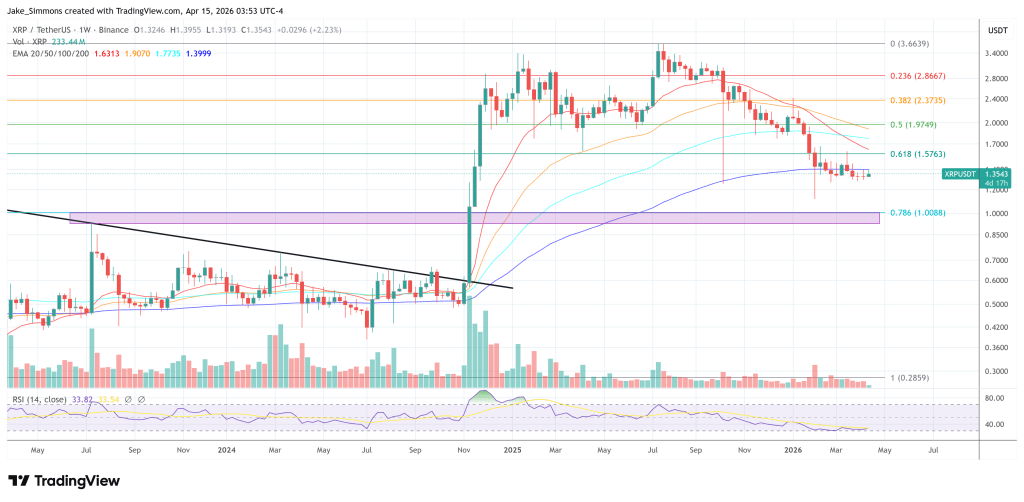
XRP must reclaim the 200-week EMA, 1-week chart | Source: XRPUSDT on TradingView.com

Preguntas relacionadas

QWhat is the main purpose of the partnership between Ripple and Kyobo Life Insurance?

AThe partnership aims to explore Korea's first tokenized government bond settlement workflow on blockchain, using Ripple Custody to hold, transfer, and settle these transactions within a regulated framework.

QHow does Ripple claim its technology will improve the settlement process for government bonds?

ARipple claims the on-chain execution will replace fragmented, manual settlement processes, potentially compressing the standard two-day settlement cycle into near real-time, reducing counterparty risk and improving capital efficiency.

QWhat additional payment rails will Ripple support Kyobo in exploring?

ARipple will support Kyobo in exploring stablecoin-based payment rails to enable 24/7 transaction capability inside a compliant framework.

QHow did Fiona Murray, Ripple's managing director for Asia Pacific, characterize the significance of this partnership?

AShe characterized it as both a market entry point into Korea and a signal to other institutions that institutional-grade digital asset infrastructure is available, proven, and ready to deploy in Korea today.

QAccording to Kyobo's executive, what is the broader goal of this initiative beyond digital assets?

AThe broader goal is to validate how traditional financial instruments, like government bonds, can operate more securely and efficiently on blockchain technology to advance Korea's financial market infrastructure.

Lecturas Relacionadas

From a $300 Million Valuation to a 'Fire Sale' at Tens of Millions: What Happened to Messari?

On June 12, leading crypto data and capital markets platform Blockworks announced its acquisition of competitor Messari for over $10 million. This price represents a significant discount from Messari's 2022 valuation peak of approximately $300 million, highlighting the survival pressures faced by high-valuation startups during the bear market and a consolidation wave in data infrastructure. Blockworks, founded in 2018, began as a media and events company but has pivoted to focus on institutional-grade data, investor relations, and compliance tools. Its recent Series A extension round, valuing the company at $192 million, aimed to fund this shift and strategic acquisitions like this one. Messari, also founded in 2018, grew as a go-to platform for professional crypto research and data, raising a $35 million Series B at its $300 million valuation in late 2022. However, the prolonged bear market and subsequent internal changes, including founder Ryan Selkis's departure in 2024, increased operational pressures. The acquisition integrates Messari's extensive data platform and API capabilities with Blockworks's strengths in issuer-side disclosure, investor relations, and compliance workflows. The combined entity aims to build a unified "system of record" for the on-chain market. This reflects a broader industry trend where high-quality, structured data is becoming critical for institutional adoption, AI agents, and creating data moats akin to traditional financial platforms like Bloomberg. The deal exemplifies how market consolidation is reshaping the fragmented crypto data landscape.

marsbitHace 2 min(s)

From a $300 Million Valuation to a 'Fire Sale' at Tens of Millions: What Happened to Messari?

marsbitHace 2 min(s)

If the AI Bubble Is Already Bursting, Who Will Truly Survive?

If the AI Bubble is Bursting, Who Will Remain? The debate over an AI bubble is intensifying, with figures like Ray Dalio warning of high levels and Jensen Huang seeing immense, early-stage opportunity. Both views hold truth: a speculative bubble in capital markets likely exists, mirroring the dot-com era, but the underlying technological shift is real and transformative. History shows that while bubbles burst—wiping out overvalued companies and speculative capital—they often leave behind critical physical and digital infrastructure. The dot-com bust, for instance, eliminated many firms but left the global fiber optic networks and data centers that enabled the rise of Amazon, Netflix, and cloud computing. Today's massive AI infrastructure investments (projected at trillions by 2030) in data centers, power, cooling, and GPUs may follow a similar path, creating the foundation for future applications. A key divergence from past bubbles is the "Jevons Paradox" effect in AI. As the cost of AI inference has plummeted by over 99.7% since 2023, enterprise spending on AI has skyrocketed. Cheap "tokens" have unlocked vast, previously uneconomical use cases, moving AI from simple chatbots into core business workflows—code generation, legal document review, scientific simulation, and financial analysis. The market is now in a phase of self-correction, weeding out superficial "API-wrapper" startups, but this cleansing process strengthens the ecosystem. The long-term trajectory is clear. The value is gradually shifting from capital expenditure (CapEx) on hardware to operational expenditure (OpEx) on transformative applications. As AI becomes a utility, the winners will be firms that deeply integrate it to solve vertical industry problems in law, healthcare, finance, and manufacturing. The泡沫 will recede, but the foundational shift towards an AI-powered era across all sectors is irreversible. The underlying productive force of AI contains no bubble.

marsbitHace 34 min(s)

If the AI Bubble Is Already Bursting, Who Will Truly Survive?

marsbitHace 34 min(s)

If the AI Bubble Is Already Bursting, Who Will Truly Remain?

**Summary: If the AI Bubble is Bursting, What Will Remain?** The debate around an AI bubble is intensifying, with figures like Ray Dalio warning of high valuations while Jensen Huang sees immense opportunity. This echoes the dot-com bubble, which saw massive wealth destruction but ultimately left behind critical infrastructure like undersea cables and broadband, enabling future giants like Amazon and Netflix. Similarly, today's AI boom involves trillions invested in data centers, power, cooling, and GPUs, while application-layer revenue remains comparatively modest. This investment-disparity signals a bubble. However, the core technological progress is real and accelerating. AI inference costs have plummeted by over 99.7% since 2023, making intelligence increasingly cheap and accessible. This cost collapse is unlocking vast new demand. Instead of reducing spending, enterprises are tripling their AI cloud expenditure. Cheap "tokens" enable AI to move beyond simple chatbots into complex workflows—automating code writing, legal document review, financial analysis, and scientific research. This follows "Jevons's paradox": improved efficiency leads to greater total consumption. The market is now undergoing a necessary purification, weeding out "API-wrapper" startups with no real moat. The deeper evolution involves a shift from capital expenditure (CapEx) on infrastructure to operational expenditure (OpEx) on value-creation in applications. While hardware vendors currently profit most, long-term value will migrate to AI-native firms solving vertical industry problems. Ultimately, a market correction will cleanse speculative excess but will not reverse the AI+ trend. The massive physical and algorithmic infrastructure being built will endure, becoming a cheap, utility-like foundation. Just as the internet became indispensable to all industries post-2000, AI is poised to empower and redefine every sector, moving society irreversibly toward an intelligence-augmented era. The bubble may burst, but the underlying productive momentum is solid.

链捕手Hace 40 min(s)

If the AI Bubble Is Already Bursting, Who Will Truly Remain?

链捕手Hace 40 min(s)

Microsoft CEO: In the AI Era, How Do You Define a Company's Moat?

Microsoft CEO Satya Nadella argues that in the AI era, a company's true competitive edge, or "moat," is not determined by choosing the single most powerful model, but by its ability to build a continuous "learning loop." This system integrates and evolves by connecting human workflows, domain expertise, organizational judgment, and employee experience. He posits that future companies will accumulate two types of capital: Human Capital (employee knowledge, judgment, creativity) and "Token Capital" (a firm's own built and owned AI capabilities). Importantly, AI amplifies rather than devalues human capital. Human direction is essential to guide progress, as computational power alone is aimless. The core opportunity lies in creating a closed-loop system where human and token capital reinforce each other in a compound, self-improving cycle. A company must be able to preserve its unique institutional knowledge—its "company veteran" expertise—even if it switches underlying general-purpose AI models. This requires private evaluation benchmarks, reinforcement learning environments based on internal data, and queryable knowledge bases. Nadella warns against a future where economic value is concentrated by a few dominant models that commoditize entire industries' knowledge. Instead, the priority should be building a broad "frontier ecosystem" where every company, industry, and nation can own its learning loop. This allows organizations to retain control of their intellectual property, amplify employee capabilities, and ensure the economic value created by AI is captured within their own businesses and communities. True corporate sovereignty in the AI age comes from turning organizational knowledge into a compounding system that creates enduring, defensible value.

marsbitHace 1 hora(s)

Microsoft CEO: In the AI Era, How Do You Define a Company's Moat?

marsbitHace 1 hora(s)

Trading

Spot
Futuros
活动图片





