Ripple IPO Could Bring ‘Something Special’ For XRP Holders, CEO Suggests

bitcoinistPublicado a 2026-05-08Actualizado a 2026-05-08

Resumen

Ripple CEO Brad Garlinghouse suggested XRP holders could receive "something special" if the company goes public, though he stressed an IPO is not an immediate priority. He addressed community concerns about Ripple's corporate success not directly benefiting XRP holders, stating the company's main contribution is building products and partnerships to increase XRP's utility and value. While not endorsing a near-term mechanism like a token buyback, Garlinghouse left open the possibility of a future IPO-related benefit for holders. He explained Ripple is not rushing to go public, citing poor recent crypto IPO performance and the benefits of remaining private. Garlinghouse also rejected concerns that Ripple's expansion into areas like stablecoins dilutes XRP's role, arguing the company, as the largest XRP holder, remains deeply incentivized to see the asset succeed. He reaffirmed his commitment to the XRP community, calling it a driving mission for the company.

Ripple CEO Brad Garlinghouse suggested that XRP holders could potentially receive “something special” if Ripple eventually goes public, while stressing that any such move is not an immediate priority for the company.

Speaking with Eleanor Terrett on the Crypto In America podcast at XRP Las Vegas, Garlinghouse addressed one of the more sensitive questions inside the XRP community: whether holders of the token should benefit more directly from the firm’s corporate success as the company’s valuation, acquisitions and institutional footprint continue to expand.

Garlinghouse Addresses XRP Holder Benefits

The exchange came after Terrett noted criticism that Ripple has become a major private-company success story while XRP holders remain economically separate from Ripple’s equity. Ripple, Garlinghouse said, was last valued at $50 billion in a share buyback, a figure that has intensified debate over whether the company’s growth should translate into a more direct benefit for the XRP community.

Asked whether the company had explored an XRP token buyback or another structure that would allow holders to share in Ripple’s wealth, Garlinghouse did not endorse a near-term mechanism. Instead, he framed the firm’s contribution as indirect but central: building products, infrastructure and partnerships that increase XRP’s utility, liquidity and trust.

“I hope XRP holders feel like they are benefiting from Ripple’s existence by virtue of what we’re doing to try to catalyze things within the XRP community,” Garlinghouse said. “Is there a scenario if and when Ripple goes public, would we do something special for people who hold XRP or something? Maybe. But I mean, that’s not in the immediate term.”

That “maybe” is likely to draw attention because it leaves open a possibility the company has rarely discussed publicly: a future IPO-related benefit tied to XRP ownership. Garlinghouse was careful, however, not to describe it as a plan, commitment or pending corporate action.

Ripple Still Not Rushing Toward An IPO

Garlinghouse also made clear that Ripple is not currently prioritizing a public listing. He pointed to recent crypto IPO performance as one reason the company is not in a hurry, citing BitGo and Gemini as examples of deals that “haven’t done particularly well,” and noting that Kraken has reportedly delayed its own listing plans.

“The long-term dynamic, you know, we have not prioritized going public for a whole bunch of reasons,” he said. “There’s benefits to being private. Like, I could get up here and kind of say whatever the hell I want to say.”

His remarks suggest that any special structure for XRP holders would depend on a much broader corporate decision that remains unresolved. Ripple may have the valuation and market profile of a company that could eventually test public markets, but Garlinghouse framed the IPO question as distant rather than imminent.

The discussion also touched on a recurring concern among parts of the XRP community: whether Ripple’s expansion into stablecoins, prime brokerage, treasury products and institutional infrastructure could dilute XRP’s role in the company’s strategy.

Garlinghouse rejected that reading. He argued that Ripple remains deeply aligned with XRP because the company is still the largest holder of the asset and has the strongest economic incentive to see it succeed.

“Today, Ripple is still the largest holder of XRP on the planet,” he said. “We are the most interested party in seeing XRP be successful. We will continue to be the most interested party in seeing XRP be successful.”

He added that Ripple’s strategy is designed around making XRP “the most useful digital asset,” “the most liquid digital asset” and “the most trusted digital asset.” In his telling, even initiatives that do not appear immediately connected to XRP can still serve that broader objective through a longer route.

“I don’t feel the need to constantly update the whole world about our strategy because to some degree that just informs people who want to compete against us,” Garlinghouse said. “We’re going to do things that may not at first blush make crystal clear sense. But I swear to you, even if it doesn’t have a direct line from point A to point B, point B being good for XRP, it may be point A to point B to point B to point C.”

That explanation appeared aimed at criticism around Ripple’s RLUSD stablecoin and broader institutional push. Garlinghouse’s argument is that Ripple’s corporate expansion is not a pivot away from XRP, but part of a larger effort to deepen institutional rails around the XRP Ledger and related liquidity.

Garlinghouse repeatedly emphasized his loyalty to the community, calling it the “XRP family” and saying he wants Ripple to make decisions that are good for that ecosystem. He pointed to acquisitions, external investments and support for digital asset treasury company Evernorth as examples of initiatives Ripple views through that lens.

“I freaking love the XRP family,” he said. “I want to do things that are good for the XRP community. It is a driving mission.”

At press time, XRP traded at $1.379.
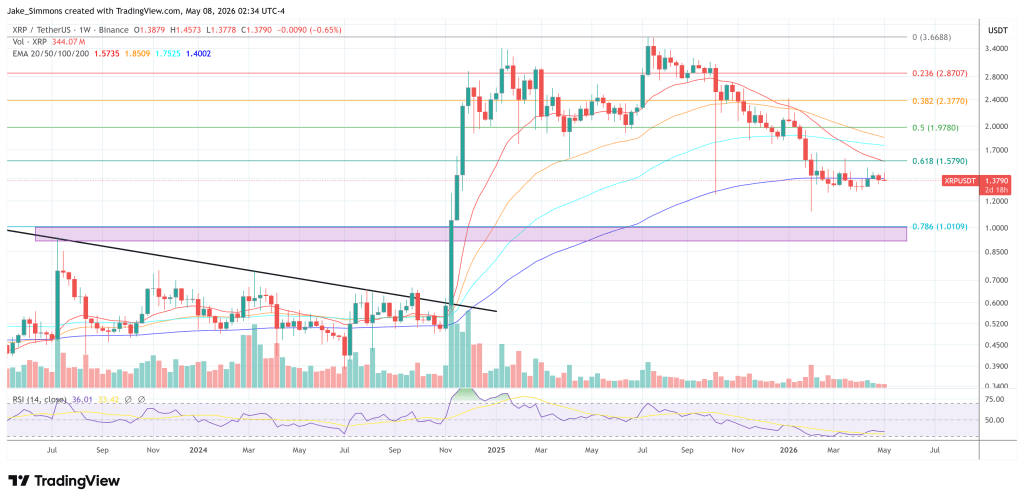
XRP trades around the 200-week EMA again, 1-week chart | Source: XRPUSDT on TradingView.com

Preguntas relacionadas

QWhat potential benefit did Ripple CEO Brad Garlinghouse suggest XRP holders might receive if the company goes public?

ABrad Garlinghouse suggested that XRP holders could potentially receive 'something special' if Ripple eventually conducts an IPO, though he emphasized this is not a current plan or commitment.

QAccording to Garlinghouse, what is Ripple's primary contribution to the XRP community currently?

AGarlinghouse stated that Ripple's primary contribution is indirect, focusing on building products, infrastructure, and partnerships that increase XRP's utility, liquidity, and trust.

QWhy is Ripple not currently prioritizing a public listing (IPO), as stated by its CEO?

ARipple is not prioritizing an IPO due to the poor performance of recent crypto IPOs (citing BitGo and Gemini as examples) and the benefits of remaining a private company, such as greater freedom in public statements.

QHow did Garlinghouse address concerns that Ripple's expansion into other areas could dilute XRP's role in its strategy?

AGarlinghouse rejected this concern, arguing that Ripple remains the largest holder of XRP and has the strongest economic incentive for its success. He stated that all corporate initiatives, even those not directly linked, are part of a broader strategy to make XRP the most useful, liquid, and trusted digital asset.

QWhat was the trading price of XRP mentioned at the end of the article?

AAt press time, XRP was trading at $1.379.

Lecturas Relacionadas

Gensyn AI: Don't Let AI Repeat the Mistakes of the Internet

In recent months, the rapid growth of the AI industry has attracted significant talent from the crypto sector. A persistent question among researchers intersecting both fields is whether blockchain can become a foundational part of AI infrastructure. While many previous AI and Crypto projects focused on application layers (like AI Agents, on-chain reasoning, data markets, and compute rentals), few achieved viable commercial models. Gensyn differentiates itself by targeting the most critical and expensive layer of AI: model training. Gensyn aims to organize globally distributed GPU resources into an open AI training network. Developers can submit training tasks, nodes provide computational power, and the network verifies results while distributing incentives. The core issue addressed is not decentralization for its own sake, but the increasing centralization of compute power among tech giants. In the era of large models, access to GPUs (like the H100) has become a decisive bottleneck, dictating the pace of AI development. Major AI companies are heavily dependent on large cloud providers for compute resources. Gensyn's approach is significant for several reasons: 1) It operates at the core infrastructure layer (model training), the most resource-intensive and technically demanding part of the AI value chain. 2) It proposes a more open, collaborative model for compute, potentially increasing resource utilization by dynamically pooling idle GPUs, similar to early cloud computing logic. 3) Its technical moat lies in solving complex challenges like verifying training results, ensuring node honesty, and maintaining reliability in a distributed environment—making it more of a deep-tech infrastructure company. 4) It targets a validated, high-growth market with genuine demand, rather than pursuing blockchain integration without purpose. Ultimately, the boundaries between Crypto and AI are blurring. AI requires global resource coordination, incentive mechanisms, and collaborative systems—areas where crypto-native solutions excel. Gensyn represents a step toward making advanced training capabilities more accessible and collaborative, moving beyond a niche controlled by a few giants. If successful, it could evolve into a fundamental piece of AI infrastructure, where the most enduring value in the AI era is often created.

marsbitHace 5 hora(s)

Gensyn AI: Don't Let AI Repeat the Mistakes of the Internet

marsbitHace 5 hora(s)

Why is China's AI Developing So Fast? The Answer Lies Inside the Labs

A US researcher's visit to China's top AI labs reveals distinct cultural and organizational factors driving China's rapid AI development. While talent, data, and compute are similar to the West, Chinese labs excel through a pragmatic, execution-focused culture: less emphasis on individual stardom and conceptual debate, and more on teamwork, engineering optimization, and mastering the full tech stack. A key advantage is the integration of young students and researchers who approach model-building with fresh perspectives and low ego, prioritizing collective progress over personal credit. This contrasts with the US culture of self-promotion and "star scientist" narratives. Chinese labs also exhibit a strong "build, don't buy" mentality, preferring to develop core capabilities—like data pipelines and environments—in-house rather than relying on external services. The ecosystem feels more collaborative than tribal, with mutual respect among labs. While government support exists, its scale is unclear, and technical decisions appear driven by labs, not state mandates. Chinese companies across sectors, from platforms to consumer tech, are building their own foundational models to control their tech destiny, reflecting a broader cultural drive for technological sovereignty. Demand for AI is emerging, with spending patterns potentially mirroring cloud infrastructure more than traditional SaaS. Despite challenges like a less mature data industry and GPU shortages, Chinese labs are propelled by vast talent, rapid iteration, and deep integration with the open-source community. The competition is evolving beyond a pure model race into a contest of organizational execution, developer ecosystems, and industrial pragmatism.

marsbitHace 6 hora(s)

Why is China's AI Developing So Fast? The Answer Lies Inside the Labs

marsbitHace 6 hora(s)

3 Years, 5 Times: The Rebirth of a Century-Old Glass Factory

Corning, a 175-year-old glass company, is experiencing a dramatic revival as a key player in AI infrastructure, driven by surging demand for high-performance optical fiber in data centers. AI data centers require vastly more fiber than traditional ones—5 to 10 times as much per rack—to handle high-speed data transmission between GPUs. This structural demand shift, coupled with supply constraints from the lengthy expansion cycle for fiber preforms, has created a significant supply-demand gap. Nvidia has invested in Corning, along with Lumentum and Coherent, in a $4.5 billion total commitment to secure the optical supply chain for AI. Corning's competitive edge lies in its expertise in producing ultra-low-loss, high-density, and bend-resistant specialty fiber, which is critical for 800G+ and future 1.6T data rates. Its deep involvement in co-packaged optics (CPO) with partners like Nvidia further solidifies its position. While not the largest fiber manufacturer globally, Corning's revenue from enterprise/data center clients now exceeds 40% of its optical communications sales, and it has secured multi-year supply agreements with major hyperscalers including Meta and Nvidia. Financially, Corning's optical communications revenue has surged, doubling from $1.3 billion in 2023 to over $3 billion in 2025. Its stock price has risen nearly 6-fold since late 2023. Key future catalysts include the rollout of Nvidia's CPO products and the scale of undisclosed customer agreements. However, risks include high current valuations and potential disruption from next-generation technologies like hollow-core fiber. The company's long-term bet on light over electricity, maintained even through the telecom bubble crash, is now being validated by the AI boom.

marsbitHace 7 hora(s)

3 Years, 5 Times: The Rebirth of a Century-Old Glass Factory

marsbitHace 7 hora(s)

Trading

Spot
Futuros

Artículos destacados

Qué es XRP 2.0

XRP 2.0: Una Nueva Frontera en el Panorama de las Criptomonedas Introducción a XRP 2.0 En el siempre cambiante ámbito de las criptomonedas, nuevos proyectos surgen continuamente, compitiendo por atención y adopción. Una de estas iniciativas prometedoras es XRP 2.0, un nuevo proyecto de criptomoneda diseñado para aprovechar la tecnología blockchain avanzada y metodologías de encriptación robustas. Aunque el nombre establece paralelismos con el XRP de Ripple, es crucial señalar que XRP 2.0 opera de manera independiente, enfocándose en mejorar la seguridad de las transacciones, la privacidad y la escalabilidad. A medida que el panorama financiero digital abraza cada vez más soluciones descentralizadas, XRP 2.0 busca contribuir de manera significativa a web3 y a la expansión general de los proyectos de criptomonedas. ¿Qué es XRP 2.0? En esencia, XRP 2.0 es un proyecto de criptomoneda que busca crear un ecosistema de moneda digital seguro y descentralizado. Su tecnología fundamental integra principios avanzados de blockchain con técnicas de encriptación de vanguardia. El objetivo principal de XRP 2.0 es establecerse como una plataforma confiable y eficiente que permita la ejecución rápida de transacciones mientras prioriza la protección de la privacidad de sus usuarios. El proyecto se promociona como una solución a muchas limitaciones enfrentadas por las criptomonedas existentes, proponiendo un sistema que puede manejar un mayor volumen de transacciones con mejor velocidad y privacidad. Esta versatilidad posiciona a XRP 2.0 como un competidor significativo en un mercado plagado de diversas monedas digitales. ¿Quién es el Creador de XRP 2.0? La identidad del creador detrás de XRP 2.0 ha sido señalada como 'Wilbur.' Sin embargo, los detalles completos sobre Wilbur o su entidad asociada siguen siendo elusivos. La anonimidad de muchos creadores de criptomonedas no es un fenómeno poco común en la industria, a menudo diseñado para mantener un grado de privacidad y seguridad. ¿Quiénes son los Inversores de XRP 2.0? Hasta ahora, la información específica relacionada con las fundaciones o organizaciones de inversión que apoyan a XRP 2.0 no está disponible públicamente. En el sector de las criptomonedas, el respaldo de inversores respetables puede influir significativamente en la credibilidad y el éxito de un proyecto, sin embargo, la transparencia sobre los patrocinadores financieros de XRP 2.0 no se ha establecido. ¿Cómo Funciona XRP 2.0? XRP 2.0 se destaca al emplear una combinación de tecnología blockchain y algoritmos de encriptación avanzados que aseguran transacciones seguras y descentralizadas. Su estructura innovadora incluye características únicas diseñadas para fomentar el compromiso del usuario y ampliar las funcionalidades más allá de las transacciones convencionales de criptomonedas. Entre estas características, XRP 2.0 incorpora capacidades impulsadas por IA, como funcionalidades de texto a imagen y de texto a voz. Estas adiciones están diseñadas para mejorar la experiencia interactiva de los usuarios, promoviendo una mayor aplicabilidad en diversos sectores. Al unir avances tecnológicos con un diseño centrado en el usuario, XRP 2.0 busca captar la atención de una amplia gama de individuos y empresas que buscan integrar soluciones de criptomonedas en sus marcos operativos. Cronología de XRP 2.0 Entender XRP 2.0 requiere examinar los hitos que han definido su viaje hasta ahora: 23 de julio de 2023: Se presenta XRP 2.0 como un nuevo proyecto de criptomonedas, con el objetivo de revolucionar las capacidades de transacciones seguras y descentralizadas en el ámbito de blockchain. 8 de septiembre de 2023: Se lanza otro proyecto, XRP20, marcando la aparición de un token ERC-20 en la blockchain de Ethereum que no guarda relación con XRP 2.0. 13 de noviembre de 2023: El Libro Mayor de XRP experimenta una actualización significativa con el lanzamiento de la versión 2.0.0 del software del servidor rippled. Es esencial señalar que este desarrollo está desconectado del proyecto de criptomonedas XRP 2.0. Puntos Clave sobre XRP 2.0 Para destilar la esencia de XRP 2.0, surgen varios factores críticos: Características Únicas: La inclusión de características como texto a imagen y texto a voz impulsadas por IA diversifica aún más las aplicaciones potenciales de XRP 2.0. Tecnología Blockchain: El marco utiliza mecanismos avanzados de blockchain y protocolos de encriptación, asegurando un entorno seguro y descentralizado para las transacciones. Escalabilidad y Privacidad: XRP 2.0 prioriza la protección mejorada de la privacidad en los procesos de transacción y la escalabilidad necesaria para acomodar una base de usuarios creciente. No Afiliación con Ripple: Es importante destacar que, a pesar de su nombre, XRP 2.0 no tiene ninguna lealtad ni colaboración con el XRP de Ripple, diferenciando su marco operativo y objetivos dentro del ecosistema de criptomonedas. Conclusión XRP 2.0 representa una ambiciosa aventura en la esfera de las criptomonedas, buscando ofrecer una combinación de seguridad, privacidad y eficiencia en las transacciones digitales. Al integrar tecnologías sofisticadas y características amigables para el usuario, el proyecto se propone ampliar los horizontes de lo que la criptomoneda puede lograr en la economía digital de hoy. Si bien la anonimidad de su creador y la falta de inversores revelados pueden generar cuestionamientos para algunos, el enfoque de XRP 2.0 en funcionalidades avanzadas y descentralización realza su atractivo en un mercado de criptomonedas cada vez más abarrotado. A medida que el paisaje de las criptomonedas sigue evolucionando, XRP 2.0 podría emerger como un jugador crucial en la expansión de soluciones blockchain seguras y escalables.

174 Vistas totalesPublicado en 2024.04.05Actualizado en 2024.12.03

Qué es XRP 2.0

Cómo comprar XRP

¡Bienvenido a HTX.com! Hemos hecho que comprar XRP (XRP) sea simple y conveniente. Sigue nuestra guía paso a paso para iniciar tu viaje de criptos.Paso 1: crea tu cuenta HTXUtiliza tu correo electrónico o número de teléfono para registrarte y obtener una cuenta gratuita en HTX. Experimenta un proceso de registro sin complicaciones y desbloquea todas las funciones.Obtener mi cuentaPaso 2: ve a Comprar cripto y elige tu método de pagoTarjeta de crédito/débito: usa tu Visa o Mastercard para comprar XRP (XRP) al instante.Saldo: utiliza fondos del saldo de tu cuenta HTX para tradear sin problemas.Terceros: hemos agregado métodos de pago populares como Google Pay y Apple Pay para mejorar la comodidad.P2P: tradear directamente con otros usuarios en HTX.Over-the-Counter (OTC): ofrecemos servicios personalizados y tipos de cambio competitivos para los traders.Paso 3: guarda tu XRP (XRP)Después de comprar tu XRP (XRP), guárdalo en tu cuenta HTX. Alternativamente, puedes enviarlo a otro lugar mediante transferencia blockchain o utilizarlo para tradear otras criptomonedas.Paso 4: tradear XRP (XRP)Tradear fácilmente con XRP (XRP) en HTX's mercado spot. Simplemente accede a tu cuenta, selecciona tu par de trading, ejecuta tus trades y monitorea en tiempo real. Ofrecemos una experiencia fácil de usar tanto para principiantes como para traders experimentados.

1.3k Vistas totalesPublicado en 2024.12.10Actualizado en 2025.03.21

Cómo comprar XRP

Discusiones

Bienvenido a la comunidad de HTX. Aquí puedes mantenerte informado sobre los últimos desarrollos de la plataforma y acceder a análisis profesionales del mercado. A continuación se presentan las opiniones de los usuarios sobre el precio de XRP (XRP).

活动图片